By combining a polymer with single-wall carbon nanotubes (SWCNTs), a novel manufacturing process has been developed to produce composites that are electrically conductive. A continuous, cellular structure made of SWCNTs may be produced by first coating PS pellets with SWCNTs and then crushing the coated pellets under high pressure. If you use this approach rather of a well-dispersed SWCNT-based composite, the electrical conductivity of the material will be significantly increased. The electrical conductivity of CPP is around 3 x 10⁻⁴ S/cm, but the electrical conductivity of a well-dispersed composite formed with the same quantity of SWCNT by coagulation is approximately 10-8 S/cm, which is a much lower value. The well-dispersed composite demonstrates a feature similar to that of a solid, which suggests that the composites manufactured by using this one-of-a-kind CPP process are easier to produce than compounds with an equivalent in PS. In contrast, the mechanical characteristics of the CPP composite rarely suffer any degradation when compared to those of PS. This innovative method of manufacture offers an important alternative to the conventional practice of pursuing better dispersion in SWCNT/polymer composites. It is possible to process polymers and nanoparticles at a low cost utilizing our straightforward coating and pressing technology, which does not need the use of organic solvents.
Keywords
Polymer Nanocomposite
Single Wall Carbon Nanotube
Polystyrene
INTRODUCTION
Non-conductive polymers' electrical conductivity may be improved using single wall carbon nanotubes (SWCNTs), which have shown great promise as a possible solution. Since polymer nanocomposites' SWCNT loadings are so low, they need to have a higher electrical conductivity so that they can withstand electromagnetic interference and guard against electrostatic discharges. Increased filler concentration over the threshold for percolation of SWCNTs is a means of achieving high electrical conductivity [6]. It's possible to reduce the percolation threshold by removing large amounts of nanotube aggregates. Single-walled nanotubes (SWCNTs) need to be exfoliated using a variety of processes including surface treatment with surfactants, functionalization of their surfaces, long-term sonication, and use of several organic solvents. When the density of SWCNTs in nanocomposites has been exfoliated efficiently, an electrical conductor network may form. These SWCNT-based nanogels [7-12] are difficult to fabricate in polymer melts because of their high viscosities. It has been shown that SWCNT nanocomposites with excellent nanotube dispersion exhibit linear viscoelastic behaviors under the same circumstances as liquid-like matrix polymers [7,11].
Melting these nanocomposites will need higher temperatures and pressures, which might lead to polymer deterioration. It's still difficult to get SWCNT/polymer nanocomposites that have acceptable electrical conductivity and adequate rheological characteristics.
Polymer nanocomposites' high electrical conductivities may be preserved while their viscoelastic characteristics are altered. Carbon black and elastomers are combined to create composites that have greater mechanical qualities, including toughness, percentage of elongation, and modulus of rupture (elongation at break length). While the bulk of SWCNTs are embedded in a homogeneous polymer matrix, the scattered polymer phase has a significant impact on the composites' mechanical and rheological characteristics [14].
For the first time, a polymer matrix has been filled with nanoscale fillers using latex technique [4, 15-16]. The latex technique was used to achieve this. Interstitial as well as interfacial holes in the dried latex will be filled with nanofillers (diameters ranging from 10 to 1000 nm).
Compared to composites containing fillers that are scattered equally throughout the material, this leads in a segregated networks with a lower electrical threshold These thresholds were 15 vol percent for very well carbon black/poly(vinyl acetate) composites, but only 2.5 vol percent for latex particles. Due to the fact that nanotubes are suspended in a liquid by adding surfactants, and that these surfactants are maintained in the final composites, the approach that uses latex and nanoparticles with materials are needed polymer particles has a basic difficulty. Electrical conductivity has been demonstrated to be adversely affected by several surfactants [18].
The innovative and uncomplicated approach described in this paper may be used to produce nanotube polymer composites with a continuous, macro cellular structure of nanotubes. The electrical conductivity of the composites is significantly improved as a consequence of this procedure. In this form, electrical conductivity percolation thresholds have been decreased, rheological behavior has been avoided, and mechanical properties have been preserved. A surfactant that lowers electrical conductivity and our coated particle technique (CPP) allow us to construct this SWCNT cellular structure without turning the polymer into rubber or using organic solvent. We are able to achieve this because organic solvents are not required. Electrical conductivity of polymer and fillers may be considerably enhanced by using our scalable CPP, which does not affect the polymer's processability. The CPP's scalability makes this feasible.
Experimental Section
Using the higher Co2 conversion (HiPCo) method, followed by HCl processing at Rice University, the first single - walled carbon nanotube were successfully generated and purified. Single-walled carbon nanotubes were used in all of the composites mentioned in this article (SWCNTs).
By employing size exclusion chromatography, it was determined to have 320 kg/mol of weight relative molecular mass and a polydispersity index less than 2.5. A 320 kg/mol weighted average molecular mass was discovered (SEC). It was established by differential scanning calorimetry that the transition temperature of the matrix polymer was 103 degrees Celsius. Particulate matter (PS) was either used in its original state or reduced to a more manageable size, as will be explained in detail below.
A coated particle method, or CPP, was devised by researchers to create SWCNT/polymer composites. Polystyrene pellets or flakes were added and the process was repeated for a total of twenty minutes after the first ten minutes at a level of 7 milligrams per milliliter. The polymer particles became softer as a consequence of drying this mixture at a high temp. This is because PS has a Tg of more over 130 degrees Celsius, which is unusual. In order to speed up the pace of water evaporation and guarantee that the softened PS pellet or flakes were coated uniformly with SWCNT during drying, the apparatus was sometimes agitated with a spatula. Polymers covered with SWCNTs were preserved after night heat at 95 degrees Celsius. Pellets or flakes of dried SWCNT-coated particles were either compressed into big rectangular samples at 150°C or processed by solid-state shear pulverization (SSSP) at a rotor speed of 300 rotations per minute and a feed rate of 50 g per hour. Modified extruders with flowing coolant are utilized to maintain the solid condition of all materials. A combination of shear and compression pressures causes the materials to shatter into smaller fragments and then recombine.
SWCNT/PS nanocomposites containing dispersed SWCNT bundles, on the other hand, were synthesized using our coagulation process and compression-molded into the appropriate shape. After being following this process for 24 hours, the SWCNTs were dissolved in DMF at a rate of 0.1 mg/ml. It was found that SWCNT-aggregate bundles with widths of about 10 nm and an aspect ratio of around 35 were formed as a result of sustained ultrasonification (AFM). In order to repeat the operation, the mixture was congealed in water and add PS/DMF.
A diamond saw was used to cut the molded samples into pieces that were 15 x 10 7 mm3 in length, breadth, and height in order to conduct conductivity tests and reflect micrographs. A Keiley 616 Digital Electrometer was used to evaluate the conductivities of SWCNT/PS hybrids at room temperature using a two-probe approach. After nine different evaluations of each composite, the results are reported as the mean and standard deviation (SD). A shear sandwich fixture was used to conduct high dynamic sweeps in the linearly elastic domain of composites at 210 degrees Celsius and 0.5 percent strain in nitrogen gas. At room temperature, three-point bend tests were performed using an Electro - mechanical Material Testing Regime (Instron Series 5564). After adjusting the cross - head speed and span to 9.9 mm, the cross - section volume of the samples was determined to be 22 milliliters. As a consequence of this, the volume of the specimen was calculated appropriately. A focussed ion beam scanning electron microscope was utilized to conduct SEM scans and analysis (FEI Strata DB235). It was then examined using a transmission electron microscope that had been fractured in liquid nitrogen (SEM).
Table 1. Example labels and properties of polystyrene (PS) and 0.5 weight percent single-walled carbon nanotube (SWCNT)/PS composites that were prepared using the coagulation technique and the coated particle process (CPP), both with and without further solid state shearing pulverization (SSSP).
Table 1: Sample SSSP Passes Number of (kg/mol) Mw Particle Shape
PSpel
0
320
Pellet
NTPSpel
0
320
Pellet
NTPSpel1st
1
320
Flake
NTPSpel2nd
2
320
Flake
PSfla
0
290
Flake
NTPSfla
0
290
Flake
NTPSfla1st
1
280
Flake
NTPSfla2nd
2
265
Flake
NTPScoag
na
320
na
RESULTS AND DISCUSSION
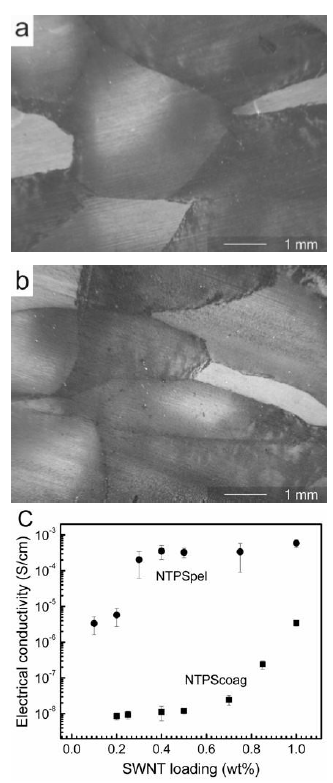
In the coated particles procedure (CPP), polystyrene (PS) pellets are mixed with an aqueous solution which does not include any detergents and includes SWCNT aggregates. First before water is removed, macroscopic SWCNT-coated pellets are formed. When water evaporates as rapidly as possible at a temperature higher than the polymer's glass transition temperature, stronger linkages between SWCNTs and polymer pellets are formed. Once the compressed PS pellets are coated with SWCNTs, the irregular polyhedra formed by the SWCNTs form a three-dimensional cell structure that fills the supporting documentation. The dimensions of the polymer pellets that were utilized to build the cellular structure have been kept in their respective size. Figure 1a indicates that the SWCNTs are limited to the interfacial areas between both the PS pellets in a 0.5 weight percent SWCNT-coated PS pellet composite, hence producing continuous paths. The figure depicts this. SWCNTs may be molded with a greater uniaxial compression, yet the cellular continuity and conductivity will not be affected. When molding with clean PS, there are no pellet-to-pellet boundaries because the PS coalesces during the compression molding process.)
A two-probe approach was used to evaluate the electrical ionic conductivity of CPP composites in relation to SWCNT loading (Figure 1c). SWCNT concentrations between 0.2 and 0.3 weight percent increase electrical conductivity substantially. SWCNTs form an electrical conductor network that covers the sample, as shown by this result. CPP with 0.5 weight percent was used to generate a composite with electrical conductivity. SWCNTs have a surface area almost seven times more than PS. Compression molding produces composites with identical electrical conductivities while applying a large amount of uniaxial stress (Figure 1a and 1b).
Electrical conductivity is another benefit of the coagulation process we adopt, as seen in Figure 1. This method was initially discovered by Du et al. [19]. To begin the coagulation process, the CPP used the same batch of purified SWCNTs that had been used in the previous stage. DMF, which substituted water in the coagulation procedure, was utilized, and the 0.1 mg/ml SWCNT solution was sonicated for twenty-four hours. Prior to precipitation in water, the mixture was subjected to a short sonication. When the dried precipitate is compressed, SWCNT bundles create a nanoscale network that is rather thin. The electrical percolation threshold of these coagulated composites is 0.7 weight percent, which is lower than that of CPP's composites. Previous SWCNT / PMMA hybrids that were produced by coagulation [7] had lower threshold concentrations, which we ascribe to differences in SWCNT batches and dispersion." SWCNT has been shown to have varying amounts of metallic SWCNT in various batches [20-21]. So far it is not possible to determine how various batches of SWCNT affect the actual electrical percolation threshold of SWCNT nano - composites [22]. Nanocomposites formed by coagulation of the identical SWCNTs had electrical conductivities that were 102–104 times greater than those made via CPP. SWCNTs included in the composites have different architectural structures.
Subsequent studies on CPP-based composites focused on the cellular structure of SWCNTs and how it affected electrical conductivity. When it comes to processing materials, SSSP, or solid-state shear pulverized concrete, is a method that uses modified twin-screw extruders in order to generate strong shear and compressive pressures. SSSP research has demonstrated that increased polymer blend miscibility and smaller dispersed phase sizes may be attained.
With SSSP, millimeter-sized PS pellets are transformed into hundreds of micron-sized polydisperse flakes. This technique also reduces the PS's molecular weight by a little amount.
It is shown in Table 1 that the CPP may be used to make pellets or flakes of 0.5 weight percent SWCNT/PS with or without the use of SSSP (NTPSpel or NTPsfla). With the use of PS flakes and the "NTPSfla1st" sample, CPP was able to develop a SWCNT/PS hybrid. After that, they performed one run of the composite via the SSSP device. A SWCNT/PS composite with a weight proportion of 0.5 wt percent was also generated as an industry standard by coagulation (NTPScoag).
Figure 1: Optical Micrographs Show the Cross - Section of SWCNT / PS Nano - Composites that were made by the Coated Particles Procedure (CPP) (a) With Facet PS Domains And (b) with Extended PS Domains because of Greater Pressures during the Compression Molding Process. The Diamond Saw is Responsible for the Lines that Run across the Polymer Domains. (c) The Average Electrical Conductivities of SWCNT/PS Composites as A Function of the Amount of SWCNT Loading for Composites Formed by the CPP Utilizing Pellets (Circles) and by the Coagulation Technique, Respectively (Squares). The Standard Error of Nine Separate Measurements is shown by the Error Bars
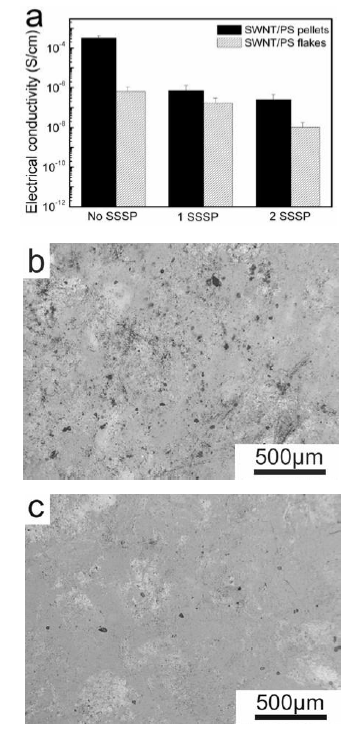
As the initial particle size drops, so does the electrical conductivity. When CPP is applied to pellets rather than flakes, the electrical conductivity of composites containing 0.5 weight percent SWCNT increases by about three orders of magnitude (Figure 2a). PS flakes contain ten times less volume than PS pellets, resulting in ten times greater surface area in the same amount of space. Since there will be less small-wall carbon nanotubes per unit area at the interfaces between polymer particles, the electrical conductivity of the CPP cellular structure formed from flake will be reduced. The resultant SWCNT layer will be uneven if the coating technique is carried out in water, which has a poor distribution of SWCNTs. This is another another problem. The electrical conductivity of the composite decreases when the inhomogeneity reduces the SWCNT density. As a result, the conductive cell routes become weaker due to inhomogeneity.
Due to shear pressures caused by SSSP, continuous SWCNT cell networks are broken in the composites comprising 0.5% NTPpel and 0.5% NTPfla, which are generated by CPP. After a few repetitions of SSSP, the SWCNT distribution becomes more uniform. Figures 2b and 2 demonstrate polymer and SWCNT-rich phases, although NTPSpel2nd exhibits better dispersion because there are less SWCNT clumps. New morphologies are more dispersed and less electrically conductive than their predecessors (Figure 2). Increased electrical conductivity may be achieved by increasing the dispersion of SWNTs. This new information, on the other hand, contradicts prior assumptions. Crushing the CPP nanocomposites may damage the SWCNT cellular network, reducing electrical conductivity by up to three orders of magnitude.
Figure 2: (a) Electrical Conductivity and High of 0.5 Percent by Weight or Higher SWCNT / PS Nanocomposite Films Generated from SWCNT-Coated PS Pellet (Dark) and Flakes (Light) in Three Different Iterations: Without SSSP, Including One Pass of SSSP, and With Passes of SSSP. Micrographs Taken With a Microscope Showing (b) Ntpspel1st and (c) Ntpspel2nd. When Compared to Composites Created Using CPP, Which Have a Cellular Structure, Pulverization Has the Dual Effect of Simultaneously Increasing the Nanotube Dispersion While Concurrently Decreasing the Electrical Conductivity
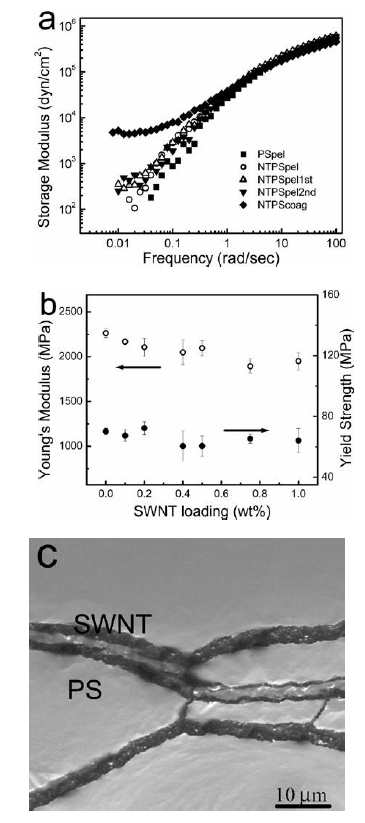
Making an initial evaluation of these composites' rheological and mechanical characteristics is based on this information. Viscoelastic properties of both the PS and the CPP (0.5 wt % SWCNTs) are linear (Figure 3a). Low-frequency properties of these composites are comparable to those of liquids, making them ideal for fiber spinning and injection molding. Composites made from PS flakes have rheological characteristics that are similar to those of liquids (not shown). To show that SWCNTs dispersed more evenly (NTPScoag) are beyond the rheological percolation threshold when the nanotubes are arranged in a sparse network, they produce a solid-like response. Traditionally used polymer processing methods are hampered by the open SWCNT network created by coagulation, which shows that there is considerable dispersion. We have been able to melt down the SWCNT nanocomposite that is formed by coagulation to roughly 5% SWCNTs. Possibly, the cellullar structure created by the CPP may be more suited to classical melt processing.
The mechanical characteristics of CPP-made nanocomposites degrade somewhat with increasing SWNT loading, as shown by three-point bending tests. Only 350 MPa and 8% drop in Young's modulus and yield strength may be attributed to increasing the SWCNT loading from 0% to 1%.. One may see clear connections between PS domains on the fracture surface of a CPP composite with SWNT-rich areas (Figure 3c). Increased loading of SWCNTs results in a decrease in interpenetration between PS and polymer particles, which weakens composites when the particle size is maintained. The PS chains seem to diffuse across the interfacial SWCNT layers during the hot pressing process of SWCNT-coated particles, according to our findings, which strengthens the CPP composites without affecting the electrical integrity of the cellular SWCNT structure.
Figure 3: (a) Comparison of the Storage Shearing Moduli of Different 0.5 Weight Percent SWCNT / PS Nano - Composites Made from Single Quarter PS Pellets, in Contrast to PS and a Composites Produced by Coagulate. (b) As a Result of SWCNT loading, the Young's Modulus and Yield Toughness of SWCNT/PS Nano - Composites Formed by the CPP from Pellets are Shown Below. (c) A Scan of the Surface Morphology of Ntpspelcontaining 0.5 Weight Percent SWCNT, as Seen Under a Scanning Electron Microscope, Reveals Evidence that PS Extends
SWCNT/PS composites have different electrical, mechanical, and viscoelastic characteristics due to the different nanotube morphologies produced by the CPP and coagulation processes. SWCNT bundles in nanocomposites may form a percolating channel in the SWCNT networks formed by coagulation if the concentrations are high enough. This occurs when the SWCNT bundle concentrations are sufficiently high. Composites generated by coagulation may have lower percolation thresholds if the nanotubes have a larger aspect ratio or more exfoliation. Because dispersion agents shorten nanotubes, introduce structural flaws in the nanotubes, and elevate nanotube-nanotube contact resistivities, these techniques diminish electrical conductivity [26, 27]. Dispersion agents may help with exfoliation.
In contrast, the CPP composites' cellular structure is formed up of SWCNT aggregates trapped at the interfacial boundaries between the polymer particles themselves. Despite their structural integrity and strong electrical conductivity, the SWCNTs are not sufficiently exfoliated by the short-term sonication and high water concentration. Rather of being packed together into extremely thin SWCNT strands as is common in coagulation-based composite materials, the SWCNT-rich layer is reinforced by PS throughout the CPP production process. These composites may approximate the viscoelastic and mechanical properties of PS, but with increased electrical conductivity, thanks to the addition of CPP. For mechanical and viscoelastic properties, the matrix polymer takes precedence over SWCNT fillers and PS molecules due to its macroscale mesh size in CPP-made cellular structures. A large amount of PS is found inside the gyratory radius of a SWCNT bundle that has been coagulated. Because of this, the nanocomposite behaves like a solid in terms of viscoelasticity. The CPP's electrically conductive nanocomposites will be easier to commercialize because of its viscoelastic and mechanical qualities.
The electrical contact resistance between nanotube bundles has been greatly reduced as a consequence of this third feature. Using CPP instead of coagulation, the average contact surface area between nanotube bundles is greater, which may result in lower electrical contact resistance [28]. According to [Citation required], Contact resistance may increase by two orders of magnitude [29] with a displacement of 0.34 nm, for example. Consequently, it is expected that CPP composites would have a lower contact resistance between the very tiny SWCNT bundles and aggregates found in CPP than it does between CPP aggregates. As a result, CPP composites have a better electrical conductivity.
With this new coated particle method, thermoplastics with mechanical qualities equivalent to the matrix polymer and a substantially better electrical conductivity may be produced. With polymer pellets and aqueous nanoparticle solutions, the CPP may produce nanocomposites with a macroscopic cell structure. The SWCNTs may be dispersed using a surfactant, however this technique may get around the need to produce a polymer latex and add a surfactant. Since organic solvents are not used in this process, it is ideal for producing low-cost polymer nanocomposites on an industrial scale. There are several ways to apply coatings, including spray, dipping, or utilizing an aerosol canister. A wide range of thermoplastics and fillers may be processed using the CPP technique, such as carbon blacks, carbon nanofibers, and metal nanowires.
CONCLUSION
The coated particles process (CPP), that is not complicated and has a wide variety of conceivable applications, may be used to facilitate the production of polymer nanocomposites having cellular topologies. Aqueous solutions and quick drying at temperatures greater than the Tg of the polymer are used in the process of coating high porous polymer particles with carbon nanotubes (the temperature at which polymer crystallizes). The resulting architectures take the form of three-dimensional cell structures. This is due to the fact that the SWCNTs are enclosed within the particle borders of the CPP composites. The viscoelastic and mechanical characteristics of the pure polymer may be observed in the SWCNT-rich interparticulate layers, which comprise of both SWCNT aggregates and interconnected polymer. These layers can be distinguished by their combination of the two components. These layers may be recognized from one another due to the presence of SWCNT aggregates inside them. The extra electrical threshold of a nanocomposite comprising well-dispersed SWCNTs is lower than a cellular structure built of SWCNTs. This is the case because the nanocomposite contains more SWCNTs. The revolutionary coated particle technique used to generate polymer nanocomposites may make it possible to produce plastic products with mechanical characteristics equivalent to those of the matrix as well as greatly enhanced electrical conductivity.
REFERENCE
Regev, O. et al.Adv. Mater., vol. 16, 2004, pp. 248.
Ou, R. et al.J. Phys. Chem. B, vol. 110, 2006, pp. 22365.
Grossiord, N. et al.Chem. Mater., vol. 18, 2006, pp. 1089.
Grunlan, J.C. et al.Macromol. Mater. Eng., vol. 291, 2006, pp. 1035.
Grunlan, J.C. et al.J. Appl. Polym. Sci., vol. 80, 2001, pp. 692.
Moniruzzaman, M., and K.I. Winey. Macromolecules, vol. 39, 2006, pp. 5194.
Du, F. et al.Macromolecules, vol. 37, 2004, pp. 9048.
Mitchell, C.A. et al.Macromolecules, vol. 35, 2002, pp. 8825.
Stevens, J.L. et al.Nano Lett., vol. 3, 2003, pp. 331.
Hobbie, E.K. et al.Langmuir, vol. 21, 2005, pp. 10284–10287.
Mitchell, C.A., and R. Krishnamoorti. Macromolecules, vol. 40, 2007, pp. 1538–1545.
Yi, X.S. et al.J. Appl. Polym. Sci., vol. 67, 1998, pp. 131.
Huang, J.C. et al.J. Polym. Eng., vol. 19, 1999, pp. 39.
Wu, M., and L. Shaw. J. Appl. Polym. Sci., vol. 99, 2006, pp. 477.
Grossiord, N. et al.Chem. Mater., vol. 18, 2006, pp. 1089–1099.
Hu, J.W. et al.Macromol. Rapid Commun, vol. 24, 2003, pp. 889.
Zhang, Q.H. et al.Macromolecules, vol. 39, 2006, pp. 658–666.
Hobbie, E.K. et al.J. Chem. Phys., vol. 125, 2006, pp. 044712.
Du, F. et al.J. Polym. Sci. Part B, vol. 41, 2003, pp. 3333.
Kiang, C.H. et al.Carbon, vol. 33, 1995, pp. 903–914.
Ebbesen, T.W. et al.Nature, vol. 382, 1996, pp. 54–56.
Moniruzzaman, M., and K.I. Winey. Macromolecules, vol. 39, 2006, pp. 5194–5205.
Tao, Y. et al.Polymer, vol. 47, 2006, pp. 6773.
Lebovitz, A.H. et al.Macromolecules, vol. 35, 2002, pp. 9716.
Furgiuele, N. et al.Macromolecules, vol. 33, 2000, pp. 225.
Badaire, S. et al.Langmuir, vol. 20, 2004, pp. 10367–10370.
Ramasubramaniam, R. et al.Appl. Phys. Lett., vol. 83, 2003, pp. 2928.
Buldum, A., and J.P. Lu. Phys. Rev. B, vol. 63, 2001, pp. 161403.
Fuhrer, M.S. et al.Science, vol. 288, 2000, pp. 494–497.
Recommended Articles
Research Article
The Effectiveness of Neuromuscular Coordination Exercises in Regulating the Electrical Activity of Shoulder Muscles and Its Reflection on Biomechanical Characteristics and the Level of Shot Put Achievement for Juniors
Waleed Khairullah Fayhan
Published: 20/01/2026
Download PDF
Research Article
Design of an Electronic Device for Measuring Complex Motor Reaction Time to Auditory and Visual Stimuli
Imad Saadallah Khamis,
Ibrahim Khalil Ibrahim
Published: 22/01/2026
Download PDF
Research Article
Effectiveness of the Hexagonal Thinking Strategy on Psychomotor Coordination and Learning the Forehand and Backhand Groundstrokes in Tennis for Students
Hameed Hammad Khalaf
Published: 02/02/2026
Download PDF
Research Article
Phosphogenic Power as a Function of Maximum Speed and Impulse Force and Their Relationship to the Triple Jump Performance of Students
Mustafa Ismal Aseen
Published: 18/01/2026
Download PDF
PO Box 101, Nakuru
Kenya.
Email: office@iarconsortium.org
Editorial Office:
J.L Bhavan, Near Radison Blu Hotel,
Jalukbari, Guwahati-India
Qummar, N. B. (2022). The Cellular Structures of Carbon Nanotubes in Polymer Matrix Enhance Composite Properties through Nanotube Dispersion. Scientific Research Journal of Multidisciplinary, 2(2), 1-6.
MLA
Qummar, Najlaa B.. "The Cellular Structures of Carbon Nanotubes in Polymer Matrix Enhance Composite Properties through Nanotube Dispersion." Scientific Research Journal of Multidisciplinary 2.2 (2022): 1-6.
Chicago
Qummar, Najlaa B.. "The Cellular Structures of Carbon Nanotubes in Polymer Matrix Enhance Composite Properties through Nanotube Dispersion." Scientific Research Journal of Multidisciplinary 2, no. 2 (2022): 1-6.
Harvard
Qummar, N. B. (2022) 'The Cellular Structures of Carbon Nanotubes in Polymer Matrix Enhance Composite Properties through Nanotube Dispersion' Scientific Research Journal of Multidisciplinary 2(2), pp. 1-6.
Vancouver
Qummar NB. The Cellular Structures of Carbon Nanotubes in Polymer Matrix Enhance Composite Properties through Nanotube Dispersion. Scientific Research Journal of Multidisciplinary. 2022 Jul;2(2):1-6.



 Download PDF
 Download XML