As a conceptual art, Sophie Calle's True Stories series challenges conventional boundaries by weaving a tapestry of visual storytelling where photographs are juxtaposed with texts, forming an exhibition-like effect yet acting as both evidence and representations of the seemingly fictional narratives. This essay first introduces the pattern of the dynamic and dialectic relationship “enrich-restrain” between photography, narrative and fiction in True Stories and elaborates on its genre: photobiographical autofiction. Then, with a focus on select narratives from the 2016 edition, this essay explores how Calle employs photography and narration styles like "écriture blanche" and "understatement" to blur the lines between reality and fiction and illustrate her subtle irony and emotions towards her art and life. By dissecting the symbiotic relationship between images and words in True Stories, this essay seeks to uncover the profound implications of Calle's artistic choices, shedding light on the dynamic fusion of photography, narrative and fiction within her captivating body of work.
Keywords
Photography
Narrative
Fiction
Sophie Calle
True Stories
INTRODUCTION
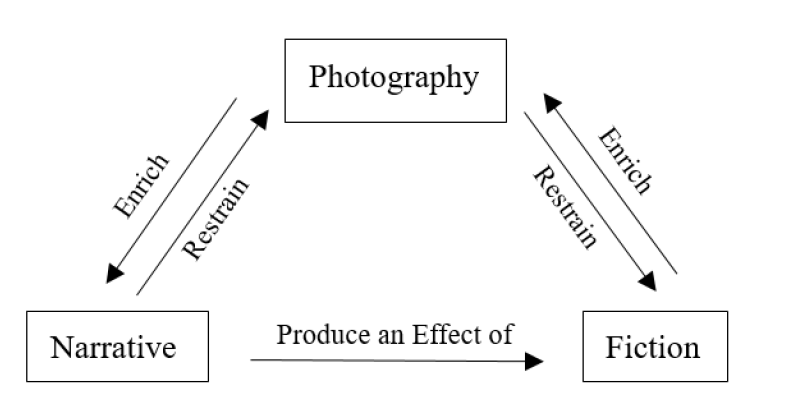
Sophie Calle’s True Stories is an integration of photography, narrative (autobiography) and fiction. The three elements are so closely intertwined as a whole that it is difficult to split two from the three and discuss their relationships without taking a closer look at individual stories from this collection. In general, the relationships between photography, narrative (The narrative in this essay has multiple meanings depending on its various foci. In the analysis of the genre, it refers to "all written stories, including fictional and non-fictional." In the first part of the "phototextuality" analysis, it refers to "texts." In the second part of the "autofiction" analysis, it refers to narration style ("écriture blanche") and rhetorical device ("understatement") and fiction in True Stories are dialectic and dynamic, basically following a pattern of "enrich-restrain" and achieving a subtle balance as a triangle, as shown in Figure 1.
For the convenience of exploring a book's content, it is necessary to first define its genre. To many critics, the work as a whole is an ongoing conceptual art project that follows the paradigm of "post-studio," in which artists create their works outside the studio, explore seemingly uncontrollable situations and "study the permeable dividing lines between public and private, subject and object, self and other, art and life" [1]. In True Stories, Calle "stages her own life as art and vice versa" [2]. A term that refers to the amalgamation of photographs and self-writing is "photobiography," which was first introduced by Gilles Mora and Claude Nori in 1983 [3]. However, with the "play of time and tense" and fictional elements implanted, Calle breaks the "contemporaneity of text, images and referent" that "photobiography" requires and ensures, making True Stories an "experiment in photobiography" [1]. Not only do the texts seem to challenge the standard, but the application of photographs also raises questions about the classification. Since its invention, photography has been traditionally recognized as a "testimonial tool" [4], a proof of "that-has-been" [5], indicating its indexicality. Calle intends to employ this quality to "lend an aura of documented truth" [2] to the stories narrated. However, since some of the texts and photographs are not "co-referential" [1] and since Calle admitted in an interview that she has inserted fiction into her work [2], it seems that the photographs not only functioned as "identifications," but also as "representations." Her playful usage of photography thus blurs the boundary between reality and fiction, true and fake, bringing about a "deceptive" effect to the narrative and "failing" readers’ expectations [4].
Figure 1: The “enrich-Restrain” Relationship Pattern (Enrich means "add more Content to" and Restrain means "Limit")
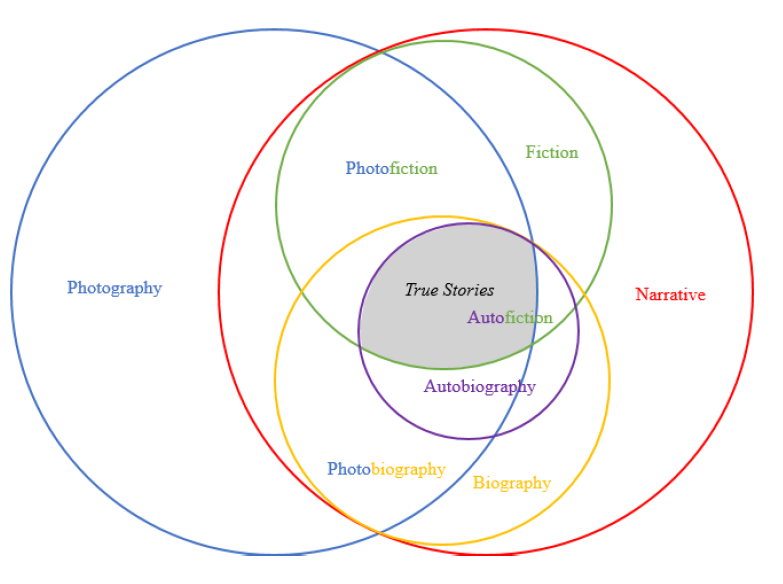
Figure 2: The Graphical Representation of the Genre of True Stories
Through this "aesthetic choice" of applying photographs and fiction to her autobiographical narrative, True Stories is also classified as "autofiction," which is, to quote the definition of Philippe Lejeune, "a retrospective prose narrative which a real person makes of his own existence, when he emphasizes his individual life, in particular the story of his personality" [4]. In True Stories, Calle shows her personality through presenting carefully selected and edited episodic events in her life and since those events are narrated from the opposite direction in which they happened, her subjectivity and fictionality are inevitable [6]. With both qualities of "photobiography" and "autofiction," though untypical at both ends, the genre of True Stories can be defined as "photo (bio) graphical autofiction" [1] and is situated at the very center of the intersection of the three-the grey area shown in Figure 2.
To define its genre is not to fix it into rigid categories but rather to provide a clearer framework for further exploration. Many scholars have followed one or more angles within the framework to investigate True Stories. For instance, the phototextuality from typographical [1] and semiotic [6] perspectives; the irony through the theme of "loss and substitution" [1]; the recuperation and detournement of the referential codes in photographs [4]; and the vulnerability of women presented through the fictionality of gendered violence [2,7]. In three parts, this essay attempts to classify, integrate and compare previous research on Sophie Calle's True Stories and elaborate on the dialectic dynamic relationships between photography, narrative and fiction, using the analysis of several selected stories from the 2016 edition as examples.
Part I: The “Enrich-Restrain” Relationship between Photography and Narrative
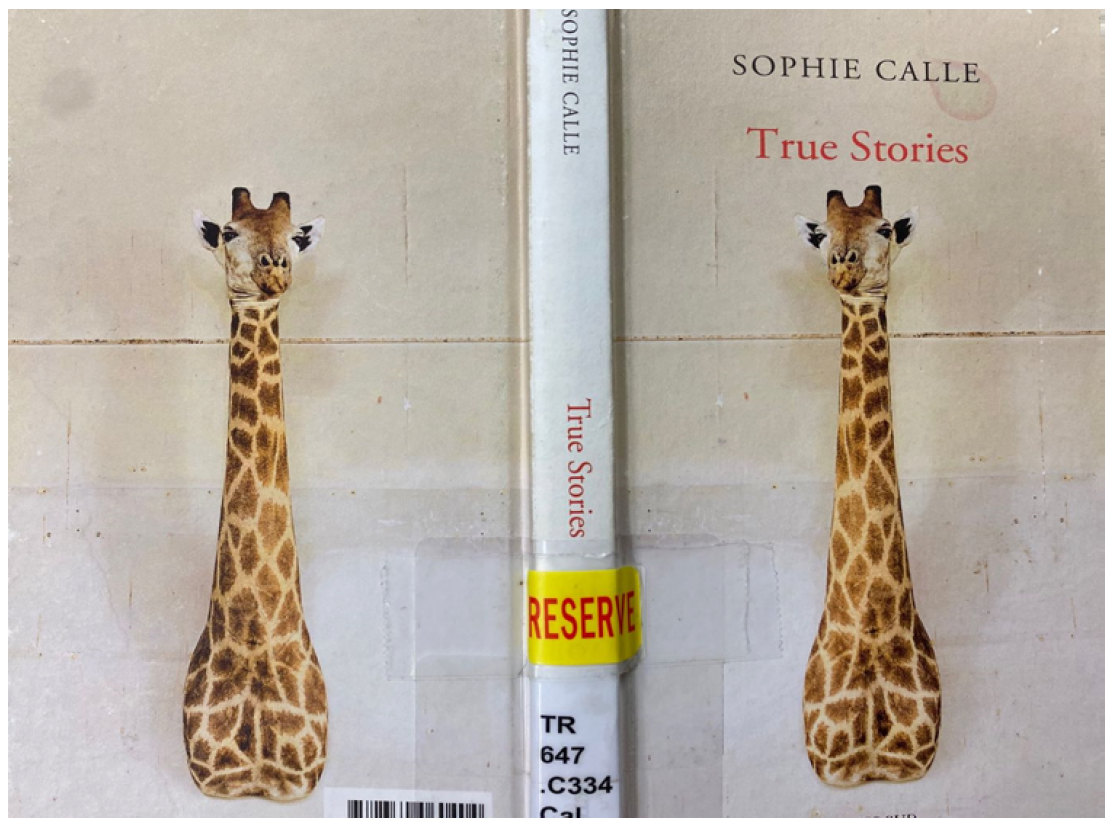
This part will elaborate on the enrich-restrain relationship between photography and narrative (texts) by analyzing the taxidermied giraffe on the book covers of True Stories [8] from the perspective of semiotics theorized by Barthes in his "Rhetoric of the Image" [9]; the "exhibition-like" effect achieved by the juxtaposition of image and text; and the "loss and substitution" theme depicted in "The Giraffe" from the perspective of phototextuality.
According to Barthes, there is a paradox about whether images can convey meaning. On one hand, images are considered too "frank" in comparison with texts, so they "resist" meaning. On the other hand, images are also believed to be delivering something beyond the mere presentation of the object, which is even richer than texts [10]. Readers might come up with numerous questions, interpretations and imaginations looking at the taxidermied giraffe. Yet since it is the cover of a book, ultimately, they would wonder about its meaning and its relation to the book.
This is when readers start to seek help from the texts because texts could restrain the imagination triggered by an image to something more specific-what Barthes calls the "anchorage" function of the linguistic message [9]. Unfortunately, however, the texts seem to be even more confusing-the phrase has nothing, at least not directly, to do with the taxidermied giraffe; in other words, the image is "decontextualized." Not to mention that "true" and "story" seem contradictory to each other [4]. Facing this "dilemma," Barthes’s theory offers another possibility of understanding the cover. He argues that an image with texts contains three kinds of messages, namely linguistic messages, denotated messages and connotated messages [9]. Now that the denoted message (a taxidermied giraffe) and the linguistic message ("True Stories") are both puzzling, readers are compelled to find meaning in the connotated messages, which require cultural knowledge to understand. A taxidermied giraffe is, of course, fake, but it is also "an imitation of a living giraffe." If the taxidermied giraffe is a representation or a metaphor for the whole work, then the book has a parallel purpose-it also "imitates life" [4]. If the readers could realize the symbolic meaning of the taxidermied giraffe on the cover, then the seemingly paradoxical and contradictory texts would be more comprehensible-it suggests that the "stories" are not absolutely "true," but something fictional. In this circumstance, understanding the connotated message of the photograph can help readers grasp the essence of True Stories, which also implies that photographs enrich texts to some extent.
Phototextuality is a topic that many scholars are interested in while investigating Calle’s works. According to Gratton, it is the study of “different kinds and degrees of relation that hold between image and language across a wide range of contexts” [1]. Since the taxidermied giraffe as the cover is discussed above, it is time to look into its story and analyze the phototextuality.
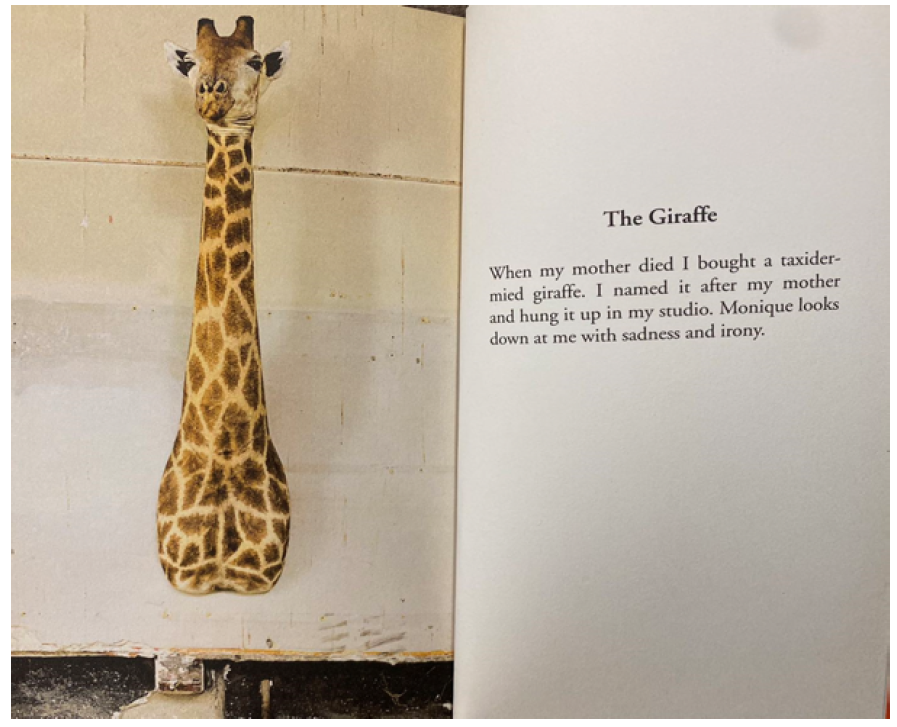
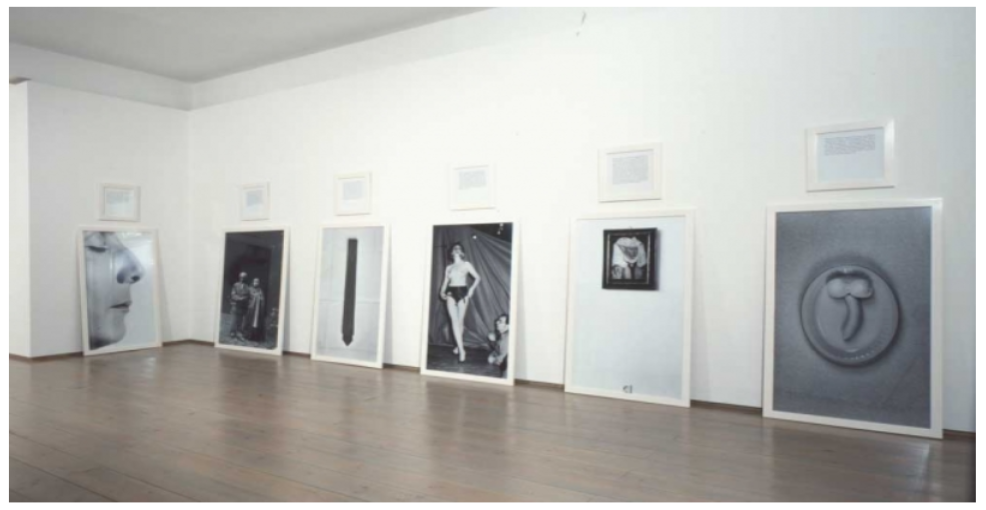
As Figure 4 shows above, the image of the taxidermied giraffe is on the left page and a short story is placed on the right. From the typographical perspective, Gratton claims that this juxtaposition of text and image is an imitation of the museum and True Stories is an "exhibition" of Calle’s life [1]. As a conceptual artist, Calle is used to have her art projects shown in museums. True Stories was also one of them, as shown in Figure 5.
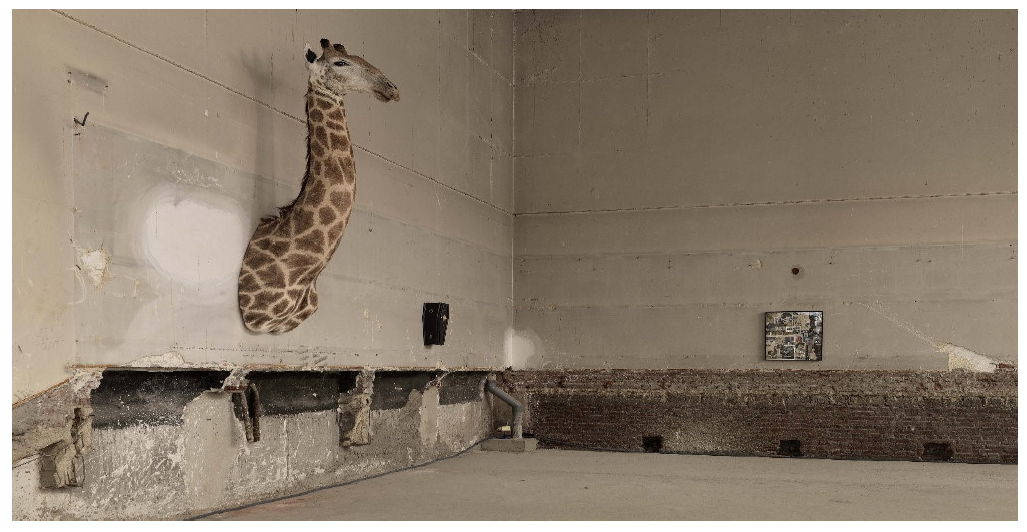
This taxidermied giraffe was one of many exhibits in the 2010 exhibition "Rachel Monique," which was held in the basement of the Palais de Tokyo in order for Calle to mourn her mother while also celebrating life [11] (Figure 6.).
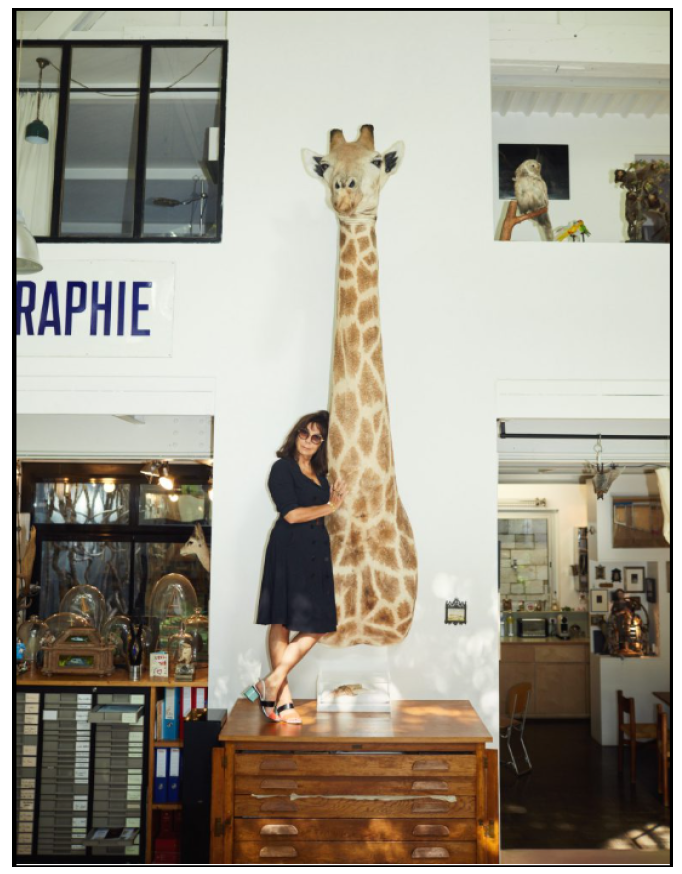
As Victor Burgin states, “language of photography” is never free from the determination of language itself [12]. Although an image of a taxidermied giraffe alone could trigger readers' numerous imaginations, when it is presented alongside a specific story, those imaginations are restrained and readers are directed to follow the way that the narrator wants them to view the image. In this case, readers would know that this taxidermied giraffe was specifically purchased by Calle to mourn her dead mother and it is a substitution (Interestingly, as Calle stated in an interview about her mother posthumous exhibition, many of the exhibits are not works of art but souvenirs of her mother [11]. But this taxidermied giraffe might be an exception-it is the representation of her mother herself. Her mother has always been longing to become part of Sophie's art projects but only succeeded at the very moment of her death [13]. Maybe this is the reason why "Monique" the taxidermied giraffe "looks" at Calle with "sadness and irony") for the loss because she names it after her mother’s name, "Monique."
Figure 3: The Covers of True Stories [8]
Figure 4: The Giraffe
Figure 5: The Exhibition of the True Stories
Figure 6: Taxidermied Giraffe in the Exhibition “Rachel Monique
Figure 7: Sophie Calle and “Monique” in her Studio
The sad and ironic "look" that the taxidermied giraffe gives with its artificial eyes would remind her of her mother. That is to say, it is no longer a random taxidermied giraffe but a consolation for death. In addition, by explicitly describing a “look”, the narrative seems to lead the readers to pay attention verbal description is not as direct as the experience of looking at the image itself. With the associated photographs, readers could seek help from the photographs to get a better understanding of that "look" and experience it "in flesh." To some degree, the photograph shortens the distance between readers and Calle since it allows readers to experience, at least partly, what she has experienced to its artificial eyes. This is when photographs come in to enrich the narrative. The narrative itself is abstract, let alone the fact "a look" is a visual experience (Figure 7).
Part II: Fictional Effect Produced by Artistic Narrative
In his Camera Lucida, Barthes states that "language is, by nature, fictional" [5]. Although this statement was an attempt to argue that the authenticity of a story cannot be proved by itself while (analogue) photographs can, it also indicates that narratives are prone to being fictional. Henry James' statement that "stories do not happen but rather are constructed in artistic ways by talented narrators" also supports this view [6]. Calle is one of the "narrative artists" [1] who knows how to narrate stories and create "tension between factual and fictional" [4]. With her unique narration style, those seemingly banal and quotidian stories are possessed with a shade of "poetic poignancy" [2]. Overall, True Stories is a rather sad work since most of the stories involve somewhat miserable events, including the deaths of Calle’s relatives, friends and pets, (gendered) violence from strangers, betrayal of husbands, departure of lovers and so on.
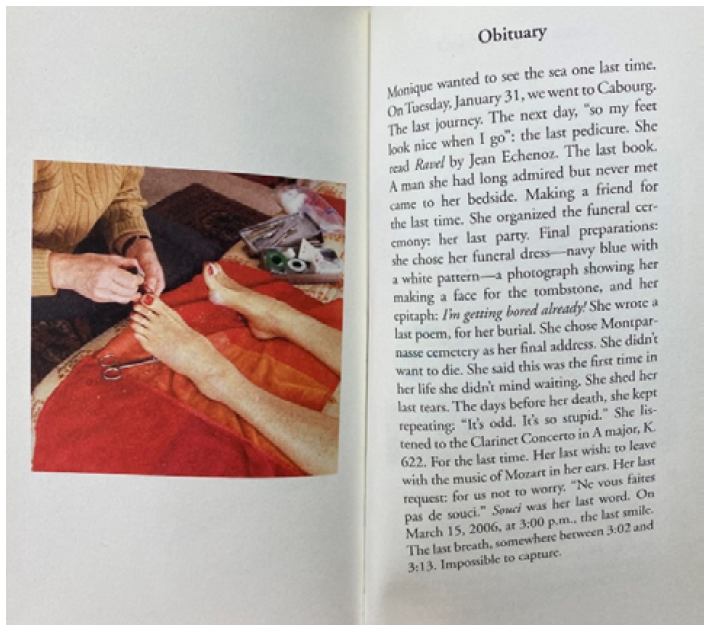
Figure 8: Obituary
This part will focus on the fictional effect produced by Calle’s narratives by analyzing the "écriture blanche" and the "understatement" in "Obituary" and in "The Neck" (Figure 8).
At first glance, though the story is about the last few things Calle’s mother Monique did before her death, Calle narrates it in a rather "icy" way [13], seemingly without any emotion or feeling attached to it. This "coldness" is first shown in its title. Just like the genre of obituaries suggests, Calle's narrative is very objective, like a camera, making the story more of a "document." Yet with a closer look at the content, readers might notice that the information Calle provided is well-selected with special intentions, making it an artistic record of Monique's several particular final behaviors that convey a sense of melancholy and "reluctance to part" of both Calle and Monique. Since many of those behaviors were supposed to make people happy, like getting a pedicure, making friends with an admired person, having a party and listening to music, it is heartbreaking to read that Monique could never do these things anymore. The sharp contrast between words like "she didn’t want to die." "She doesn’t mind waiting," and Monique’s epitaph, "I’m getting bored already!" pushes this feeling to the climax. Within a few lines, an image of a woman who was depressed, desperate and afraid of her own death, yet still pretended to be optimistic and happy, was vividly constructed. Thanks to Calle’s artistic narration, Monique's final moment was also fictionalized in a tragic atmosphere. As the last lines wrote, "The last breath [...] (is) Impossible to capture." They reveal Calle's pity, powerlessness and sorrow towards the fact that even with the help of a camera [13], she is still unable to capture and hold back the fading of Monique’s life and soul (Figure 9).
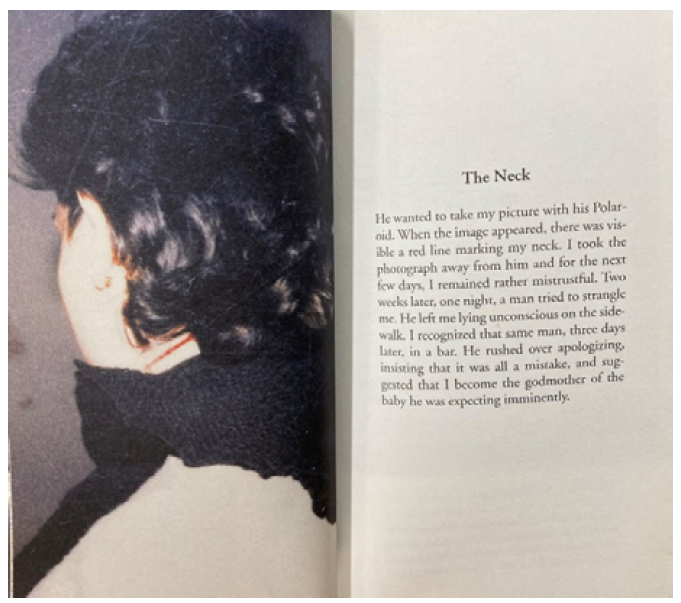
Another example is The Neck. It is a rather mysterious story about gendered violence [2]. The story starts with the "objectification" of women as Calle is asked to take a photo by a male and ends with an apology from a male stranger for his violent behavior, of which Calle was the victim. The photograph on the left page shows a red line that "resembles a puncture wound" [2] on Calle’s neck, which is referential to the narrative.
Figure 9: The Neck
This narrative resembles fiction in three aspects. The first one is the red line. Strangely, it appeared, worrying Calle and then an "accident" occurred as if the red mark "foretold" her misery. Since Calle does not give any further explanation, an atmosphere of suspense is created through this mystery. Secondly, the story ends abruptly, without showing Calle’s response to the male stranger’s apology,leaving the readers some space to imagine. Last but not least, the violent behavior and the aftermath were narrated in only two short sentences, forming a sense of lightness, as if it were just something banal and trivial in everyday life. From the perspective of rhetorical devices, this narration can be classified as, according to A Glossary of Literary Terms, an “understatement” -a figure of speech that deliberately represents something as very much less in magnitude or importance than it really is, or is ordinarily considered to be [14]. With less enthusiasm presented, Calle reduces the seriousness of violence, showing her "indifference" to the violence. However, since understatement is "used for emphasis, irony, hedging, or humor," Calle fictionalized the story to make the experience "sound as if it were less harmful" in order to achieve a counter-effect, that is, to indirectly show "her vulnerability and a sense of irony" [6].
These "icy" narratives demonstrate Calle’s "emotional economy" in True Stories. She "distills the violent and the tragic into short, unembellished sentences that constitute their own form of punctuation, leaping out at the reader from the banality of the quotidian and the flatness of the page itself" [2]. According to Carr, this kind of “simplified” and "neutral" writing is what Barthes called "écriture blanche"—"a writing that is made of the absence of cries and judgements (…) implies no refuge, no secret (…) rather innocent” introduced in Le Degré zéro de l'écriture [15]. Although it seems to minimize the direct expression of emotions and feelings, itproduces an effect of fiction that allows her inner thoughts to be presented in an indirect way. Just as Carr concludes, by couching the violence and tragedies with her unique writing style and "enfolding them in the quotidian," Calle is exhibiting in True Stories "to what extent her life constantly brushes against disaster and verges on fiction" [8].
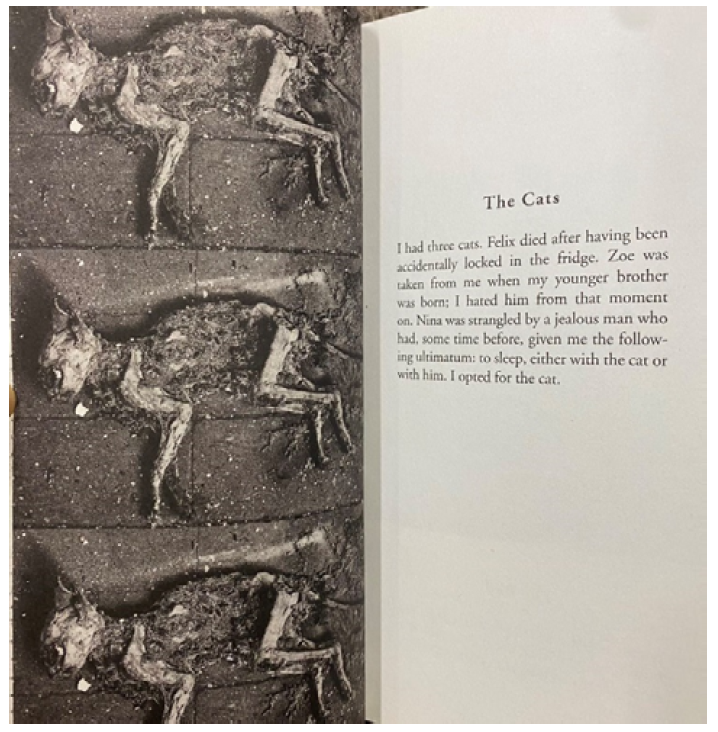
Figure 10: The Cats
Part III: The “Enrich-Restrain” Relationship between Photography and Fiction
As Perron states, some photographs are "too artistic, too polished" so that people would doubt their "truthfulness." It is not only the photograph as medium used in True Stories that "contributes to the production of certain "ethos" to an image, but also Calle’s aesthetic choices of photographs for the narratives makes the combinations more interesting and meaningful [4]. In some stories, Calle deliberately uses the indexicality of photographs as representation and erases their possibility of verifying the authenticities of narratives to challenge readers’ cognitions and expectations, making them simultaneously believe and doubt the truthfulness of the narratives. This part will elaborate on the "enrich-restrain" relationship between photography and fiction and the mischievous effect generated by analyzing the prominent non-referentiality of the photograph and fictional narrative in "The Cats." (Figure 10).
It is the alleged tragedy of Calle losing three beloved cats that were killed in an accident (might be a murder), taken away, or strangled to death. The photograph on the left page is a composed picture-a repetition of three identical photos of a decayed dead cat. Although the species (cat) and the number (three) fit the narrative, readers still "cannot be sure at the level of the referent." In other words, the photograph and narrative are not "co-referential" [1]. If readers only look at the photograph, they might only think of one dead cat whose photograph is placed here three times and if they have no knowledge of "cat archeology," they wouldn’t recognize the cause of its death. If they only read the narrative, they might imagine the scenes of two poor cats dying (since Zoe was only taken away, it might not be dead in reality. But to Calle, it is already a "dead" cat because she might never see it again). However, the photograph falls short of readers' expectations, stifling their imaginations and degrading their visual experience to only three identical cat corpses. This displacement, or "nonconnection," makes the whole story appear confusing and ironic [1], because neither the photograph nor the narrative is reliable. Ultimately, readers are "obliged to disqualify any possibility of dealing with real photos of the three cats" [4] and only regard the photographs as a “monument” [1] or an "archive" of the three cats that Calle lost. This is the point at which the fiction (because the photograph cannot verify the authenticity of the story, it could be a product of imagination) enriches the photograph's denoted message-it bestows special meanings on this "might-be-random" dead cat and projects human memories on its cold corpse.
CONCLUSION
To sum up, True Stories is a "photo(bio) graphical autofiction" that artistically mingles photography, narrative (autobiography) and fiction as one. It stages Sophie Calle’s life and art through the presentation of meaningful incidents in a form of combinations of photographs and creative yet somehow melancholic fictional narratives. As a conceptual artist, Calle juxtaposes images and texts in this book to imitate the form of exhibitions and galleries. As a photographer and writer, she accurately grasps the essence of photography’s dual qualities of "identification" and "representation" and applies them sophistically to texts. In terms of the relationships between photography, narrative and fiction in True Stories, since "the mingling of fact and fiction takes on different forms" [1] in different narratives, it is suggested that the research be conducted accordingly in specific stories. From the narratives being analyzed in this essay, photographs can trigger readers' various imaginations, while relative narratives can shrink the divergence of imagination, leading the readers to a particular way of viewing and interpreting photographs. If the narrative and photographs do not match each other, which means the authenticity of the narrative is uncertain, plus Calle’s artistic narration style of "écriture blanche" and "understatement" rhetorical devices are applied to the narrative, "fiction comes into play" [1]. With deliberate non-referentiality, photographs no longer serve as "identifications," but as "representations" of elements or objects mentioned in fiction and, in return, are endowed with new meanings by fiction. True Stories constantly challenges readers' expectations through the application of these dynamic relationships, allowing readers to arouse open and different interpretations while remaining within the framework that Calle provided. Her playful blurring of the lines between reality and fiction, true and false, results in more subtle irony and emotions that linger and impress.
Carr, J. “The Disaster Artist: Sophie Calle’s Histoires vraies.” Contemporary French and Francophone Studies, vol. 24, no. 3, 2020, pp. 330–337. https://doi.org/10.1080/17409292. 2020.1785733.
Kawakami, A. et al. “Introduction.” Photobiography: Photographic Self-Writing in Proust, Guibert, Ernaux, Macé, Routledge, 2013, pp. 1–16. https://doi.org/10.4324/9781351191593.
Perron, L. “Récupération et Détournements des Codes Référentiels par l’Image Photographique chez Sophie Calle.” L’Atelier (Nanterre), vol. 11, no. 1, 2019, pp. 67–84.
Barthes, R. Camera Lucida: Reflections on Photography. Translated by R. Howard, Hill and Wang, 1981.
Penny, C. “‘In My Fantasies, I’m the Man’: Sophie Calle’s True Stories.” Parachute: Contemporary Art Magazine, no. 82, 1996, pp. 10–15.
Calle, S. True Stories. Actes Sud, 2016.
Barthes, R. “Rhetoric of the Image.” Image–Music–Text, translated by S. Heath, Fontana Press, 1977, pp. 32–51.
White, E. “Rhetoric of the Image.” How to Read Barthes’ Image–Music–Text, 1st Edn., Pluto Press, 2012, pp. 25–38. ProQuest Ebook Central, ebookcentral. proquest.com/lib /ed/detail.action?docID=3386680.
Burgin, V. “Looking at Photographs.” Thinking Photography, Palgrave Macmillan, 1982, p. 143.
Krasinski, J. “Sophie Calle’s Rachel Monique.” MFA Art Writing, artwriting.sva.edu/journal/post/sophie-calle-39-s-em-rachel-monique-em. Accessed 6 Dec. 2022.
Abrams, M.H. and G.G. Harpham. A Glossary of Literary Terms. 10th ed., Wadsworth Cengage Learning, 2011, pp. 166–167.
Barthes, R. “L’écriture et le silence.” Le degré zéro de l’écriture: Suivi de éléments de sémiologie, Seuil, 1972, p. 60.
Recommended Articles
Research Article
Symbols of Life and Death in Lol Soyinka's Drama: A Thematic and Literary Analysis
Zaid Fouad Hashim
Published: 18/01/2026
Download PDF
Research Article
Mediating Role of Speaking Confidence in the Relationship between Classroom Interaction Frequency and Listening Comprehension Scores in ESP Courses in Iraq Universities
Tuqa Mohammed Hannoon
Published: 29/12/2025
Download PDF
Research Article
Character style in a novel throwing sparks
Maison jasim Abdullah Hussein
Download PDF
Research Article
Video Clips, Pupils Interest and Performance in French Language in Akwa Ibom North East Senatorial District
Kingsley E. NWACHUKWU,
Helen. A. OTUAKHENA
Download PDF
PO Box 101, Nakuru
Kenya.
Email: office@iarconsortium.org
Editorial Office:
J.L Bhavan, Near Radison Blu Hotel,
Jalukbari, Guwahati-India
Lin, M. (2023). The Relationship Between Photography, Narrative, and Fiction in Sophie Calle’s True Stories. Scientific Research Journal of Education and Literature, 3(2), 1-7.
MLA
Lin, Mengxi. "The Relationship Between Photography, Narrative, and Fiction in Sophie Calle’s True Stories." Scientific Research Journal of Education and Literature 3.2 (2023): 1-7.
Chicago
Lin, Mengxi. "The Relationship Between Photography, Narrative, and Fiction in Sophie Calle’s True Stories." Scientific Research Journal of Education and Literature 3, no. 2 (2023): 1-7.
Harvard
Lin, M. (2023) 'The Relationship Between Photography, Narrative, and Fiction in Sophie Calle’s True Stories' Scientific Research Journal of Education and Literature 3(2), pp. 1-7.
Vancouver
Lin M. The Relationship Between Photography, Narrative, and Fiction in Sophie Calle’s True Stories. Scientific Research Journal of Education and Literature. 2023 Jul;3(2):1-7.


 Download PDF
 Download XML