Synthesis of New Schiff Bases Complex from 2-((3-Ethoxy-4-Hydroxybenzylidene) Amino) Benzoic Acid: Characterization and Evaluation of the Physicochemical Properties, Biological Activities and SEM Study
Ahmed G. Ahmed
1
,
Hasan A. Mohammed
2
,
Ziyad M. Mustafea
1
1
Chemistry Department, College of Sciences, University of Kirkuk, Kirkuk, Iraq
2
Chemistry Department, College of Education for Pure Sciences, University of Kirkuk, Kirkuk, Iraq
This study involved the preparation of a New Complexes Schiff bases (L): 2-((3-ethoxy-4-hydroxybenzylidene) amino) benzoic acid, made using the identical precursor for the electron acceptor (A): The molar ratio of the reaction between 3-ethoxy-4-hydroxy benzaldehyde and electron donors (Ds) anthranilic acid was 1:1. The Schiff base ligands were used to react the salts of the Co(II), Ni(II), Cu(II), Zn(II) and Cd(II) complexes. The complexes Measurements of molar conductivity are not electrolytic. CHN analysis of the elements, FTIR spectra, mass spectra, 1HNMR and 13CNMR were used to characterize the Schiff base ligand (L) and the same complexes samples in order to corroborate the molecular structures. The molecular structures determine the optical and biological activity. The tetrahedral geometry surrounding both of the metals and the curved planar geometry around Cu (II).
Keywords
Schiff Base
New
Complex
Biological
INTRODUCTION
The azomethine imine functioning group (-HC=N) is present in Schiff bases organic substances and is created when a carbonyl compound reacts with primary amines and ligating metals through lone pair in the N atom [1]. The group (C=N) is regarded as a significant class of ligands, having been thoroughly investigated in coordination research and possessing numerous industrial and biological uses [2]. The percentage of donating atoms contained within the ligand determines the mono/polydentate bridging. Schiff compounds are extensively used in many technological domains and their biological activity is contingent upon their molecular structure [3,4]. When electrons (es)- acceptors (A) and electrons (es)-donors (D) interact following a partial or total transfer of electron (e) density from D to A, a Charge-Transfer Complex (CTC) or molecules compound known as a schiff base is created. The stability attained a high electron affinity of A and a low desorption potential for the person who donated [5]. Because they can function as enzymes in the conversion to hydrogen of olefins, schiff bases are useful for antibacterial, antifungal and anti-tumor drugs [6-8]. In this work, we synthesized the Schiff bases complexes from anthranilic acid and 3-ethoxy-4-hydoxy benzaldehyde.
Experimental
Materials and Methods
All predecessors and reactants that are bought from reputable and certified businesses are pure chemical substances that are utilized just as supplied, requiring no additional purifying.
Schiff base ligand preparation and characterisation [9]
L: Scheme 1 ethanolic solution Anthranilic acid (0.495 gm, 0.00361 mol) added slowly dropwise to the ethanolic solution 3-ethoxy-4-hydroxy benzaldehyde (0.6 gm, 0.00361 mol) in 100 mL flat bottom flask with the addition of glacial acetic acid by drops. The solution refluxed at 75°C for 10 h. The color changes and then it is cooled. A precipitate is formed after leaving it for a day with a dark yellow color. It is filtered, washed with ethanol and dried., m.p. 166-168°C
Metal Complex Synthesis
After dissolving a solution of 0.00105 mol the Schiff base ligand in 15 ml of hot 100% ethanol, a solution of 0.00105 mol corresponding metal chlorides was added. The reaction was finished after the solution was refluxed on a mantle with a water condenser for around 4 hours. Following chilling, filtering and washing with ethanol and diethyl ether, respectively, the final product (Scheme 2) was taken out as a precipitate once the concentration had dropped to half of its original volume.
All the formed Compund conducted at the Central Laboratory of Chemistry Department of the College of Sciences, the University of Kirkuk-Kirkuk-Iraq and the photon center Bagdad-Iraq with the use of electronic, CHN elemental measurements, molar permeability, FTIR IR and 1H/13CNMR spectroscopies, Scanning Electron Microscopy (SEM) and powder XR diffraction (p-XRD) in both the solid and liquid states. Melting temperature: SMP30 melting temperature FTIR spectra: FTIR-ALFA Burker-27 Infrared Spectrophotometer in wavenumber range (400-4000 cm-1); mass spectra: Agilent 5975C; apparatus: Stuart Co.; (CHN) element analyses: Thermo Fisher, Eager300.1H-NMR and 13C-NMR: Bruker AVANCE (400 MHz) spectrometer, Surface analysis by TESCAN MIRA3.
The Schiff base ligand and complexes used the well agar diffusion experiment to check for their antibacterial properties against specific bacterial strains. In order to inoculate the test strains, sterilized medium was put onto 25 mL glass Petri dishes that had been sterilized and hardened at room temperature. microbial suspension made in sterile saline that is 1.5*105 CFU mL‒1 or McFarland 0.5 by standard solution. A sterile cotton swab bathed in the modified solution was splashed onto the dried agar surface and allowed to dry for 15 minutes after the turbidity of the added inoculum suspension had been adjusted for 15 minutes with the lid closed. Using a sterile borer, create a 6-mm-diameter well in cemented medium sample diluted in DMSO (20 mg/mL) (control). Each well received 100 μL of the sample, which was then incubated for 24 and 48 hours at 37°C. Measured in triplicate, the inhibition zone (mm) [10,11].
Scheme 1: Preparation outline scheme of ligand (L)
Scheme 2: Prepartion outline scheme of Complexes
Using a PGT92+ UV-Visible spectrophotomer constructed using Beer's lambert law, the optical activity in DMSO solutions at wavelengths between 190 and 900 nm was measured in a 1.0 cm quartze cell [12]. The entire wavelength curves of the electronic spectra were captured.
RESULTS AND DISCUSSION
The produced ligand and complex's chemical and physical characteristics are compiled in Table 1. The ligands for Schiff bases (L) and metals complexes' physicochemical characteristics are shown in Table 1.
A molecular framework of the compound ligand (L) and metal confirmed by hydrogen bonding (H.B) In addition to metal, interactions between nearby moieties increased the m.p. of (L) [13]. The stoichiometry associated with the compound's production reaction was validated by the quantitative micro component CHN analysis, which revealed agreement between the calculated and observed values [14]. It is suggested that the Schiff chemical ligands in sunscreen lotions must dissolve in the appropriate solvent in order to influence the antibacterial activity and the spectral shift of the band position [15].
Various solvents tested for the solubility of (L) and complexes as shown in Table 2.
Characterization Schiff Base Ligand and Metal Complex
FTIR spectra of L and complexes showed in the Figure 1-5.
Table 3 collected the functional groups in each ligand and complexes based by the vibrational bands of bonds as molecule diatomic simple harmonic oscillator.
Figure 3-4 showed 1HNMR spectra confirmed types of protons of ligands in DMSO solvent.
Table 5 collected the chemical shift δ (ppm) for the NO. and types of carbon atoms assigned for ligand and M5 complex [18,19].
The molecular weight (Mw.) confirmed from mass spectra, represented in the Figure 6. The observed M.wt. 287.3 gmol‒1 was agreement is good with cal. M.wt. 285.29 gmol‒1. The fragmentation patterns at ration of (m/z) ratio 269.6 loss H2O, 241.4 fragmentation from OCH2CH3 and 119.8 bond breaking at one side benzene ring [20].
Figure 7 shows the molecular size (M.wt.) of [Zn(L)Cl2], which was verified by mass spectra. Cal and the measured Mw of 424.2 gmol‒1 agreed well. 423.3 gmol‒1 M.wt. The decomposition patterns at the mass/charge ratio of (m/z) are as follows: fragmentation from the benzene ring 77.6; loss of Zn, 287.4 and mass/charge ratio 359.1 [20].
The particle size and morphology of (L) and M1, M3 obtained from SEM micrographs, Figure 8-10.
Table 1: The produced ligand and complex's chemical and physical characteristics are compiled
N.B. +, ÷, - (soluble, partially soluble and insoluble respectively)
Figure 1: FTIR spectra of L
Figure 2: FTIR spectra M2 and M5
Figure 3: 1HNMR Spectra of (L)
Figure 4: 1HNMR Spectra of (M5)
Figure 5: 1H NMR spectrum of ligand (L)
Figure 6: Mass spectra of ligand (L)
Figure 7: Mass spectra of M5
Table 3: FTIR Assigned vibrational bands [16]
ῡ(M-N)
ῡ(M-O)
ῡ(C=C)
ῡ(C=O)
ῡ(C=N)
ῡ((NH2) Sym & asy
ῡ(OH)
Ligand
-
-
1522
1620
1577
-
-
L
578
464
1513
1657
1584
-
3418
M1
577
497
1517
1647
1574
-
3307
M2
459
585
1516
1673
1580
-
3302
M3
490
566
1558
1618
1596
-
3375
M4
460
575
1576
1651
1590
-
3467
M5
Table 4: Assigned 1HNMR of Schiff base ligands (L) and M5
δ (ppm) M5
δ (ppm) L
Assignments
7.671, 7.274, 6.726 (1H),s (2)
8.306, 7.396(1H),t, 8.261,7.691(1H),d (1)
7.417, 7.367, 6.736 (1H), s (2)
8.078, 7.909(1H),t, 8.059,7.775(1H),d (1)
Ar-CH
1.325 (3H), t
1.392 (3H), t
CH3
4.059 (2H), q
4.108 (2H), q
OCH2
8.462 ( 1H), s
8.487 ( 1H), s
-CH=N
9.733 (1H), s
9.971 (1H), s
OH Phenolic
10.190 (1H), s
10.207 (1H), s
OH arboxylic
Figure 8: SEM micrograph of ligand (L)
Figure 9: SEM micrograph of M3
Figure 10: SEM micrograph of M1
Table 5: Assigned 13CNMR of Schiff base ligands (L) and M5
δ (ppm) M5
δ (ppm) L
Assignments
15.13
15.02
CH3
64.40
64.30
OCH2
112-147.51
110.35-134.12
Ar-CH
170.09
170.38
-CH=N
149.38
151.82
C-OH
147.75
147.70
C-O-CH2
153.67
153.61
C-N
191.45
191.51
HO-C=O
Samples measured by a Scanning Electron Microscope (SEM) appear to be in the form of variously shaped plates and confirmed the Nano scale particle size (nm). The importance of this structure lies in its potential applications. The layered structure also provides a high surface area - to-volume ratio and large area surface, enabling it to enhance interactions between molecules and other materials. These properties are useful in a variety of applications, such as catalysis, sensing and energy storage [5].
Figure 11: PXRD pattern of ligand (L)
Figure 12: PXRD pattern of M2
Figure 13: PXRD pattern of M3
Table 6: X'Pert High Score Plus Version 3.0.5
Pos. [°2Th.]
Height [cts]
FWHM [°2Th.]
d-spacing [Å]
Rel. Int. [%]
Tip width [°2Th.]
Partical Size [nm]
L
9.6027
1661.42
0.2880
9.20295
9.97
0.3456
27.69472
11.5648
2415.12
0.2880
7.64563
14.49
0.3456
27.73867
13.8398
1625.69
0.2400
6.39348
9.75
0.2880
33.36005
16.8289
4832.79
0.2880
5.26403
28.99
0.3456
27.89784
17.7697
4705.66
0.3360
4.98740
28.23
0.4032
23.94232
18.9023
1259.08
0.3360
4.69103
7.55
0.4032
23.98054
19.5551
1989.51
0.2880
4.53587
11.93
0.3456
28.00431
21.3552
1231.41
0.2880
4.15744
7.39
0.3456
28.08379
24.2656
1691.14
0.2400
3.66498
10.14
0.2880
33.87367
24.7645
3062.41
0.2880
3.59227
18.37
0.3456
28.25477
27.0687
16670.16
0.2880
3.29148
100.00
0.3456
28.38581
27.6655
2543.00
0.1920
3.22181
15.25
0.2304
42.63274
46.6538
274.57
0.4800
1.94531
1.65
0.5760
18.03248
M3
10.1062
384.17
0.1920
8.74552
16.67
0.2304
41.55781
12.4097
1862.93
0.1440
7.12687
80.83
0.1728
55.52031
15.3861
514.06
0.1440
5.75426
22.30
0.1728
55.69636
16.4786
614.31
0.1440
5.37513
26.65
0.1728
55.77072
17.7229
556.26
0.1920
5.00045
24.14
0.2304
41.89638
19.6364
1458.12
0.1920
4.51729
63.27
0.2304
42.01161
20.5210
1268.41
0.1920
4.32452
55.04
0.2304
42.06906
21.1082
2186.88
0.1440
4.20552
94.89
0.1728
56.1449
26.2623
2304.69
0.2400
3.39068
100.00
0.2880
34.00621
30.9097
1390.86
0.1920
2.89065
60.35
0.2304
42.94931
35.7505
419.98
0.1920
2.50956
18.22
0.2304
43.49598
38.7963
436.01
0.1920
2.31927
18.92
0.2304
43.88765
42.7001
1914.70
0.1920
2.11583
83.08
0.2304
44.4465
45.7146
475.95
0.1440
1.98307
20.65
0.1728
59.89859
49.4167
607.77
0.2880
1.84282
26.37
0.3456
30.37879
52.3143
447.02
0.2400
1.74736
19.40
0.2880
36.89558
55.5860
406.73
0.1920
1.65201
17.65
0.2304
46.79462
64.1187
263.85
0.1440
1.45121
11.45
0.1728
65.12702
M2
10.6333
226.33
0.2400
8.31321
24.82
0.2880
33.26013
16.4662
645.82
0.2400
5.37917
70.82
0.2880
33.46191
18.9509
123.09
0.1440
4.67912
13.50
0.1728
55.95855
20.2257
128.24
0.1440
4.38698
14.06
0.1728
56.06612
23.2971
174.18
0.1440
3.81510
19.10
0.1728
56.35574
26.9846
911.98
0.2400
3.30155
100.00
0.2880
34.05697
33.4547
598.64
0.2400
2.67634
65.64
0.2880
34.5803
38.2609
291.83
0.2880
2.35048
32.00
0.3456
29.2107
42.6491
291.05
0.1920
2.11824
31.91
0.2304
44.43878
51.9240
102.07
0.1440
1.75958
11.19
0.1728
61.39029
58.3656
139.39
0.2880
1.57978
15.28
0.3456
31.60981
The sharp and well-defined Bragg Peaks at specific 2theta(θ) angles identified from the powder X-ray diffraction patterns, Figure 11-13 confirmed Nano scale particle size and obeyed Bragg equation [21]:
n λ = 2dsin(θ)
(1)
p-XRD patterns corroborated the crisp, well-defined Bragg reflection at particular 2theta angles. The data in p-XRD patterns were fitted using X'Pert High Score Plus Version 3.0.5 as well as the resultant results given in Table 6.
According to the Sherrar equation, the average particle sizes of the ligand (L) 28.54 and M2, M5 are 46.53 nm and 42.71 nm, respectively [21].
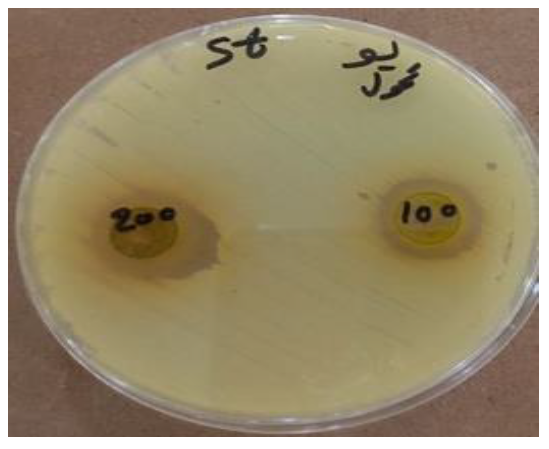
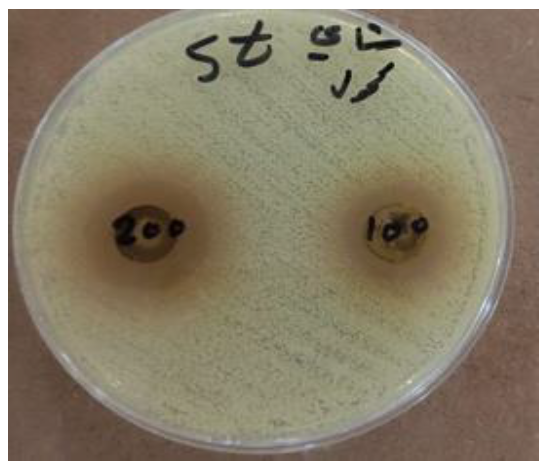
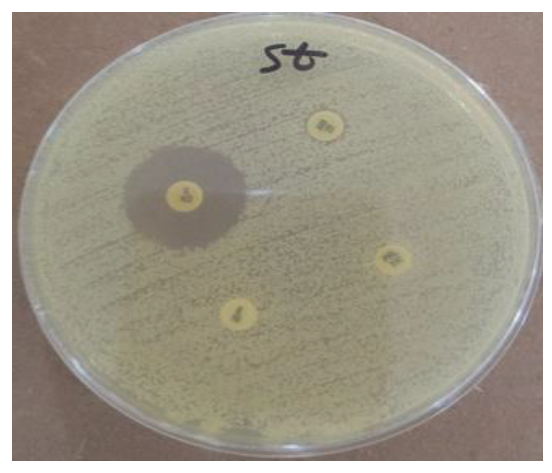
The inhibition zone diameters of the ligands and complex's antibacterial activity against different bacterial strains are displayed in Figure 14 and Table 7.
The ligand and M1, M5 complex showed middle antibacterial properties against the majority of investigated for the bacterial lineage, as did the chemical that was assessed for antibacterial activity against different bacterial stains. Because of the differing cellular wall structures, the G+ effect is stronger than the G-effect [22].
Figure 15-18 show the electrical spectra in DMSO at ambient temperature. displays the UV-visible spectra of the ligand (L) at varying concentrations. The presence of chromophores C=C and C=N is responsible for the significant broad absorption band at 356 nm and at 461 nm, which is caused by n-π* and ππ* occurring in succession. These can also be seen in the complexes' spectra and their shift to lower intensities verifies that the ligand and metal ions are coordinated. Because of charge transfer, the compound M1's electronic spectra displayed absorption bands at 462 nm. The higher charge transfer metal to ligand transitions most likely happened from the n-π* Schiff base orbitals to the d-orbitals of metals; this is true even if M2 and M3 don't show, all complexe M1, M2 and M3 showed absorption bands at range 595-631 nm due to the 4A2(F)4T1(P) transition for M1, M3 and 2B1g2A1g such as sugesst the tetrahedral and square planar.
Figure 14: The inhibition zone (mm) of Schiff base (L) and Complex M1, M5
Figure 15: UV-Vis. spectra of ligand 1
Figure 16: UV-Visble. spectra of M1
Table 7: Inhibition zone of (L) and complexes towards with different Gram positive and by Gram negative bacteria
Inhibition zone (mm)
Staph (G‒)
E. coli (G+)
D
C
B
A
D
C
B
A
Sample
-
-
-
-
4
6
6
8
L
-
-
4
6
-
4
8
10
M1
-
-
-
-
-
-
-
-
M2
-
-
-
-
-
-
-
-
M3
-
4
6
8
8
10
10
12
M5
-
-
-
-
-
-
-
-
DMSO
24
Amoxicillin (10 mg/mL)
22
Ampicillin (10 mg/mL)
*(A, B, C, D) are 0.1 M, 0.01 M, 0.001 M and 0.0001 M, respectively, ‒: Not active with bacteria, Amoxicillin and Ampicillin standard antibiotics
Figure 17: UV-Visble. spectra of M2
Figure 18: UV-Visble. spectra of M3
Table 8: The Transitions with suggested form and hybridization of the (L) and complexes
Type of hybridization
Suggest geometry
Type of transfer
Wave length (cm)
Wave length (nm)
Compound
-
-
28089
356
L
21691
461
Sp3
T.d
31948
313
M1
4A2(F)4T1(P)
16891
592
dsp2
Sq.P
32894
304
M2
2B1g2A1g
15847
631
Sp3
T.d
31847
314
M3
C.T (L M)
21645
462
3T1(P)3T1(F)
15923
628
We have done spectra measurement for the complexes Co(II), Cu(II) and Ni(II) complexes but we did not do it for the complexes Zn(II)and Cd(II) because they do not have an empty orbital. Table 8 showed all The mentioned values[2,4,523].
CONCLUSION
New Complexes from Schiff bases ligand(L) :2-((3-ethoxy-4-hydroxybenzylidene) amino) benzoic acid, prepared from benzaldehyde: 3-ethoxy-4-hydroxy benzaldehyde reacted with Anthranilic acid in the molar ratio: 1:1. And prepared metal complexes with Co(II), Ni(II) Cu(II), Zn(II) and Cd(II). The lage area surface of this nm scale compound by p-XRD and the SEM measurement improved the interaction with the bacteria cell and shifted the absorption wavelength.Because of their nano-sized size, they can be used as drug carriers and can also be used in chemical catalytic reactions, in addition to energy storage materials such as batteries used in solar energy. The Lewis's base es-donor molecule's chemical structure determines the physiochemical characteristics of the Schiff basis ligand L). The novel optical characteristics and characterisation of the synthesized Schiff base compounds were provided by the intermolecular and intramolecular hydrogen bonds that were created in the solid state. Therefore, this affects molecular structure and affected the electronic absorption bands. Magnetic measurements, FT-IR and NMR showed a change in the composition of the prepared compounds, which indicates coordination with metals.
REFERENCE
Abdullah, M.M. et al. “Synthesis and Characterization of Some Copper (II) Complexes with New Schiff Bases Ligands.” Kirkuk Journal of Science, vol. 16, no. 1, 2021.
Ahmed, A.G. et al. “Facile and Rapid Synthesis of a New Series of Schiff Bases: Characterization and Evaluation of the Physicochemical Properties and Biological Activities.” New Journal of Chemistry, vol. 49, no. 31, 2025, pp. 13357–13368.
Mohammed, H.A. et al. “Synthesis, Characterization, Biological Activity and Scanning Electron Microscopy Studies of Schiff Base Binuclear Complexes Co (II), Cu (II), Cd (II) and Pt (II) Derivative from Tolidine with Salicylaldehyde.” Chemical Methodologies, vol. 7, no. 8, 2023, pp. 594-604.
Saleh, G.I. et al. “Synthesis, Characterization, Antibacterial Activity Study of Vanillin Schiff Base Complexes.” Kirkuk Univ. Journal-Scientific Studies, vol. 16, no. 4, 2021, pp. 13-20.
Ahmed, S.H. and H.A. Mohammed. “Metal (II) Complexes Derived from Proline Dithiocarbamate and Ligand Adducts Phenathroline: Synthesis, Characterization, Biological Activity and SEM Study.” AIP Conference Proceedings, vol. 3097, no. 1, May 2024, AIP Publishing.
Al-Obaidi, F.N. et al. “Potentiometric Study of the Dissociation Constants of Some Schiff Bases from Ortho-Hydroxynaphthaldehyde and 2,4-Substituted Aniline and Stability Constants of Their Cu (II) Complexes in Mixed Solvents.” Russian Journal of General Chemistry, vol. 93, suppl. 4, 2023, pp. S858-S867.
Thakur, S. and A. Bhalla. “Sustainable Synthetic Endeavors of Pharmaceutically Active Schiff Bases and Their Metal Complexes: A Review on Recent Reports.” Tetrahedron, vol. 153, 2024, p. 133836.
El Batouti, M. et al. “Synthesis, Characterization and Evaluation of New Anti-inflammatory Iron Charge Transfer Complexes.” Heliyon, vol. 10, no. 12, 2024.
Mounika, K. et al. “Synthesis, Characterization and Biological Activity of a Schiff Base Derived from 3-Ethoxy Salicylaldehyde and 2-Amino Benzoic Acid and Its Transition Metal Complexes.” Journal of Scientific Research, vol. 2, no. 3, 2010, pp. 513-513.
Hashem, H.E. et al. “Synthesis, Antimicrobial Activity and Molecular Docking of Novel Thiourea Derivatives Tagged with Thiadiazole, Imidazole and Triazine Moieties as Potential DNA Gyrase and Topoisomerase IV Inhibitors.” Molecules, vol. 25, no. 12, 2020, p. 2766.
Omar, A.M.M. and O.M. Aboulwafa. “Synthesis and in Vitro Antimicrobial and Antifungal Properties of Some Novel 1,3,4‐Thiadiazole and s‐Triazolo [3,4‐b][1,3,4] Thiadiazole Derivatives.” Journal of Heterocyclic Chemistry, vol. 23, no. 5, 1986, pp. 1339-1341.
Vogt, C. et al. “Ultraviolet-Visible (UV-Vis) Spectroscopy.” Springer Handbook of Advanced Catalyst Characterization, Springer International Publishing, 2023, pp. 237-264.
Wang, J.H. et al. “Effects of Hydrogen Bond on the Melting Point of Azole Explosives.” Journal of Molecular Structure, vol. 1163, 2018, pp. 54-60.
Fetouh, H.A. et al. “Synthesis, Characterization and Evaluation of Optically Active Polar Semi-Organic Glycine-Cobalt Chloride Crystals.” Alexandria Journal of Science and Technology, vol. 2, no. 2, 2024, pp. 193-201.
Rasheed, A. et al. “Formulation, Characterization and in Vitro Evaluation of Herbal Sunscreen Lotion.” Oriental Pharmacy and Experimental Medicine, vol. 12, 2012, pp. 241-246.
Berthomieu, C. and R. Hienerwadel. “Fourier Transform Infrared (FTIR) Spectroscopy.” Photosynthesis Research, vol. 101, 2009, pp. 157-170.
Silva, M.S. “Recent Advances in Multinuclear NMR Spectroscopy for Chiral Recognition of Organic Compounds.” Molecules, vol. 22, no. 2, 2017, p. 247.
Balci, M. Basic 1H- and 13C-NMR Spectroscopy. Elsevier, 2005.
Sjödin, M. et al. “Kinetic Effects of Hydrogen Bonds on Proton-Coupled Electron Transfer from Phenols.” Journal of the American Chemical Society, vol. 128, no. 40, 2006, pp. 13076-13083.
Al-Adilee, K.J. et al. “Synthesis of Some Transition Metal Complexes with New Heterocyclic Thiazolyl Azo Dye and Their Uses as Sensitizers in Photo Reactions.” Journal of Molecular Structure, vol. 1108, 2016, pp. 378-397.
Radamson, H.H. “X-ray Techniques.” Analytical Methods and Instruments for Micro- and Nanomaterials, Springer International Publishing, 2023, pp. 3-53.
Rohde, M. “The Gram-Positive Bacterial Cell Wall.” Microbiology Spectrum, vol. 7, no. 3, 2019, pp. 10-1128.
Perkampus, H.H. UV-Vis Spectroscopy and Its Applications. Springer Science & Business Media, 2013.
Vavoulas, A. et al. “A Survey on Ultraviolet C-Band (UV-C) Communications.” IEEE Communications Surveys & Tutorials, vol. 21, no. 3, 2019, pp. 2111-2133.
Al-Mafrgy, M.M. et al. “Synthesis and Characterization of Some Copper (II) Complexes with New Schiff Bases Ligands.” Kirkuk Univ. Journal-Scientific Studies, vol. 16, no. 1, 2021, pp. 28-47.
Recommended Articles
Research Article
Knowledge of the Patient's Family about the Level of Emergency Based on Triage with the Satisfaction of the Patient's Family in the Emergency Department of the Sumedang Area General Hospital
Roganda Situmorang,
...
Raida Rihadatul Aisyi
Published: 30/03/2024
Download PDF
Research Article
The Influence of Murottal Al Qur'an Surat Ar Rahman Irama Hijaz Therapy on the Pain Scale of Post-Explorative Laparatomy Patients in the Icu Room of Bandung City Hospital
Andri Nurmansyah,
...
Fifi Siti Fauziah Yani
Published: 30/03/2024
Download PDF
Research Article
The role of IFN-g gene polymorphism (+874 T/A) as predisposing factor for pulmonary tuberculosis
Download PDF
Research Article
Assessment of Knowledge on Common Pediatric Infections and Their Prevention Among Parents in Chamba, Himachal Pradesh
Isha Bhatia,
Rupika
Published: 20/12/2024
Download PDF
PO Box 101, Nakuru
Kenya.
Email: office@iarconsortium.org
Editorial Office:
J.L Bhavan, Near Radison Blu Hotel,
Jalukbari, Guwahati-India
G. Ahmed, A., A. Mohammed, H. & M. Mustafea, Z. (2025). Synthesis of New Schiff Bases Complex from 2-((3-Ethoxy-4-Hydroxybenzylidene) Amino) Benzoic Acid: Characterization and Evaluation of the Physicochemical Properties, Biological Activities and SEM Study. Scientific Research Journal of Clinical and Medical Sciences, 5(2), 1-13.
MLA
G. Ahmed, Ahmed, Hasan A. Mohammed and Ziyad M. Mustafea. "Synthesis of New Schiff Bases Complex from 2-((3-Ethoxy-4-Hydroxybenzylidene) Amino) Benzoic Acid: Characterization and Evaluation of the Physicochemical Properties, Biological Activities and SEM Study." Scientific Research Journal of Clinical and Medical Sciences 5.2 (2025): 1-13.
Chicago
G. Ahmed, Ahmed, Hasan A. Mohammed and Ziyad M. Mustafea. "Synthesis of New Schiff Bases Complex from 2-((3-Ethoxy-4-Hydroxybenzylidene) Amino) Benzoic Acid: Characterization and Evaluation of the Physicochemical Properties, Biological Activities and SEM Study." Scientific Research Journal of Clinical and Medical Sciences 5, no. 2 (2025): 1-13.
Harvard
G. Ahmed, A., A. Mohammed, H. and M. Mustafea, Z. (2025) 'Synthesis of New Schiff Bases Complex from 2-((3-Ethoxy-4-Hydroxybenzylidene) Amino) Benzoic Acid: Characterization and Evaluation of the Physicochemical Properties, Biological Activities and SEM Study' Scientific Research Journal of Clinical and Medical Sciences 5(2), pp. 1-13.
Vancouver
G. Ahmed A, A. Mohammed H, M. Mustafea Z. Synthesis of New Schiff Bases Complex from 2-((3-Ethoxy-4-Hydroxybenzylidene) Amino) Benzoic Acid: Characterization and Evaluation of the Physicochemical Properties, Biological Activities and SEM Study. Scientific Research Journal of Clinical and Medical Sciences. 2025 Jul;5(2):1-13.



 Download PDF
 Download XML





 4T1(P) transition for M1, M3 and 2B1g