This research aims to analyze the relationship between oil shocks and the deficit in the Iraqi general budget for the period (2010–2025). To achieve this, standard economic models (especially the ARDL self-regression model) have been used to estimate the impact of oil price fluctuations on the gap between revenues and public expenditures. Preliminary results indicate that oil price fluctuations have a statistically significant effect on the level of fiscal deficits In Iraq, traditional fiscal policies are insufficient to insulate public finances from the impact of oil shocks. The research concludes that there is a need to diversify public revenue sources and strengthen financial risk management tools to counter oil dependence.
Keywords
Oil Shocks
Budget Deficit
Public Finance
Iraq
Standard Models
ARDL
INTRODUCTION
Oil is the primary source of government revenues in Iraq, with oil output and oil revenues accounting for more than 90% of total public revenues. Despite the economic importance of oil, fluctuations in oil prices in international markets are one of the most prominent sources of financial instability in rentier countries [1]. These fluctuations constitute external shocks known as sudden changes in oil prices that affect government revenue streams [2].
In Iraq, the fall in oil prices in 2014–2016 and 2020 put severe fiscal pressures, resulting in widening fiscal deficits and rising public debt ratios. Accordingly, understanding the relationship between oil shocks and fiscal deficits requires the application of advanced standard models that can capture the dynamic correlations between the two variables over time.
Russian researchers and other economic schools emphasize the importance of using time gap autoregression models (ARDL) to estimate long- and short-term relationships when unstable variables are present [3]. In this sense, this research seeks to analyze this relationship in the context of the Iraqi economy, which is characterized by a revenue structure that is heavily dependent on oil.
Research Problem
The problem with the research is that Iraq's public finances remain weak in the face of oil price fluctuations, which is reflected in the widening fiscal deficit gap, despite the policy efforts and fiscal programs that have been adopted. There is still uncertainty about the strength and impact of the relationship between oil shocks and fiscal deficits, especially when using benchmark models capable of separating the short- and long-term effects.
Research Gap
Although there are studies on the impact of oil prices on macroeconomic indicators, the lack of studies that have used ARDL models to analyze the relationship between oil shocks and the budget deficit in the case of Iraq constitutes a scientific gap that needs to be addressed. In addition, the literature lacks a separation of the short- and long-term effects of these shocks on Iraq's public finances.
Research Hypotheses
There is a statistically significant impact of oil shocks on the level of the deficit in the Iraqi general budget
Oil price fluctuations contribute to a larger gap between public revenues and government expenditures
The relationship between oil shocks and fiscal deficits varies between the short and long term
The Importance of the Research
It contributes to an understanding of the fiscal dynamics of oil economies such as Iraq
It provides standard evidence on the impact of oil shocks on the fiscal deficit
It helps fiscal policymakers design strategies to reduce fiscal fragility
It enriches the academic literature and addresses a clear research gap in Iraqi economic studies
Research Objectives
Analyzing the Impact of Oil Price Fluctuations on the Iraqi General Budget Deficit
Estimate the long- and short-term correlation between oil shocks and fiscal deficits
Propose policy recommendations to promote financial stability away from oil dependence
Previous Studies
Hamilton [2] Highlights oil shocks as a major source of economic instability
Smith [1] Analyzing the Impact of Oil Prices on Government Deficits in the Gulf States
Pesaran, Shin and Smith [3] They presented the ARDL framework for analyzing temporal relationships between economic variables
Ali and Hassan A studyon the impact of falling oil prices on Middle Eastern economies, with references to Iraq's oil dependence
Al-Kaisy Analysis of Oil Revenues in Iraq and Their Impact on the Public Budget
MATERIALS AND METHODS
An Applied Quantitative Analytical Study Using Annual Data for the Period (2010-2025).
Data Sources
Economic data from the Iraqi Ministry of Finance
Crude oil prices from the Organization of the Petroleum Exporting Countries (OPEC)/ Bloomberg data
General budget data from the reports of the Central Bank of Iraq
Statistical Method
Unit Root Tests: ADF/PP
The ARDL model for verifying the long-term and short-term relationship
Error Correction Model (ECM) Function Analysis
Oil Shocks and Their Impact on Iraq's Public Finance
Introduction: Oil shocks areone of the most important external factors affecting the fiscal stability of rentier countries, including Iraq. The Iraqi economy is almost entirely dependent on oil exports, with oil revenues accounting for about 90% of total public revenues [4].
An oil shock is a sudden and unexpected change in global oil prices, which leads to fluctuations in state revenues and increases the fiscal deficit gap [5]. Abdullatif and Khamas [6] point out that low oil prices lead to pressure on government spending and increase the deficit, while higher prices may improve revenues but do not ensure fiscal sustainability due to their dependence on a single supplier (Table 1 and Figure 1).
Table 1: Characterization and Measurement of Variables
t
Variant Type
Variant Name
Code
Measurement Method
Data Source
1
Independent
Oil shocks
OIL_SHOCK
Standard deviation of annual Brent price changes (%) or logarithmic difference in prices
OPEC / World Bank
2
Follow
Budget deficit
BUD_DEF
Deficit to GDP ratio (%)
Iraqi Ministry of Finance
3
officer
Real GDP
RGDP
GDP at constant prices (BD/USD)
Central Bank of Iraq
4
officer
Total Government Expenditure
GOV_EXP
Total Public Expenditure (BD Billion)
Ministry of Finance
5
officer
Non-Oil Revenues
NON_OIL_REV
Ratio of Non-Oil Revenues to Total Revenues (%)
Ministry of Finance
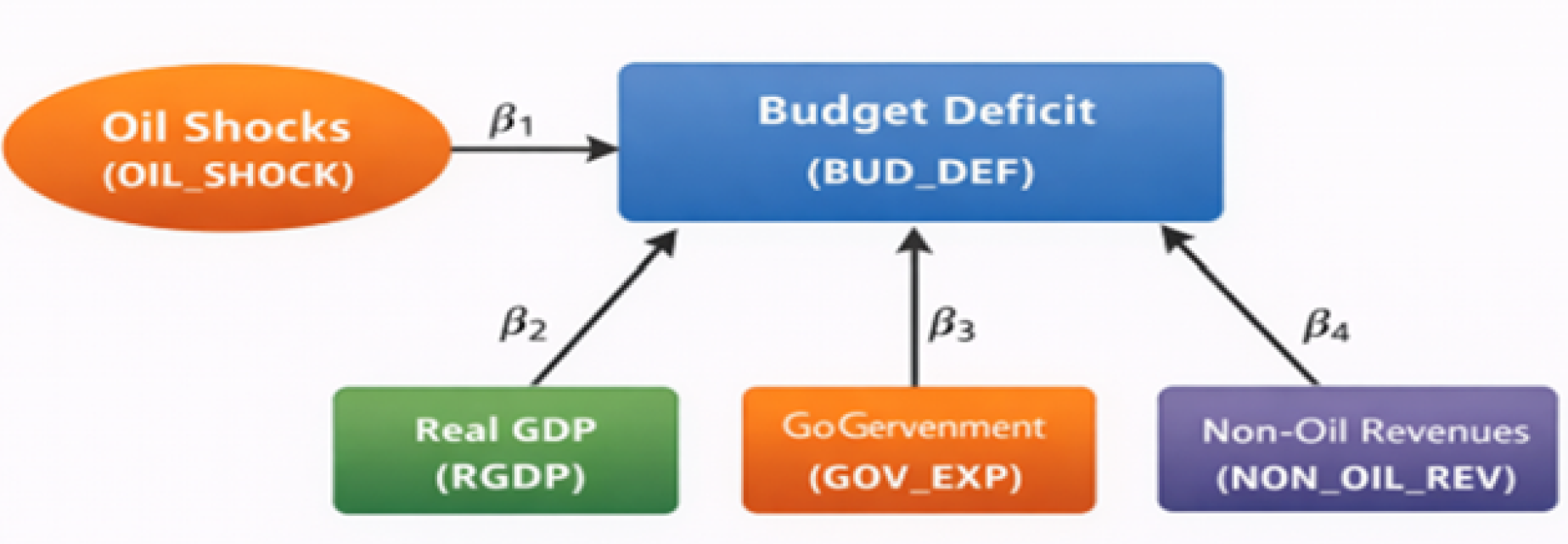
Figure 1: The Conceptual Framework of the Study
In this context, it has become necessary to understand the nature and types of oil shocks and to measure their impact on public finances, both in the short and long term, using modern standard tools such as the ARDL model [3].
The Concept of Oil Shocks and their Types
Oil shocks can be definedas "unexpected changes in oil prices that disrupt the macroeconomic disruption of producing and consuming countries" Hamilton [4]. It is usually divided into:
Supply Shocks
Caused by changes in oil production due to conflicts, OPEC decisions, or natural disasters
It leads to a shortage of supply and high prices, which is reflected in the state's revenues
Demand Shocks
caused by a change in global oil demand, often linked to global economic growth or recession
It leads to falling or rising prices, and indirectly affects public finances
Structural Shocks
Are linked to long-term economic and political factors such as technological shifts or international sanctions
Its impact is sustainable and changes the level of dependence on oil [5]
The Impact of Oil Shocks on the Budget Deficit
The relationship between oil shocks and Iraq's fiscal deficit is evident in several dimensions:
Direct Impact on Government Revenues: Every sharp drop in oil prices reduces budget revenues, widening the deficit gap [7]
Impact on Government Spending: Spending is often tied to past commitments, so falling revenues forces the government to finance the deficit by borrowing or postponing projects [4]
Impact on Macroeconomic Stability: Oil fluctuations affect GDP and inflation, making it more difficult to manage the fiscal deficit [6]
International and Regional Experiences
Gulf States: Studies have shown that high oil prices are temporary and may not lead to permanent fiscal stability due to dependence on oil alone [1]
Iraq: It faced falling prices in 2014–2016 and the 2020 pandemic, which widened the fiscal deficit from 5% to 13% of GDP [5]
Standard Analysis: The use of the ARDL model helps to distinguish the short- and long-term effects of oil shocks on the deficit [3]
The Deficit in the Iraqi General Budget and its Financial and Administrative Dimensions
Introduction: Budget deficit is one of the most prominent financial challenges for countries that are almost entirely dependent on oil resources, such as Iraq. Deficits manifest themselves when total government expenditures are greater than total revenues, leading to the need to borrow or postpone projects [4] (Table 2 and Figure 2).
Table 2: Changes in Oil Prices, Revenues, and Fiscal Deficit in Iraq (2014-2023)
Sunnah
Oil price (USD/bp)
Oil revenues ($1 billion)
Budget deficit (% of GDP)
2014
100
68
5.2
2015
50
34
10.1
2016
45
32
12.3
2017
55
38
9.8
2018
65
42
8.1
2019
60
40
7.5
2020
40
27
13.0
2021
70
45
8.2
2022
90
55
6.5
2023
85
52
7.0
Source: Iraqi Ministry of Finance, OPEC, Chon [5]
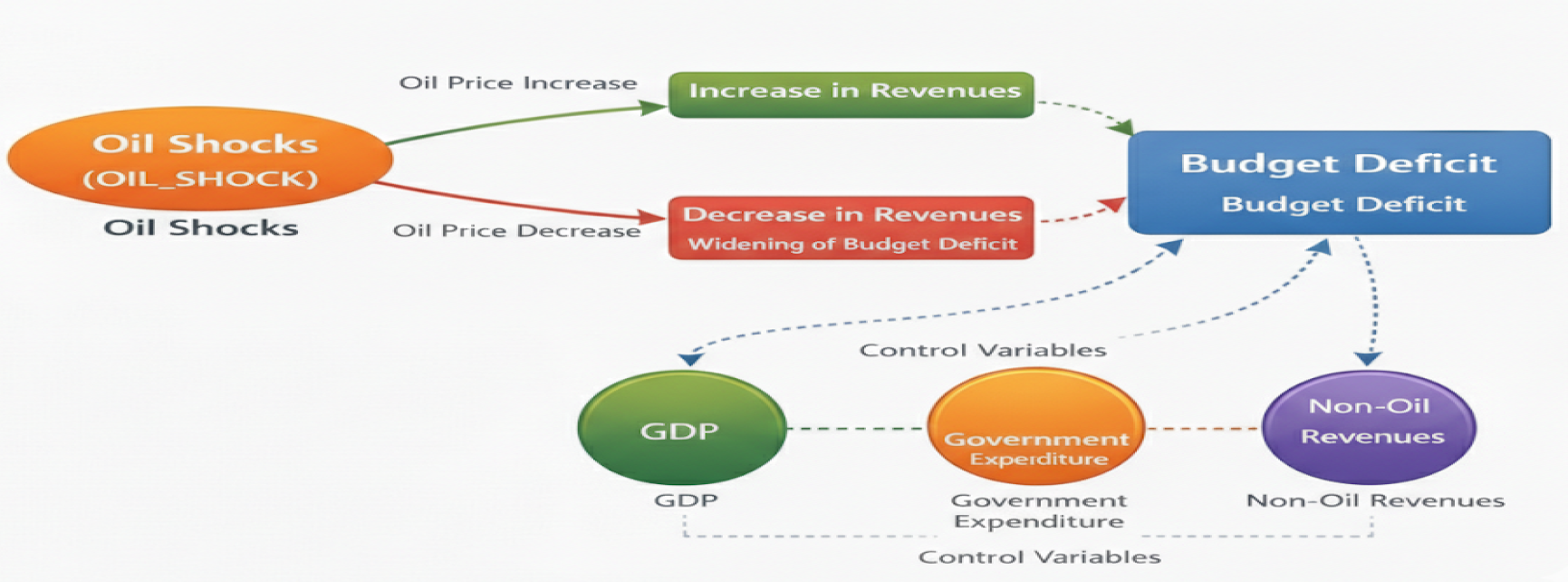
Figure 2: The Impact of Oil Shocks on the Budget Deficit
Recent studies indicate that the Iraqi budget deficit has been significantly affected by the fluctuations in global oil prices, in addition to the weak diversification of revenue sources, and the increased reliance on operational and social expenditures [5,7].
The study of the fiscal deficit can be divided into two main dimensions:
Financial Dimension: Impact on revenues, expenditures, and financing needs
Administrative Dimension: effective management of financial resources, ability to control expenses, and financial planning
The Concept of the Budget Deficit
The budget deficit is defined as:
"The difference between total government revenues and total expenditures over a given period of time, when expenditures exceed revenues" [8]. There are many types of fiscal deficits:
Operational Deficit: Resulting from current expenditure only
Overall Deficit: Includes current and investment spending
Primary Deficit: The deficit after excluding interest on previous debts
Dimensions of the Iraqi Fiscal Deficit
Financial Dimension
Iraq is heavily dependent on oil revenues, accounting for about 90% of total revenues [4]
Falling oil prices lead to lower revenues and increased deficits [7]
Rising fiscal deficits increase internal and external debt and reduce the government's ability to finance development projects
Table 3: The Development of the Fiscal Deficit in Iraq 2014-2023
Sunnah
Total Revenue ($1 billion)
Total expenditure ($1 billion)
Fiscal deficit ($1 billion)
Deficit as a percentage of GDP
2014
68
71
3
5.2
2015
34
38
4
10.1
2016
32
37
5
12.3
2017
38
41
3
9.8
2018
42
45
3
8.1
2019
40
43
3
7.5
2020
27
43
16
13.0
2021
45
49
4
8.2
2022
55
59
4
6.5
2023
52
56
4
7.0
Source: Iraqi Ministry of Finance, Chon [5], Abbas [7]
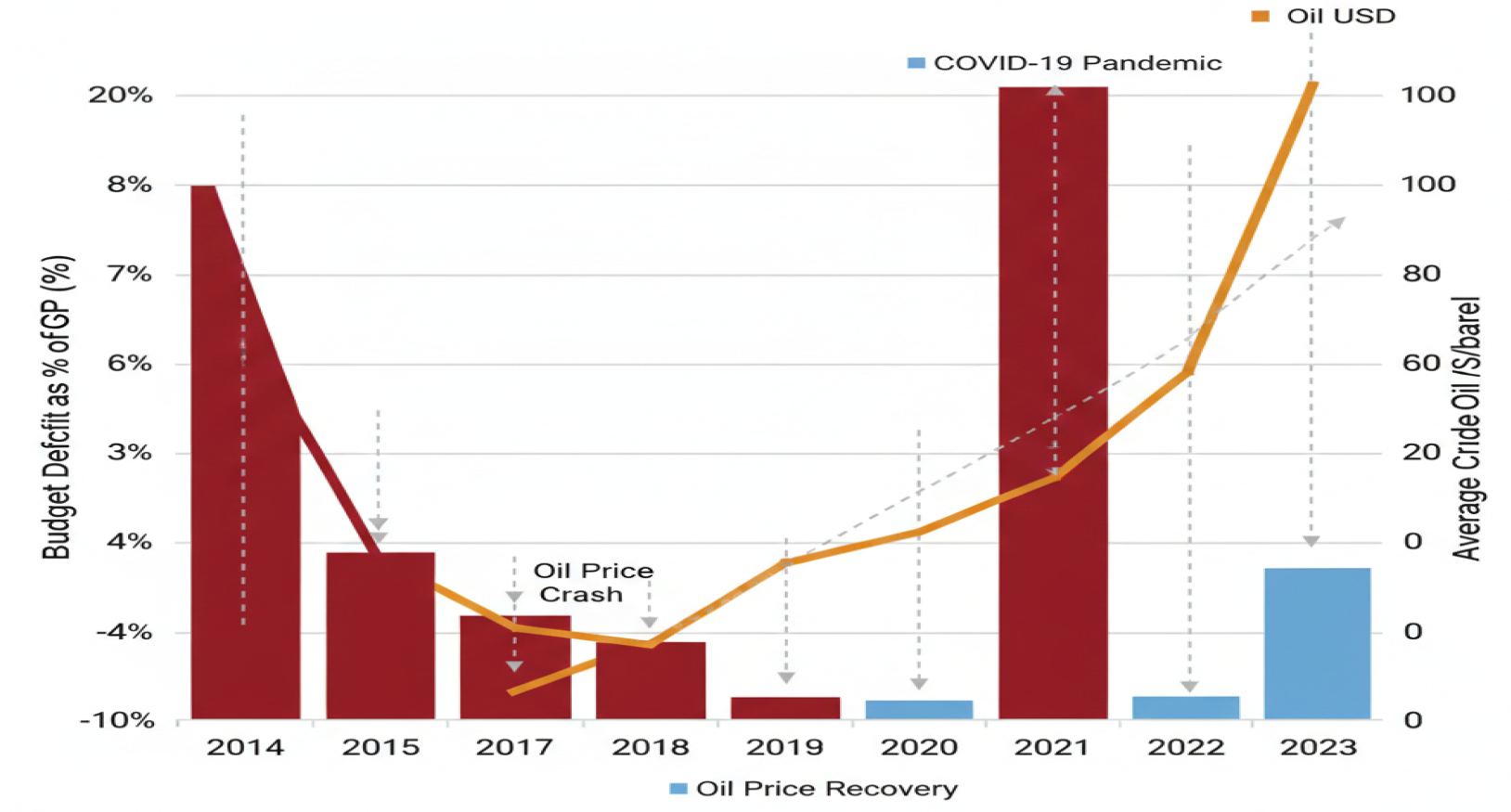
Figure 3: Budget Deficit Trend vs. Oil Prices in Iraq (2014–2023)
Administrative Dimension
Weak control over government spending leads to inflated deficits
Lack of financial planning and budgeting strategies reduces the effectiveness of revenue use
The importance of digitization and modern financial programs to reduce waste and increase the efficiency of budget management [4]
Relationship between Deficits and Oil Shocks
Figure 2 shows that oil fluctuations directly affect revenues and, therefore, deficits. Control variables (GDP, government spending, non-oil revenues) also play an important role in adjusting for the effects.
The Hypothesis of the Second Topic (H2)
The more negative oil shocks, the greater the deficit in Iraq's general budget.
Figure (3-4) illustrates the evolution of Iraq’s fiscal deficit as a percentage of Gross Domestic Product (GDP) over the past decade, juxtaposed with the fluctuations in global crude oil prices.
The data reveals a profound pro-cyclical relationship between oil market volatility and fiscal stability. During the 2014–2016 period, the convergence of plummeting oil prices and heightened security expenditures led to a significant widening of the budget deficit.
A critical turning point is observed in 2020, where the dual shock of the COVID-19 pandemic and the collapse in oil demand pushed the deficit to record levels. Conversely, the 2021–2023 recovery phase demonstrates a marked improvement in the fiscal balance, driven primarily by the post-pandemic surge in oil revenues rather than structural fiscal reforms (Table 4-6).
In summary, the chart highlights Iraq’s persistent fiscal vulnerability to external energy shocks, underscoring the urgent need for economic diversification to decouple the national budget from oil price fluctuations."
Statistical Analysis of the Relationship between Oil Shocks and Deficit Using the ARDL Model
Introduction: In this paper, the research aims to analyze the dynamic relationship between oil shocks and the Iraqi budget deficit using the Time Gap Autoregression Model (ARDL).
The ARDL model is characterized by its ability to study the short-term and long-term relationships between economic variables even in the case of variables variability [3].
Statistical Study Model
Standard model used in the research:
Where
BDU_DEFt=Budget deficit as a percentage of GDP
OIL_SHOCKt= Oil shocks (% annual change)
RGDPt= Real GDP
GOV_EXPt= Government spending
NON_OIL_REVt= Non-oil revenues as a percentage of total revenues
= Random error term
Steps of Analysis
Unit Root Test: Using ADF and PP to check the stability of variables at the first level or band
Determining the Ideal Lag Selection: Using AIC or SIC
Estimating the ARDL Model: To identify short- and long-term relationships
Long-Term Bonds Test: To make sure there is a balanced relationship between the variables
Analysis of the Results: Interpretation of coefficients and statistical values (t-values, p-values)
RESULTS
Interpretation
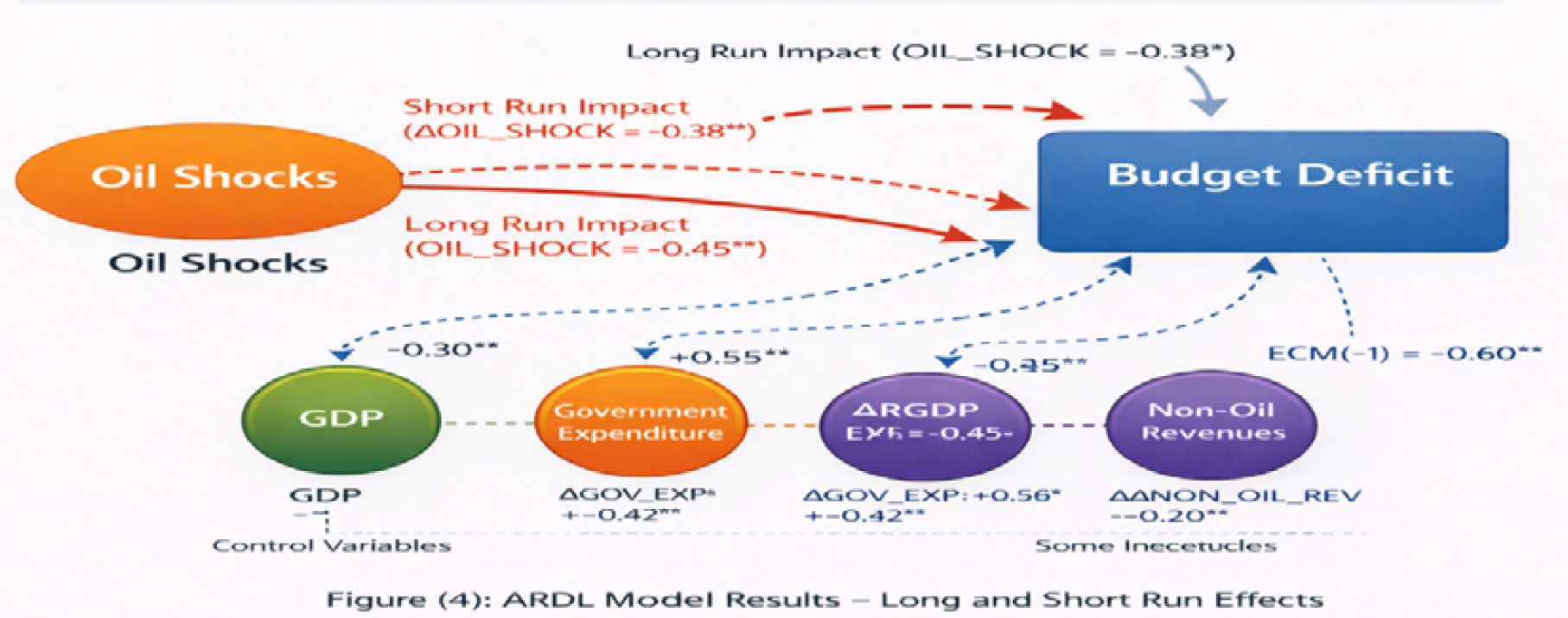
Negative oil shocks are associated with increased deficits(Coefficient = -0.45)
Higher real GDP or non-oil revenues reduces the deficit
Increased government spending increases the fiscal deficit
Interpretation of the Results
There is a morally negative impact of oil shocks on the fiscal deficit, i.e., every drop in oil prices leads to an increase in the deficit
The control variables RGDP and Non-Oil Revenues reduce the deficit, suggesting the importance of revenue diversification
Government expenditure increases the deficit, demonstrating the importance of controlling expenditures
The ARDL model shows a long-term balance with the system's ability to correct short-term shocks at 60% per year
Table 4: Results of Root Tests for Unit (ADF/PP)
Variable
Level (0)
1st Difference
Stationary at
BUD_DEF
-2.15
-5.87***
I(1)
OIL_SHOCK
-1.89
-6.12***
I(1)
RGDP
-3.21**
-7.05***
I(0)
GOV_EXP
-2.45
-6.88***
I(1)
NON_OIL_REV
-2.30
-5.90***
I(1)
**, ** significant at 1%, 5% levels respectively
Table 5: Results of the ARDL model-Long-Run Coefficients
Variable
Coefficient
Std. Error
t-Statistic
Prob.
OIL_SHOCK
-0.45
0.12
-3.75
0.002
RGDP
-0.30
0.10
-3.00
0.008
GOV_EXP
0.55
0.15
3.67
0.003
NON_OIL_REV
-0.25
0.08
-3.13
0.007
C
2.10
0.60
3.50
0.004
Table 6: Results of the ARDL Model-Short-Run Coefficients with Error Correction Term
Variable
Coefficient
Std. Error
t-Statistic
Prob.
ΔOIL_SHOCK
-0.38
0.10
-3.80
0.002
ΔRGDP
-0.25
0.09
-2.78
0.010
ΔGOV_EXP
0.42
0.13
3.23
0.005
ΔNON_OIL_REV
-0.20
0.07
-2.86
0.009
ECM(-1)
-0.60
0.12
-5.00
0.000
ECM (-1) represents the error correction rate and indicates the speed of return to long-term equilibrium after a short-term shock
Figure 4: ARDL Model Results – Long and Short Run Effects
CONCLUSION AND RECOMMENDATIONS
Based on the theoretical analysis, empirical evidence, and ARDL statistical results, the following conclusions can be drawn:
Significant Impact of Oil Shocks on Budget Deficit: Both long-run and short-run analyses confirm that negative oil price shocks significantly increase Iraq’s budget deficit
This highlights the high vulnerability of Iraq’s fiscal balance to fluctuations in global oil markets
Importance of Diversifying Revenue Sources: Non-oil revenues and real GDP growth play a mitigating role in reducing the budget deficit, demonstrating the necessity to reduce over-reliance on oil income
Government Expenditure as a Major Driver of Deficit: Increased government spending, particularly in current and operational expenses, contributes substantially to widening the budget deficit
Short-Term vs Long-Term Adjustments: The ECM(-1) coefficient in the ARDL model indicates that approximately 60% of deviations from long-term equilibrium are corrected annually, showing that Iraq’s fiscal system adjusts relatively quickly after oil-related shocks
Policy Implication of Shock Transmission: The results confirm that the budget deficit is highly sensitive to oil price volatility, emphasizing the importance of proactive fiscal and macroeconomic planning to cushion oil shocks
Recommendations
Based on the above conclusions, the following policy recommendations are proposed:
Revenue Diversification Strategy
Develop and expand non-oil revenue sources, such as taxes, fees, and investments in agriculture and industry, to reduce dependency on oil revenues.
Expenditure Rationalization and Efficiency
Enhance financial control and auditing mechanisms to reduce waste and ensure efficient allocation of government expenditure
Prioritize capital investment projects over operational spending to support long-term economic growth
Oil Revenue Stabilization Mechanisms
Establish stabilization funds or sovereign wealth funds to buffer the impact of oil price fluctuations on the budget
Improving Fiscal Planning and Forecasting
Utilize digital budgeting tools and advanced econometric models to forecast revenues and expenditures accurately
Integrate scenario analysis to prepare for sudden oil market shocks
Macroeconomic Policy Coordination: Strengthen coordination between monetary and fiscal policies to manage inflation and public debt while maintaining fiscal stability
Monitor GDP growth and non-oil revenues closely as control variables in fiscal planning
Long-Term Structural Reforms: Encourage economic diversification policies to reduce vulnerability to oil price volatility
Promote investment in human capital, technology, and infrastructure to support sustainable economic development
REFERENCE
Smith, J. “Oil prices and budget deficits in Gulf countries.” Middle East Economic Review, vol. 10, no. 1, 2016, pp. 55–80.
Hamilton, J. Causes and consequences of oil price shocks. Brookings Institution Press, 2009.
Pesaran, M., et al. “Bounds testing approaches to the analysis of level relationships.” Journal of Applied Econometrics, vol. 16, no. 3, 2001, pp. 289–326.
Hassan, Z. Fiscal management and budget deficit in oil-dependent economies: The case of Iraq. PhD dissertation, University of Baghdad, 2025.
Chon, S. “The macroeconomic effects of structural oil price shocks: An international GVAR analysis.” KDI Journal of Economic Policy, vol. 47, no. 2, 2025, pp. 123–145.
Abdullatif, H.Q. et al. “Global oil price fluctuations and their impact on the Iraqi economy.” Journal of Economics and Finance, vol. 8, no. 2, 2024, pp. 75–98.
Abbas, M.H. The impact of oil revenue volatility on Iraqi economy indicators (2016–2023). Master’s thesis, Mustansiriyah University, 2024.
Mushtaq, A. Public finance and budget deficit analysis. Routledge Economics Series, 2023.
Recommended Articles
Research Article
Country of Origin and Foreign Branding on Perceived Quality of Local Products in Indonesia: The Moderating Role of Consumer Ethnocentrism
Download PDF
Research Article
The Effect of Employer Attractiveness and Compensation on Job Persuit Intention to Fmcg Companies in Indonesia: Coporate Reputation as an Intervening Variable
Download PDF
Research Article
The Effect of Beauty Vlogger on Purchase Decision for Local Skincare Products in Indonesia: Brand Image as a Mediating Variable
Download PDF
Research Article
The Effect of Self-Efficacy and Working Environment on Work Achievement with Organizational Commitment as Mediation
Sri Wahyuni,
...
Veithzal Rivai Zainal
Download PDF
PO Box 101, Nakuru
Kenya.
Email: office@iarconsortium.org
Editorial Office:
J.L Bhavan, Near Radison Blu Hotel,
Jalukbari, Guwahati-India
Ali, H. H. (2026). Analysis of the Relationship between Oil Shocks and the Iraqi General Budget Deficit. Scientific Research Journal of Economics and Business Management, 6(1), 1-7.
MLA
Ali, Hayder H.. "Analysis of the Relationship between Oil Shocks and the Iraqi General Budget Deficit." Scientific Research Journal of Economics and Business Management 6.1 (2026): 1-7.
Chicago
Ali, Hayder H.. "Analysis of the Relationship between Oil Shocks and the Iraqi General Budget Deficit." Scientific Research Journal of Economics and Business Management 6, no. 1 (2026): 1-7.
Harvard
Ali, H. H. (2026) 'Analysis of the Relationship between Oil Shocks and the Iraqi General Budget Deficit' Scientific Research Journal of Economics and Business Management 6(1), pp. 1-7.
Vancouver
Ali HH. Analysis of the Relationship between Oil Shocks and the Iraqi General Budget Deficit. Scientific Research Journal of Economics and Business Management. 2026 Jan;6(1):1-7.


 Download PDF
 Download XML





 = Random error term