The study sought to examine the capacity of monetary policy to employ its instruments and the mechanisms by which they function in managing the growth rates of money supply and inflation in the Iraqi economy from 2004 to 2022. This was accomplished by the implementation of an analytical methodology. The research analyzed the correlation between the instruments utilized in monetary policy and the occurrence of inflation. It elucidated the connection between monetary policy and the money supply. The results indicated that the Central Bank of Iraq successfully diminished a substantial fraction of inflation and regulated the expansion rates of the money supply by employing monetary policy instruments, notwithstanding the economic and security obstacles confronting the nation.
Keywords
Monetary policy
Inflation
Money supply
Central Bank of Iraq
Economic growth
Policy instruments
Economic challenges
Iraq economy
Security issues
Inflation control
Money supply management
INTRODUCTION
Monetary policy is a crucial element of economic policy implemented by governments and central banks to control the money supply within an economy. It is employed to regulate the growth rates of the money supply and inflation, as well as to attain economic stability through the management of the money supply, interest rates, and the mitigation of inflation. This facilitates price stability, thereby invigorating economic activity by establishing advantageous financing circumstances. Furthermore, it governs interest rates to equilibrate savings and investments. The instruments of monetary policy, including interest rates, open market operations, and the reserve requirement ratio, are essential in promoting economic activity and regulating the money supply in the financial market.
The Central Bank of Iraq plays a crucial and pivotal role in executing monetary policy. The Central Bank establishes interest rates, intervenes in the market
to uphold currency stability and inflation rates, assesses the economic landscape, and implements measures to counteract adverse changes and challenges confronting the Iraqi economy, which adversely affect the economy and monetary system.
Iraq's dependence on oil income heightens economic volatility, requiring the implementation of a robust monetary policy that fosters economic stability, offers improved prospects for consumers and investors, mitigates inflation, and stimulates economic growth. This necessitates robust collaboration between the government and the Central Bank to attain specified economic goals.
Research Problem:
The study topic focuses on evaluating the degree to which Iraq's monetary policy, via its instruments, can manage the growth rates of money supply and mitigate inflation in a rentier economy characterized by significant financial resources yet constrained productive capacity in the real sector. This assessment is performed with regard to the tenets of economic theory.
Hypothesis:
The study is based on the hypothesis that monetary policy, following the issuance of the new Central Bank Law after 2003, has played a significant role in achieving monetary and economic stability despite the presence of numerous challenges.
Research Significance:
This research is significant due to the crucial role of monetary policy in influencing the goals and direction of the Iraqi economy, ensuring price stability, and tackling many economic challenges, including money supply and inflation, that persistently affect the economy.
Research Objective:
The study seeks to analyze the characteristics of monetary policy operations and evaluate the principal monetary instruments utilized by the monetary authority to fulfill its goals. This study aims to examine the significant changes in Iraq's monetary policy post-2003 and evaluate the degree of internal monetary stability (stability of the general price level) and external monetary stability (stability of the currency exchange rate) attained in the nation.
First Chapter
Section One: Monetary Policy in Iraq (2004–2022)
1. The State of Monetary Policy in Iraq Before 2003
Undoubtedly, the direct or qualitative tools of monetary policy were the most commonly used means to achieve the desired objectives prior to 2003. During this period, monetary policy in Iraq was heavily influenced by political authority, particularly regarding excessive monetary issuance by the Central Bank. This was due to the economic sanctions imposed on Iraq, making the Central Bank a "financial lever" used to cover any budget deficits unconditionally and excessively.
As a result, this practice led to a sharp increase in inflation rates, a rapid rise in the general price level, and significant growth in money supply. For instance, Iraq's budget deficit in 2002 reached 547,160 million Iraqi dinars. Additionally, the excessive monetary issuance to finance the budget deficit, often referred to as "cheap money," resulted in reduced economic growth rates in the real sectors and further exacerbated inflation rates [1]
Moreover, monetary policy was constrained by several factors over the course of five decades. Among these factors are the following [2]
1. Lack of Coordination Between Fiscal and Monetary Policies:
The weak or absent coordination between fiscal and monetary policies rendered monetary policy subordinate to fiscal policy. At the same time, it worked to mitigate the negative impacts on the Iraqi economy.
2. The Rentier Nature of the Iraqi Economy:
The Iraqi economy, being primarily rentier or single-sided—particularly reliant on oil revenues—resulted in the money supply being automatically tied to the state's fiscal position and its spending policies.
2. The State of Monetary Policy in Iraq After 2003:
The enactment of Central Bank Law No. 56, which superseded the previous Central Bank Law No. 64 of 1976, signified a pivotal moment among the economic and political transformations in Iraq post-2003. The Central Bank of Iraq (CBI) obtained complete authority, with the Board of Directors promulgating regulations and directives and instituting processes and guidelines for monetary policy to attain fundamental objectives.
Among the key objectives were:
- Enhancing the purchasing power of the Iraqi dinar, increasing its value, and maintaining its stability against foreign currencies, particularly the US dollar.
- Reducing inflation rates.
- Building and managing foreign reserves, as the Central Bank is responsible for issuing currency and maintaining its value both domestically and internationally (Al-Nasiri, 2015, p. 27).
3. Monetary Policy Tools in Iraq:
Monetary policy is a pivotal economic strategy designed to attain economic stability and stabilize exchange rates, so providing the national economy with the power and resilience to confront economic problems and fluctuations. Iraq's foreign currency reserves currently total roughly $57 to $61 billion. Securing and sustaining foreign reserves while stabilizing the exchange rate of the Iraqi dinar against foreign currencies, especially the US dollar, is very important.
The currency auctions held by the Central Bank have proven essential and positive in maintaining and stabilizing the exchange rate of the Iraqi dinar. However, these auctions have also had negative implications, particularly in the lack of control over foreign currency flows. This has led to a portion of the currency leaving the country officially but without effective oversight.
To address these challenges, the Central Bank of Iraq has implemented several measures to expand the available monetary policy tools. These measures also include covering the required reserves, granting short-term credit facilities, and managing government deposits. Such steps aim to enable commercial banks to manage their liquidity effectively and dynamically. The progress and achievements in monetary policy tools can be summarized as follows [3]
1. Development of the Legal Reserve Ratio During the Study Period:
The Central Bank of Iraq has established the legal reserve ratio at 25% of deposit balances, applicable to both US dollars and Iraqi dinars. Twenty percent of the deposits subject to the legal reserve must be retained by the bank with the Central Bank, while five percent is maintained as cash reserves in the bank's vaults.
A bank that does not sustain reserves in accordance with the authorized reserve ratio faces a penalty from the Central Bank of Iraq. The penalty is determined by the interest rate on loan plus 5% of the deficiency in the average reserve held relative to the mandated reserve. The Central Bank withdraws this penalty from the bank's current account at any point during the month subsequent to the reserve maintenance period.
If a bank incurs penalties for reserve shortfalls for two consecutive months, the Central Bank intervenes with regulatory measures to address liquidity issues in a timely and gradual manner [4]. Table (1) illustrates the legal reserve ratio in Iraq during the period (2004–2022) as follows:
Table (1)
Growth Rate of Legal Reserves in Iraq for the Period (2004–2022) (in Million Dinars)
Year
Legal Reserve
Annual Growth Rate (%)
2004
1604537
-
2005
2965526
84.8
2006
4078106
37.56
2007
12084441
196.3
2008
19993802
65.45
2009
9416761
-52.9
2010
7155093
-24
2011
7814853
9.22
2012
8624023
10.35
2013
9626882
11.62
2014
10576103
9.86
2015
9390493
-11.2
2016
8707551
-7.27
2017
6505171
-25.3
2018
10409660
60.02
2019
9580388
-7.96
2020
9193395
-4.03
2021
11014941
19.8
2022
12803677
16.3
Source: Prepared by the researcher based on the annual reports of the Central Bank of Iraq (2004–2022).
Table (1) clearly indicates that the permissible reserve ratio fluctuated between 2004 and 2022. In 2004, the legal reserve totaled 1,604,537 million Iraqi dinars. Consequently, the Central Bank of Iraq increased the legal reserve ratio for all commercial banks as a component of an expansionary policy aimed at augmenting reserves at the Central Bank. This resulted in a rise in the Central Bank's reserves to 2,965,526 million dinars, reflecting an annual growth rate of 84.88% in 2005. The reserves expanded to 12,084,441 million dinars, with a growth rate of 196.32% in 2007, marking the peak growth rate of obligatory reserves maintained by the Central Bank of Iraq throughout the research period.
The reserves fluctuated between 2008 and 2015, with growth rates of 65.45%, 52.90%, 24.01%, 9.22%, 10.35%, 11.62%, 9.86%, and 11.21%, respectively. These fluctuations were due to the monetary policies in place, where reserves decreased during expansionary policies and increased during contractionary policies aimed at controlling inflation and enhancing monetary and economic stability in Iraq.
From 2016 to 2020, the growth rates were negative, except for 2018, due to improvements in security conditions, which contributed to a resurgence in public investment in banks through deposits. In 2021, the legal reserve increased to 11,014,941 million dinars, with a positive annual growth rate of 19.8%. In 2022, the legal reserve reached 12,803,677 million dinars, with an annual growth rate of 16.3%.
2. Development of Open Market Operations
Open market operations are one of the most important quantitative, indirect tools used by the Central Bank to achieve its objectives. Among the most prominent open market operations are:
- Foreign Currency Window in Iraq
The Central Bank of Iraq use the foreign currency window as a monetary policy instrument for the exchange of foreign currencies. This is regarded as one of the quantitative instruments employed to regulate money supply and inflation, as well as to stable the local currency's exchange rate against foreign currencies. This instrument seeks to attain price stability and mitigate inflation.
The foreign currency window was established in 2003 and has remained operational continuously since that time. The Central Bank of Iraq has openly employed this method to equilibrate foreign money with the domestic currency and maintain monetary stability [5]
Table(2) Purchases and Sales of Foreign Currency (US Dollar) by the Central Bank of Iraq for the Period (2004–2022)
Year
Purchases of Foreign Currency from Ministry of Finance (Million USD)
Annual Growth Rate of Purchases (%)
Sales of Foreign Currency (Million USD)
Annual Growth Rate of Sales (%)
2004
10800
ــــــــ
ــــــــــــ
ــــــــــــ
2005
10600
1.8-
ــــــــــــ
ــــــــــــ
2006
18000
69.8
2719
ــــــــــــ
2007
26700
48.3
12982
377.4
2008
45500
70.4
20301
56.3
2009
27000
40.6-
29421
44.9
2010
41000
51.8
33977
15.4
2011
51000
24.3
35432
4.3
2012
57000
11.7
44985
26.9
2013
62000
8.7
41005
8.8-
2014
47515
-23.3
37165
9.3-
2015
32450
31.7-
38315
3
2016
25653
-20.9
15710
58.9-
2017
40355
57.3
31374
99.7
2018
52229
29.4
38345
22.2
2019
58851
12.6
45315
18.2
2020
30730
47.7-
40711
11.4-
2021
38628
25.7
29180
28.3-
2022
53355
38.1
37726
29.2
Source: Central Bank of Iraq, Directorate General of Statistics and Research, Annual Report for the Period (2004–2022).
Extracting the growth rate from the researcher's work.
It can be observed from the table above that the Central Bank's purchases in 2004 amounted to 10,800 million USD, and in 2005, they were 10,600 million USD, with a difference of 200 million USD. The Central Bank's purchases and sales increased in the years 2006, 2007, and 2008, with purchases reaching 45,500 million USD and an annual growth rate of 70.4% in 2008. This was due to excessive public spending following a large increase in oil revenues, which prompted the government to increase public expenditure. This led to an increase in the money supply, which in turn raised purchasing power and caused inflation. The Central Bank’s sales also rose in 2008, reaching 20,301 million USD with a growth rate of 56.1%, as the continued sale of foreign currency helped stabilize the exchange rate and improve the value of the local currency. This was due to improved security stability in the country, which helped reduce inflationary pressures. However, in 2009, the Central Bank's purchases dropped to 27,000 million USD, reflecting a growth rate of -40.6%, as a result of the global financial crisis and a decrease in oil revenues. Meanwhile, the Central Bank’s sales increased to 29,421 million USD, with a growth rate of 44.1%, Due to the Central Bank's continued sale of dollars to maintain the financial system and achieve monetary stability, the Central Bank's sales increased during the years 2010-2013 to finance the private sector in obtaining the imports needed by the market, especially imported goods, in order to maintain the stability of goods and services. However, the Central Bank's purchases and sales decreased during the years 2014, 2015, and 2016, with purchases amounting to 47,515 million USD in 2014. This decline was attributed to the deteriorating security situation in the country, following the emergence of terrorist groups. Sales also decreased in 2014, reaching 37,165 million USD, due to the Central Bank issuing new instructions for the sale and purchase of foreign currency. These instructions tightened the Bank's policy by imposing new restrictions on banks in response to concerns about money laundering and illegal foreign currency outflows linked to increased demand for foreign currency.
In 2016, the Central Bank adopted procedures to develop the foreign currency sale process through its window by encouraging banks to use letters of credit for financing foreign trade, instead of relying on money transfer methods.
The Central Bank's purchases increased during the years 2017, 2018, and 2019, respectively. However, there was a slight difference between the sales and purchases in 2017 and 2018, as the bank aimed to maintain monetary stability and reduce the gap between the official exchange rate and the Iraqi dinar in the parallel market. The sales reached 45,315 million USD in 2019. Purchases declined in 2020 to 30,700 million USD, while sales amounted to 40,711 million USD. In 2021 and 2022, the Central Bank's purchases of dollars rose to 38,628 million USD in 2021 and 53,355 million USD in 2022. The sales for these years were 29,180 million USD in 2021 and 37,726 million USD in 2022.
3. The Development of the Discount Rate Over the Study Period:
The discount rate is a longstanding instrument employed by the central bank to affect the volume of credit that commercial banks provide to the money market. It denotes the interest rate at which the central bank discounts securities that commercial banks use to acquire cash reserves for financing their lending operations to people and institutions. The discount rate plays an important role in banking activities. If the credit volume exceeds the required or permissible amount in the money market, inflationary pressures may begin to emerge, prompting the central bank to raise the discount rate. This leads to an increase in the cost for commercial banks to obtain cash reserves, which consequently raises the interest rate on loans provided by commercial banks to their customers. As a result, the demand for credit decreases, which in turn reduces overall spending. This helps alleviate inflationary pressure, while the opposite occurs in times of recession [6]
It is evident from Table (3) that the discount rate in Iraq during the period (2004-2022) followed specific trends. The discount rate in 2004 was 3.95%, and in 2005 it increased to 7%. A significant change occurred after the central bank gained independence, as the discount rate was adjusted to 16% in 2006. The monetary policy continued to raise the discount rate to 20% in 2007.
Table (3)
Discount Rate in Iraq for the Period (2004-2022)
Years
Discount Rate (%)
Years
Discount Rate (%)
2004
3.95
2014
6
2005
7
2015
6
2006
16
2016
4.33
2007
20
2017
4
2008
16.75
2018
4
2009
8.83
2019
4
2010
6.25
2020
4
2011
6
2021
4
2012
6
2022
4
2013
6
Source: Central Bank of Iraq, Annual Statistical Bulletin, Directorate General of Statistics and Research for the period (2004-2022).
It is natural that the Central Bank followed a contractionary monetary policy to reduce inflation rates and control them. On the other hand, commercial banks raised the discount rate (i.e., the interest rate) on the securities and commercial papers presented by individuals to projects and financial institutions. This therefore resulted in a substantial reduction of funds flowing in the monetary market. The Central Bank then lowered the discount rate to 16.75% in 2008. In this setting, the Central Bank implemented an expansionary monetary policy subsequent to effectively lowering inflation rates. The monetary authority consistently reduced the discount rate, achieving 8.83% in 2009 and subsequently 6.25% in 2010. It maintained a stability of 6% from 2011 to 2015, followed by a slow decline in the next years, culminating at 4.33% in 2016, and thereafter stabilizing at 4% from 2017 to 2022.
4- Trends in Interest Rates During the Study Period:
Since 2004, the Iraqi economy has undergone transformations subsequent to the enactment of Central Bank Law No. (56) of 2004, which aimed to promote economic liberalization to attract foreign investment and facilitate integration into the global economy. Consequently, the Central Bank was compelled to implement requisite steps to align with the developments and transformations in the world economy. One of these approaches was establishing the Central Bank's interest rate as a positive function of inflation and the output gap, so correlating the interest rate with the condition of the Iraqi economy. The Central Bank of Iraq would increase the interest rate if inflation in the Iraqi economy above the goal rate, and conversely, would decrease it if inflation fell below the target [7]
Table (4)
Interest Rates in Iraq for the Period (2004-2022)
Years
Interest Rate (Policy Rate) %
Years
Interest Rate (Policy Rate) %
2004
6.0
2014
6.0
2005
6.3
2015
6.0
2006
10.3
2016
4.3
2007
20.0
2017
4.0
2008
16.7
2018
4.0
2009
8.5
2019
4.0
2010
6.2
2020
4.0
2011
6.0
2021
4.0
2012
6.0
2022
4.0
2013
6.0
Average
7.28
Source: Central Bank of Iraq, General Directorate of Statistics and Research, Statistical Bulletins for Various Years for the Period (2004-2022).
Table (4) depicts the evolution of interest rates established by the Central Bank of Iraq during the research period. In 2004, the interest rate was 6.0%, which rose to 6.3% in 2005. It persisted in ascending till it attained its peak at 20.0% in 2007 throughout the research period. The rise resulted from the austerity policies implemented by the Central Bank to address inflation in 2006 and 2007. Subsequently, the Central Bank of Iraq reduced the interest rate to 6.0% from 2011 to 2015 to stimulate local and foreign investment and foster an appealing investment climate. Consequently, the Central Bank further decreased the interest rate to 4.0% throughout the subsequent term (2017-2022). The objective of this decrease was to enable banks to have a more significant role in fostering economic growth while simultaneously promoting the private sector through loan availability. It is clear that Iraq's monetary policy, by lowering interest rates, has fostered a favorable indication for the investment climate in the Iraqi economy.
5- Development of Exchange Rate Trends during the Study Period:
The exchange rate index is one of the important tools in monetary policy and is a key economic indicator that investors, particularly foreign investors, rely on when directing their investments. The more stable the exchange rate, the more it reassures and encourages investors to invest. When the value of the local currency declines, it leads to lower prices for goods exported by the country in the international market. This, in turn, results in unexpected losses for the investor who had not anticipated such changes while engaging in investment activities in the host country. [8]
Table (5)
Official Exchange Rate in Iraq for the period (2004-2022)
Years
Official Exchange Rate (IQD/USD)
Years
Official Exchange Rate (IQD/USD)
2004
1454
2014
1218
2005
1473
2015
1251
2006
1477
2016
1281
2007
1266
2017
1256
2008
1206
2018
1211
2009
1183
2019
1202
2010
1187
2020
1240
2011
1199
2021
1471
2012
1234
2022
1482
2013
1233
Average
1290
Source: Central Bank of Iraq, Directorate General of Statistics and Research, Statistical Bulletins for Various Years (2004-2022).
An analysis of Table (5) indicates that the Central Bank, by its monetary policies, has elevated the value of the Iraqi dinar relative to the US dollar from 2004 to 2022. In 2004, the currency rate was 1454 dinars per dollar, which somewhat rose to 1473 dinars in 2005. From 2007 until 2020, the exchange rate exhibited minor fluctuations, oscillating between 1266 and 1240 dinars. Nonetheless, the exchange rate escalated in 2021 to 1471 dinars, and in 2022, it further ascended to 1482 dinars. Consequently, the monetary policy during the research period has attained a degree of stability in the exchange rate, with the Iraqi dinar's value restoring confidence. This stability fosters investment in Iraq, favorably impacting the establishment of a conducive investment climate.
Chapter Two: Developments in Money Supply and Inflation Rates in Iraq during the Period (2004 – 2022)
First: The Reality of Money Supply in Iraq:
The monetary activity in Iraq witnessed many changes after 2003, with the most significant of these changes being the issuance of the Central Bank of Iraq's independence law No. 56 of 2004. The goal of this law was to ensure that the Central Bank performs its monetary duties away from government interventions, in order to transition towards a free-market economy. The Central Bank adopted a contractionary monetary policy to reduce inflation rates, which was accompanied by economic stagnation and a decrease in investment levels. The aim of this policy was to achieve a balance between money supply growth and the productive capacity of the economy, so that monetary flows would align with real economic flows [9]
As shown in Table (6), which illustrates the development of the broad money supply components in the Iraqi economy, the broad money supply in 2004 was (12,254) billion dinars. It increased in 2005 to (14,684) billion dinars, with an annual growth rate of (19.8%), due to the increase in currency outside banks as well as the rise in deposits included in the broad money supply. The broad money supply continued to rise until 2008, reaching (19,349) billion dinars with an annual growth rate of (29.5%).
Table (6)
Development of Broad Money Supply (M2) in Iraq for the period (2004-2022) (Billion Dinars)
Years
Broad Money Supply (M2) Development
Annual Growth Rate (%)
2004
12254
ـــــــــــــ
2005
14684
19.8
2006
21080
43.6
2007
26956
27.8
2008
34919
29.5
2009
45437
15.8
2010
60386
32.8
2011
72178
19.5
2012
77187
14.2
2013
89512
16.4
2014
92988
3.2
2015
84527
-9.2
2016
90466
6.6
2017
92857
1.5
2018
95390
6.7
2019
103441
8.4
2020
119906
15.9
2021
139886
16.6
2022
168291
20.2
The source: Central Bank of Iraq, General Directorate of Statistics and Research, Annual Bulletin for the period (2004 - 2022).
Extracting the growth rate from the researcher's work.
This is due to the reforms implemented by the Central Bank regarding monetary policy in general, particularly in terms of money supply, by directly ensuring monetary stability through managing money supply and credit policies for the banking sector in the Iraqi economy. Furthermore, the stabilization of the security situation, which the monetary policy seeks to achieve, has contributed to the realization of its objectives, including achieving stability in the general price level and controlling inflation. The broad money supply (M2) increased in 2009, reaching 457,437 billion dinars, with an annual growth rate of 15.8%.
The broad money supply continued to rise in 2014, reaching 92,988 billion dinars with an annual growth rate of 3.2%. This increase is attributed to the continuous rise in currency outside the banks and the deposits that contribute to the formation of broad money supply, as well as the decrease in interest rates on deposits, which encourages individuals to increase their savings. This is part of the Central Bank of Iraq’s efforts to promote economic growth by providing appropriate credit to private sector activities.
In 2015, the broad money supply decreased, reaching 84,527 billion dinars with an annual growth rate of -9.2%. This decline was due to the challenges faced by monetary policy, primarily the drop in oil prices in global markets and the instability in the security situation due to military operations against terrorist groups. This led individuals to hold onto cash for liquidity purposes amid economic stagnation.
The broad money supply increased again in 2016, reaching 90,466 billion dinars with an annual growth rate of 6.6%. This was due to the increase in currency outside the banks, as the public held onto savings in response to economic stagnation. The broad money supply continued to rise through 2019, reaching 103,441 billion dinars with an annual growth rate of 8.4%. It continued to increase into 2022, reaching 168,291 billion dinars with an annual growth rate of 20.2%. This increase was primarily driven by the rise in currency outside the banks, due to government grants to unemployed individuals and an increase in current deposits.
Second: Developments in Inflation Rates in Iraq during the Study Period (2004–2022):
Inflation is a monetary phenomenon characterized by a substantial and persistent rise in the overall price level, affecting both established and emerging countries. Iraq is considered a developing country with a low or weak domestic production capacity, which means that the economy is unable to meet local demand with locally produced goods and services. As a result, demand exceeds supply, leading to repeated inflationary waves. In response, various economic policies, including monetary, fiscal, and trade policies, aim to mitigate the risks of this phenomenon, which has significant social and economic consequences. This section will focus on the inflation rates and the consumer price indices in Iraq. [1]
Table (7)
Evolution of the Inflation Rate in the Iraqi Economy for the Period (2004-2022)
Years
Inflation Rate (%)
Years
Inflation Rate (%)
2004
26.8
2014
-0.8
2005
36.9
2015
2.4
2006
53.1
2016
0.1
2007
31.0
2017
0.2
2008
12.6
2018
0.4
2009
8.5
2019
0.2-
2010
2.4
2020
0.6
2011
5.6
2021
1.0
2012
6.0
2022
50.
2013
2.4
Average
10.2
Source: Central Bank of Iraq, Directorate General of Statistics and Research, Statistical Bulletins for Various Years, for the period (2004-2022).
The data indicates that the inflation rate in 2004 was 26.8%, escalating to a peak of 53.1% in 2006, a notably high figure. Subsequently, the inflation rate declined to 31.0%, 12.6%, and 8.5% in 2007, 2008, and 2009, respectively, signifying the conclusion of the initial phase of elevated inflation during the research period. The rise in inflation from 2004 to 2009 is ascribed to aggregate demand pressures, which intensified inflationary risks due to heightened overall expenditure, particularly consumer spending, while most productive sectors in the economy were unable to satisfy this escalating demand. In 2010 and 2015, the inflation rate was 2.4%, attributable to the effects of the global financial crisis on the worldwide economy. Inflation continued to decrease, reaching 0.1% in 2016, due to the economic recession in Iraq. The rate was 0.2% in 2017, 0.4% in 2018, and decreased further to -0.2% in 2019. It then increased to 0.6% in 2020, and rose further in the remaining two years of the study, reaching 1.0% in 2021, and then 5.0% in 2022. This increase is attributed to the austerity policy adopted by monetary and fiscal policies, as well as the rise in aggregate demand, compounded by the recession in the Iraqi economy due to the decline in global oil prices.
Chapter Three: Analysis of the Relationship Between Monetary Policy and Its Impact on Money Supply and Inflation Rates in Iraq (2004–2022)
First: Analyzing the Relationship Between Monetary Policy and Money Supply in Iraq
1. The Relationship Between Legal Reserves and Money Supply in Iraq:
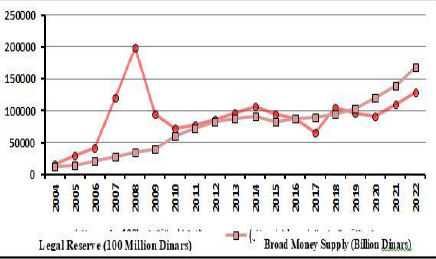
As shown in Figure (1), the relationship between legal reserves and money supply in Iraq fluctuated throughout the study period. Although the time trend for both variables generally showed an increase in most years, suggesting a positive relationship overall, it was inverse in certain years. Specifically, during the period from 2004 to 2008, the relationship was positive, with monetary authorities raising the legal reserve ratio and interest rates to high levels in 2007 and 2008 to address expected inflationary pressures, while the broad money supply increased at a decreasing rate. However, in 2009 and 2010, the relationship became inverse after the monetary authorities reduced the legal reserve ratio. Between 2011 and 2015, the relationship turned positive again, with their time paths aligning. During the period from 2016 to 2020, the relationship became generally inverse, with a positive deviation in 2018. Despite substantial fluctuations in the legal reserve values, both increasing and decreasing, the broad money supply grew at decreasing rates in 2016, 2017, and 2018. In 2019 and 2020, the money supply continuously increased at accelerating rates, while legal reserves continuously decreased at decreasing rates. In 2021 and 2022, the money supply continued to increase as before, while the trajectory of legal reserves reversed, showing continuous growth at an accelerating pace, making the relationship between the two variables positive during these two years.
Figure (1): The Relationship between Legal Reserve and Broad Money Supply for the Period (2004-2022)
Source: The researcher's work based on the data from Tables (1) and (6).
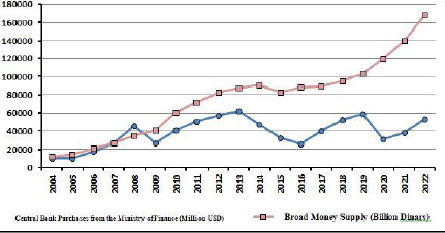
2- The relationship between the Central Bank of Iraq's purchases of dollars and money supply:
Source: Prepared by the researcher based on the data from Tables (2) and (6).
It is notable that the relationship was negative in 2009 due to the global mortgage crisis, as well as in 2014 and 2016 due to the events of June 9, 2014, and their aftermath. Additionally, it was negative in 2020 due to the repercussions of the COVID-19 pandemic. This indicates that the increase in the Central Bank's purchases of dollars from the Iraqi Ministry of Finance led to a continuous increase in the broad money supply.
3- The relationship between the Central Bank's dollar sales and money supply in Iraq:
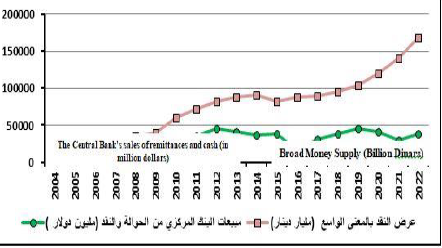
From Figure (3), it is evident that the relationship between the Central Bank's sales of remittances and cash and the money supply in Iraq was variable throughout the study period. To better understand this, the period was divided into two halves. The relationship during the first half of the study, which includes the years (2004-2012), was fully positive, with the note that the Central Bank's sales of remittances and cash began in 2006.
In the second half of the study period, covering the years (2013-2022), the relationship was varied. It was inverse during the period (2013-2016) due to the repercussions of the events of June 9, 2014. However, it became positive during the period (2017-2019) after relative stability in security and political conditions. In the years 2020 and 2021, the relationship reverted to a negative one due to the repercussions of the COVID-19 pandemic, but once the pandemic subsided, the relationship returned to a positive one.
4- The Relationship Between the Discount Rate and Money Supply in Iraq:
From Figure (4), it is observed that the relationship between the discount rate and the money supply in Iraq was varied throughout the study period and is somewhat unclear in its general form. During the period (2004-2007), the relationship was positive. However, from (2008-2010), it became inverse. It was highly fluctuating during the period (2011-2016), alternating between positive and inverse year after year. In the period (2017-2022), no notable relationship was observed, as the discount rate remained constant at 2.5%.
Figure (4): The Relationship Between the Discount Rate and Broad Money Supply for the Period (2004-2022)
Source: Compiled by the researcher based on the data from Tables (3) and (6).
It can be concluded that the relationship between the discount rate and the broad money supply in Iraq was not clear due to the monetary authorities initially raising the discount rate to high levels, followed by a gradual reduction and eventual stabilization in the final third of the study period. It is worth noting that the stabilization of the discount rate during this period helped to drive the increase in the broad money supply at an accelerating pace, particularly in the last quarter of the study period.
5- The Relationship Between Interest Rates and Money Supply in Iraq:
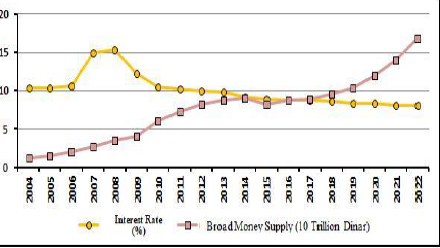
As shown in Figure (5), the relationship between interest rates and the money supply in Iraq was generally inverse. Despite the continuous increase in broad money supply throughout the study period, interest rates steadily declined since 2008. However, the relationship between the two variables during the period from 2004 to 2008 was direct. It is worth noting that the Central Bank of Iraq, under exceptional circumstances, raised interest rates during this period in a series of steps to control anticipated inflationary pressures. Additionally, the relationship was direct in 2015 due to the repercussions of the June 9th, 2014 events.
Thus, we can conclude that the relationship between interest rates and the broad money supply in Iraq over the study period was generally inverse. Notably, the reduction of interest rates to lower levels in the last third of the study period contributed to an increasing rate of growth in the broad money supply.
Figure (5): Relationship between the Interest Rate and Broad Money Supply (2004-2022)
Source: Prepared by the researcher based on the data from Tables (4) and (6).
6- The Relationship Between the Exchange Rate and Money Supply in Iraq:
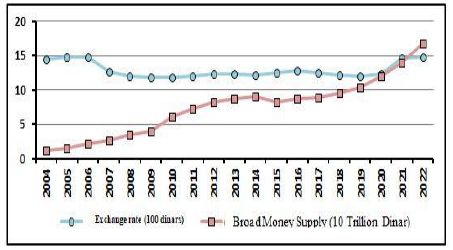
As shown in Figure (6), the relationship between the exchange rate and the broad money supply in Iraq was inconsistent throughout the study period, and it appears to be unclear in its general pattern. Specifically, the relationship was positive during the period (2004-2006), reversed to negative during (2007-2009), became positive again from (2010-2012), and turned negative from (2013-2019), with a noticeable positive trend in 2016.
Figure (6): The Relationship Between the Exchange Rate and Broad Money Supply for the Period (2004-2022)
Source: Created by the researcher based on the data from Tables (5) and (6).
Second: Analysis of the Relationship Between Monetary Policy and Inflation Rate in Iraq.
1- The Relationship Between Legal Reserves and Inflation Rate in Iraq:
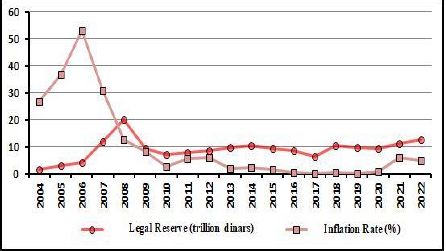
From Figure (7) below, we observe that the relationship between legal reserves and inflation in Iraq has generally been positive, meaning that an increase in the legal reserve ratio was accompanied by an increase in inflation rates, and every decrease in the reserve ratio was matched by a decrease in inflation rates. This pattern held in most years of the study, except for the years 2007 and 2008, during which the relationship was inverse. In those years, the significant decrease in inflation was accompanied by an exceptional rise in the legal reserve ratio and interest rates. The relationship was also inverse in 2013, although the increase in the legal reserve ratio was very slight. Similarly, the relationship was inverse in 2020 due to the repercussions of the COVID-19 pandemic, where the legal reserve ratio decreased due to the halt in economic activity, while inflation rates increased due to rising price indices. In 2022, the inflation rate decreased due to a reduction in the consumer price index, while the legal reserve ratio increased by 2% to mitigate inflationary pressures resulting from the Russia-Ukraine war.
Figure (7): The Relationship Between Legal Reserves and Inflation Rate in Iraq for the Period (2004-2022)
Source: Researcher's work based on data from Tables (1) and (7).
2- The Relationship Between the Central Bank's Purchases of Dollars and the Inflation Rate in Iraq:
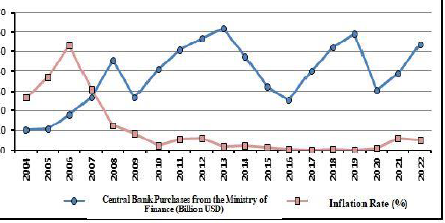
Figure (8) shows that the relationship between the Central Bank of Iraq's purchases of dollars from the Iraqi Ministry of Finance and the inflation rate was fluctuating, inconsistent, and unclear throughout the study period. At the beginning of the period, the relationship was positive until 2006, then became negative in 2007 and 2008. It shifted to positive again in 2009 and negative in 2010, and then became positive again in 2011 and 2012. The relationship continued to fluctuate between positive in one year and negative in the following year until the end of the period. It can be concluded that the relationship between the Central Bank of Iraq's purchases of dollars from the Ministry of Finance and the inflation rate is ambiguous and inconclusive throughout the study period.
Figure (8): The Relationship Between Central Bank Purchases of US Dollars and Inflation Rate in Iraq (2004-2022)
Source: Prepared by the researcher based on the data from Tables (2) and (7).
3- The Relationship Between Central Bank Sales of US Dollars and Inflation Rate in Iraq:
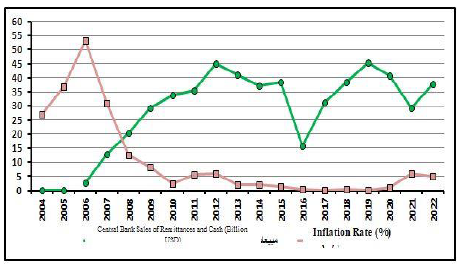
As shown in Figure (9), the relationship between the Central Bank's sales of foreign exchange and the inflation rate in Iraq was generally inverse for most of the study period, with the exception of the period (2011-2013), during which the relationship was positive. The inflation rate increased in 2011 and 2012, coinciding with an increase in the Central Bank's sales of US dollars, while the opposite occurred in 2013. The relationship was also positive in 2016 and 2018; however, the change in inflation rate during these years was very slight.
Figure (9): The Relationship between the Central Bank's Dollar Sales andInflation Rate in Iraq for the period (2004-2022).
Source: Prepared by the researcher based on the data from Tables (2) and (7).
4- The Relationship between the Discount Rate and Inflation Rate in Iraq:
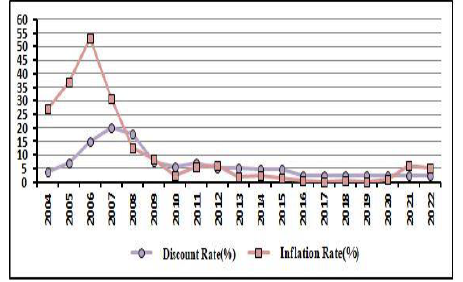
From Figure (10) below, we observe that the relationship between the discount rate and the inflation rate in Iraq has generally been positive. Their time paths were almost identical in terms of both increases and decreases, with some slight variations in certain years, particularly during the period (2012-2014). However, during the period (2016-2022), the discount rate remained constant, indicating no relationship between the discount rate and the inflation rate. We can conclude that the stabilization of the discount rate by the Central Bank of Iraq contributed to reducing inflation rates to their lowest levels during the study period. The rise in inflation rates in 2021 and 2022 was attributed to the Central Bank of Iraq raising the exchange rates of the Iraqi dinar against the US dollar.
Figure (10): The Relationship Between the Discount Rate and Inflation Rate in Iraq for the Period (2004–2022)
Source: Prepared by the researcher based on the data from Tables (3) and (7).
5- The Relationship Between the Interest Rate and Inflation Rate in Iraq:
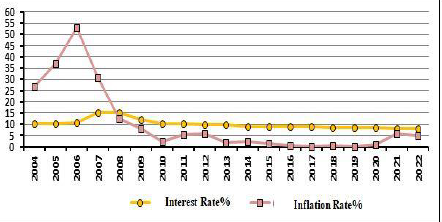
Figure (11) below shows that the relationship between the average interest rates and the inflation rate in Iraq was inconsistent throughout the study period, though it generally tended to be positive. To understand this relationship more precisely, the study period was divided into two halves.
In the first half, covering the years (2004–2012), the relationship was entirely positive. However, in the second half, spanning the years (2013–2022), the relationship became highly variable. During the period (2013–2016), the relationship was negative due to the repercussions of the June 9, 2014 events. It shifted to a positive relationship during the period (2017–2019). In 2021, the relationship was negative, driven by the disruptions caused by the central monetary authorities' decision to raise the exchange rate.
It is worth noting that in the years 2017, 2020, and 2022, there was no discernible relationship between the interest rate and inflation rate, as the general average of interest rates on deposits and bank loans remained fixed.
Figure (11): The Relationship Between Average Interest Rates and Inflation Rates in Iraq for the Period (2004–2022)
Source: Prepared by the researcher based on the data from Tables (4) and (7).
6- The Relationship Between Exchange Rate and Inflation Rate in Iraq:
From Figure (12) below, it can be observed that the relationship between the exchange rate and the inflation rate in Iraq was inconsistent throughout the study period. However, overall, it tended to be positive. To better understand this relationship, the period was divided into two halves.
During the first half of the study (2004–2013), the relationship was entirely positive, with the exception of 2007, where it was negative. The second half of the study (2014–2022) exhibited a more varied relationship. It was negative between 2014 and 2016, mainly due to the aftermath of the events of June 9, 2014. During the 2017–2020 period, the relationship fluctuated but generally leaned towards being positive, with exceptions in 2018 and 2022, where it turned negative. However, the changes in the exchange rate during these two years were negligible.
It is noteworthy that actions taken by monetary authorities, particularly the Central Bank of Iraq, significantly contributed to increasing the inflation rate in 2021 and 2022, driven by a rise in the Consumer Price Index.
CONCLUSION
Through the analysis of theoretical aspects during the period (2004-2022), several conclusions were reached as follows:
The rediscount rate is regarded as a principal instrument utilized by the Central Bank to affect the quantity of bank credit. This system eventually regulates the money supply, so mitigating inflationary pressures.
2. An inverse correlation exists between the rediscount rate and inflation, the legal reserve ratio and inflation, as well as open market activities (particularly the foreign currency sales window) and inflation. A direct correlation was established between the exchange rate and inflation. The results elucidated the connection between monetary policy and the money supply.
3. The creation of the foreign currency sales window for the purchase and sale of foreign currencies significantly contributed to preserving the value of the local currency, stabilizing the exchange rate of the Iraqi dinar, and regulating inflation.
Propositions
Based on the previous conclusions, several proposals can be outlined for the study period:
1. Vigilantly observe inflation metrics. Efforts must be undertaken to monitor inflation correctly utilizing dependable and exact measurements. This would facilitate the identification of any anomalous surges in inflation rates and allow for the implementation of requisite corrective measures.
2. The Central Bank must implement contemporary tools and mechanisms to mitigate and regulate inflation. These techniques may involve modifying current loan facilitation procedures and promoting innovation in financial operations.
3. Enhancing openness and delivering precise information about monetary and economic policy helps foster confidence between the public and monetary authorities. This will consequently alleviate tensions and adverse expectations that might aggravate inflation.
4. A specific index tracking the exchange rate of the Iraqi dinar versus international currencies must be established. This index must be computed based on daily foreign currency market activities.
5. It is essential to progressively elevate the legal reserve ratio based on empirical research. This may mitigate inflation by adversely affecting banking operations, investment trends, and domestic commerce.
Conflict of Interest:
The authors declare that they have no conflict of interest
Funding:
No funding sources
Ethical approval:
The study was approved by the Tikrit University, Tikrit/ Iraq.
REFERENCES
Qasim, M. M. S. Monetary Policy in Iraq: Building Macroeconomic Stability and Maintaining a Sound Financial System. 1st ed., Bayt Al-Hikma, 2012.
Al-Jubouri, H. H. K. New Trends in Monetary Policy in Iraq: A Comparative Analysis for the Period 2000-2008. Unpublished master's thesis, Tikrit University, Faculty of Administration and Economics, 2010.
Mousa, H. T., et al. "The Role of Monetary Policy in Achieving Financial Stability in Iraqi Banks for the Period (2009-2017)." Journal of Economic and Administrative Sciences, vol. 26, no. 117, 2020, pp. 1-15. DOI: https://doi.org/10.1108/JEAS-08-2019-0080.
Al-Burmawi, A. M. Evaluating the Effectiveness of Monetary Policy Under Financial Globalization. Doctoral dissertation, Faculty of Commerce, Tanta University, Egypt, 2019.
Wissam, B. Monetary Policy as a Tool to Achieve Economic Objectives. Master’s thesis, Faculty of Economic Sciences, Commercial Sciences, and Management Sciences, University of Larbi Ben M’hidi Oum El Bouaghi, Algeria, 2012.
Al-Shaibani, F. K. K. "The Role of Modernized Monetary Policy in Addressing Inflation: An Analytical Study of the Iraqi Economy for the Period (1990-2003)." Al-Mustansiriyah Journal of Arab and International Studies, vol. 61, 2018, pp. 1-12. Link to journal.
Al-Obaidi, O. F. M. The Role of Optimal Monetary Policy in Achieving Financial Stability: An Econometric Study on the Iraqi Economy for the Period (2004-2015). Master’s thesis, Faculty of Administration and Economics, University of Anbar, 2018.
Dagher, M. M., and S. R. Mohi. "Monetary Policy Management: From Money Supply to Interest Rates in the Iraqi Economy for the Period (2004-2011)." Journal of Economic and Administrative Sciences, vol. 20, no. 79, 2014, pp. 20-35. DOI: https://doi.org/10.1108/JEAS-09-2012-0042.
Al-Samarrai, A. D. M. The Impact of Money Supply on Some Indicators of Economic Stability in Iraq and Jordan for the Period (2005-2020). Master’s thesis, Tikrit University, Faculty of Administration and Economics, 2022.
Recommended Articles
Research Article
Country of Origin and Foreign Branding on Perceived Quality of Local Products in Indonesia: The Moderating Role of Consumer Ethnocentrism
Download PDF
Research Article
The Effect of Employer Attractiveness and Compensation on Job Persuit Intention to Fmcg Companies in Indonesia: Coporate Reputation as an Intervening Variable
Download PDF
Research Article
The Effect of Beauty Vlogger on Purchase Decision for Local Skincare Products in Indonesia: Brand Image as a Mediating Variable
Download PDF
Research Article
The Effect of Self-Efficacy and Working Environment on Work Achievement with Organizational Commitment as Mediation
Sri Wahyuni,
...
Veithzal Rivai Zainal
Download PDF
PO Box 101, Nakuru
Kenya.
Email: office@iarconsortium.org
Editorial Office:
J.L Bhavan, Near Radison Blu Hotel,
Jalukbari, Guwahati-India
Aziz, K. I. (2025). Analysis of Monetary Policy Trends in Iraq and Their Role in Achieving Economic Stability Post-2003. Scientific Research Journal of Economics and Business Management, 5(1), 1-12.
MLA
Aziz, Khalil I.. "Analysis of Monetary Policy Trends in Iraq and Their Role in Achieving Economic Stability Post-2003." Scientific Research Journal of Economics and Business Management 5.1 (2025): 1-12.
Chicago
Aziz, Khalil I.. "Analysis of Monetary Policy Trends in Iraq and Their Role in Achieving Economic Stability Post-2003." Scientific Research Journal of Economics and Business Management 5, no. 1 (2025): 1-12.
Harvard
Aziz, K. I. (2025) 'Analysis of Monetary Policy Trends in Iraq and Their Role in Achieving Economic Stability Post-2003' Scientific Research Journal of Economics and Business Management 5(1), pp. 1-12.
Vancouver
Aziz KI. Analysis of Monetary Policy Trends in Iraq and Their Role in Achieving Economic Stability Post-2003. Scientific Research Journal of Economics and Business Management. 2025 Jan;5(1):1-12.


 Download PDF
 Download XML