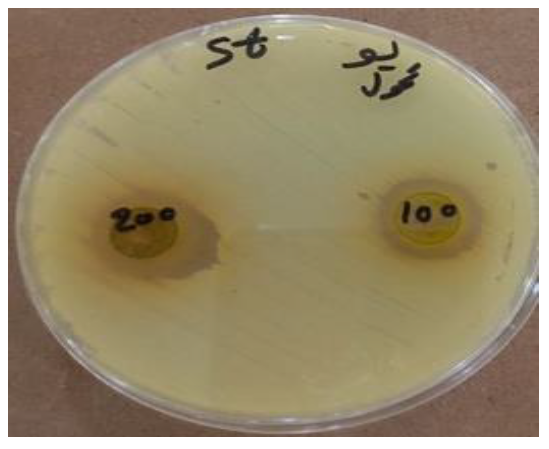
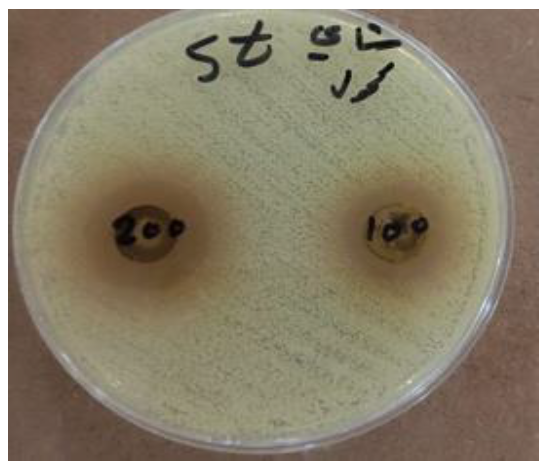
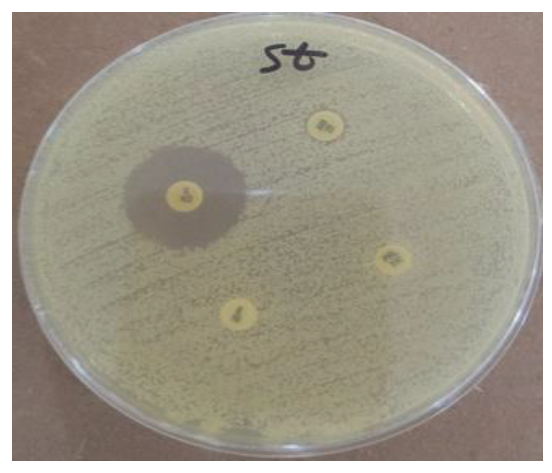
The pH and temperature stability of the xylanase and β-galactosidase enzymes produced from Bacillus sp. Strain RL1. It was found that the xylanase enzyme showed stability between pH 6-8, as it retained 97.87% of its total activity, while the enzyme lost 10-15% of its activity at numbers The acid pH ranged from 4-5, while the remaining enzyme activity reached 89.43% at the pH 10 and the beta enzyme showed stability between pH 5-6 and retained 88.04% of its total effectiveness, while the enzyme lost more than 15% of its effectiveness at a pH of 4, while the remaining enzymatic high reached 64.13% percent at a pH of 10. While the results of the incubation of the xylanase and β-galactosidase enzymes produced from the isolate Bacillus sp. Strain RL1 at temperatures ranging from 30-90°C, it was found that the xylanase enzyme retained its full effectiveness at temperatures confined between 30-60°C, after which the effectiveness decreased with the increase in temperature to 90°C and found that the β-galactosidase enzyme retained its full effectiveness at temperatures confined between 30-50°C, after which the effectiveness decreased with the increase in temperature to 90°C.
Keywords
Xylanase Enzyme
-Galactosidase Enzyme
PH
Temperature
Stability
INTRODUCTION
Xylan, the second most prevalent polysaccharide in nature after cellulose, is hydrolyzed by xylanase. The primary enzymes of the microbial hemicellulolytic system or xylanases, randomly cut the xylan's-1,4 backbone. Most xylanases are grouped into glycoside hydrolase family (GH) 10 and 11 based on amino acid sequence homologies and hydrophobic cluster analysis. The (GH) families 5, 7, 8, 16, 26, 43, 52 and 62 are home to additional minorities [1,2].
In nature, β-galactosidase (EC 3.2.1.23), also known as lactase or -D-galactosidase galactohydrase, is mostly disregarded. Reaction mechanism [3,4] and three-dimensional structure [5] are two topics on which research has been done. E. coli produces the most completely studied β-galactosidase (pH optimum, pH 7), whereas yeasts and various Aspergillus species produce the most significant industrial β-galactosidase (pH optimum, between pH 4 and 5). In food technology, these fungal β-galactosidase are used to hydrolyze the lactose molecule's-(1,4) linkage to glucose. According to Gonzalez and Suarez [6], there are roughly 5.75 million metric tons of lactose produced annually worldwide.
MATERIALS AND METHOD
Micoorganisim
The xylanase and β-galactosidase enzymes producing bacterial Bacillus sp. Strain (RL1) was isolated from soil.
Identification of the Isolates
The standard protocols [7] was used and identification was carried out according to Burges’s Manual (7th Ed.).
Secondary Screening
The method used by Teather and Wood [8] is used which indicates the formation of a clear zone from hydrolysis to decomposition of cellulose.
Xylanase and β-Galactosidase Enzymes Assay
As detailed by Bailey et al. [9], xylanase and β-galactosidase activity were assessed as the substrate and the amount of reducing sugars released was calculated using the dinitrosalicylic acid method [10].
pH Stability
The xylanase and β-galactosidase enzymes were pre-incubated at pH values ranging from pH 4 to 10 at 40°C for 30 min. to determine pH stability. Under typical enzyme assay conditions, the residual activity was measured.
Temperature Stability
The xylanase and β-galactosidase enzymes were pre-incubated at different temperatures between 30 and 90°C for 30 min at an ideal pH and the remaining activity was assessed under standard enzyme assay conditions to determine the temperature stability.
RESULTS AND DISCUSSION
Stability of pH for Xylanase and β-Galactosidase Enzymes
Findings of Figure 1 demonstrate that the xylanase enzyme maintained some of its caustic activity between pH 6 and 8, while the enzyme lost more than 10-15% of its enzymatic activity at the acidic pH that ranged from 4-5, while the remaining enzymatic activity was 89.43 at a pH of 10.
Figure 1: Optimal pH Curve for the Stability of Xylanase Enzyme Produced from Bacillus sp. Strain RL1
The results shown in Figure 2 show that the β-galactosidase enzyme showed stability between pH 5-6 and retained an amount of its caustic activity, while the enzyme lost more than 15% of its enzymatic activity at the acidic pH that ranged from 4, while the remaining enzymatic activity was 64.13 at a pH of 10.
Figure 2: Optimal pH Curve for the Stability of β-Galactosidase Enzyme Produced From Bacillus sp. Strain RL1
The influence of the medium's acidity on the enzyme's composition and the ionization of the groups in the active site account for the enzyme's decreased activity at non-extreme pH levels, while the decrease in the stability of the enzyme at the extreme acidic and basic values occurs as a result of the irreversible denaturation of the enzyme molecule due to the large change that occurs in the charges of the ionizable side chains Which leads to the destruction of the triple structure of the enzyme molecule to create a more random structure instead and change the effective site and thus the effectiveness [11].
Seo etal. [12] when studying the stability of the xylanase enzyme produced from Bacilluslicheniformis JK7, ranged from 4-6, while Gowdhaman etal. [13], stated that the best stability of the xylanase enzyme produced from Bacillusaerophilus KG12 bacteria was in the pH range from 6-8. While Sarika etal. [14], stated that the best Stability in a range from pH 6-10, while the xylanase enzyme produced from Paenibacillusmacquariensis gave stability in a range from pH 5.8-10 [15].
Crueger and Crueger [16], stated that the stability of the β-galactosidase enzyme produced from Aspergillusniger, Aspergillusoryzae, pH ranged (2.5-8) and (2.5-7), respectively. pH levels between 6 and 9 were used by Miyazaki [17] to examine the stability of the β-galactosidase enzyme generated by Bacillus macerals. According to Jensen and Olsen (1992), the pH range between 6 and 9 provided the highest stability for the β-galactosidase enzyme generated by Thermocycles lanuginose.
Figure 3: The Impact of Temperature on the Xylanase Enzyme Generated by Bacillus sp. RL1 During Incubation
Stability of temperature for xylanase and β-galactosidase enzymes
Findings of Figure 3 from incubating the xylanase enzyme at temperatures ranging from 30 to 90 C revealed that the enzyme was most effective at temperatures between 30 and 60°C and that as the temperature rose, the activity reduced and the xylanase enzyme did not lose its effectiveness and retained more than 70% of them at a temperature of 90°C, the remaining enzymatic activity reached 70.79%.
The results of incubating the β-galactosidase enzyme at temperatures ranging from 30-90°C, shown in Figure 4, showed that the β-galactosidase enzyme retained its full effectiveness at temperatures limited to between 30-50°C, after which the activity decreased with the increase in temperature and the β-galactosidase enzyme did not lose its effectiveness and retained more than 60% of them at a temperature of 90°C, the remaining enzymatic activity reached 63.55%.
Figure 4: The effect of temperature on the incubation stability on the β-galactosidase enzyme produced by Bacillus sp. RL1
The reason for the decrease in the activity of the enzymes at high temperatures is due to the denaturation of the enzyme, as the rapid change in the nature of the enzyme leads to the breaking of the weak hydrogen bonds in a way that leads to the enzyme losing its activity. The difference in the type of organism from which the enzyme is extracted and the different development and production conditions.
Pithadiya et al. [18] reported that the xylanase enzyme produced from Bacillus circulans gave stability in a range of temperatures ranging from 40-60°C and Kumar et al. [19] reported that the temperature of the stability of the xylanase enzyme was in the range of 60-80°C. Gowdhaman et al. [13] found that the best stability of the xylanase enzyme produced from Bacillus aerophile. While Guo et al. [20] reported that the stability of the xylsnase enzyme produced from Bacillus subtilis was in a range of temperatures ranging from 55-65°C, the product from basil spanned from 40 to 60°C.
According to Lind et al. [21], a Thermoanaerobacter sp.'s intracellular and remarkably thermostable β-galactosidse is. At 75°C. While Jensen and Olsen [22] reported that Thermomyces lanuginosus generated β-galactosidase with around 58% of its enzymatic activity at a temperature of 50°C.
REFERENCE
Collins, T. et al. "Xylanases, xylanase families and extremophilic xylanases." FEMS Microbiological Reviews, 2005, vol. 29, pp. 3-23.
Motta, F. et al. "A review of xylanase production by the fermentation of xylan: classification, characterization, and applications." IntechOpen, 2013.
Bader, D.E. et al."Site-directed mutagenic replacement of Glu-461 with Gln in β-galactosidase (E. coli): evidence that Glu-461 is important for activity." Biochemical and Biophysical Research Communications, 1988, vol. 153, pp. 301-305.
Ring, M. et al. "Site-directed mutagenesis of β-galactosidase (E. coli) reveals that Tyr-503 is essential for activity." Biochemical and Biophysical Research Communications, 1988, vol. 152, pp. 1050-1055.
Jacobson, R.H. et al."Three-dimensional structure of β-galactosidase from E. coli." Nature, 1994, vol. 369, pp. 761-766.
González, M.I. and S. Suárez Doval. "Klyveromyces lactis immobilization on corn grits for milk whey lactose hydrolysis." Enzyme and Microbial Technology, 1994, vol. 16, pp. 303-310.
Kannan, N. Handbook of Laboratory Culture Media, Reagents, 2002.
Teather, R.M. and P.J. Wood. "Use of Congo red-polysaccharide interactions in enumeration and characterization of cellulolytic bacteria from the bovine rumen." Applied and Environmental Microbiology, 1982, vol. 34, pp. 777-780.
Bailey, M.I. et al."Inter laboratory testing of methods for assay of xylanase activity." Journal of Biotechnology, August 1992, vol. 25, pp. 257-270.
Miller, G.L. "Use of dinitrosalicylic acid reagent for determination of reducing sugar." Analytical Chemistry, 1959, vol. 31, no. 3, pp. 426-429.
Palmer, T. Understanding Enzyme, 2nd ed., Ellis Harwood, 1985.
Seo, J.K. et al. "Characterization of cellulolytic and xylanolytic enzymes of Bacillus licheniformis JK7 isolated from the rumen of a native Korean goat." Asian-Australasian Journal of Animal Sciences, 2013, vol. 26, no. 1, pp. 50-58.
Gowdhaman, D. et al. "Optimization of the xylanase production with the newly isolated Bacillus aerophilus KGJ2." Turkish Journal of Biochemistry, 2014, vol. 39, no. 1, pp. 70-77.
Sarika, C. et al. "Isolation and identification of xylanolytic enzyme from an effective strain Bacillus licheniformis isolated from decaying wood." International Journal of Applied Biology and Pharmaceutical Technology, 2013, vol. 4, no. 4, pp. 92-100.
Sharma, M. et al. "Purification and characterization of alkaline xylanase secreted from Paenibacillus macquariensis." Advances in Microbiology, 2013, vol. 3, pp. 32-41.
Crueger, A. and W. Crueger. Biotechnology, vol. 6a. Edited by K. Kieslich, Verlag Chemie, 1984, pp. 421-457.
Miyazaki, Y. "Purification, crystallization, and properties of β-galactosidase from Bacillus macerans." Agricultural and Biological Chemistry, 1988, vol. 52, pp. 625-631.
Pithadiya, D. et al. "Partial purification and optimization of xylanase from Bacillus circulans." Archives of Applied Science Research, 2016, vol. 8, no. 2, pp. 1-10.
Kumar, S. et al. "Purification, characterization, and thermostability improvement of xylanase from Bacillus amyloliquefaciens and its application in pre-bleaching of kraft pulp." Biotechnology, 2017, vol. 3, pp. 7-20.
Guo, G. et al. "Purification and characterization of a xylanase from Bacillus subtilis isolated from the degumming line." Journal of Basic Microbiology, 2011, vol. 51, pp. 1-10.
Lind, D.L. et al."β-Galactosidase from a strain of the anaerobic thermophile, Thermoanaerobacter." Enzyme and Microbial Technology, 1989, vol. 11, pp. 180-186.
Jensen, B. and J. Olsen. "Physicochemical properties of a purified α-amylase from the thermophilic fungus Thermomyces lanuginosus." Enzyme and Microbial Technology, 1992, vol. 14, pp. 112-116.
Recommended Articles
Research Article
The Impact of Medicinal Plant Extracts on Entamoeba histolytica Parasite in Rats: A Study on Hematological and Biochemical Parameters
Haneen Mohanad Maher,
...
Noor Rassam kamil
Published: 28/02/2026
Download PDF
Research Article
Study the Influence of Planting Depths and Soil Type on Broad Bean Seed Germination and Growth
Muhammad Amin Walid Taha
Download PDF
Research Article
Determination of the Factors that Define the Tropism of Astroviruses in Established Cell Lines
Marwah Ali Oudah,
...
Shahad Ahmed Bakheet
Published: 15/12/2025
Download PDF
Research Article
Assessment of the Efficiency of Using Sand Filters for Four Different Types of Charcoal on Water Quality
Issam Mohammed Ali Alradiny
Download PDF
PO Box 101, Nakuru
Kenya.
Email: office@iarconsortium.org
Editorial Office:
J.L Bhavan, Near Radison Blu Hotel,
Jalukbari, Guwahati-India
Khudhair, R. S. (2023). Stability of pH and Temperature for Xylanase and β-Galactosidase enzymes Produced by Bacillus sp. Strain RL1. Scientific Research Journal of Agriculture and Life Sciences, 3(2), 1-3.
MLA
Khudhair, Raed S.. "Stability of pH and Temperature for Xylanase and β-Galactosidase enzymes Produced by Bacillus sp. Strain RL1." Scientific Research Journal of Agriculture and Life Sciences 3.2 (2023): 1-3.
Chicago
Khudhair, Raed S.. "Stability of pH and Temperature for Xylanase and β-Galactosidase enzymes Produced by Bacillus sp. Strain RL1." Scientific Research Journal of Agriculture and Life Sciences 3, no. 2 (2023): 1-3.
Harvard
Khudhair, R. S. (2023) 'Stability of pH and Temperature for Xylanase and β-Galactosidase enzymes Produced by Bacillus sp. Strain RL1' Scientific Research Journal of Agriculture and Life Sciences 3(2), pp. 1-3.
Vancouver
Khudhair RS. Stability of pH and Temperature for Xylanase and β-Galactosidase enzymes Produced by Bacillus sp. Strain RL1. Scientific Research Journal of Agriculture and Life Sciences. 2023 Jul;3(2):1-3.


 Download PDF
 Download XML