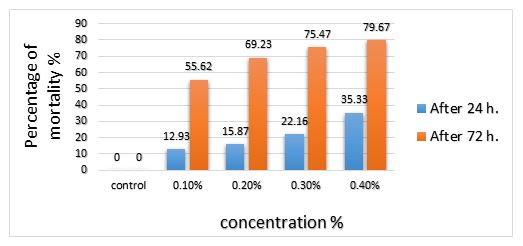
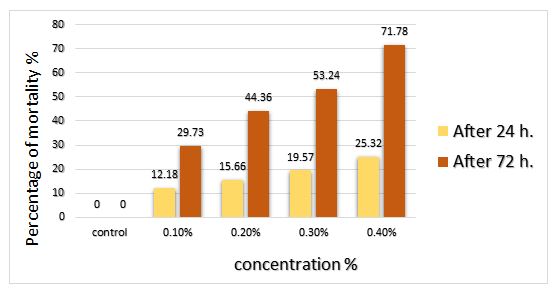
This study included the investigation of the role of an insect housefly Musca domestica in the transport of Entamoeba histolytica parasite that cause diarrhea and Evaluation of cyromazine as a Biocontrol Agent. The percentage of transmission for the parasite was examining through exposed The samples to the stool of people injured, and then samples from the water washing insects were tested individually to determine the percentage of transfer, which was (71.11)%. On the other hand, cyromazine concentrations affected the life stages of the house fly, where the lowest mortality rate was in the egg stage at a concentration of 0.1% g/L after 24 and 72 hours was 12.93% and 55.62%, respectively. The highest mortality rate at a concentration of 0.4% g/L after 24 and 72 hours was 35.33% and 79.67%, respectively. The lowest kill rate of first stage larvae at a concentration of 0.1% g/l after 24 and 72 hours was 12.18% and 29.73%, respectively. The highest mortality rate at a concentration of 0.4% g/l after 24 and 72 hours was 25.32% and 71.78%, respectively.
Keywords
Musca domestica
Entamoeba histolytica
Cyromazine
INTRODUCTION
The most prevalent fly species in homes, the housefly (Musca Domestica), belongs to the suborder Cyclorrhapha and is responsible for both human and animal diseases [1]. It is a pest organism that is found all over the world and is the most common synanthropic fly species in homes, restaurants, and animal production. In both field and lab settings, it has been demonstrated that houseflies carry parasitic helminth eggs on their body surfaces, including those of Ancylostoma caninum, Ascaris lumbricoides, Hymenolepis nana, Hymenolepis diminuta, Taenia spp., and Trichuris trichiura [2]. House domestic flies are irritating, pestiferous scavengers that share a natural habitat with people and may cause serious public health risks. Their biology renders them reactive and appropriate as mechanical vectors for a variety of diseases, including parasites [3].
Entamoeba histolytica is a parasite that can cause severe amebiasis, which is a highly infectious parasitic disease with serious clinical signs. Early detection and treatment of E. histolytica are critical for avoiding consequences and deaths [4]. E. histolytica affects about 50 million individuals worldwide [5]. Nearly 1-10 of individuals infected develop amoebic colitis or liver abscesses, causing severe symptoms such as diarrhea, stomach discomfort, and fever [6]. It is often a global epidemic in undeveloped areas, causing in more than 40,000 deaths annually [7]. Developing countries have to encounter difficulties in controlling amoebiasis. annually, approximately 900 million people are infected by amoebiasis; however, only 10% of these persons exhibit symptoms of the disease, while 90% do not exhibit symptoms but remain to function as carriers. Asymptomatic people possess E. histolytica cysts in their feces, which are carried by houseflies and contaminate food and drink. E. histolytica is a very effective pathogen due to its well-developed virulence factors, which aid in both host infection and immune response suppression [8]. The aim of research included the study of the role of an insect housefly Musca domestica in the transport of E. histolytica parasite which cause diarrhea.
Cyromazine (N-cyclopropyl-1,3,5-triazine-2,4,6-triamine) is an efficient, commonly used insecticide that acts as a growth regulator. Its insecticide characteristics stem from its capacity to inhibit chitin creation, and it is thus widely utilized for fly control in different environments [9]
Cyromazine is used to control fly larvae and prevent the growing of adult flies. It acts as a growth regulator and interrupts larval growth in dipteran species [10]. Cyromazine's physiological effects on larvae including irregular melanization and sclerotization of the cuticle, necrotic lesions, insect body rupture, and death [11].
METHODS AND MATERIALS
Samples collection
A numbers of housefly’s adults are collected with a manual insect collection net and then transferred to breeding boxes. The insects were fed in Petri plates containing cotton pieces injected with sterile water and milk. The insects were grouped according to [12] into groups to produce successive generations at 30±1°C and 20-30% humidity.
Insect's roles in transfer parasitic cysts
Thirty stool samples were taken from people who had diarrhea, were stored in tightly closed 60ml plastic containers to keep them moist and prevent them from drying out. The stools were examined within 30 min according to Garvey et al., 1977. The Lugol's iodine solution was also prepaid using the method described in [13]. The samples were then performed under a microscope to confirm the existence of cysts of intestinal parasites [14]. To identify the house fly's roles in the mechanical transfer of parasitic cysts, a stool sample containing the parasite was taken and placed in a petri dish within the insect breeding box. Then 15 insects were placed into the breeding box and left for 24 hours. The stool sample was then removed, and the insects were killed by placing the breeding box in the refrigerator for 30 min. Each insect washed off with distilled water, then transferred the wash water into a 10 mL test tube for centrifugation. To confirm the existence of parasite cysts, a drop of the precipitated wash water was placed on a glass slide, followed by a drop of iodine solution, and examined under an electron microscope. The assay was carried out for every 15 insects, and in three replications [15]
Application of growth regulator (IGR)
Four concentrations (0,1%, 0,2%, 0,3% and 0,4%) of Cyromazine were prepared. The Cyromazine was Application regularly at the egg period, the larval stage, the pupal stage and the adult stage.
RESULTS AND DISCUSSION
The role of housefly in the transfer parasite cysts
This study showed that this insect has the ability to transmit pathogens mechanically from the main source, which is feces, and the percentage of the house fly’s role in transmitting the parasite was 71.11%. These results were consistent with [16] who conducted a study to determine the role of houseflies as a vector of parasitic pathogens, and stated that 81.31% of the samples were infected with parasites. Ten types of parasites that were isolated from the outer surface and digestive system of house flies, including two types of cysts, one of which is E. histolytica [16]. Houseflies are the most common flies in worldwide. It is mechanically transported helminthic eggs and protozoa cysts through their vomit or excreta. Houseflies coexists with humans and domestic animals and is frequently found in areas where humans congregate, such as restaurants, hospitals, food centers, food markets, fish markets, and slaughter houses [17]
Effect of growth regulator
Figure 1 shows the effect of different concentrations of growth regulator on the mortality rates of house fly eggs after 24 and 72 hours of application. The results indicated that the lowest mortality rate was 12.93% and the highest rate was 35.33% after 24 hours of application of growth regulator. While after 72 hours the lowest rate was 55.56% and the highest rate was 79.47%.
Figure (1): Percentage of house fly egg mortality after 24 and 72 hours of using cyromazine at different concentrations
The cyromazine had strong development inhibition abilities against house fly larvae. It was more effective during the early phases of insect growth than later levels. The results indicate that there is a direct relationship between the concentration of the growth regulator and the percentage of death, which is what many studies have indicated. showed that the growth regulator cyromazine inhibited egg hatching by 11%. This was confirmed, that chitin synthesis inhibitors inhibit the formation of chitin in the embryo and it dies inside the egg shell as a complete larva, which is one of the most common symptoms resulting from surface treatment of the egg. stated in an experiment in which the growth regulator cyromazine was used that it inhibited egg hatching of the house fly at different rates. The growth regulator cyromazine was effective in controlling An. stephensi, and the efficacy of this preparation was peak when the growth regulator was used in the egg and early larval stages because it is highly sensitive [18]
The results also show that there is a direct relationship between the concentration of the growth regulator and the percentage of death of house fly pupae. The results ranged between 12.19 - 25.32% after 24 hours of using the growth regulator. While they ranged between 29.73 - 71.78% after 72 hours.
Figure (2): Percentage of housefly pupal mortality after 24 and 72 hours of using cyromazine at different concentrations
The failure of adults to emerge from pupae treated with chitin synthesis inhibitor may be due to the sensitivity of the pupal stage due to the incomplete hardening of its body wall if it is treated when it is one-day old. This leads to the penetration of large quantities of the regulator into the insect's body, affecting its development and thus not completing the pupal stage, or it completes its development and emerges partially as parts of the regulator stick to the pupal wall.
The results of this study were similar to what, reported that the use of the growth regulator Dimilin resulted in the death of housefly pupae by 25%. The use of the growth regulator Diflubenzuron resulted in the death of housefly pupae by 99.1% and the rate of adult emergence was 0.1%. [19] reported that treating Agrotis ipsilon pupae with the growth regulator Neporex resulted in a high rate of death and there was a decrease in the emergence of adults in addition to the resulting insect deformities.
When the growth regulator was applied to the adult housefly, the results indicated that there was no effect on the insect and that the mortality rate was 0%. This is consistent with what was mentioned [20] that the adult of tephensi and quinquefasciatus insects do not die when exposed to the chitin formation inhibitor Triflumuron but they suffer from a decrease in functional activities and a decrease in nutrition, thus reducing the number of eggs laid by the treated females.reported that treating adult of houseflies with the chitin synthesis inhibitor Dimlin did not cause any mortality after 9 days of treatment.
CONCLUSION
The housefly is a mechanical vector of infections, including parasites. To prevent human or animal infections, a variety of strategies for controlling, preventing, or eradicating houseflies should be used.
Conflict of Interest:
The authors declare that they have no conflict of interest
Funding:
No funding sources
Ethical approval:
The study was approved by the College of Basic Education/ Missan University.
Umeche et al; "Musca domestica as a Carrier of Intestinal Helminths in Calabar, Nigeria" 66.5 (1989) Pp349-352
Förster et al; "The House Fly (Musca domestica) as a Potential Vector of Metazoan Parasites Caught in a Pig-Pen in Germany" 160.1-2 (2009) Pp163-167, doi https://doi.org/10.1016/j.vetpar.2008.10.087
Jing et al; "Serologic Diagnosis of Entamoeba histolytica Infection Based on the Gradient-Based Digital Immunoassay" 1.1 (2025) Pp343602, doi https://doi.org/10.1016/j.aca.2024.343602
FAO et al; "Pesticide Residues in Food 2007: Joint FAO/WHO Meeting on Pesticide Residues" 1.1 (2007) Pp1-2, Available from: Not provided in original citation
Van De Wouw et al; "The Insect Growth Regulator Insecticide Cyromazine Causes Earlier Emergence in Drosophila melanogaster" 63.3 (2006) Pp101-109, doi https://doi.org/10.1002/arch.20147
Vinuela et al; "Ultrastructure of Ceratitis capitata Wiedemann Larval Integument and Changes Induced by the IGI Cyromazine" 48.3 (1994) Pp191-201, doi https://doi.org/10.1006/pest.1994.1019
Mustafa Abdel Fattah et al; "The Effect of Colors on Attracting and Gathering House Flies (Musca Locala L.)" 11.3 (2012) Pp759-764
Zeibig et al; "Clinical Parasitology: A Practical Approach" 1.1 (2012) Pp1-2, Available from: Not provided in original citation (Elsevier Health Sciences)
Singh et al; "Rapid Diagnosis of Intestinal Parasitic Protozoa" 61.3 (2009) Pp280-286
Al-Moussawi et al; "Epidemiology of Giardia lamblia Parasite in Al-Ma'meira and Souq Dohan Villages with a Study of the Effect of Raw Powder of Pomegranate Peels (Punica granatum) on Its Experimental Infections in Cats" 4.2 (2012) PpNot specified
Al-Aredhi et al; "Role of House Flies (Musca domestica) as Vector Host for Parasitic Pathogens in Al-Diwaniya Province/Iraq" 4.4 (2015) Pp1961-1965
Abdul-Razzaq et al; "Effect of Neporex Growth Regulator on All Phases of Anopheles stephensi" 1.1 (2019) PpNot specified
Hazaa et al; "Synergistic Effect of the Insect Growth Regulator, Neporex to Gamma Radiation on The Black Cutworm Agrotis Ipsilon" 43.1 (2011) PpNot specified
Al Hilfy, A. A. & S. Alwan, S. (2025). Role of Housefly (Musca domestica) in the Transmission of Entamoeba histolytica Cysts and Evaluation of Cyromazine as a Biocontrol Agent. Scientific Research Journal of Agriculture and Life Sciences, 5(1), 1-4.
MLA
Al Hilfy, Alla A. and Sura S. Alwan. "Role of Housefly (Musca domestica) in the Transmission of Entamoeba histolytica Cysts and Evaluation of Cyromazine as a Biocontrol Agent." Scientific Research Journal of Agriculture and Life Sciences 5.1 (2025): 1-4.
Chicago
Al Hilfy, Alla A. and Sura S. Alwan. "Role of Housefly (Musca domestica) in the Transmission of Entamoeba histolytica Cysts and Evaluation of Cyromazine as a Biocontrol Agent." Scientific Research Journal of Agriculture and Life Sciences 5, no. 1 (2025): 1-4.
Harvard
Al Hilfy, A. A. and S. Alwan, S. (2025) 'Role of Housefly (Musca domestica) in the Transmission of Entamoeba histolytica Cysts and Evaluation of Cyromazine as a Biocontrol Agent' Scientific Research Journal of Agriculture and Life Sciences 5(1), pp. 1-4.
Vancouver
Al Hilfy AA, S. Alwan S. Role of Housefly (Musca domestica) in the Transmission of Entamoeba histolytica Cysts and Evaluation of Cyromazine as a Biocontrol Agent. Scientific Research Journal of Agriculture and Life Sciences. 2025 Jan;5(1):1-4.


 Download PDF
 Download XML