Contents
Download PDF
pdf Download XML
377 Views
404 Downloads
Share this article
Research Article | Volume 2 Issue 1 (Jan-June, 2022) | Pages 1 - 4
Association between Blood Eosinophil Count and Tissue Eosinophil Grading Among Patients Suffering From Sinonasal Polyposis Attending Tertiary Care Hospital
 ,
 ,
 ,
 ,
 ,
1
MS, ENT,Civil Hospital, Chowari, Chamba, Himachal Pradesh, India
2
Professor and Head, Department of ENT, Head and Neck Surgery, Dr. RPGMC Kangra at Tanda, Himachal Pradesh, India
3
Professor, Department of ENT, Head and Neck Surgery, Dr. RPGMC Kangra at Tanda, Himachal Pradesh, India
4
Professor, Department of Pathology, Dr. RPGMC Kangra at Tanda, Himachal Pradesh, India
5
Assistant Professor, Department of ENT, Head and Neck Surgery, Dr. RPGMC Kangra at Tanda, Himachal Pradesh, India
6
MS, Ophthalmology, Pt. Jawahar Lal Nehru GMC, Chamba, Himachal Pradesh, India
Under a Creative Commons license
Open Access
Received
Feb. 3, 2022
Revised
March 9, 2022
Accepted
April 19, 2022
Published
May 10, 2022
Abstract

Background: Present study aimed to evaluate the association between blood eosinophil count and tissue eosinophil grading among patients suffering from Sinonasal Polyposisattending routine ENT OPD in Dr. RPGMC Tanda. Material and Methods: The present study was done as a hospital based cross sectional study in the department of ENT & Head and Neck Surgery, in Dr. RPGMC Kangra at Tanda. It was done in 30 patients of chronic rhinosinusitis with nasal polyposis (CRSwNP) from June 2018 to June 2019 who met the inclusion criteria. Data regardingBlood & Tissue eosinophil count was retrieved. Results: in the present study, there were a total of 30 patients out of which there were 16 males and 14 females. The mean age observed of patients was 42.47±13.68. Among the total, 17 patients were classified as Eosinophilic Chronic Rhinosinusitis with Nasal Polyposis (ECRSwNP) while 13 were classified as Non-Eosinophilic Chronic Rhinosinusitis with Nasal Polyposis (NECRSwNP). There were 9 cases of ECRSwNP where tissue eosinophils were >10/HPF while 8 cases had <10 tissue eosinophils/HPF. Similarly, 9 cases of NECRSwNP had <10 tissue eosinophils/HPF while 4 cases had tissue eosinophils were >10/HPF. The association between blood eosinophil count and tissue eosinophil grading was not significant with p value of 0.225. Conclusion: Present study concluded that there was no significant association of blood eosinophil count between NECRSwNP and ECRSwNP with tissue eosinophils.

Keywords
INTRODUCTION

Majority of nasal polyps result as a consequence of chronic mucosal inflammation. Recurrent attacks of rhinitis eventually lead to focal protrusion of the mucosa leading to the formation of nasal polyp [1]. Once present and when activated, eosinophils lead to the damage of mucosa through degranulation and release of toxic mediators with resulting epithelial sloughing and tissue edema [2-4].


In contrasts to United States or Europe, studies showed that in Eastern Asian population about >50% of cases of CRS with Nasal polyposis are non-eosinophilic dominant and that in some samples, neutrophils are the dominant cell type characterized by mixed T helper cell type 1 (Th1) or Th17 type inflammation [5-7]. So it has been suggested to classify CRSwNP into “eosinophilic” and “noneosinophilic” according to eosinophil infiltration within Nasal Polyp.


Previous data showed that blood eosinophilia and the extent of eosinophilic inflammation is related to the extent of sinonasal mucosal involvement, the severity of nasal disease and size of nasal polyps suggesting that Chronic rhinosinusitis (CRS) with and without Nasal polyposis (NP) represent two ends of a spectrum of chronic inflammatory disease [8,9].


There is paucity of research with respect to Blood eosinophil count and tissue eosinophil grading among patients suffering from Sinonasal Polyposis in Himachal Pradesh. Therefore, the present study is undertaken to determine the association between blood eosinophil counts and eosinophil count in histopathological specimen in CRSwNP patients attending routine ENT OPD in Dr. RPGMC Tanda.


Aim and Objective

To evaluate the association between blood eosinophil counts and eosinophil count in histopathological specimen in CRSwNP patients attending routine ENT OPD in Dr. RPGMC Tanda.

MATERIALS AND METHODS

Source of Data

Patients suffering from Sinonasal Polyposis attending routine ENT OPD in Dr. RPGMC Tanda.


Methods of Collection of Data

Study Area: Department of ENT, Head and Neck Surgery in Dr. RPGMC Tanda.


Study Population 

30 patients of Chronic Rhinosinusitis with Nasal Polyposis.


Study Design

Hospital based cross sectional study.


Study Period

One Year, i.e. from June 2018 to June 2019.


Inclusion Criteria

Study population included adult population (>18 years) suffering from CRSwNP who were not taking any treatment at least for the last 1-2 weeks, diagnosis being made on basis of history and clinical examination.


Clinically patient having following symptom was included: 


  • Sneezing 

  • Itching in nose, eyes, ears and palate

  • Nasal discharge

  • Nasal obstruction

  • Loss of smell

  • Facial Pain or pressure

  • Headache

  • Nasal polyposis

  • Patients not on medication for the past 2 week.

  • All patients willing to give consent.


Exclusion Criteria

Patients didn’t willing to give consent.

Patients aged <18 years.

Patients suffering from diseases like:


  • DNS

  • Adenoid hypertrophy

  • History of Sinonasal surgeries (for recurrent nasal polyp)

  • Patients with cystic fibrosis

  • Patients suffering from fungal sinusitis

  • Patients with immunotherapy

  • Pregnancy

  • Nasal neoplasm 

  • Patients who have used nasal, inhaled or systemic steroids within 2 months

  • Chronic bronchitis

  •  Bronchial asthma


Methodology and Type of Data Collected

Present study was conducted in the Department of ENT in Dr RPGMC Tanda, after obtaining clearance and approval from the institutional ethical committee; patients fulfilling the inclusion/exclusion criteria were included in the study after obtaining informed consent. Blood drawn from median cubital vein under all aseptic conditions in labelled EDTA vial for each patient was sent to centralized laboratory of the Institute for complete haemogram test and thus peripheral blood eosinophil count was obtained in all patients prior to surgery. 


Blood eosinophil count ≥ 6 % of differential leucocyte count in CRSwNP patient is taken as Eosinophilic CRSwNP while values ≥ 6% are considered as Non eosinophilic CRSwNP. 


Following endoscopic sinus surgery, the biopsy of the polyp was sent for histopathological study in the Department of Pathology Dr. RPGMC Tanda. Samples were fixed with formaldehyde solution and later with haematoxylin and eosin staining. Slides were examined for tissue eosinophil count. Tissue eosinophil count was graded as 0, 1+ and 2+ where 0 is no eosinophils while 1+ is occasional or less than 10 eosinophils and 2+ being more than 10 eosinophils /HPF in the sample slide. 


Eosinophilic CRSwNP was defined when tissue eosinophil count was >10/HPF or tissue eosinophil count grade 2+. Both the counts (eosinophilic blood count and histopathological eosinophil count) were compared to know the relation and significance of eosinophil count in sinonasal polyposis. 


Statistical Analysis

The data entry and analysis was done in Microsoft Office Excel 2007 and Epi Info software. Descriptive analysis was done using frequency, percentages and Mean (+/-S.D.). Association between Absolute Eosinophil count and histopathological eosinophil count between non eosinophilic chronic rhino sinusitis (NECRSwNP) and in eosinophilic chronic rhinosinusitis (ECRSwNP) groups was determined by applying student ‘t’ test. p value <0.05 was taken as statistically significant.
RESULTS

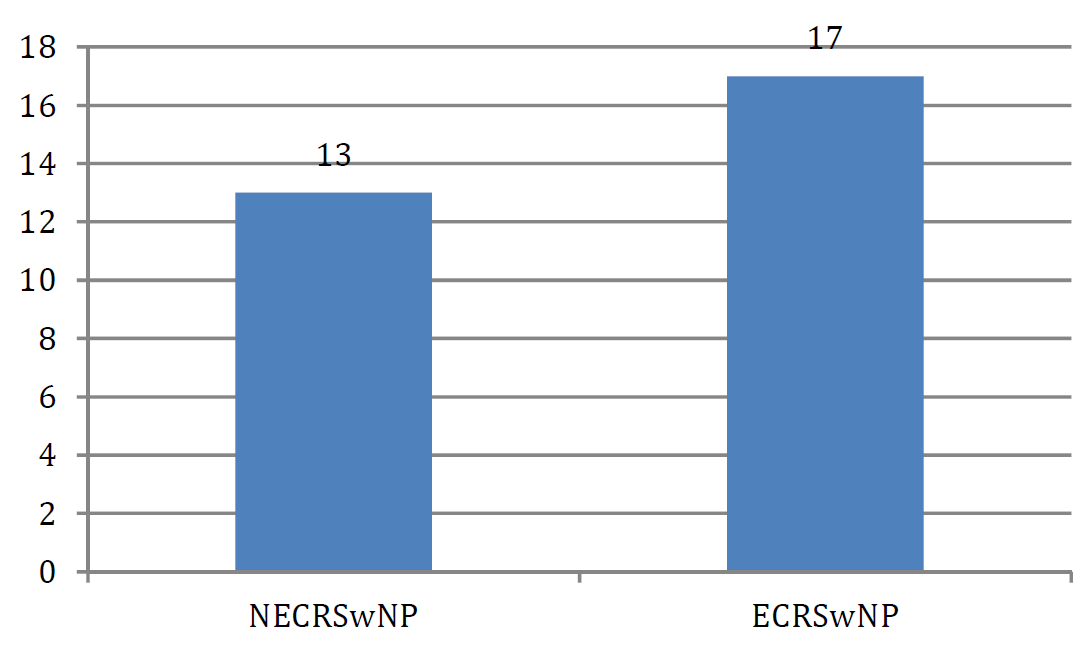
The present study was carried out in the Department of ENT, Head and Neck Surgery at Dr. RPGMC Tanda (Himachal Pradesh) from June 2018 to June 2019. A total of 30 patients were enrolled into the study. The results of which are as below: There were a total of 30 patients of Chronic Rhinosinusitis with Nasal Polyposis, out of which there were 16 males and 14 females with male to female ratio of 1.14:1. The mean age of all patients was 42.47±13.68 ranging from 21 to 79 years. The mean age of males was 45.88±13.3 and mean age of females was 38.57±13.53 which was less than that of males (Table 1). Among the total 30 patients, 17 were classified as Eosinophilic Chronic Rhinosinusitis with Nasal Polyposis (ECRSwNP) while 13 were classified as Non-Eosinophilic Chronic Rhinosinusitis with Nasal Polyposis (NECRSwNP) (Figure 1).


There were 9 cases of ECRSwNP where tissue eosinophils were >10/HPF while 8 cases had <10 tissue eosinophils/HPF. Similarly, 9 cases of NECRSwNP had <10 tissue eosinophils/HPF while 4 cases had tissue eosinophils were >10/HPF. The association between blood eosinophil count and tissue eosinophil grading was not significant with p value of 0.225 (Table 2).


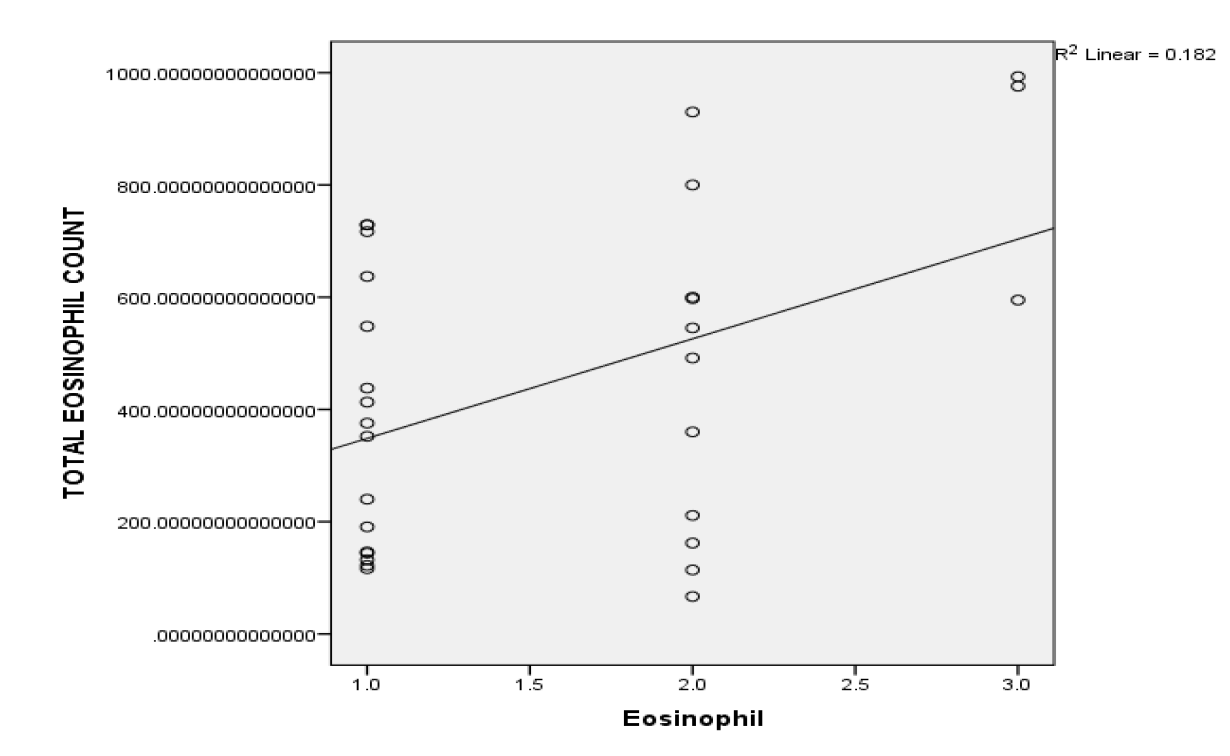
The scattered plot diagram also showed that there is positive relation between tissue eosinophil and peripheral eosinophil count but the relation is not significant (Figure 2).


Table 1: Age and Gender Wise Distribution of Patients

Gender

Frequency (Number)

Percentage

Mean Age ±SD

Range

Males

16

53.3

45.88±13.3

22-79

Females

14

46.7

38.57±13.53

21-65

Total

30

100

42.47±13.68

21-79


Table 2: Comparison of Peripheral Eosinophil Count with Tissue Eosinophil Count in CRS Patients with and without Eosinophilia


Blood Eosinophil Count

Tissue Eosinophil Grading

p value 

1+ (<10/Hpf)

2+ (>10/Hpf)

CRS Without Eosinophilia

9

4

0.225

CRS With Eosinophilia

8

9


Figure 1: Classification of Patients into ECRSwNP and NECRSwNP


Figure 2: Scattered Plot Diagram Showed Positive Relation between Tissue Eosinophil Count and Peripheral Eosinophil Count


DISCUSSION

The present study was carried out in the Department of ENT, Head and Neck Surgery at Dr. RPGMC Tanda (Himachal Pradesh) including 30 patients of Chronic Rhinosinusitis with Nasal Polyposis which were further classified into “Eosinophilic” and “Non eosinophilic” CRS with Nasal polyposis bases on operational definition.


In study by Cao PP et al. [10] the association of blood eosinophil count between NECRSwNP and ECRSwNP with tissue eosinophil was significant (P value <0.001) similar to another study by Aslan F. et al. [11] which observed significant association between tissue and peripheral eosinophilia (p value <0.001) while in our study, there was no significant association of blood eosinophil count between NECRSwNP and ECRSwNP with tissue eosinophil count and p value found was 0.225. This may be attributed due to smaller number of patients in study group and shorter study period than other similar studies. Also, this might be due to geographical variations and easy availability of medication without prescription in our health set up in India as our study group patients were more symptomatic compared to other study groups. 

CONCLUSION

Conclusion and Recommendation

In our study we did not find any significant correlation between the peripheral eosinophil count and tissue eosinophil count as on histological examination and the difference between eosinophilic and noneosinophilic group was also not found significant statistically. This could be due to smaller sample size, geographical variation and noncompliance with antihistaminics and INCS due to easy availability of non-prescriptive medication. So, a further larger sample size study is required to study the relation between peripheral eosinophil count and tissue eosinophil count.

REFERENCE
  1. Kumar, V. et al. Pathologic Basis of Disease. 7th ed., Saunders, 2004.

  2. Harlin, S.L. et al. “A clinical and pathological study of chronic sinusitis: Role of the eosinophil.” Journal of Allergy and Clinical Immunology, vol. 81, 1988, pp. 867–875.

  3. Bernardes, J.F. et al. “Protein nitration in chronic sinusitis and nasal polyposis: Role of eosinophils.” Otolaryngology–Head and Neck Surgery, vol. 131, no. 5, 2004, pp. 696–703.

  4. Bachert, C. et al. “Nasal polyposis: From cytokines to growth.” American Journal of Rhinology, vol. 14, no. 5, 2000, pp. 279–290.

  5. Cao, P.P. et al. “Distinct immunopathologic characteristics of various types of chronic rhinosinusitis in adult Chinese.” Journal of Allergy and Clinical Immunology, vol. 124, nos. 1–2, 2009, pp. 478–484.

  6. Kim, J.W. et al. “Histological and immunological features of non-eosinophilic nasal polyps.” Otolaryngology–Head and Neck Surgery, vol. 137, 2007, pp. 925–930.

  7. Ikeda, K. et al. “Subclassification of chronic rhinosinusitis with nasal polyp based on eosinophil and neutrophil.” Laryngoscope, vol. 123, 2013, pp. 1–9.

  8. Bryson, J.M. et al. “Local and systemic eosinophilia in patients undergoing endoscopic sinus surgery for chronic rhinosinusitis with and without polyposis.” Clinical Otolaryngology, vol. 28, 2003, pp. 55–58.

  9. Staikuniene, J. et al. “Association of chronic rhinosinusitis with nasal polyps and asthma: Clinical and radiological features, allergy and inflammation markers.” Medicina, vol. 44, no. 4, 2008, pp. 257–265.

  10. Cao, P.P. et al. “Distinct immunopathologic characteristics of various types of chronic rhinosinusitis in adult Chinese.” Journal of Allergy and Clinical Immunology, vol. 124, nos. 1–2, 2009, pp. 478–484.

  11. Aslan, F. et al. “Could eosinophilia predict clinical severity in nasal polyps.” Multidisciplinary Respiratory Medicine, vol. 12, August 2017, article 21.

Recommended Articles
Research Article
Advantages of Two Clips Laparoscopic Cholecystectomy (TCLC) and Conventional Laparoscopic Cholecystectomy (CLC): A Comparative Study
...
Published: 10/01/2022
Download PDF
Research Article
Bladder Brilliance: Unveiling the Tapestry of Knowledge on Bladder Cancer in District Kangra, Himachal Pradesh
...
Published: 08/12/2023
Download PDF
Research Article
A Gentle Start: Evaluating Knowledge of Erb’s Palsy and Brachial Plexus Injuries AmongHamirpur Residents
Published: 24/12/2024
Download PDF
Research Article
Awareness regarding Symptoms and Treatment Options for Benign hypertrophy of prostate among the male patients attending outpatient department of Civil hospital , Nurpur, Himachal Pradesh
Published: 26/05/2023
Download PDF
Chat on WhatsApp
Flowbite Logo
PO Box 101, Nakuru
Kenya.
Email: office@iarconsortium.org

Editorial Office:
J.L Bhavan, Near Radison Blu Hotel,
Jalukbari, Guwahati-India
Useful Links
Order Hard Copy
Privacy policy
Terms and Conditions
Refund Policy
Shipping Policy
Others
About Us
Team Members
Contact Us
Online Payments
Join as Editor
Join as Reviewer
Subscribe to our Newsletter
+91 60029-93949
Follow us
MOST SEARCHED KEYWORDS
Copyright © iARCON International LLP . All Rights Reserved.