Contents
Download PDF
pdf Download XML
1175 Views
392 Downloads
Share this article
Research Article | Volume 4 Issue 2 (July-Dec, 2023) | Pages 1 - 4
Exploring the Inflammatory Bowel Disease Awareness Landscape in District Moga, Punjab: A Comprehensive Study
 ,
1
Lecturer, Department of General Medicine, Genesis Dental College Hospital and Research Centre, Ferozepur, India
2
MD, International Higher School of Medicine (Kyrgyzstan), India
Under a Creative Commons license
Open Access
Received
June 3, 2023
Revised
July 9, 2023
Accepted
Aug. 19, 2023
Published
Sept. 20, 2023
Abstract

Background: Inflammatory Bowel Diseases (IBD), including Crohn's disease and ulcerative colitis, are complex, chronic gastrointestinal disorders with a rising global prevalence. Understanding IBD and its management is crucial for improving patient outcomes and healthcare resource utilization. This study aimed to assess IBD awareness and knowledge levels among the general population of District Moga, Punjab, considering the region's unique sociodemographic and cultural context. Materials and Methods: A cross-sectional survey was conducted in District Moga, Punjab, between January and March 2023. The study included 400 adult residents who had lived in the district for at least 12 months. A structured questionnaire was used to collect data on demographic characteristics and IBD knowledge. Data were analyzed using Epi Info V7 software, with results presented as frequencies and percentages. Results: The study revealed varying levels of IBD awareness and knowledge among participants. Approximately 16.25% demonstrated very good knowledge, 25.25% exhibited good knowledge, while 31.75% and 26.75% had fair and poor knowledge, respectively. These findings highlight the need for targeted educational interventions in District Moga to enhance overall IBD awareness. Regional disparities in knowledge levels underscore the importance of cultural and dietary factors in shaping IBD perceptions and management.Conclusion: This study provides valuable insights into IBD awareness in District Moga, Punjab. The findings emphasize the necessity for culturally sensitive educational programs aimed at improving IBD knowledge. By addressing this knowledge deficit, healthcare providers and policymakers can contribute to early diagnosis, reduced stigma, optimized healthcare resource utilization, and an enhanced quality of life for individuals living with IBD in the region.

Keywords
INTRODUCTION

Inflammatory Bowel Diseases (IBD), encompassing conditions such as Crohn's disease and ulcerative colitis, are chronic, debilitating gastrointestinal disorders characterized by inflammation of the digestive tract. These conditions are known to significantly affect the quality of life of those afflicted and pose substantial challenges to healthcare systems worldwide. The global prevalence of IBD has been steadily rising, with an estimated 3.4 million individuals affected in the United States alone. While IBD has garnered considerable attention in Western countries, our understanding of its prevalence, impact, and management in different regions, particularly in India, remains a complex and evolving landscape [1-4].


District Moga, nestled in the northwestern state of Punjab, India, presents a unique sociodemographic and cultural milieu that may significantly influence the perception and management of IBD. Punjab, renowned for its rich cultural heritage and distinct dietary practices, is poised to contribute valuable insights into the regional dynamics of IBD. Furthermore, healthcare infrastructure and accessibility to medical resources in Punjab play pivotal roles in shaping healthcare-seeking behaviors and disease management strategies [5,6].


This study seeks to bridge the knowledge gap by undertaking a comprehensive assessment of the levels of awareness and knowledge regarding Inflammatory Bowel Diseases among the general populace of District Moga, Punjab. By doing so, we aspire to uncover regional variations in IBD awareness, explore the influence of cultural factors on its management, and inform strategies for enhanced patient education and healthcare delivery tailored to this specific context. As IBD continues to emerge as a global healthcare challenge, it is essential to unravel its local dynamics and empower individuals and healthcare professionals in District Moga with the knowledge necessary to effectively manage this complex condition. The findings from this study have the potential to contribute to the development of targeted public health campaigns, educational initiatives, and healthcare policies, ultimately leading to improved IBD management and a better quality of life for those grappling with this condition in the region.


Objectives of the Study

The objective of this study is to gauge the levels of awareness and knowledge about Inflammatory Bowel Diseases among the general population of District Moga, Punjab

MATERIALS AND METHODS

Research Approach 

Descriptive


Research Design

Cross-sectional survey design


Study Area

District Moga, Punjab


Study Duration

Between January 2023 to March 2023


Study Population

The study's target population encompassed all adults aged 18 and above who had been residents of District Moga, Punjab for a minimum of 12 months


Sample Size

A robust sample size of 400 adults was determined using a 95% confidence level, an estimated knowledge level of 50% regarding Inflammatory Bowel Diseases, a precise 5% absolute error margin, and a conservative 5% non-response rate. 


Study Tool

A google form questionnaire consisting of questions regarding socio-demography and knowledge regarding Inflammatory Bowel Diseases was created. The questionnaire was initially pre-tested on a small number of participants to identify any difficulty in understanding by the respondents. 


Description of Tool

Demographic Data Survey Instrument: The demographic form elicited information on participants’ background: age, marital status, religion, employment, education and many more.


Questionnaire

The questionnaire contains 20 structured knowledge related questions regarding Inflammatory Bowel Diseases. One mark was given for each correct answer and zero for incorrect answer. The maximum score was 20 and minimum score was zero. Scoring was done on the basis of marks as >80% (16-20) = very good, 60-79% (12-15) = Good,41-59% (8-11) = Fair, <40% (< 8) = poor


Validity Of Tool 

By the experts in this field


Data Collection

Data was collected under the guidance of supervisors. The google form questionnaire was circulated among the residents of District Moga, Punjab for responses using online modes like e-mail and social media platforms like Whatsapp groups, Facebook, Instagram and Linkedin till the 400 responses were collected. 


Data Analysis

Data was collected and entered in Microsoft excel spread sheet, cleaned for errors and analyzed with Epi Info V7 Software with appropriate statistical test in terms of frequencies and percentage. 


Ethical Considerations

Participants confidentiality and anonymity was maintained. 

RESULTS

The primary objective of this study was to gauge the understanding of Inflammatory Bowel Diseases among the general population of District Moga, Punjab. A total of 400 participants took part in the study, with 290 (72.50%) residing in urban areas and 110 (27.50%) in rural areas (Table 1).


Table 1: Knowledge Regarding Inflammatory Bowel Diseases among Study Participants

S. No.

Statements

Frequency of Correct Responses

Percent
  1.  

What are Inflammatory Bowel Diseases (IBD), and can you name the two primary types of IBD?

178

44.5

  1.  

Can you explain the key differences between Crohn's disease and ulcerative colitis?

105

26.25

  1.  

What are some common symptoms of IBD?

157

39.25

  1.  

Are there any known risk factors for developing IBD?

44

11

  1.  

How is IBD diagnosed by healthcare professionals?

101

25.25

  1.  

Are there any dietary or lifestyle factors that can influence the development or exacerbation of IBD symptoms?

128

32

  1.  

Can you name some potential complications of IBD?

76

19

  1.  

What are some of the available treatment options for managing IBD?

92

23

  1.  

How does IBD impact a person's quality of life?

128

32

  1.  

Are there any known genetic factors associated with IBD?

11

2.75

  1.  

Can you describe the difference between a flare-up and remission in IBD?

39

9.75

  1.  

What role does inflammation play in IBD, and how does it affect the digestive system?

67

16.75

  1.  

Are there any known environmental factors that might contribute to the development of IBD?

42

10.5

  1.  

How can stress and mental health impact IBD symptoms and management?

69

17.25

  1.  

Are there any non-gastrointestinal symptoms associated with IBD?

83

20.75

  1.  

What is the relationship between IBD and colorectal cancer?

24

6

  1.  

Can you explain the concept of a "gut microbiome" and its relevance to IBD?

16

4

  1.  

What are some common medications used to treat IBD, and what are their potential side effects?

75

18.75

  1.  

Are there any surgical options for individuals with severe IBD, and when might surgery be considered?

48

12

  1.  

How can someone support a friend or family member who has been diagnosed with IBD?

21

5.25


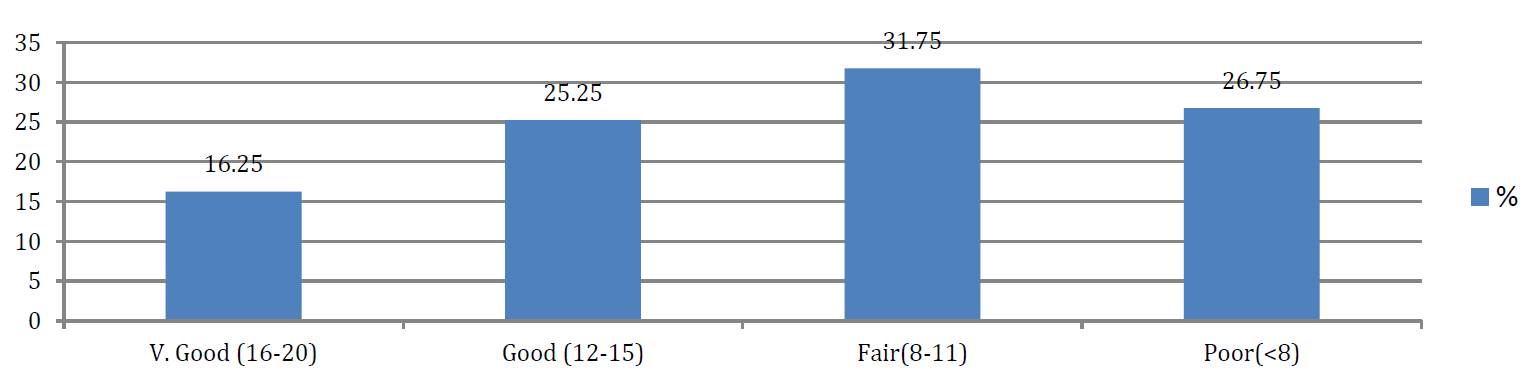
In the present study 16.25% (65) participants had very good knowledge (16-20 marks) towards Inflammatory Bowel Diseases, 25.25% (101) had good knowledge (12-15 marks), 31.75% (127) had fair knowledge (8-11 marks) and 26.75% (107) having poor knowledge (<8 marks) (Figure 1).


Figure 1: Knowledge Scores towards Inflammatory Bowel Diseases among Study Participants

DISCUSSION

The findings of this study provide valuable insights into the awareness and knowledge levels concerning Inflammatory Bowel Diseases (IBD) among the general population of District Moga, Punjab. IBD, encompassing conditions like Crohn's disease and ulcerative colitis, constitutes a complex healthcare challenge that necessitates a thorough understanding among both the public and healthcare professionals for effective management and improved quality of life.


The study results reveal a diverse spectrum of knowledge levels among the participants. Approximately 16.25% of the respondents demonstrated a very good understanding of IBD, scoring between 16 to 20 points on the knowledge assessment. This group exhibited a comprehensive grasp of IBD, including its types, symptoms, risk factors, and management strategies. Another 25.25% showed good knowledge, indicating a solid foundation in IBD-related information. Nevertheless, it is noteworthy that a significant portion of the population exhibited fair (31.75%) or poor (26.75%) knowledge, scoring below 12 points.


This distribution of knowledge levels underscores the need for tailored educational interventions in District Moga to elevate overall IBD awareness. Educational campaigns should not only target the general populace but also prioritize subgroups with lower knowledge levels, aiming to bridge the knowledge gap and ensure a more informed community.


District Moga's unique cultural and sociodemographic landscape in Punjab introduces an intriguing dimension to the findings. Punjab is celebrated for its distinctive cultural heritage and dietary practices, which might impact the prevalence and management of gastrointestinal disorders, including IBD. Although this study did not directly explore the influence of dietary factors on IBD knowledge, future research could delve into this aspect, as it holds the potential to tailor dietary recommendations to local preferences [6-9]. Comparing the study's findings with research conducted in other regions reveals significant variations in IBD awareness levels. Studies conducted in Western countries, where extensive research on IBD has been undertaken, often report higher levels of awareness and knowledge. In contrast, studies in regions with limited exposure to IBD-related information may reveal lower levels of understanding, as seen in the present study [10-12].


These regional disparities underscore the importance of region-specific educational campaigns. Strategies for disseminating information should consider cultural nuances and dietary practices that can influence the perception and management of IBD. By adapting successful models from other regions while accommodating the local context, healthcare providers and policymakers can develop effective awareness and education initiatives tailored to the unique needs of District Moga.


The study's findings carry significant implications for healthcare providers, public health authorities, and policymakers in District Moga. It is evident that there is a substantial scope for improvement in IBD awareness and knowledge levels among the population. Addressing this knowledge deficit is critical for several reasons:


  • Timely Diagnosis and Management: Increased awareness can lead to the early recognition of IBD symptoms, motivating individuals to seek medical evaluation and diagnosis. Timely intervention can enhance IBD management and improve patients' quality of life

  • Reduced Stigma: Raising awareness can reduce the stigma associated with gastrointestinal disorders, fostering a more supportive and understanding community for individuals living with IBD

  • Optimized Healthcare Resource Utilization: A well-informed population is more likely to use healthcare resources efficiently, reducing unnecessary visits and tests, which can be beneficial both for patients and the healthcare system

  • Enhanced Quality of Life: Empowering individuals with knowledge about IBD can help them make informed lifestyle choices and dietary decisions, potentially alleviating symptoms and enhancing their overall quality of life


To address these implications, healthcare providers, in collaboration with public health agencies, can design and implement culturally sensitive educational programs. These programs should not only target the general population but also focus on healthcare professionals to ensure accurate diagnosis and management of IBD.
CONCLUSION

In conclusion, this study sheds light on the current levels of awareness and knowledge regarding Inflammatory Bowel Diseases within District Moga, Punjab. While some participants exhibited a strong understanding of IBD, a substantial proportion had limited knowledge. These findings underscore the need for region-specific educational initiatives that consider cultural factors and dietary practices. By enhancing IBD awareness and knowledge, we can improve the diagnosis, management, and quality of life for individuals grappling with IBD in District Moga.

REFERENCE
  1. Kaplan, G.G. and S.C. Ng. “Understanding and preventing the global increase of inflammatory bowel disease.” Gastroenterology, vol. 152, no. 2, 2017, pp. 313–321.

  2. Loftus Jr, E.V. “clinical epidemiology of inflammatory bowel disease: Incidence, prevalence, and environmental influences.” Gastroenterology, vol. 126, no. 6, 2004, pp. 1504–1517.

  3. Dahlhamer, J.M. et al. “prevalence of inflammatory bowel disease among adults aged ≥18 years—United States, 2015.” MMWR. Morbidity and Mortality Weekly Report, vol. 65, no. 42, 2016, pp. 1166–1169.

  4. Lakhanpal, S. “Influence of punjabi diet on health.” International Journal of Science, Environment, and Technology, vol. 7, no. 4, 2018, pp. 1311–1313.

  5. Ng, S.C. et al. “worldwide incidence and prevalence of inflammatory bowel disease in the 21st century: A systematic review of population-based studies.” The Lancet, vol. 390, no. 10114, 2017, pp. 2769–2778.

  6. Ananthakrishnan, A.N. “Epidemiology and risk factors for IBD.” Nature Reviews Gastroenterology & Hepatology, vol. 12, no. 4, 2015, pp. 205–217.

  7. Molodecky, N.A. et al. “Increasing incidence and prevalence of the inflammatory bowel diseases with time, based on systematic review.” Gastroenterology, vol. 142, no. 1, 2012, pp. 46–54.

  8. Cholapranee, A. et al. “What should we tell our patients with IBD about pregnancy and breastfeeding?” Inflammatory Bowel Diseases, vol. 23, no. 5, 2017, pp. 724–731.

  9. Molodecky, N.A. et al. “Increasing incidence and prevalence of the inflammatory bowel diseases with time, based on systematic review.” Gastroenterology, vol. 142, no. 1, 2012, pp. 46–54.

  10. Rubin, D.T. et al. “ACG clinical guideline: Ulcerative colitis in adults.” The American Journal of Gastroenterology, vol. 114, no. 3, 2019, pp. 384–413.

  11. Torres, J. et al. “ECCO guidelines on therapeutics in crohn’s disease: Medical treatment.” Journal of Crohn’s and Colitis, vol. 14, no. 1, 2020, pp. 4–22.

  12. Lamb, C.A. et al. “British society of gastroenterology consensus guidelines on the management of inflammatory bowel disease in adults.” Gut, vol. 68, suppl. 3, 2019, pp. s1–s106.


Recommended Articles
Research Article
The Efficacy of 5- Fluorouracil Cream and 25% Podophyllin Solution in Treatment of Plantar Warts in Alternative Day Regimen ; An Open Therapeutic Trial.
Download PDF
Research Article
An evaluation of Profile of Medico-legal autopsies conducted at Dr. Radhakrishnan Govt. Medical College, Hamirpur, Himachal Pradesh
Download PDF
Research Article
Imaging Evaluation of Ultrasonography Versus Magnetic Resonance, Imaging in Diagnosis of Carpal Tunnel Syndrome among Female Patients with Positive Nerve Conduction Study
Download PDF
Research Article
Twisted Truths: Public Awareness of Ligament Injuries and Sports-Related Orthopedic Trauma in Kangra
...
Published: 05/04/2025
Download PDF
Chat on WhatsApp
Flowbite Logo
PO Box 101, Nakuru
Kenya.
Email: office@iarconsortium.org

Editorial Office:
J.L Bhavan, Near Radison Blu Hotel,
Jalukbari, Guwahati-India
Useful Links
Order Hard Copy
Privacy policy
Terms and Conditions
Refund Policy
Shipping Policy
Others
About Us
Team Members
Contact Us
Online Payments
Join as Editor
Join as Reviewer
Subscribe to our Newsletter
+91 60029-93949
Follow us
MOST SEARCHED KEYWORDS
Copyright © iARCON International LLP . All Rights Reserved.