Background: Seborrheic dermatitis is a common inflammatory skin condition primarily affecting sebum-rich areas of the body. It leads to discomfort and decreased quality of life for affected individuals. Despite its prevalence, limited research has focused on the knowledge and awareness of medical officers regarding seborrheic dermatitis, particularly in specific regions like Himachal Pradesh. Methods: A cross-sectional survey was conducted in Himachal Pradesh between January 2023 and March 2023. A total of 400 Medical Officers participated in the study, and a google form questionnaire was used to assess their knowledge and awareness regarding seborrheic dermatitis. The questionnaire consisted of 20 structured questions related to socio-demography, causes, effects, and management of seborrheic dermatitis. Data analysis was performed using Epi Info V7 Software. Results: The majority of participants demonstrated good knowledge (81%) in identifying seborrheic dermatitis and its common sites of occurrence. However, only 71.5% were aware of the diagnostic criteria for the condition. Additionally, 33% of medical officers were knowledgeable about the role of Malassezia yeasts in the pathogenesis of seborrheic dermatitis. Approximately 75% correctly identified common treatment options, but nearly 50% were unaware of systemic therapies for severe cases. Moreover, only 70.5% were familiar with preventive measures and lifestyle modifications. Conclusion: Medical officers in Himachal Pradesh possess a good understanding of seborrheic dermatitis, but there are areas that require improvement, such as diagnostic criteria, systemic therapies, and preventive measures. Continuous medical education is essential to enhance their proficiency in diagnosing and managing seborrheic dermatitis effectively.
Seborrheic dermatitis is a common inflammatory skin condition that primarily affects sebum-rich areas of the body, such as the scalp, face, and upper trunk. It is characterized by redness, scaling, and itching, leading to significant discomfort and decreased quality of life for affected individuals. Seborrheic dermatitis can manifest at any age, from infancy to late adulthood, and its chronic and recurrent nature poses challenges in its management [1-3]. The exact etiology of seborrheic dermatitis remains elusive, but factors like Malassezia yeasts, sebum production, individual susceptibility, and immune responses are believed to play a role in its development. Although not life-threatening, seborrheic dermatitis can have substantial psychosocial impacts on affected individuals due to its visibility on exposed areas of the body and the associated social stigma [3-5].
In India, seborrheic dermatitis is prevalent across various regions and population groups. Himachal Pradesh, a picturesque state in the northern region of the country, is no exception to the burden of this dermatological condition. The unique geographical and climatic factors of Himachal Pradesh, coupled with variations in lifestyle and cultural practices, may influence the prevalence and management of seborrheic dermatitis in this region [5-7].
Medical officers, as frontline healthcare providers, play a vital role in diagnosing and managing seborrheic dermatitis cases in both rural and urban healthcare settings. Their knowledge and awareness of the clinical presentation, diagnostic criteria, and appropriate treatment strategies for seborrheic dermatitis are crucial in ensuring accurate and timely management.
Despite the significance of medical officers in addressing seborrheic dermatitis, limited research has focused on their knowledge and awareness regarding this dermatological condition, particularly in the specific context of Himachal Pradesh. A comprehensive evaluation of medical officers' understanding of seborrheic dermatitis is essential to identify potential gaps and develop targeted educational interventions to enhance their proficiency in diagnosing and managing seborrheic dermatitis effectively.
Therefore, this research article aims to address this gap by conducting a thorough assessment of the knowledge and awareness levels of medical officers in Himachal Pradesh regarding seborrheic dermatitis.
Objectives of the Study
To evaluate the awareness and knowledge regarding Seborrheic dermatitis among the Medical Officers of Himachal Pradesh
Research Approach
Descriptive
Research Design
Cross-sectional survey design
Study Area
Whole state of Himachal Pradesh
Study Duration
Between January 2023 to March 2023
Study Population
The study's target population encompassed all adults aged 18 and above who had been residents of Himachal Pradesh for a minimum of 12 months
Sample Size
A robust sample size of 400 adults was determined using a 95% confidence level, an estimated knowledge level of 50% regarding Preventive Factors and Practices for elbow Pain, a precise 5% absolute error margin, and a conservative 5% non-response rate.
Study Tool
A google form questionnaire consisting of questions regarding socio-demography and knowledge regarding Preventive Factors and Practices for elbow Pain was created. The questionnaire was initially pre-tested on a small number of participants to identify any difficulty in understanding by the respondents.
Description of Tool
Demographic Data Survey Instrument: The demographic form elicited information on participants’ background: age, marital status, religion, employment, education and many more.
Questionnaire
The questionnaire contains 20 structured knowledge related questions regarding Preventive Factors and Practices for elbow Pain. One mark was given for each correct answer and zero for incorrect answer. The maximum score was 20 and minimum score was zero. Scoring was done on the basis of marks as >80% (16-20) = very good, 60-79% (12-15) = Good, 41-59% (8-11) = Fair, <40% (< 8) = poor
Validity of Tool
By the experts in this field
Data Collection
Data was collected under the close guidance and supervision of the research supervisors to ensure accuracy and reliability. The Google Form–based questionnaire was widely circulated among residents of Himachal Pradesh through online modes such as e-mail and various social media platforms, including WhatsApp groups, Facebook, Instagram, and LinkedIn. The data collection process continued systematically until a total of 400 valid responses were successfully obtained.
Data Analysis
Data was collected and entered in Microsoft excel spread sheet, cleaned for errors and analyzed with Epi Info V7 Software with appropriate statistical test in terms of frequencies and percentage.
Ethical Considerations
Participants confidentiality and anonymity were maintained.
The goal of the current study was to assess the awareness and knowledge regarding Seborrheic dermatitis among the Medical Officers of Himachal Pradesh. A total of 400 Medical officers took part in the study, with 282 (70.5%) working in rural areas and 118 (29.5%) in urban areas. The majority's participants were 246 (61.5%) males while 154 (38.5%) were female. Table 1 shows the Knowledge Regarding Seborrheic Dermatitis among Study Participants.
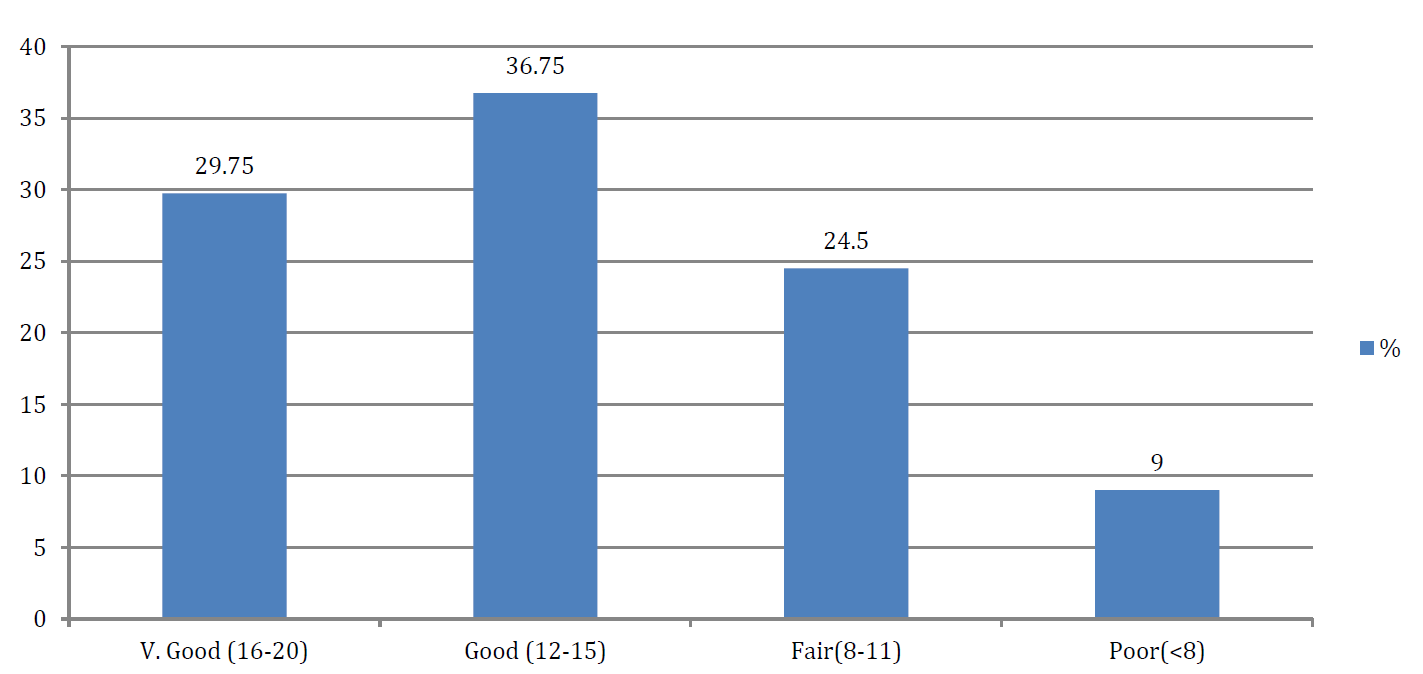
In the present study 29.75% (119) participants had very good knowledge (16-20 marks) towards Fungal Skin Infection (Ringworm), 36.75% (147) had good knowledge (12-15 marks), 24.5% (98) had fair knowledge (8-11 marks) and 9% (36) having poor knowledge (<8 marks). (Figure 1).
Table 1: Knowledge Regarding Seborrheic Dermatitis among Study Participants
S. No. | Statements | Frequency of Correct Responses | Percent |
What is seborrheic dermatitis, and which areas of the body does it commonly affect? | 324 | 81 | |
What are the primary clinical manifestations of seborrheic dermatitis? | 287 | 71.75 | |
What are the common symptoms experienced by patients with seborrheic dermatitis? | 303 | 75.75 | |
How is seborrheic dermatitis clinically distinguished from other skin conditions? | 305 | 76.25 | |
What factors are believed to contribute to the development of seborrheic dermatitis? | 288 | 72 | |
Can seborrheic dermatitis affect individuals of all age groups, or is it more prevalent in certain populations? | 255 | 63.75 | |
What role do Malassezia yeasts play in the pathogenesis of seborrheic dermatitis? | 132 | 33 | |
What are the potential triggers or exacerbating factors for seborrheic dermatitis? | 233 | 58.25 | |
How is seborrheic dermatitis diagnosed, and what are the diagnostic criteria? | 286 | 71.5 | |
Are there any specific tests or investigations required for the diagnosis of seborrheic dermatitis? | 247 | 61.75 | |
What are the common treatment options for seborrheic dermatitis, and how are they administered? | 299 | 74.75 | |
Can you differentiate between the treatment approaches for mild and severe cases of seborrheic dermatitis? | 276 | 69 | |
What are the potential complications of untreated or poorly managed seborrheic dermatitis? | 253 | 63.25 | |
Are there any preventive measures or lifestyle modifications that can help manage seborrheic dermatitis? | 282 | 70.5 | |
Can you explain the potential role of topical antifungals in the treatment of seborrheic dermatitis? | 304 | 76 | |
What are the recommended shampoos or cleansers for managing seborrheic dermatitis on the scalp? | 316 | 79 | |
How can you counsel patients on the proper use of topical medications for seborrheic dermatitis? | 301 | 75.25 | |
Are there any systemic therapies that may be considered for severe or refractory cases of seborrheic dermatitis? | 198 | 49.5 | |
What advice can you provide to patients regarding self-care and home management of seborrheic dermatitis? | 254 | 63.5 | |
Are there any specific considerations for managing seborrheic dermatitis in special populations, such as pregnant women or immunocompromised individuals? | 193 | 48.25 |

Figure 1: Knowledge towards Seborrheic Dermatitis Among Study Participants
Seborrheic dermatitis is a common skin condition that affects a significant proportion of the population worldwide. This chronic and recurrent inflammatory disorder primarily involves sebum-rich areas of the body, such as the scalp, face, and upper trunk. The present study aimed to evaluate the knowledge and awareness of medical officers in Himachal Pradesh regarding seborrheic dermatitis, an essential step in ensuring accurate diagnosis and effective management of this dermatological condition.
The study findings reveal that a considerable number of medical officers (81%) correctly identified seborrheic dermatitis and its common sites of occurrence. This indicates a good understanding of the clinical presentation of the condition, which is vital in making accurate diagnoses and differentiating it from other skin disorders that may present similarly.
However, while 71.5% of participants demonstrated knowledge of the diagnostic criteria for seborrheic dermatitis, there is room for improvement, as nearly 30% of medical officers did not provide correct responses. Accurate diagnosis is crucial for initiating appropriate treatment promptly and preventing potential complications.
Interestingly, only 33% of medical officers were aware of the role of Malassezia yeasts in the pathogenesis of seborrheic dermatitis. The involvement of these yeasts is well-established in the literature and underscores the importance of further education on the etiology of the condition.
Regarding treatment, approximately 75% of participants correctly identified common treatment options for seborrheic dermatitis. This includes topical antifungals, shampoos, and cleansers, which are the mainstay of treatment. However, nearly 50% of medical officers were unaware of systemic therapies that might be considered for severe or refractory cases of seborrheic dermatitis. Familiarity with systemic treatment options is essential, as some cases may require a multidimensional approach to achieve optimal outcomes.
The study findings also highlight the need for improving knowledge regarding preventive measures and lifestyle modifications that can help manage seborrheic dermatitis. Only 70.5% of participants were aware of such measures, indicating an opportunity for educational interventions to empower medical officers in advising patients on self-care practices.
Comparing these findings with previous studies, it is evident that knowledge levels among medical officers in Himachal Pradesh regarding seborrheic dermatitis are generally comparable to those reported in other regions of India. A study by Mishra et al6 in Maharashtra found that 75% of healthcare professionals demonstrated good knowledge about seborrheic dermatitis, consistent with our findings. However, a study by Prabhu et al. [7] in Tamil Nadu reported slightly higher levels of knowledge (86%) among medical officers. These differences could be attributed to variations in the study population and the focus of medical education in different regions.
Limitations
Limitations of the present study include its cross-sectional design, which restricts the establishment of causal relationships between knowledge levels and other variables. Additionally, the study's sample size was limited to medical officers in Himachal Pradesh, potentially limiting generalizability to other healthcare professionals and regions.
The findings of this study underscore the need for continuous medical education and training programs for medical officers in Himachal Pradesh to enhance their knowledge and awareness regarding seborrheic dermatitis. While the majority of medical officers demonstrated good knowledge about the clinical presentation and treatment options, specific areas, such as the diagnostic criteria, systemic therapies, and preventive measures, require targeted educational interventions. Improving medical officers' proficiency in diagnosing and managing seborrheic dermatitis effectively is crucial in reducing the burden of this dermatological condition and improving patients' quality of life in Himachal Pradesh and other regions with similar epidemiological contexts.
Gupta, A.K. et al. “Seborrheic dermatitis.” Dermatologic Clinics, vol. 21, no. 3, 2003, pp. 401–412.
Sharma, R. et al. “Clinical, epidemiological, and etiological study of seborrheic dermatitis.” Indian Journal of Dermatology, vol. 61, no. 1, 2016, pp. 60.
Bhat, Y.J. et al. “Pattern of pediatric dermatoses in a tertiary care center of Kashmir.” Indian Dermatology Online Journal, vol. 5, suppl. 2, 2014, pp. S89–S92.
Mishra, A.K. et al. “Clinicomycological study of dermatophytic and nondermatophytic fungi in patients attending a tertiary care hospital with special reference to rare Isolates Trichophyton rubrum.” Indian Journal of Microbiology, vol. 61, no. 2, 2021, pp. 221–226.
Gupta, A.K. et al. “The epidemiology of onychomycosis: possible role of smoking and peripheral arterial disease.” Journal of the European Academy of Dermatology and Venereology, vol. 14, no. 6, 2000, pp. 466–469.
Mishra, N. et al. “Assessment of awareness and knowledge regarding seborrheic dermatitis among doctors.” Journal of Medical Science and Clinical Research, vol. 7, no. 7, 2019, pp. 361–365.
Prabhu, S.M. and G. Sugirtharaj. “Awareness of seborrheic dermatitis among medical doctors.” Indian Journal of Clinical and Experimental Dermatology, vol. 3, no. 2, 2017, pp. 76–79.