Data from 120 rural families was collected to know the Clothing purchase pattern of rural families for marriage/occasional use. It was found that regarding occasional purchase, most of the respondents prefer to buy from shops in their own cities. Majority (80%) of the respondents reported that individuals and parents collectively took the decision for the type and number of clothing items to be purchased for occasions like marriage. About 62.58 per cent of the respondents spent ₹ 1-3 lac on purchase of trousseau and other clothing. Wedding events, newspapers/magazines, internet and fair/mela were used as an inspiration source for trousseau planning by the respondents. Family members played a major role in trousseau planning, as reported by 93.33 per cent of the respondents. For purchasing trousseau articles, various speciality stores were used by 85 per cent of the respondents.
Keywords
Buying Behaviour
Respondents
Wedding Event
Occasion
Trousseau
Extravagant Weddings
INTRODUCTION
Clothing is one of the means of achieving social and economic status in a society and fulfils the comfort and luxury aspects of human wants besides being a necessity. Clothing plays a very important role in an individual’s personality at all the stages of life. They provide a means of self-expression and aesthetic enjoyment to the wearer.
Clothing has an important function at the different stages of life cycle mainly at the time of marriage. In marriage, clothing becomes not only a major part of expenditure, but also an important area of personal satisfaction and social identification [1]. The clothes needed by the bride and groom for the wedding and associated activities depends upon many factors like the type of wedding, the customs of the community, the clothing taste of the families, the clothes which the couple have on hand and the wedding budget of the families [2]. With the current trend towards extravagant weddings at all income levels, there is a temptation to fall into the popular pattern of spending. Many families who can’t afford high elaborate wedding, do so under the social pressures, therefore they often get involved in buying on credit that requires months and years to repay [3]. Now a days, stars are being treated as a role model. Individuals are changing their dressing style related with their favourite superstar. This thing makes a great effect on the purchasing behaviour of the people and have an incredible effect on perception of consumers while selecting any product [4].
Clothing and fashion have undergone several transformations reflecting the changing social, political, religious and economic forces. The varying changes in the society have brought transition in the trousseau as well as clothing in general. Today, technological advancement in every sector provides more opportunities to shop as the consumers are more aware about latest trends. Moreover, these trends are quickly spread through internet, wedding events, television, exhibitions etc [5].
MATERIALS AND METHODS
A sub-mountaineous area of Hoshiarpur district was selected for the study. Two blocks namely Talwara and Hazipur from Tehsil Mukerian and Dasuya and Hoshiarpur from Tehsil Hoshiarpur were selected. Then from each tehsil, three villages were selected using stratified random sampling technique. A total of 30 respondents (families) from each block (10 from each village) were selected, making it a total of 120 families. A snow ball sampling technique was used to select the families where marriage of any family member (male/female) has been solemnised within last three years.
An interview schedule was developed for obtaining the relevant information. The information regarding clothing buying practices of rural families for marriage clothing was recorded. The data obtained through interview schedule were coded and tabulated. Frequency and percentages were computed in order to interpret the results in comprehensive manner.
RESULTS AND DISCUSSION
Buying practices refers to the decision and acts people undertake to buy products or services (both online or offline) for individual or group use. This process may include consulting search engines, engaging with social media posts, or a variety of other actions.
Data in Table 1shows different locations/places like own town/city shop and another town/city shops used by the respondents for buying occasional clothing items. All the respondents (100%) preferred to buy salwar suits from their own town/city shops whereas 16.67 per cent also bought from another town/city shops. About 58.33 per cent of the respondents went for lehnga choli from their own city shops followed by another city shops for the same as reported by 12.50 per cent of the respondents.
Table 1: Places Preferred for Buying Marriage/Occasional Clothes n=120*
Garments
Own town/ city shops F (%)
Another town/ city shops F (%)
Salwar suits
120 (100.00)
20 (16.67)
Lehnga choli
70 (58.33)
15 (12.50)
Gharara/Shrara
5 (4.17)
17 (14.17)
Gown/dress
17 (14.17)
10 (8.33)
Saree
5 (4.17)
12 (10.00)
Phulkari
10 (8.33)
55 (45.83)
Woollen
60 (50.00)
40 (33.33)
Coat suit
38 (31.67)
52 (43.33)
Pant shirt
55 (45.83)
70 (58.33)
Footwear
45 (37.50)
62 (51.67)
Jewellery
70 (58.33)
60 (50.00)
Miscellaneous
78 (65.00)
62 (51.67)
Figure in parentheses indicates percentages
Only 14.17 per cent chose for dress or gowns for occasional use (marriage or reception party) and bought from another city shops. Phulkari’s were mainly preferred from Patiala, Ludhiana or other cities by 45.83 per cent of the respondents. Woollens (shawl, stole, muffler, sweaters, cardigans etc) were purchased from their own town/city shops and another city shops by 50.00 and 33.33 per cent of the respondents, respectively.
For gent’s coat suits, good shops in another nearby towns/cities were mainly preferred by 43.33 per cent followed by own town/city shops (31.67%) by the respondents for the marriage or other formal occasions. Similar trend was observed for pant shirts. Foot wear for formal use were again preferred from another city shops (51.67%) along with their own town/city shops where good brands were available. For jewellery, both own town/city shops (58.33%) and another town/city shops (50.00%) were sometimes mainly preferred by the respondents as they found good designs in another city shops. Majority of the respondents went for miscellaneous items (women’s purse, belts, wallet, watch, neck ties, scarf, lingerie’s etc) from their own town/city shops.
Clothing choice of consumers gets affected by various sources like advertisements, exhibitions, window display, catalogues etc. Data in Table 2 shows that window/store front and TV/movies, sometimes influence the choice of 68.33 and 50.00 per cent of the respondents, respectively. The clothing choice of 73.33 and 58.33 per cent of the respondents also got influenced by advertisements and internet/cyber-mall. Newspaper /leaflets and hoardings/wall posters rarely influenced the clothing choice of 43 and 50.00 per cent of the respondents. Almost fifty per cent of the respondents reported that they were often influenced by the sales person.
For marriage, number of clothing items are to be decided and purchased by the families. Data in Figure 1 shows the decision makers for the planning and purchase of trousseau items.
Table 2: Influence Of Informational Sources on Marriage/Occasional Clothing Choice of The Family n=120
Sources
Often F (%)
Sometimes F (%)
Rarely F (%)
Never F (%)
Window display/store front
6 (5.00)
82 (68.33)
20 (16.67)
12 (10.00)
Television/Movies
5(4.17)
60(50.00)
30(25.00)
25(20.83)
Advertisements
7(5.83)
88(73.33)
19(15.83)
6(5.00)
Newspaper/Leaflets
10(8.33)
15(12.50)
52(43.33)
43(35.84)
Hoarding/Wall posters
20(16.67)
28(23.33)
60(50.00)
12(10.00)
Internet/Cyber mall
10(8.33)
70(58.33)
25(20.83)
15 (12.50)
Influence of sales person
62(51.67)
30(25.00)
20(16.67)
8 (6.66)
Figure in parentheses indicates
Figure 1: Decision Maker for Planning and Purchase of Trousseau Items
Majority (80.40%) of the respondents reported that individuals and parents collectively took the decision for the type and number of clothing and other items to be purchased for occasions like marriage. Individual, parents and relatives’ decisions regarding trousseau/occasional clothing purchase were reported by 10.2 per cent of the respondents. Although parents and relatives also took decision about marriage purchase that was reported by only 5 per cent of the respondents. Individual and parents alone also decided about trousseau articles but reported by very few per cent age (3.00 and 1.40) of the respondents. Kaur in her study also reported that more than 54 per cent of the respondents were in favour of joint decision by individuals and their parents. Only very few of them were of the view that collective decision by individual, parents and relatives should be preferred as it was very difficult to take joint decision.
A considerable amount of money is spent by people on purchase of trousseau (including jewellery, footwear, home furnishings etc) and other clothing items. Data in Figure 2 elucidates that about 62.58 per cent of the respondents spent ₹ 1-3 lac followed by 15.00 per cent, who just spent ₹ 3-5 lac on trousseau purchases, respectively.
Figure 2: Money Spent by the Families on Trousseau
Very less per cent age (14.25%) of the respondents spent less than Rs.1 lac, whereas only 8.17 per cent spent more than Rs 5 lac on trousseau purchases. The reason reported by the respondents for spending less than Rs 1 lac on trousseau was low family income and those who spent more than Rs 5 lac reported that they just spent that amount to fulfil the needs of their child and to show off their status in the society and relatives.
Various impersonal inspirational sources were used while planning trousseau which includes newspapers/magazines, Fair/ mela, wedding and other events, internet etc. Figure 3 depicts that first rank was given to wedding events (attending weddings, shagun, reception parties of relatives or others) with weighted mean score of 3.61 and this was followed by newspapers/magazines (advertisements regarding different products), with weighted mean score 3.57 (rank II). Internet and fair/Mela were the other sources used as an inspiration source for trousseau planning. Kaur 2018 also reported that wedding events were main inspirational source followed by newspapers and magazines for trousseau planning.
Figure 3: Impersonal Inspirational Sources used for Trousseau Planning
Obsession depends upon age, electronic and print media and more importantly how we are following our cultural and societal norms. Data in Figure 4 depicts the multiple response for influencers of trousseau planning.
Figure 4: Influencers of Trousseau Planning
Family members played a major role in trousseau planning, that included number of different items, their type, including price as well as clothing as reported by 93.33 per cent of the respondents. This was followed by relatives and friends who also influenced the planning of trousseau as reported by 88.33 and 16.67 per cent of the respondents, respectively. Kaur in her study on intergenerational transition of trousseau practices among women of Punjab also reported that family members were the main influencing force in both the generations for trousseau planning.
Different sources used for procuring trousseau articles from the market are given in Figure. 5 These include speciality/variety stores, discounted stores, exhibitions and boutiques. Respondents used multiple sources for purchasing trousseau related articles. Majority of the respondents (85%) used speciality/variety stores (who exclusively have wedding products range) which was followed by discounted stores with 69.17 per cent of the respondents. Exhibitions and boutiques were other sources used by only 11.67 and 6.66 per cent of the respondents, respectively for purchasing trousseau articles. Kaur also stated that speciality stores were the main choice for purchase of trousseau articles by both the generations.
Figure 5: Sources used for Procuring Trousseau Articles
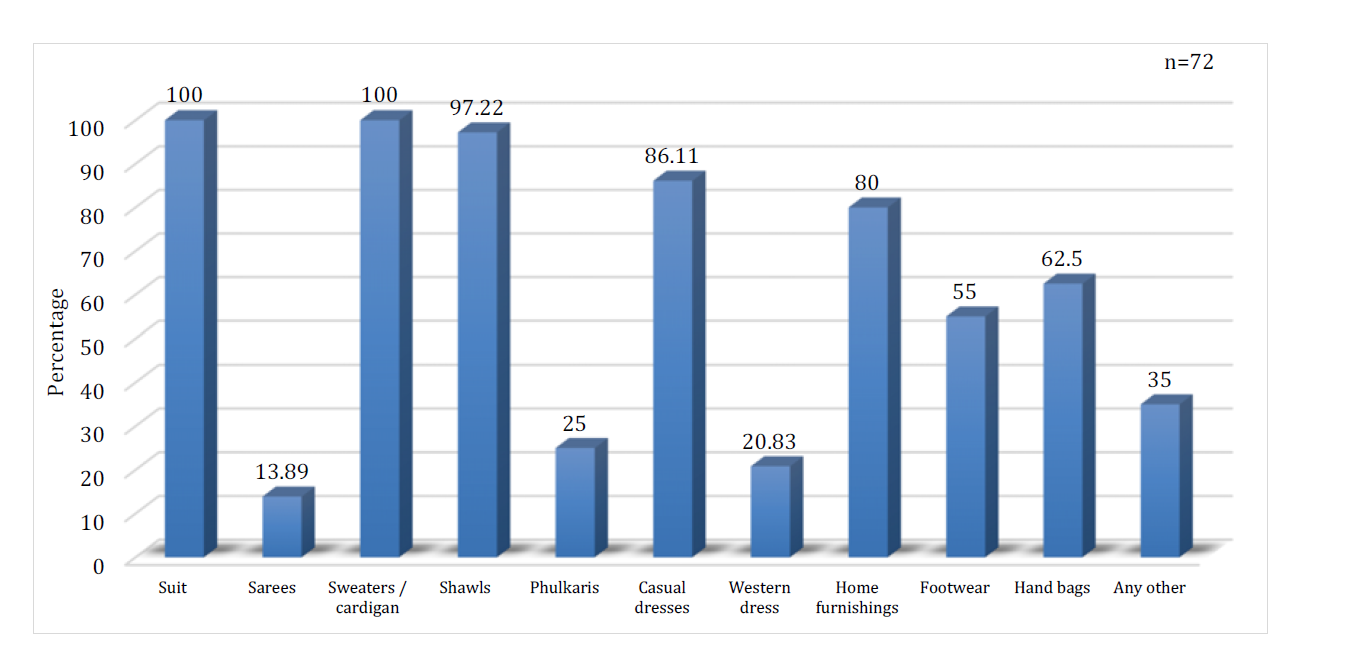
Data in Figure 6 shows the different types of items included in the trousseau. It was found that all the respondents (100%) included suits and sweaters/cardigans in their trousseau which was closely followed by shawls as reported by 97.22 per cent of the respondents. Other items included in the trousseau were casual dresses (tops, kurtis, pyjama etc) by 86.11 per cent of the respondents whereas Phulkaris, western dresses and sarees were included by very less per cent age of the respondents. About 35 per cent of the respondents reported that have also included towels, lingeries, nightsuits etc. under any other category in their trousseau. Home furnishing is an important aspect of decorating and furnishing home. Also, it gives clear reflection of one’s personality. Moreover, for the start of new life after marriage, new looks to the home can be introduced by use of different furnishings. Different types of home furnishings (quilts, blankets, durries, mattress etc) were included by 80.00 per cent of the respondents. Footwear and hand bags are another important part of apparel when it comes to trousseau articles. So, data in fig also represent that about 55.00 per cent of the respondents included different types of footwear and 62.50 per cent also included handbags of different types according to their need.
Figure 6: Clothing and Other Items Included in Trousseau
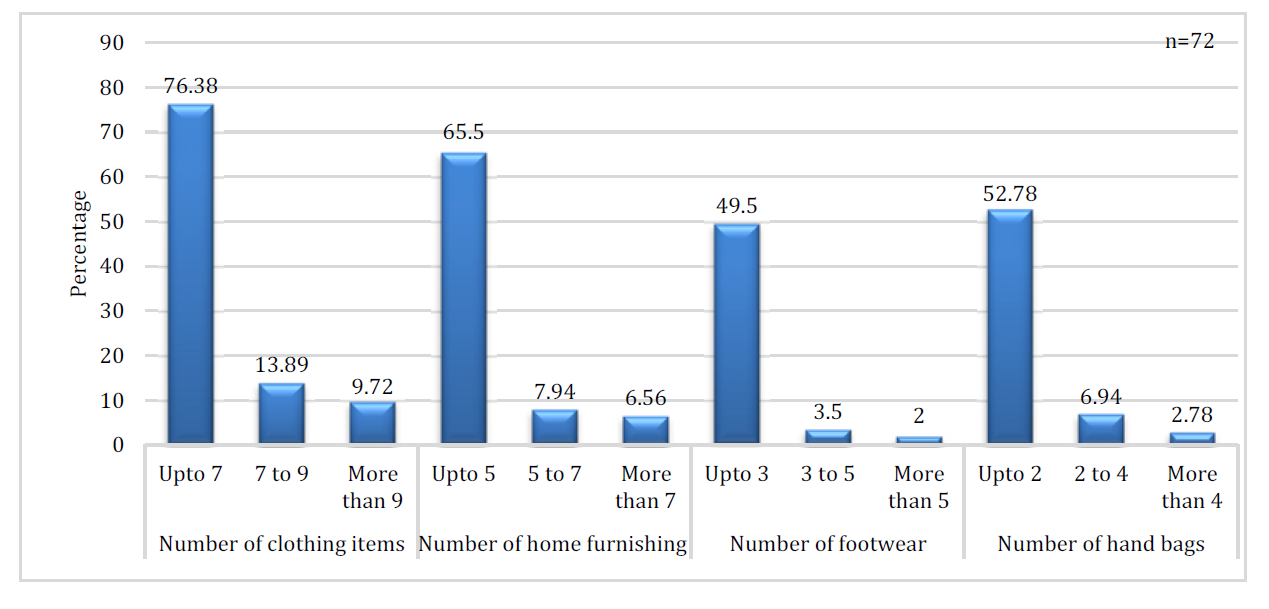
Similarly, number of articles included in trousseau were also enquired from the respondents just to know the rituals of their area. Data in Figure 7 illucidate that maximum per cent age of the respondents (76.38%) reported that have included upto seven clothing items (suits, saris etc). in the trousseau of their children. In case of home furnishings, 65.50 per cent respondents stated that they added upto five home furnishing articles in the trousseau. Regarding footwear and handbags, it was found that about 50.00 per cent of them added upto three pairs of footwear and two handbags respectively, in the trousseau of their children.
Figure 7: Number of Articles Included in Trousseau
CONCLUSION
Thus, it can be concluded that regarding marriage/ occasional purchase, most of the respondents prefer to buy from shops in their own cities. Phulkari’s were mainly preferred from Patiala, Ludhiana or other cities. For gent’s coat suits, good shops in another cities were mainly preferred followed by shops in own city by the respondents for the marriage or other formal occasions. For jewellery, both shops in their own cities and another city shops were sometimes preferred by more than 50 percent of the respondents as they find good designs in other city shops. For marriage, number of clothing items are to be decided and purchased by the families. Majority (90%) of the respondents reported that individuals, parents and relatives collectively take the decision for the type and number of clothing items to be purchased for occasions like marriage. Various inspirational sources were used while planning trousseau which includes weddings, internet, newspapers etc. Family members play a major role in trousseau planning that includes number of different items, their type including price as well as clothing. Speciality stores, discounted stores, exhibitions and boutiques were various sources used for purchasing trousseau articles
REFERENCE
Hoffman, A.M. “College clothing expenditure.” Journal of Home Economics, vol. 52, 1960, pp. 655–666.
Tate, M.T. and O. Glisson. Family Clothing. John Wiley & Sons, 1965, pp. 4–19.
Joshi, S. A Study of Clothing Expenditure Pattern on Marriage in the City of Ludhiana. M.Sc. thesis, Punjab Agricultural University, 1982.
Khatri, P. “Celebrity endorsement: A strategic promotion perspective.” Journal of Indian Media Studies, vol. 1, 2006, pp. 25–37.
Guha, S. “The changing perception and buying behaviour of women consumers in urban areas.” IOSR Journal of Business and Management, vol. 11, 2013, pp. 34–39.
Recommended Articles
Research Article
Climate change and its impact on Akoko rural farmers' productivity, in Ondo State, Nigeria
Download PDF
Research Article
Investigating Students’ Culture Shock during International Credit Transfer in Philippines
Download PDF
Research Article
Laparoscopic Cholecystectomy and find out Risk operator for Conversion in Al-Ramadi Teaching Hospital Retrospective Analysis
Download PDF
Research Article
The effect of education factor on the comparison of intravenous cannula and spinal needle pain in pregnant women
Yasin Tire,
...
Ümmügülsüm Esenkaya
Published: 28/02/2021
Download PDF
PO Box 101, Nakuru
Kenya.
Email: office@iarconsortium.org
Editorial Office:
J.L Bhavan, Near Radison Blu Hotel,
Jalukbari, Guwahati-India
None, N. & Saini, H. K. (2022). Clothing Purchase Pattern of Rural Families for Marriage. IAR Journal of Humanities and Social Science, 3(1), 1-5.
MLA
None, Neha and Harminder K. Saini. "Clothing Purchase Pattern of Rural Families for Marriage." IAR Journal of Humanities and Social Science 3.1 (2022): 1-5.
Chicago
None, Neha and Harminder K. Saini. "Clothing Purchase Pattern of Rural Families for Marriage." IAR Journal of Humanities and Social Science 3, no. 1 (2022): 1-5.
Harvard
None, N. and Saini, H. K. (2022) 'Clothing Purchase Pattern of Rural Families for Marriage' IAR Journal of Humanities and Social Science 3(1), pp. 1-5.
Vancouver
Neha N, Saini HK. Clothing Purchase Pattern of Rural Families for Marriage. IAR Journal of Humanities and Social Science. 2022 Jan;3(1):1-5.


 Download PDF
 Download XML