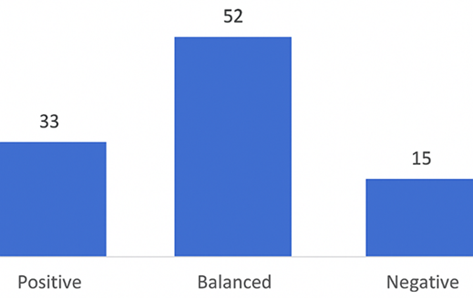
People often visit and revisit the success story of an institution with good organizational climate. The environment of an institution is frequently reminisced by the culture it promotes. The organizational climate of such successful institution alludes to the members' perceptions of a set of attributes that exist within an organization. The organizational atmosphere reflects how employees feel about working there; the ‘perceptions’. A leader must establish a pleasant corporate atmosphere in order to heighten the morals and values of employees that assures ease and flawless continuation of their working habits. This research paper is a critical examination of the role institutional climate play in order to establish a value and is geared toward explaining and detecting patterns in various studies and approaches used to investigate school climate and student outcomes.
In today's world, the behind-curtain-working of globalization necessitates that companies, especially educational institutions, be efficient and effective in their procedures in order to fulfill their goals and meet the expectations of society. Because of the huge problems that company encounter at all levels, the current work environment is drastically different from that of the past. Increased competition, high levels of technological innovation, changes in the nature and structure of organizations, and challenges faced by employees, such as redefining employment contracts, getting to grips with new business processes, flexible work patterns, and work–life balance, are just a few of these challenges [1] It is at this juncture, organizational atmosphere is one way via which the aforementioned challenges might be addressed [2]
“In line with these key themes surrounding the conceptualization of climate, our definition of organizational climate is the following: Organizational climate is the shared meaning organizational members attach to the events, policies, practices, and procedures they experience and the behaviors they see being rewarded, supported, and expected.”.
The organizational climate is the members' perceptions of the organization's current practices. As our perception goes, organizational culture is qualitative, because it is based on shared systems and values. The discourse regarding organizational climate invites adequate attention to drill on its individual connotation. ‘Climate’ generally brings in our mind the long story of certain system which is continued for longer horizons without occasional disturbances. Whereas the word ‘organizational’ peeps into certain human ability in certain practice system. This key word oozes on ability as well feeling involving with it. Organizations differ in many ways - their aims, the ethnic makeup of their workforce, and so on - yet one may perceive or 'feel' their uniqueness. This distinctiveness is also referred to as the company's culture. The texture of the organization, atmosphere, personality of the organization, and climate of the organization are all phrases that are used interchangeably. Although the 'feeling' that allows us to recognize that one organization is distinct from another is intangible, we do have evidence that the environment of one organization differs from that of another.
Cornell is said to have coined the phrase "organizational environment" in 1955. He used the term to denote a "delicate blending of interpretations or perceptions by persons in the organization of their jobs or roles in relationship to others and their interpretation of the roles of others in the organization". He used the term "organization" to refer to a formal framework. Different writers have defined the word "organizational climate" in various ways. used the term "personality or organizational climate," while others referred to it as "a general flow of behavior and sentiment," and saw organizational climate as the interplay between environmental and personal characteristics of members of a group or groups operating in an organization. The combination of organizational components, such as culture, structure, system, leadership behavior, and psychological requirements of the members of the company, creates organizational climate.
Extracting data from the perspectives of individuals in the organization may be used to measure the organizational climate. In organizations, leadership is critical. Leaders set the tone and promote the processes that allow organizations to achieve their objectives [3] According to [4] organizational climate is the study of people's views of numerous characteristics of the workplace environment. Organizational climate refers to members' shared impressions of organizational practices and processes, which provide an indicator of the institutionalized normative frameworks that drive behavior [7,8] By providing contextual indicators that encourage ethical behavior, an organization's ethical climate shapes the ethical character of the organization [9] According to [10] an organization's ethical climate is a distinct form of climate since it is founded on principles, and the organization's leaders are responsible for expressing and showing the genuine relevance of ethical values to the organization's members.
There are two different categories for thinking and describing how people feel and characterize their work situations, they are organizational climate and organizational culture (including not only businesses but also schools and governments). [11] summarizes the definition of organizational climate as follows:

[5] believes organizational climate might be viewed from two perspectives: (1) organizational climate as reflected by the link between organizational activities and managerial behavior and (2) organizational climate as perceived by members.
[6] have identified the organizational climate continuum based on the results of their research using the Organizational Climate Description Questionnaire (OCDQ). There are five classifications of organizational climate, namely: open climate, autonomous climate, controlled climate, familiar climate, closed climate and low satisfaction and job performance. [6] are of the view that there is an existence of three types of organizational climate namely, familiar climate, open climate and autonomous and paternal climate, which was based on the classification of organizational climate. Finally, [6] distinguished two types of organizational climate: open climate and closed climate. Rather than a single grouping, the two classes constitute a continuum from open to closed. Managers who work in an open organizational setting do better than those who work in a closed environment, according to [11] findings.
As a result, it's possible to say that organizational atmosphere has an impact on effectiveness. Institutions with an open climate work environment display better trust and efficacy as compared to those who experience a closed climate [12,13]are of the view that, school performance was determined by the type of leadership that was developed and a pleasant school environment. As a result, both the organizational environment and the leadership style have an impact on it. The organizational culture that emerges has an impact on the climate of the organization.
According to Owens and [4], a leader's performance is determined by his obligation to create an atmosphere that permits students to attain high levels of growth. The quality of the relationship between leaders and subordinates determines the organizational climate. According to [14] if a leader's relationship with his or her subordinates is favourable, the leader may be able to exert greater influence and authority than if the relationship is bad. On the basis of this argument, it can be argued that leaders who use a human relations orientation would encourage an open atmosphere more than leaders who use a task orientation (provide trust and respect). The leadership style of a manager has an impact on the organizational atmosphere.
The organisational environment is impacted by the leadership style and organisational culture, according to several study findings and perspectives. According to [14] there are eight climate components, each of which is a categorization of group characteristics and leader behaviour, namely:
Non-participation or disengagement refers to how disengaged and uncommitted workers are to achieving organizational goals.
The employees under the leadership's impression that their duty is being burdened, is referred to as an impediment or obstacle.
Intimacy refers to the degree of cohesion among employees in an organization, as well as leader conduct.
Workplace morale is referred to as esprit or excitement, and it has to do with meeting social requirements and feeling successful at work.
Aloofness, also known as spacing, is a level of formal and impersonal boss behaviour that shows a social distance from employees.
Leaders' behaviour that encourages employees to work hard is referred to as "production focus" or "emphasis on outcomes."
"Production focus" or "emphasis on outcomes" refers to a leader's behavior that pushes staff to work hard.
Consideration or attention, which relates to a leader's degree of conduct in treating employees with respect and decency.
The quest for an effective school begins with the Principal's and his staff's devotion to their school and students. Because it is multi-dimensional, the idea of a school's efficacy is difficult to grasp. Administrative functioning, leadership behaviors, level of trust, teacher morale, culture and climate, parental involvement, loyalty and satisfaction of teachers, teachers' efficiency and commitment, community support and students' academic performance are all factors to consider for school effectiveness. Instrumental and expressive activities are the two basic components of educational success.
Visiting a number of schools will immediately make one notice the feelings every individual is going through. Teachers and principals in a school, for example, are enthusiastic and confident in their work. Working with one another brings them delight. This happiness is passed on to the students, who are at least given the chance to learn how to make school a cheerful place to learn. In the second case, taking instance, the teachers' dissatisfaction was apparent. While the principal pretended to cover his inadequacy, he wore the robe improperly one more time. He alternated between being self-deprecating and interfering in other people's concerns while interacting with others. The psychological distress experienced by pupils, who, in their frustration, return a depressed environment to the instructor. Empty rituals, as well as displeasing and sorrow, characterized the third school. One gets the impression that one is looking at a complicated jigsaw in which the instructor, principal, and pupils are acting erratically. The activity was nuanced, even linguistic / articulate, yet it seemed to have little significance to the members in a bizarre, unreal sense. People who attend different schools also notice that each student has his unique characteristics.
The organizational atmosphere of the school is represented by the personality illustrated in the figure. Personality, on the other hand, is about the individual, whereas organizational environment is about organization. From my experience, it is clear that schools have distinct emotions - and this inquiry is required to map them. The second driving force is dissatisfaction with the concept of spirit in the chaotic way it is used in particular studies of schools and the educational system. Statements regarding a school's excitement are insufficient to characterize the school's organizational atmosphere. The third motivating factor originates from firsthand experience gained through the Leader Behavior Description Questionnaire (LBDQ) study. Experience has shown that principals with high ratings in both contemplation and starting structure fail in schools where the members are not particularly prepared to embrace a leader.
The group may not be able to mobilize the leader, especially if the principle is not present. It is the responsibility of a leader to foster a positive organizational climate in his or her organization. LBDQ should provide leaders with the information they require to complement the relevant data about the organization. The members of an organization opine on of the working environment which is known as organizational climate. It is the responsibility of a leader to foster a positive organizational environment in his or her organization. Starting with a business company, it is reasonable to assume that it will need to define a common set of subtests as well as a common climate unit.

Motivation, performance, and job happiness are all influenced by the atmosphere at the workplace. As a result, it can be concluded that the organizational environment has a direct impact on the effectiveness of the organization. Organizations that function in an open climate have more trust and efficiency than those that work in a closed environment. School success was impacted by the sort of leadership produced and the strong school atmosphere, according to [13]. As a result, organizational atmosphere and leadership conduct have an impact on organizational performance. The organizational environment is also impacted by the culture that emerges inside it. This is in keeping with [15] theory, according to which organizational culture and organizational climate have a link. Culture is assumed to be the batteries, while climate is assumed to be the nuclear power plant. As a result, the organizational environment (probably the battery) reigns supreme.
According to [4] organizational culture has a significant impact on climate change. Employee attitudes and emotions are said to be influenced by business culture. This position is backed by [16], who observed in his research that in successful organizations, a climate of success is connected to a culture of pride in the organization. A climate of success is defined by openness among organizational members in carrying out their responsibilities, whereas a culture of pride is defined by emotional commitment and people's connections to one another. People have a strong sense of belonging to a big organizational structure.
Organizational culture is a personality trait that influences how people behave in the workplace [17]. According to [4] climate change has a tremendous influence on organizational culture. It is also believed that organizational culture has an impact on the attitudes and feelings of its members. In his research, [16] established that a company's culture of pride is connected to the company's success climate. Under a culture of pride, people think they are a part of a meaningful organizational entity, which is defined as an emotional and value link between individuals and organizations [16] Several expert study findings support the idea that organizational culture influences organizational climate. Based on some of the viewpoints offered, it may be stated that leadership behavior influences organizational culture, and organizational culture influences organizational climate and effectiveness. A strong organizational culture is accompanied with a more open organizational atmosphere, which increases organizational effectiveness.
Organizational leaders have an inherent responsibility to address challenges with an ethical component. Integrating personal beliefs and the needs of the social system in the construction of an ethical framework is what ethical leadership entails [18]. Leader values are likely to have a direct impact on the direction of the organization's moral climate as a result of this integration. Personal values, ethics, and morals are critical for leaders to understand because they influence the decisions and acts they take. Leaders whose personal ethics and values are incompatible with the organization's values are more likely to downplay the importance of these values to their employees.
This discussion will end after outlining some major issues related organizational climate. Firstly, organization may be defined as a group of two or more individuals working together to achieve a shared goal or set of goals. There are various components to this collaboration. Secondly, the values of the organization's features define it. The organizational climate is influenced by the organizational culture that develops inside it, as well as the leadership style of the manager or administrator. Organizational culture has a significant impact on climate change. Finally, a friendly environment inculcates a positive and productive environment. This in turn would enrich the productivity of every unit of the organization. The attitudes and sentiments of an organization are influenced by its culture. A good and productive institution balances and benefits the society, enriches cooperation and empathy and creates a democratic environment.
The authors declare that they have no conflict of interest
No funding sources
The study was approved by the Sidho-Kanho-Birsha University, Purulia, W.B., India.
Kangis & Williams, (2000). Organizational climate and corporate performances: an empirical investigation, Management Decision, MCB University Press, 38 [8], 531-540.
Tahir, L. M., Lee, S. L., Musah, M. B., Jaffri, H., Said, M. N. H. M., & Yasin, M. H. M. (2016). Challenges in distributed leadership: evidence from the perspective of headteachers. International Journal of Educational Management. August, Vol. 30, No.6, pp.848-863. http://doi.org/10.1108/IJEM-02-2015-0014
Zaccaro, S. J., & Klimoski, R. J. (2001), ‘The Nature of Organizational Leadership: An Introduction’, in S. J. Zaccaro and R. J. Klimoski (eds.), The Nature of Organizational Leadership (Jossey Bass, San Francisco), pp. 3–41.
Owens, R. E., & Valesky, T. C. (2015). Organizational Behavior in Education: Leadership and School Reform. New York: Pearson.
Bhagat, R. S., & Steers, R. M. (2009). Cambridge Handbook of Culture, Organizations, and Work. Cambridge: Cambridge University Press.
Halpin, A. W., & Croft, D. B. (1999). The Organizational Climate of School. Chicago: Midwest Administration Center, University of Chicago.
Schneider, B. (1975), ‘Organizational Climates: An Essay’, Personnel Psychology, 28, 447–479.
Schneider, B. (1983), ‘Work Climates: An Interactionist Perspective’, in N. W. Feimer and E. S. Geller (eds.), Environmental Psychology: Quality and Perspectives (Praeger, New York) pp. 106–128.
Victor, B., & Cullen, J. B.: (1988), ‘The Organizational Bases of Ethical Work Climates’, Administrative Science Quarterly, 33, 101–125.
Dickson, M. W., D. B. Smith, M. W. Grojean and M. Ehrhart: (2001). ‘Ethical Climate: The Result of Interactions between Leadership, Leader Values, and Follower Values’, Leadership Quarterly 12, 1–21.
Miner, J. B. (2015). Organizational Behavior 4: From Theory to Practice. New York: Routledge.
Hoy, W. K., & Miskel, C. G. (2005). Educational Administration: Theory, Research, and Practice. New York: McGraw Hill.
Heck, R. H., & Marcoulides, G. A. (1993). Principal Leadership Behaviors and School Achievement. NASSP Bulletin, 77(553), 20-28.
Owens, R. E. (1997). Organizational Behavior in Education. New York: Allyn & Bacon.
DeRoche, E. F. (2011). Leadership for Character Education Programs. Journal of Humanistic Counseling, Education, and Development, 39, 41-46.
Kanter, R. M. (1999). The Enduring Skills of Change Leaders. Leader to Leader, 13, 15-22.
Gibson, J. L., Ivancevich, J. M., Donnelly, J. H., & Konopaske, R. (2003). Organizations: Behavior, Structure, Processes. New York: McGraw Hill, Inc.
Gottlieb, J. Z. and J. Sanzgiri: (1996), ‘Towards an Ethical Dimension of Decision Making in Organizations’, Journal of Business Ethics 15, 1275–1285.