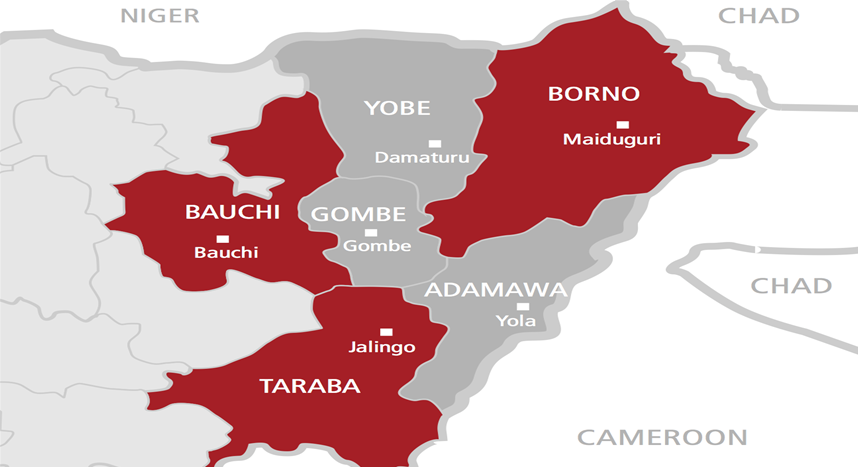
The study assessed the contribution of TETFund (Tertiary Education Trust Fund) to the development of higher education in North-East Nigeria. It examined the effectiveness of TETFund contributions to the development of higher education in Abubakar Tafawa Balewa University Bauchi, Sir Kashim Ibrahim College of Education Maiduguri in Borno state and Mai Idris Alooma Polytechnic Geidam in Yobe. It also, identified possible ways of improving such contributions to strengthened the development of higher education in Nigeria`s North-East region. Primary and secondary methods of data collection were utilized in the study. The study found out that, TETFund is seriously contributing to the development of higher education in Nigeria`s North-East region. It discovered that TETFund contribution to the development of higher education in North-East Nigeria are effective. The study recommended increased annual and special interventions to public higher institutions in North-East Nigeria as possible ways of improving TETFund contributions to the development of higher education in the region.
Keywords
Education
Higher
TETFund
Nigeria
North-East
INTRODUCTION
The aim of higher education is to meet the socio-cultural and developmental needs of a country. Higher education provides an opportunity for individuals to develop their potential. It fulfils the needs for high-level manpower in a society. Its objectives include cultural and material development to meet the learning needs and aspirations of individuals through the development of their intellectual abilities and aptitudes throughout their lives. Higher education equips individuals to make the best use of their talents and of the opportunities offered by society for self- fulfilment. The ultimate goal of higher education is to produce graduates who will be effective leaders in their chosen professions, valued members of their communities, and responsible citizens of the world. Higher education institutions assure the relevance of their knowledge, identify skills gaps, create special programs and build the right skills that can help countries improve economic prosperity and social cohesion, adapt workforce development to the economy and changing demand for the new skills, develop relevant ideas necessary for promoting national cohesion and societal development. Thus, higher education in every country is guided by a philosophy which is concerned with specific problems arising from the existence of universities and higher education institutions [1]. It is the desire to developed higher education to the required level capable for encouraging sound national integration and development that all aspects of national life that contributed to the emergence of the Tertiary Education Trust Fund (TETFund) in Nigeria.
From 1980’s and beyond, the decay of all tiers of education was monumental. Facilities had almost collapsed; teachers and lecturers’ morale were at its lowest. Enabling environment for conducive teaching and learning was absent. The administration of President, Ibrahim Babangida mindful of the reality of the situation took measures to arrest the rot. In December 1990 the Federal Government constituted the Commission on the Review of Higher Education in Nigeria (the Gray Longe Commission) to review the post-independence Nigerian Higher Education after Lord Ashby’s Commission of 1959. The Longe Commission recommended among others the funding of higher education through earmarked tax to be borne by companies operating in Nigeria. An implementation committee under the chairmanship of Professor Olu O. Akinkugbe was constituted to implement Grey Longe’s Commission report recommendations also an Agreement was signed between the Federal Government and ASUU on the 3rd September, 1992 on funding of universities [2]. In January 1993, the Education Tax Act No7 of 1993 was promulgated alongside other education related Decrees. The Decree imposed a 2% tax on the assessable profits of all companies in Nigeria. This was a home-grown solution to address issues of funding to rehabilitate decaying infrastructure, restore the lost glory of education and confidence in the system as well as consolidate the gains thereto; build capacity of teachers and lecturers; teacher development; development of prototype designs; etc. The Education Tax Act of No7 of 1993 mandated the Fund to operate as an Intervention Fund to all levels of public education (Federal, State and Local). This mandate was faithfully discharged between 1999 to May 2011 when the ET Act was repealed and replaced by the Tertiary Education Trust Fund Act, due to lapses and challenges in operating the Education Trust Fund [3]. The Tertiary Education Trust Fund (TETFund) was originally established as Education Trust Fund (ETF) by the Act No 7 of 1993 as amended by Act No 40 of 1998 (now repealed and replaced with Tertiary Education Trust Fund Act 2011). It is an intervention agency set up to provide supplementary support to all level of public tertiary institutions with the main objective of using funding alongside project management for the rehabilitation, restoration and consolidation of Tertiary Education in Nigeria. The main source of income available to the Fund is the two percent education tax paid from the assessable profit of companies registered in Nigeria. The Federal Inland Revenue Services (FIRS) assesses collects the tax on behalf of the Fund. The funds are disbursed for the general improvement of education in federal and state tertiary educations specifically for the provision or maintenance of essential physical infrastructure for teaching and learning, institutional material and equipment, research and publications, academic staff training and development and any other need which, in the opinion of the Board of Trustees, is critical and essential for the improvement and maintenance of standards in the higher educational institutions. The Fund is managed by an eleven (11) member Board of Trustees with members drawn from the six geo-political zones of the country as well as representative of the Federal Ministry of Education, Federal Ministry of Finance and the Federal Inland Revenue Services [4].
Justification of the Study
The Tertiary Education Trust Fund (TETFund) has been very instrumental in the area of funding higher education in Nigeria. Public tertiary institutions have been benefiting in several ways through TETFund. Study on Tertiary Education Trust Fund (TETFund) is very significant in the sense that the fund since establishment has been contributing immensely to the development of higher education in Nigeria. Although, few and not many are able to understand and appreciate the role of TETFund in the development of higher education in the country. Numerous studies have been conducted on the development of higher education in the country with non-examining the role of the TETFund in the growth of higher education in Nigeria. A study on TETFund contributions to the development of higher education in Nigeria will serve as an eye opener to both the federal government of Nigeria and the international community in realizing efforts been made by TETFund in the area of higher education development in the country.
Studies by Iruonagbe, Dawodu, Okebukola, Obasi, Obadara and Alake [2,3,5], Odebiyi and Aina [6] as well as Moji [7] among others have examined the development of higher education tremendously in Nigeria adopting the explorative method of analysis and investigation. Their studies succeeded in exploring the growth and development of higher education in the country. But because most of the previous studies on the development of higher education in Nigeria were conducted before the establishment of TETFund, initial studies were unable to assessed the contribution of TETFund to the development of higher education in the country. This is one of the gaps created in knowledge. Several works on the development of higher education have also adopted in their analysis, qualitative method of inquiry which never gave academic and non-academic staff as well as students` the privilege to participate on studies concerning the development of higher education in the country thus, creating yet, additional gap to be bridged in the area of methodology. It is the desire to bridge gaps created in knowledge by previous studies which have failed to assessed the contribution of TETFund to the development of higher education in Nigeria and the failure to incorporate both qualitative and quantitative methods of inquiries in their studies of on the development of higher education in Nigeria that justified the basis for this study.
Aims and Purpose of the Study
The aims and purpose of the study include to:
Assess the contributions of TETFund to the development of higher education in north east Nigeria
Examine the effectiveness of TETFund contributions to the development of higher education in Nigeria`s north east region
Identify possible ways of improving TETFund contributions to the development of higher education in north east Nigeria
Research Question
The questions of the study are:
What are the contributions of TETFund to the development of higher education in north east Nigeria?
How effective is TETFund contribution to the development of higher education in Nigeria`s north east region?
Through what process can TETFund contribution to the development of higher education in north east Nigeria be improved?
Literature Review
Higher education, any of various types of education given in postsecondary institutions of learning and usually affording, at the end of a course of study, a named degree, diploma, or certificate of higher studies. The goal of higher education in Nigeria is designed towards advancing Nigeria's economic growth and global competitiveness through the provision of accessible, relevant, high quality education in our Tertiary Education Institutions and to constantly attract, develop and graduate competent, knowledgeable and talented individuals from our Tertiary Education Institutions [6]. The ultimate goal of higher education is to produce graduates who will be effective leaders in their chosen professions, valued members of their communities, and responsible citizens of the world. Higher education institutions assure the relevance of their knowledge, identify skills gaps, create special programs and build the right skills that can help countries improve economic prosperity and social cohesion, adapt workforce development to the economy and changing demand for the new skills, develop relevant [5]. The National Policy on Education is anchored on Nigeria's philosophy on education as enunciated through the nation's objectives. Nigeria has five main national objectives as provided by the Second National Development Plan and accepted as the necessary foundation for the National Policy on Education. Nigeria`s philosophy of higher education is concerned with specific problems arising from the existence of universities and higher education institutions in the country. The aim of higher education is to meet the socio-cultural and developmental needs of a country. Higher education provides an opportunity for individuals to develop their potential. It fulfils the needs for high-level manpower in a society. Its objectives include cultural and material development. Higher education can lead to many benefits, such as prosperous career and financial security. In the 21st century, education plays an even more significant role in other aspects of your life. Attaining a higher education can increase your opportunities and improve your overall quality of life. Poverty Reduction, connecting across borders, sense of accomplishment, more productivity, better communication, critical thinking skills, identification of skills and greater sense of discipline are some of the benefits of higher education. These benefits also accompanied the acquisition of higher education knowledge in Nigeria like in other countries of the world [5].
Historical development of higher education in Nigeria is a tale full of numerous sacrifices made by the country`s founding fathers. Nigeria is a multi-ethnic and multi-religious country. Before the 18th century, there was little or no difference between Europe and Africa, but the slave trade coupled with the industrial revolution in Europe changed the socio-economic equation. Africa became the trading subordinate of Europe and later its colony. A review of the Nigerian educational system from 1842 to 1959 revealed that there was absolutely nothing in the Nigerian educational system that promoted “national consciousness”, “national unity”, “patriotism” or the like. In fact, the colonial government never pretended to build a Nigerian nation. The citizens were either British subjects or British protected persons whose loyalty was supposed to be for the British Empire and the King or Queen of England. The consequent effect of this was that instead of training the people in the area of technology, majority of the citizens were educated in the area of civics as they were meant to assist the British colonizers in some administrative duties [8].
The first higher educational institution in Nigeria, the Yaba Higher College, was established in 1932. The agitation of Nigerians for a more comprehensive higher education provision led to the constitution of the Asquith and Elliot Commission on Higher Education. Their reports in 1943 favoured the establishment of universities in Nigeria. Consequently, in 1948, the University College Ibadan was founded as an affiliate of the University of London. The University College continued as the only university institution in Nigeria until 1960 [9]. In April 1959, the Nigerian government commissioned an inquiry (Ashby Commission) to advise it on the higher education needs of the new nation for its first two decades of independence. Before the submission of the report on 2nd September 1960, the Eastern Region government established its own university at Nsukka, the University of Nigeria Nsukka, 1960. The recommendations of the Ashby report include:
the Federal Government should give support to the development of new universities in Nigeria
a university should be established in the North using the old site of the Nigerian College in Zaria as its base
a university should be established in Lagos to handle courses in business, commerce and economics
University College Ibadan should widen its curriculum and develop into a full university
a National Universities Commission should be set up to have undisputed control over the affairs of the universities, particularly in terms of finance, staff and courses
So, the University of Nigeria, Nsukka was founded in 1960 while the Obafemi Awolowo University, Ile-Ife (formerly, the University of Ife) was established in 1961. Ahmadu Bello University Zaria and University of Lagos were both established in 1962 while the University College transformed into a substantive university also in 1962. In 1970, the newly created Bendel State established a university, known as University of Benin. Consequently, the six universities established during this period 1960-1970 became known as first generation federal universities. Higher educational Institutions in Nigeria include Universities, Polytechnics and Colleges of Education. There are currently 129 approved universities in Nigeria comprising 40 Federal Universities, 39 State Universities and 50 Private Universities (NUC, 2014). Also, Nigeria has a total 128 approved polytechnics and 117 approved Colleges of Education in Nigeria, making it the largest higher education system on the African Continent [10]. Although Public Universities have dominated the higher education landscape in Nigeria for several decades, their failure to cope with admission pressure became more compelling from the 1990s.
Moja [7], affirmed that “Access to higher education and the lack of the capacity of the system to absorb the numbers of students seeking admission to higher education institutions continues to pose a serious problem. For example, it is estimated that out of 400,000 JAMB candidates seeking admission to university education, more than 320,000, which is about 80% are not able to gain admission to any of the 37 Nigerian universities”. Also, Onyekakeyah [11], stated that, “The Joint Admission and Matriculation Board (JAMB) figures clearly show that the situation has not improved. According to JAMB figures, out of about 800,000 candidates that sat for the 2005 examination, only 147,000 were offered places in the existing universities, representing only 18.4 percent”. Another major problem facing higher education especially Federal and State Institutions is funding. Enrolments have increased more quickly than government’s capacity to finance these institutions. This has hampered education delivery, monitoring, inspection and other quality assurance activities.
Government has made efforts at addressing this problem; for example, in 1993, the Education Tax Decree was enacted to provide 2% of the profits of companies registered in Nigeria to be collected by government and paid into a fund called the Education Tax Fund (ETF) now Education Trust Fund (ETF) and recently, the Tertiary Education Trust Fund (TETFund). Despite increase in funding from over 11 billion naira in 1999 to over 90 billion naira in 2008, funding still remains a major challenge [3]. This was the trend in Nigeria such that the admission crisis became more critical after 2001. The access rate had fallen by 2002 to less than 13 percent [5]. Based on this fact, the expansion of access through the establishment of Private Universities became one of the most reasonable policy options [5].
There are enormous problems facing the higher education system in Nigeria. Indeed, over the years, higher education in Nigeria has suffered much neglect manifested in the form of inadequate funding, inconsistent policy changes; lack of infrastructure and disruption of the school system. These problems in the higher education system have been very disturbing. In fact, budgetary allocations to education in Nigeria have been grossly inadequate leading to agitations by lecturers and students about obsolete equipment, old and outdated textbooks and journals including poor remuneration for lecturers especially at the tertiary level, which have also heightened the level of brain drain in the country as many of them moved to different parts of the world in search of greener pastures. There have been complaints by employers of labor within and outside the country that most graduates from Nigerian Universities are not properly trained to fit into the world of work in terms of desirable knowledge and skill. In developed countries, especially in Europe and America, most Nigerian graduates are seen as half-baked due to such issues as constant strikes, conflicts, disruption of academic calendar and cultism which have destroyed the quality of education in Nigeria including the dearth of qualified and experienced lecturers. Education is the engine that drives the growth and development of a nation.
Funding for education has not been commensurate with the demand of the education sector. Reportedly, the percentage of federal budgetary allocation to education has been dwindling. It was 7.2% in 1995 and 4.5% in 2004. The condition becomes more pathetic when Nigeria’s Gross National Product (GNP) allocation to education is compared with those of less affluent African nations that allocate greater percentage: Ivory Coast allocates 5% of its GNP to education, Kenya 6.5% and Nigeria 0.76%. Lack of teaching tools and poor remuneration has contributed to “acute shortage of qualified teachers” that leads to the falling standards of university education. More revealing is the 2006 ranking of African universities in which Nigerian universities, that were once highly rated, were behind universities in poorer countries. It is imperative to add that in 2004, the sum of N216, 708,206.00 was requested by the federal funded universities. The Federal government released the sum of N53, 406, 287. 01 representing 24.7% of the budget request from the Universities. As espoused by Odebiyi and Aina [6], the multiplier effects of this low level of funding include: poor laboratory facilities; limited number of field trips and academic conferences; inadequate and obsolete infrastructure and equipment; embargo on study fellowship and reduction in study grants. This is the educational situation in Nigeria that gave birth to the emergence of private universities.
Generally speaking, higher education refers to post-secondary education or tertiary educational institutions other than universities. The National Policy on Education in Nigeria (FGN, 2004) defines higher education as post-secondary education comprising universities, polytechnics and colleges of education including such institutions as may be allied to them. In Nigeria, higher education is involved in the traditional functions of teaching, research and community service so as to develop manpower and disseminate necessary knowledge needed in Industry and other sectors. Education in general and higher education in particular are fundamental to the construction of a knowledge economy in all nations [12]. The decade from 1990 witnessed an upsurge in the number of private institutions of learning in Africa in general and Nigeria in particular. Before this decade, most African countries committed much of their expenditures on public education, which served as an instrument for building the nation, following independence. The establishment of higher educational institutions was in pursuit of meeting the global requirements of producing manpower that will serve in different capacities and contribute positively to the nation’s socio-economic and political development in Nigeria [13]. Federal Government of Nigeria promulgated enabling law to found higher education towards producing high level relevant manpower training, self-reliance, national utility through the establishment of both conventional and special universities, polytechnics, colleges of education and monotechnic in different parts of the country by the Federal, state governments, private organizations and individuals [13]. Though, persistent problem affecting the funding of higher education in Nigeria has led to the transformation of the country`s Education Trust Fund (ETF) into the Tertiary Education Trust Fund (TETFund) aim at creating various avenue of investing in higher education in the country.
MATERIALS AND METHODS
The study was conducted using both quantitative and qualitative methods of data collection. Primary data were sourced through the administration of closed ended questionnaire which was administered on 300 respondents chosen from three selected TETFund beneficiaries’ institutions in three states in the north east region of Nigeria. Qualitative was revalidated with the use of NVivo software after in-depth interview of the respondents selected in the study areas. Abubakar Tafawa Balewa University Bauchi, Sir Kashim Ibrahim College of Education Maiduguri and Mai Idris Alooma Polytechnic Geidam-Yobe State are the three areas (institutions) selected for the proposed research. Figure 1 using star, marked out the areas of the three institutions studied in the research.
And, each of the three institutions was represented by 100 respondents i.e. 50 students, 30 academic staff and 20 non-academic staff. Statistical package for Social Science (SPSS) was adopted in analyzing the data collected for the study hence, the frequency, percentage, mean and standard deviation statistical tools f analysis were used in analyzing the primary data collected for the study where, Q refer to Question, F=Frequency, P=Percentage, M=Mean, SD=Standard Deviation, and SD again implies Strongly Disagreed, D=Disagreed, N=Neutral, A=Agreed and SA=Strongly Agreed. The instrument of data collection was personally administered on the respondents by the Researcher and were all retrieved at the three selected institutions at different date.
RESULTS
Data Presentation and Analysis
The data collected for the study are hereby presented and analyzed.
Table 1 shows that 1.67% of the respondents involved in the study strongly disagreed with the view that, TETFund is actively involved in local and foreign training and development of academic staff in their institution, 3.33% of them disagreed, 6.67% were neutral, 25% agreed and 63.33% of them strongly agreed with the view. It is clearly demonstrated by table 1 that 53.34% of the respondents strongly disagreed with the position that, TETFund is not involved in the sensitization of academic and non-academic staff in their school through conferences, seminars, workshops and short courses both at home and abroad, 23.33% of them disagreed, 10% remained neutral while 8.33% agreed and 5% of them strongly agreed with the position. Also, table 1 indicated that the 5% of the respondents strongly disagreed that, students` industrial training fund (SIWES) and teaching practices of student teachers are being supported by TETFund in their institution, 8.33% disagreed, 10% preferred to be neutral, 21.67% agreed and 55% strongly agreed. On the assertion that, research, book development, engineering fabrication among academic staff and journal publication in their school are not funded by TETFund, 63.33% of the respondents strongly disagreed, 26.67% disagreed, 5% wished to be neutral, 3.33% agreed and 1.67% strongly agreed. It is clearly noted in table 1 that, 1.67% of the respondents strongly disagreed with the view that, capital projects on administrative block, classrooms, science and engineering complexes, workshops, laboratories, lecture theaters, entrepreneur and skill acquisition centers, information and communication technology (ICT) centers, libraries and mobility buses have been provided to their institution through TETFund annual and special interventions, 5% disagreed, 6.67% of them were neutral, 26.66% of them agreed with the view and 60% of them strongly agreed with it. The average mean for all the questions in table 1 is 60 while Q4 recorded the highest standard deviation score of 4,970, Q1 has 4,850, Q5 has 4,290, Q3 has 3,040 and Q2 has 2,850. The average standard deviation score for all the questions in table 1 is 4,000.
Table 1: Contribution of TETFund to the development of higher education in North-East Nigeria
Questions
F/P
SD D N A SA M SD
Q1. TETFund is actively involved in local and foreign training and development of academic staff in your institution.
5
1.67%
10
3.33%
20
6.67%
75
25%
190
63.33%
60
4,850
Q2. TETFund is not involved in the sensitization of academic and non-academic staff in your school through conferences, seminars, workshops and short courses both at home and abroad.
160
53.34%
70
23.33%
30
10%
25
8.33%
15
5%
60
2,850
Q3. Students` industrial training fund (SIWES) and teaching practices of student teachers are being supported by TETFund in your institution.
15
5%
25
8.33%
30
10%
65
21.67%
165
55%
60
3,040
Q4. Research, book development, engineering fabrication among academic staff and journal publication in your school are not funded by TETFund.
190
63.33%
80
26.67%
15
5%
10
3.33%
5
1.67%
60
4,970
Q5. Capital projects on administrative block, classrooms, science and engineering complexes, workshops, laboratories, lecture theaters, entrepreneur and skill acquisition centers, information and communication technology (ICT) centers, libraries and mobility buses have been provided to your institution through TETFund annual and special interventions.
5
1.67%
15
5%
20
6.67%
80
26.66%
180
60%
60
4,290
Q: Question, F: Frequency, P: Percentage, SD: Strongly Disagreed, D: Disagreed, N: Neutral, A: Agreed, SA: Strongly Agreed, M: Mean and SD: Standard Deviation, Source; Researcher`s Field Survey (2020)
Figure 2: Contribution of TETFund to the development of higher education in North-East Nigeria
Q: Question, F: Frequency, P: Percentage, SD: Strongly Disagreed, D: Disagreed, N: Neutral, A: Agreed, SA: Strongly Agreed, M: Mean and SD: Standard Deviation, Source; Researcher`s Field Survey (2020)
Table 2 tested the effectiveness of TETFund contribution to the development of higher education in North-East Nigeria and thus, 1.67% of the respondents strongly disagreed that, TETFund has been effective in the area of manpower development among academic and non-academic staff in their institution, 3.33% disagreed, 8.33% remained neutral, 30% agreed and 56.67% strongly agreed. It is also contained in table 2 that, 55% of the respondents strongly disagreed with the view that, TETFund has not been supporting and funding infrastructural development in their school, 23.33% disagreed, 10% were neutral while 6.67% agreed and 5% of them strongly agreed with the view. Table 2 again demonstrated that, 6.67% of the respondents strongly disagreed with the position that, Conducive condition for teaching and learning are provided by TETFund in their institution through the provision of academic facilities, 3.33% disagreed, 8.33% preferred to be neutral, 30% agreed and 51.67% of them strongly agreed with the position. It is clearly indicated in table 2 that 60% of the respondents strongly disagreed with the assertion that, TETFund support in the area of research and development in their school is not effective, 18.33% disagreed, 5% remained neutral, 10% agreed and 6.67% strongly agreed with the assertion. Also, table 2 presented that, 5% of the respondents strongly disagreed with the view that, Annual and special interventions from TETFund are effective in the development of higher education in North-East Nigeria, 8.33% disagreed, 8.33% were neutral and 30% agreed while 53.34% of them strongly agreed with the view. All the questions in table 2 has equal mean score of 60, Q1 has the highest standard deviation score of 3,950, Q3 has the lowest standard deviation score of 3,050, Q2 has 3,130 as its standard deviation score while Q4 has standard deviation score of 3,790 and Q5 has standard deviation score of 3,330. The average standard deviation score for all the questions in Table 2 is 2,850.
Table 2: Effectiveness of TETFund contribution to the development of higher education in North-East Nigeria
Questions
F/P
SD D N A SA M SD
Q1. TETFund has been effective in the area of manpower development among academic and non-academic staff in your institution.
5
1.67%
10
3.33%
25
8.33%
90
30%
170
56.67%
60
3,950
Q2. TETFund has not been supporting and funding infrastructural development in your school.
165
55%
70
23.33%
30
10%
20
6.67%
15
5%
60
3,130
Q3. Conducive condition for teaching and learning are provided by TETFund in your institution through the provision of academic facilities.
20
6.67%
10
3.33%
25
8.33%
90
30%
155
51.67%
60
3,050
Q4. TETFund support in the area of research and development in your school is not effective.
180
60%
55
18.33%
15
5%
30
10%
20
6.67%
60
3,790
Q5. Annual and special interventions from TETFund are effective in the development of higher education in North-East Nigeria.
15
5%
25
8.33%
10
3.33%
90
30%
160
53.34%
60
3,330
Q: Question, F: Frequency, P: Percentage, SD: Strongly Disagreed, D: Disagreed, N: Neutral, A: Agreed, SA: Strongly Agreed, M: Mean and SD: Standard Deviation, Source; Researcher`s Field Survey (2020)
Figure 3: Effectiveness of TETFund contribution to the development of higher education in North-East Nigeria
Q: Question, F: Frequency, P: Percentage, SD: Strongly Disagreed, D: Disagreed, N: Neutral, A: Agreed, SA: Strongly Agreed, M: Mean and SD: Standard Deviation, Source: Researcher`s Field Survey (2020)
It is presented in Table 3 that 5% of the respondents strongly disagreed with the position that, increase allocation of annual and special interventions to their school by TETFund will improve TETFund contribution to the development of higher education in Nigeria`s North-East region, 8.33% of them disagreed, 5% were neutral, 18.33% agreed and 63.34% of them strongly agreed with the position. Table 3 also shows that, 53.33% of the respondents strongly disagreed with view that, process evaluation and supervision of projects by TETFund Supervisors in their school will not improve TETFund contribution to the development of higher education in North-East Nigeria, 25% disagreed, 6.67% remained neutral, 10% agreed and 5% of them strongly agreed with the view. It is also contained in table 3 that, 6.67% of the respondents strongly disagreed with the assertion that, monitoring TETFund projects in your institution and ensuring that they are executed based on professional specification by TETFund monitoring team will improve TETFund contribution to the development of higher education in Nigeria`s North-East region, 11.67% of them disagreed, 3.33% wished to be neutral, 21.67% agreed and 56.66% of them strongly agreed with the assertion. Furthermore, table 3 shows that, 55% of the respondents strongly disagreed with the view that, periodic auditing of how annual and special interventions given to their school by TETFund are utilized by expert Auditors from TETFund will not improve TETFund contribution to the development of higher education in North-East region of Nigeria, 23.33% of them disagreed, 11.67% were neutral, 6.67% agreed while 3,33% of them strongly agreed with the view. The average mean score for all the questions in table 3 is 60. Table 3 also shows that, Q2 has the highest standard deviation score of 4,790, Q4 has the lowest standard deviation score of 3,170, Q1 has standard deviation score of 4,440, while Q3 recorded standard deviation score of 3,350 and Q5 has standard deviation score of 3,330. The average standard deviation score for all the questions in table 3 stood at 4,000.
Table 3: Ways of improving TETFund contribution to the development of higher education in North-East Nigeria
Questions
F/P
SD D N A SA M SD
Q1. Increase allocation of annual and special interventions to your school by TETFund will improve TETFund contribution to the development of higher education in Nigeria`s North-East region.
15
5%
25
8.33%
15
5%
55
18.33%
190
63.34%
60
4,440
Q2. Process evaluation and supervision of projects by TETFund Supervisors in your school will not improve TETFund contribution to the development of higher education in North-East Nigeria.
160
53.33%
75
25%
20
6.67%
30
10%
15
5%
60
4,790
Q3. Monitoring TETFund projects in your institution and ensuring that they are executed based on professional specification by TETFund monitoring team will improve TETFund contribution to the development of higher education in Nigeria`s North-East region.
20
6.67%
35
11.67%
10
3.33%
65
21.67%
170
56.66%
60
3,350
Q4. Periodic auditing of how annual and special interventions given to your school by TETFund are utilized by expert Auditors from TETFund will not improve TETFund contribution to the development of higher education in North-East region of Nigeria.
165
55%
70
23.33%
35
11.67%
20
6.67%
10
3.33%
60
3,170
Q5. Timely release of interventions to your institution by TETFund will improve the contribution of TETFund to the development of higher education in North-East Nigeria.
15
5%
25
8.33%
10
3.33%
90
30%
160
53.34%
60
3,330
Q: Question, F: Frequency, P: Percentage, SD: Strongly Disagreed, D: Disagreed, N: Neutral, A: Agreed, SA: Strongly Agreed, M: Mean and SD: Standard Deviation, Source; Researcher`s Field Survey (2020)
Figure 4: Ways of improving TETFund contribution to the development of higher education in North-East Nigeria
Q: Question, F: Frequency, P: Percentage, SD: Strongly Disagreed, D: Disagreed, N: Neutral, A: Agreed, SA: Strongly Agreed, M: Mean and SD: Standard Deviation, Source: Researcher`s Field Survey (2020)
DISCUSSION
TETFund contribution to the development of higher education in Nigeria`s North-East region is enormous. It is actively involved in the training of academic staff in higher institutions in the region both at home and abroad. Through TETFund Academic Staff Training and Development (AST&D) several Lecturers and Instructors have acquired Masters and Doctorate degrees in Nigerian and foreign universities-development which is boasting the quality of teaching staff in higher institutions in the region. Manpower development and availability problem in tertiary institutions in the region has seriously been addressed by TETFund. Several graduates` unwilling to take up teaching job in tertiary institutions in the region have done so because of the interest to benefit foreign training. And today, lecturing job in higher institutions in the region is one of the most competitive profession in the region and the country at large. Academic and Non-Academic staff in higher institutions in North-East Nigeria are seriously been sensitized through conferences, workshops, seminars and short courses opportunities at offered by TETFund both at home and abroad. Industrial training fund (SIWES) and teaching practices of students in higher institutions in the region are also been supported by TETFund through adequate funding of the exercises. Through research fund and support provided by TETFund, academic staff in higher institutions in Nigeria`s North-East region are now actively involved in research, documentation and development. Findings of their researches are being published in reputable journals globally and this is creating avenue for them to contribute in building knowledge in their respective fields and areas of specialization. Adequate funding of research among academic staff by TETFund has made delay in promotion some foregone issue as published findings by academic staff in journals are basic consideration for their promotions in higher institutions in the region. Unlike before, academic staff in higher institutions in the region now developed their manuscripts into published textbooks distributed to several libraries free of charge for students` usage as contribution to knowledge. Manuscript and book development projects in higher institutions in the region are highly funded by TETFund. Public higher institutions in the region now published quarterly journals with research papers accepted from scholars and authors world wide free of charge. Journal publication projects in the schools is funded and supported by TETFund. Engineering fabrications are higher among academic staff in public tertiary institutions in the region now courtesy of TETFund support and funding. Schools in the region can now boast of fabrications made by their own academic staff which is a development in the area of science and technology as well as technical education in the region. TETFund is seriously contributing to the development of higher education in public tertiary institutions in Nigeria`s North-East region.
Through TETFund annual and special interventions, several capital projects have been executed in institutions in the region while some are still ongoing and many more are still to commenced. Administrative blocks worth millions of moneys have been started and completed in some tertiary institutions in the region. Classrooms with comfortable sitting arrangement to make teaching and learning effective have also been built by TETFund in some of the higher institutions while in others, similar project is on the way. Multi-Million and digital libraries have been constructed and equipped with adequate facilities and reading materials by TETFund in public higher institutions in the region.
And today, public Universities, Polytechnics and Colleges of Education in the region boast of standard library. TETFund has also supported and funded the establishment of skill acquisition centers in higher institutions in the region through the building and equipping of entrepreneur development centers. Capital projects on science and engineering complexes, workshops, laboratories and lecture theaters have also been executed by TETFund in higher institutions in the region. And, to ease mobility, buses and vans have been provided to higher institutions in the region by TETFund.
The effectiveness of TETFund contribution to the development of higher education in Nigeria`s North-East region are numerous. Such effectiveness manifest in the area of manpower training and development among academic and non-academic staff in higher institutions in the region. Another area of effectiveness of TETFund contribution is in the aspect of supporting and funding infrastructural development which have made teaching and learning easier in public higher institutions in the region. This effectiveness translates in the availability of adequate academic facilities for teaching and learning in higher institutions in the North-East region. The effectiveness of TETFund contribution to the development of higher education in North-East Nigeria is felt in the area of research, documentation and development.
Today, research culture is well encouraged among academic staff in higher institutions in the region through fund and support provided by TETFund. Thus, it is obvious to affirmed that TETFund, annual and special interventions to public higher institutions are effective in the development of higher education in the North-East region of Nigeria. And, considering the ongoing conflict in the North-East region and the destructions which have affected several TETFund projects in higher institutions in the region, there is the need to create ways for improving TETFund contributions to the development of higher education in North-East Nigeria. This improvement will result in the coming up of more capital projects, renovation of those affected by Boko Haram insurgency and giving higher institutions in the region a second chance to enjoy the benefits amounting from TETFund contributions to public tertiary institutions nationwide.
Major Findings
The followings emerged as the findings of the study:
TETFund is active in the area of academic staff training and development at home and abroad in public tertiary institutions in North-East Nigeria
Through conferences, seminars, workshops and short courses in Nigeria and oversea, TETFund improve the quality of manpower among academic and non-academic staff in public higher institution in the North-East region
TETFund supports students` industrial training fund (SIWES) and teaching practice in higher institutions in North-East Nigeria
Research, book development, engineering fabrication among academic staff and journal publication in tertiary institutions in the region are funded by TETFund
Capital projects on administrative block, classrooms, science and engineering complexes, workshops, laboratories, lecture theaters, entrepreneur and skill acquisition centers, information and communication technology (ICT) centers, libraries and mobility buses have been provided to institutions in the region through TETFund annual and special interventions
TETFund is effective in the area of manpower development among academic and non-academic staff in public higher institutions in North-East Nigeria
The effectiveness of TETFund contribution to the development of higher education in the region is visible in the area of funding infrastructural development
TETFund contribution to the development of higher institution in North-East Nigeria is effective in the area of creating conducive condition for teaching and learning through building of well facilitated classrooms and lecture theaters
TETFund is very effective in the area of supporting and funding research and development in higher institutions in Nigeria`s North-East region
Annual and special interventions from TETFund to public higher institutions are effective in the development of higher education in North-East Nigeria
There is the need to improve TETFund contribution to the development of higher education in North-East Nigeria
TETFund contributions to the development of higher education in North-East Nigeria can be improved through several ways.
CONCLUSION
Based on the findings made, the study arrived at the conclusion that, TETFund contributes to the development of higher education in Nigeria`s North-East region to a larger extent. The study also reached the conclusion that, TETFund contributions to the development of higher education in North-East Nigeria are very effective. And also, the study came to conclusion that, there is the need to improve TETFund contribution to the development of higher education in North-East Nigeria.
As a result of the conclusion drawn by the study, the following recommendations are made:
Annual and special interventions to public higher institutions in Nigeria`s North-East region should be increased. Although, TETFund has its own ways of deciding how much should be given as special and annual interventions to each public University, Polytechnic and College of Education benefiting from it, but there is the need to give special consideration to institutions in the North-East region. This consideration is important because of the ongoing Boko Haram insurgency in the region which have affected several capital projects executed by TETFund in public institutions in the North-East. Such consideration will also ameliorate the low level of enrollment for higher education in the region. Upward review of interventions to schools in the North-East by TETFund will improve its contribution to the development of higher education in the region
In order to improve its contribution to the development of higher education in the North-East region, TETFund need to embark on periodic evaluation and supervision of projects it is supporting or funding in higher institutions in the region. This evaluation and supervision should not be restricted to capital projects alone. Projects on manpower development like academic staff training, conferences, workshops, engineering fabrications, supply of equipment among others should also be subjected to severe evaluation and supervision by TETFund. The supervision should be done by Supervisors external to the institutions and sent by TETFund. Proper care must be taken to ensure that only people with outstanding record of honesty, discipline, accountability, prudence and commitment to duty are chosen by TETFund as Supervisors. The choice of such persons will avoid or minimize the chances of manipulating findings and influencing Supervisors by institutions. The supervision should be applicable to ongoing and executed projects. It should also be done with zero tolerance to cases of uncompromised attitudes to standard, specification and agreement
In addition to evaluating and supervising ongoing and completed projects, monitoring is very important. The essence of monitoring is to ensure that projects supervised and okayed to have compromised with standard and specification undergo periodic and routine assessment to ensure that they are been utilized adequately and properly as well as been maintained as required by the benefiting institutions. In this aspect too, Monitors of TETFund projects should be sent to institutions where projects are executed by TETFund and must not be working in the institution where such projects are done. TETFund monitoring team should monitor ongoing projects to ensure that the projects are been executed with regard to set standard. The team should also monitor executed projects periodically to make sure that benefiting institutions are maintaining the project properly and utilizing them adequately. These measures will boast the level of effectiveness of TETFund projects and thus, its contribution to the development of higher education in North-East Nigeria
Periodic audit of how annual and special interventions given to higher institutions by TETFund are disbursed or exhausted is very important and necessary. TETFund should send Auditors to its beneficiary institutions periodically to audit institutions records of disbursement. This should mostly include personnel auditing relating to disbursement of research grant, conference fund, book development, engineering fabrication among others. This is because in some cases, those nominated to TETFund for approval to be considered for these funds are not actually staff of the institutions which have submitted their names. And, in other cases, real staff are joint with non-staff as in the cases of double researchers or Fabricators. In some of the institutions, what is obtained, is the management sharing TETFund money based on interest without any guideline or template to follow. Researchers carrying out more capital-intensive projects have been given little money than those conducting studies on less capital demanding work. Same applies to academic staff training and development. If really there are templates or outstanding guideline for disbursing fund, TETFund should not just approved figures submitted by institutions. It should make sure that submitted figures are scrutinized in line with it template to ensure that approval given to institutions bear figures of amount of fund considered based on its template. This will have reduced grudges among staff in higher institutions in the North-East and improve TETFund contribution to the development of higher institutions in the region
Timely release of interventions to higher institutions the North-East region by TETFund will improve the contribution of TETFund to the development of higher education in North-East Nigeria. Though, the delay in release of interventions to institutions may be due to the fact that, the Federal Inland Revenue Service (FIRS) have to gather education tax from companies annually before remitting it to TETFund for allocation to beneficiary institutions. This involved a long process. But then, possible measures should be taken to ensure that interventions are released to beneficiary institutions timely. This will prevent the cases of deferment of admissions among academic staff nominated for training and delay in the embarkment of capital projects in higher institutions in the region
REFERENCE
Saint, W., T.Hartnett, and E.Strassner. Higher Education in Nigeria: A Status Report.Higher Education Policy, vol. 16, 2003, pp. 259–281.
Iruonagbe, C.T., D.Imhonopi, and M.E.Egharevba. Higher Education in Nigeria and the Emergence of Private Universities.International Journal of Education Research, vol. 1, no. 49, 2015, pp. 56–71.
Dawodu, O. Financing Higher Education in the Federal Republic of Nigeria: Development and Trends. July 2020, www.dawodu.com.
Tertiary Education Trust Fund (TETFund). Updated Web Page. July 2020, www.tetfund.gov.ng.
Okebukola, P. The State of University Education in Nigeria. National Universities Commission (NUC), June 2002, Abuja.
Odebiyi, A.I., and O.I.Aina. Alternative Modes of Financing Higher Education in Nigeria and Implications for Governance. Final Report, Association of African Universities (AAU), Accra, 1999.
Moja, T. Nigeria Education Sector Analysis: An Analytical Synthesis of Performance and Main Issues. Report for the World Bank, 2000.
Fafunwa, B.A. Nigerian Education: Yesteryears, Now and the Future. In F.Abayomi and D.Atilade, eds., State of Education in Nigeria: What Hope for the Future? Ajasin Foundation Annual Colloquium, Monograph 3, 2003, pp. 1–26.
Jibril, M. Nigerian Higher Education Profile. In D.Teferra and P.G.Altbach, eds., African Higher Education: An International Reference Handbook. Indiana University Press, 2003, pp. 492–499.
Adesulu, D. Limited Admission Spaces: Way Out of Admission Problems by Stakeholders.Vanguard, July 2020, www.vanguardngr.com.
Onyekakeyah, L. University Education and Challenges.The Guardian, July 2020.
Adesina, A., and O.Awonusi. Reflections on Nigeria’s Universities in the Past Decade.The Nigerian Social Scientist, vol. 7, no. 1, 2004, pp. 7–11.
Abdulkareem, A.Y., Y.A.Fasasi, and O.P.Akinnubi. Human Resource Utilization and Internal Efficiency in State-Owned Universities in Nigeria.International Journal of Academic Research in Business and Social Sciences, vol. 1, no. 1, 2011, pp. 26–34. HRMARS, Pakistan.
Recommended Articles
Research Article
Climate change and its impact on Akoko rural farmers' productivity, in Ondo State, Nigeria
Download PDF
Research Article
Investigating Students’ Culture Shock during International Credit Transfer in Philippines
Download PDF
Research Article
Laparoscopic Cholecystectomy and find out Risk operator for Conversion in Al-Ramadi Teaching Hospital Retrospective Analysis
Download PDF
Research Article
The effect of education factor on the comparison of intravenous cannula and spinal needle pain in pregnant women
Yasin Tire,
...
Ümmügülsüm Esenkaya
Published: 28/02/2021
Download PDF
PO Box 101, Nakuru
Kenya.
Email: office@iarconsortium.org
Editorial Office:
J.L Bhavan, Near Radison Blu Hotel,
Jalukbari, Guwahati-India
Muktar, A. & Alooma, M. I. (2020). An Assessment of Contribution of Tetfund To the Development of Higher Education in North East Nigeria: A Case Study of Bauchi, Borno And Yobe States. IAR Journal of Humanities and Social Science, 1(2), 1-11.
MLA
Muktar, Abba and Mai I. Alooma. "An Assessment of Contribution of Tetfund To the Development of Higher Education in North East Nigeria: A Case Study of Bauchi, Borno And Yobe States." IAR Journal of Humanities and Social Science 1.2 (2020): 1-11.
Chicago
Muktar, Abba and Mai I. Alooma. "An Assessment of Contribution of Tetfund To the Development of Higher Education in North East Nigeria: A Case Study of Bauchi, Borno And Yobe States." IAR Journal of Humanities and Social Science 1, no. 2 (2020): 1-11.
Harvard
Muktar, A. and Alooma, M. I. (2020) 'An Assessment of Contribution of Tetfund To the Development of Higher Education in North East Nigeria: A Case Study of Bauchi, Borno And Yobe States' IAR Journal of Humanities and Social Science 1(2), pp. 1-11.
Vancouver
Muktar A, Alooma MI. An Assessment of Contribution of Tetfund To the Development of Higher Education in North East Nigeria: A Case Study of Bauchi, Borno And Yobe States. IAR Journal of Humanities and Social Science. 2020 Jul;1(2):1-11.


 Download PDF
 Download XML