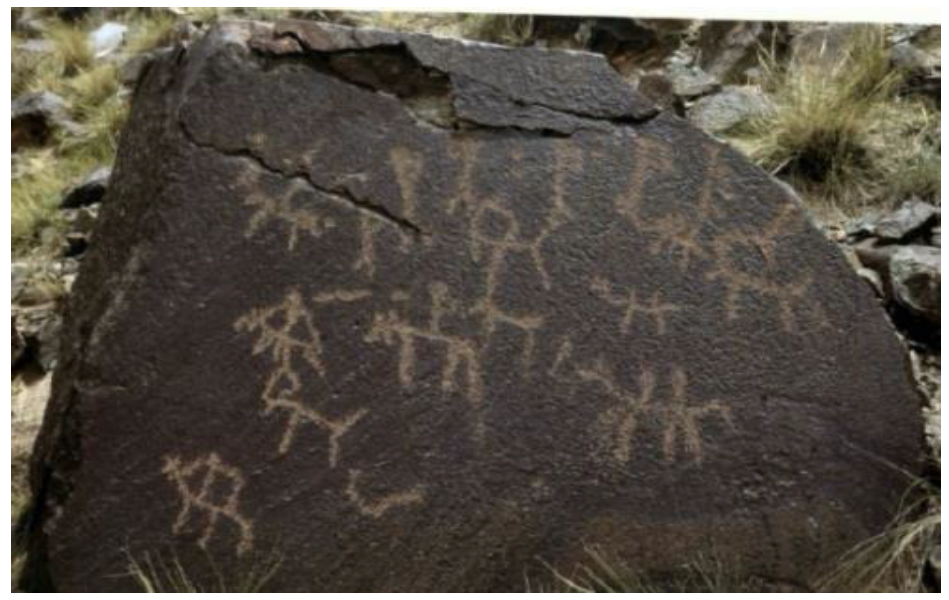
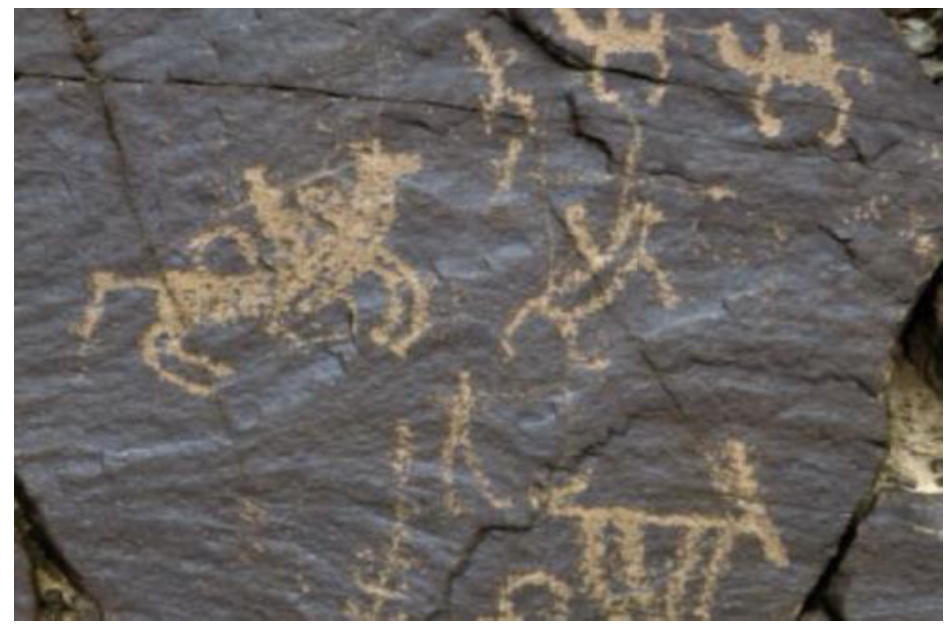
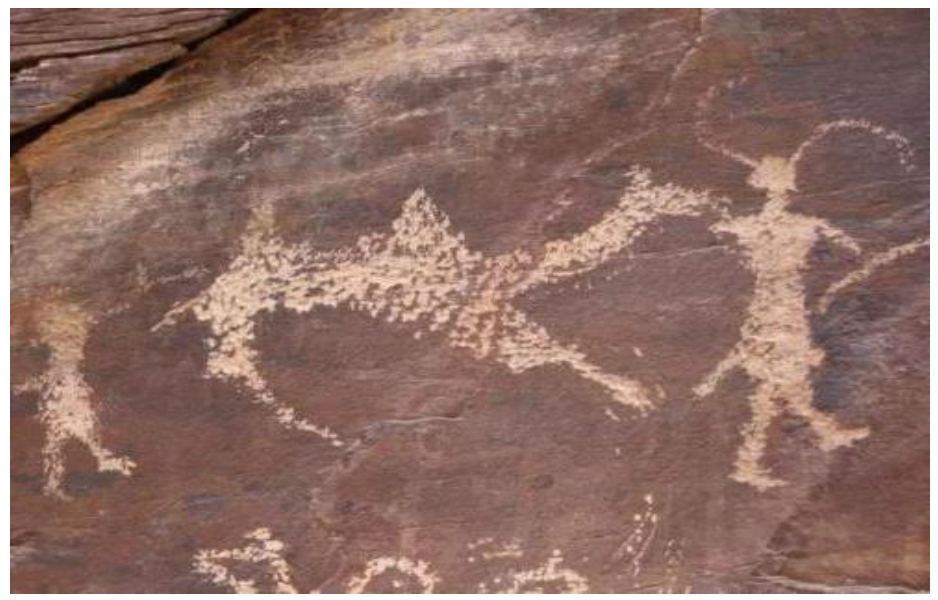
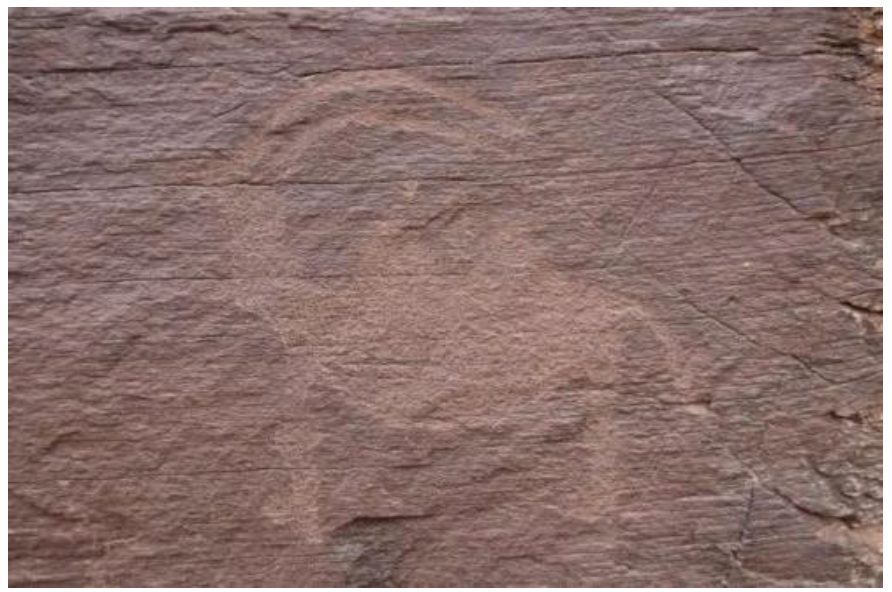
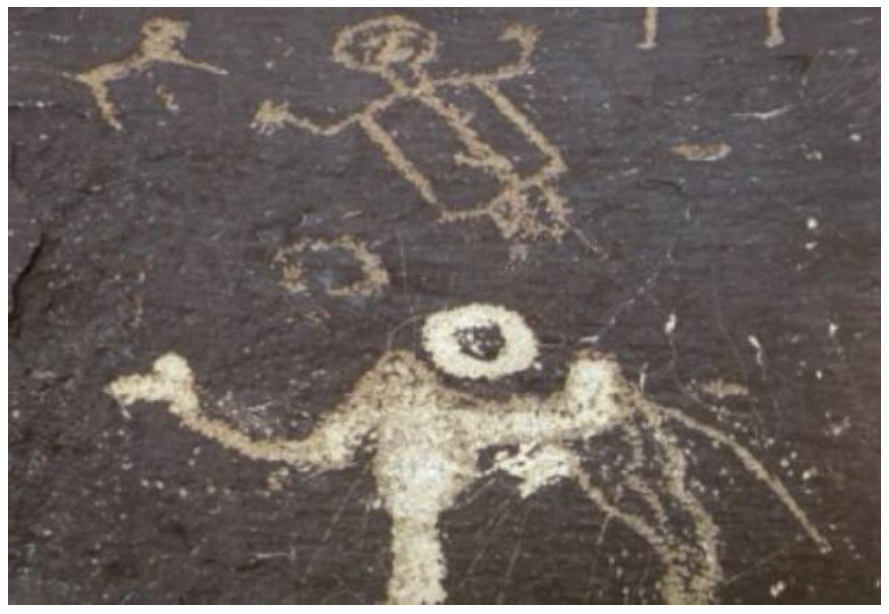
Rock art, known as the history book painted on stone, is the original document of primitive human before the invention of writing. There are a large number of rock arts with camel patterns in Central Asia grassland. These rock arts reflect the hunting and nomadic life of primitive human, It’s also the confirmation of primitive human's worship of camel. Analyzing the artistic characteristics of camel image rock arts and the cultural connotation of camel pattern worship has important practical significance for studying the time characteristics and artistic aesthetics of ancient nomads in the grasslands of Central Asia.
Keywords
Rock Arts
Camel Pattern
Nomads
Symbolization
INTRODUCTION
The Central Asia grassland rock arts lasted about 30000 years from the Paleolithic age, the Neolithic age, the bronze age, the early iron age, and various historical periods to modern times. In addition to the primitive clan tribes, after thousands of years of vicissitudes, the nomadic people of all ages living here, for example, Donghu, Xiongnu, Xianbei, Turk, Uighur, Dangxiang and Mongolia have formed their own customs, social psychological characteristics and culture. With their further creation, the Central Asian grassland rock art belt was formed.
The first "canvas" of mankind is the surface of rock, based on Emmanuel Anati [1]. Rock art is the earliest painting work preserved by human beings. It is a painting on the rock surface painted by ancient primitive human beings with pigments or tools. It reflects the rich content of the ancient people's production and life, social patterns, philosophical thoughts, religious beliefs, national psychology and aesthetic concepts from many aspects. It is a vivid illustration for humans to record their own development in the form of painting, and it is also a historical and cultural phenomenon produced by the development of human history to a certain stage. It is hailed by the historian as "the language of images, the epic of art". So far, studies have found that rock arts are distributed in five continents, more than 150 countries and regions, and there are more than 35 million statistical figures, based on Emmanuel Anati [2]. Among all kinds of rock arts in Central Asia grassland, the number of animal rock arts is absolutely dominant, accounting for more than 90% of all rock arts, based on A Sibagen [3]. The differences of animal communities are shown in rock arts due to the differences of regions and natural climate. For example, rock arts of camel pattern are mostly found in the desert and arid areas of Central Asia grassland. The earliest known camel pattern rock arts in the Central Asian steppe are as well as the sacrificial scene and primitive symbols and other graphics.in the Alxa League in Inner Mongolia, China, is the area where camel pattern rock arts exist most. Here, this paper will analyze the rock arts of camel patterns in Central Asia grassland area from the perspective of art.
Classification of Rock Arts in Camel Patterns
Camel pattern rock arts are found in Mongolia, China, Kazakhstan, Russia, the Republic of Tuva, Republic of Yakutia and other countries. Among them, Mongolia, China, Kazakhstan have more camel pattern rock arts. The content of the rock arts is wide and varied. The pictures depict single or group camels images from different painting periods; rock arts in which animals of different species appear in the same picture; the scene of one person shooting or more people shooting or grazing, as well as the sacrificial scene and primitive symbols and other graphics.
The social functions of rock arts are multifaceted. Therefore, the collected rock arts can be divided into three types: camel pattern, production and life, and religious sacrifice. Each type of rock art has its unique cultural connotation. The production techniques of camel pattern rock arts in Central Asia grassland area are mainly grinding and chiseling, some of them are carving, and a few of them are painted with mineral pigments, which shows the high artistic skills of primitive humans and ancient nomads.
Camel Pattern
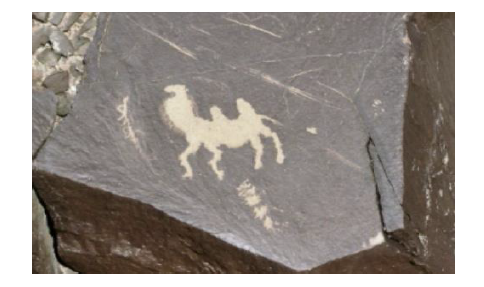
Rock arts of a single camel pattern are found in Mandela Mountain in the Alxa League and Del Mountain in the Central Gobi Province of Mongolia. The following are the rock art images with typical characteristics: The running camel has exaggerated the shape of the mane on its neck. The camel's head is tilted back, and its limbs are clearly distinguishable. The movement of running is described very strongly. There is a line of Uighur Mongolian script on the left side of the camel. According to the interpretation by Professor Bai Yanchagan from the History Department of Inner Mongolia Normal University, it means "good luck" or "be safe" (see Figure 1).
Figure 1: Camel and Uighur Mongolian (China)
The standing camel, the camel in the painting is standing sideways, the front and rear limbs are overlapped, and the huge hump is drawn in an exaggerated way, clearly showing the body characteristics of the camel (see Figure 2).
Figure 2: The Standing Camel (Mongolian)
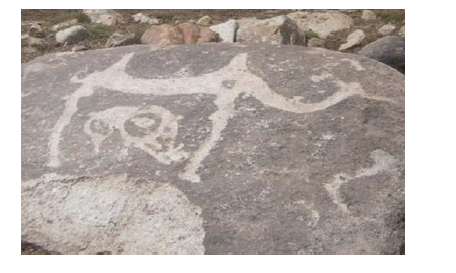
Camel and boar, in the picture, a boar stands under the camel's body, and both of them stand on their sides. The camel raises its head and the boar lowers its head. Their heart parts are clearly depicted (see Figure 3).
Figure 3: Camel and Boar (Mongolian)
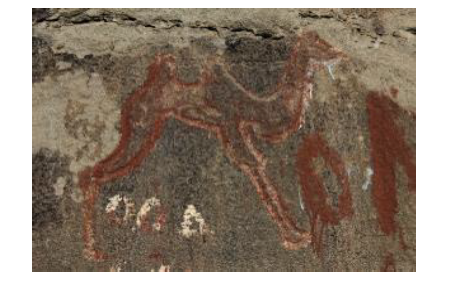
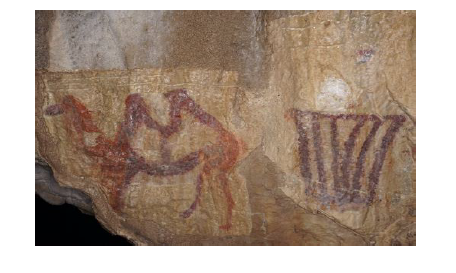
The camel images in Figures 4 and 5 are quite realistic from body proportions to postures. Both of them very similar to the real camel in nature. The creator painted with ochre pigment, which is relatively rare in the rock paintings of camel patterns in the grasslands of Central Asia (see Figure 4, 5).
Figure 4: Ochre Pigment Painted Camel (the Republic of Tuva)
Figure 5: Ochre Pigment Painted Camel (the Republic of Tuva)
There are also depictions of camel groups in the rock arts. As shown in Figure 6, the composition of the picture is an oblique triangle. The three camels are located on three corners. The heads of the camels are all to the right. The shape and size of the camels are similar. The front legs are bent forward. The camels in the picture are natural and vivid with a strong sense of decoration.
Figure 7 depicts a group of 15 camels. The camels in the picture have different shapes. There are four baby camels, and the baby camel in the middle are suckling.
Production and Life
The economic lifestyles of primitive humans in the grasslands of Central Asia are also reflected in camel patterns of the rock arts. Hunting is a common way of life of primitive humans, so the early rock arts with camel patterns mainly depict single hunting and group hunting; while the number of domestic animals increased in the later period, the pictures of camel captive and grazing gradually appeared in the rock arts. There are many descriptions of hunting and grazing scenes in the rock arts of Central Asia grassland area, which is the portrayal of hunting and grazing production and lifestyles of primitive human and ancient nomadic people. It can be seen from these rock arts that the ancient hunters had very detailed observations on the shape and habits of camels. When creating rock arts, they grasped and expressed the characteristics of camels very realistic, it can reflect the relationship between human and camel at that time. For example, here are two rock arts found in the Alxa League Left Banner of Inner Mongolia (see Figure 8) and the South Gobi Province of Mongolia (see Figure 9), hunters riding the horses, hold bows and arrows, aiming at the camel ahead. The legs of the horse and camel are in a running shape.
In the late hunting era, hunters have accumulated rich experience in long-term hunting activities. The relationship between humans and animals is no longer in a completely hostile state as in the early and middle hunting era. Secondly, due to the accumulation of hunting experience, the improvement of hunting tools and hunting techniques, hunters can hunt live animals and often keep them in captivity when there is no lack of food for the time being. For example, in these two rock arts, herders are grazing on horses. There are animals such as camels, goats and horses in the picture. The camel is on the lower right of the picture. The figure is prominent, and the body is outlined with a single line. The lines are simple and the abstraction factor is strong (see Figure 10).
Figure 10: Grazing Scene (China)
As shown in Figure 11, at the top right of the image, a shepherd is leading two camels, and the two shepherds in the middle position are riding camels and horses to graze. The camel on the left is sturdy, and its body is much larger than the other animals. There are images of goat, North goat and sika deer at the bottom of the picture. Such a scene may represent the process of camels being hunted and domesticated by humans from wild animals to domestic animals.
Figure 11: Grazing Scene (China)
Religious Sacrifice
"No matter how primitive the nation is, there are religions and witchcraft", based on Bronislaw Malinowski [4]. In ancient times, the religious ideas of primitive human beings were often triggered by the natural things they often touched. With the emergence of primitive religions and beliefs of primitive humans in prehistoric tribes, early religious rock arts appeared in the Stone Age. Primitive art is based on the survival needs of primitive humans and their perception of the world. It is related to labor (such as hunting), primitive religion (such as witchcraft), games (such as singing and dancing), and symbolic wild thinking (such as Totem, taboo) are closely related, based on Ban Lan, Feng Junsheng. Shamanism is one of the oldest religious forms of nomads in Central Asia, based on Song Yaoliang [5]. For example, a rock art found in the Xilin Gol League in Inner Mongolia (Figure 12). On the right side of the picture, there is a shaman wore a hat with horns on his head, dressed in a robe, with his left leg raised, as if was dancing. He holds a long rod in his hand, which is estimated to be a religious artifact, followed by a camel behind him. Shaman's clothes have a tradition of using the bones of spiritual animals as decorations. Most of their hats are decorated with antlers, which means that they can communicate with gods, while camel bone is the main decoration on their clothes. When shamans communicate with gods, camel bone is considered as the auxiliary God to fight with demons, which can protect them.
Artistic Characteristics of Rock Arts with Camel Pattern
Rock painting is a form of expression with a high concentration of aesthetic consciousness and interest of primitive humans. It embodies their understanding of beauty, expression of beauty, pursuit of beauty and enjoyment of beauty. Through the analysis and summary of the artistic characteristics of the rock arts with camel patterns in the grasslands of Central Asia, it is possible to infer the creative intentions of the creators of the rock arts, and to understand the changes in human aesthetic consciousness and aesthetic concepts in different periods.
Figure 12: Shaman and Camel (China)
The composition of rock art is very different from that of modern painting. It draws on infinite rock walls without the restriction of walls, canvases and other conditions. It can freely arrange the position of each image in the picture according to its own creative intention, based on Song Yaoliang [5]. In the rock arts of camel images found in the grassland of Central Asia, the images of camels and human beings, camels and other animal disproportionate proportions are very common, and the reasons for breaking the proportionality are often determined by the creator's creative intention and subjective idea. As shown in Figure 11, the camel being ridden is extremely huge, while the person's body is very small. The reason why the creator uses such a proportion of painting may be to highlight the dominant image of camel in his mind, to show the great power gap between human and camel, as well as people's awe and worship of camel.
By comparing and analyzing the styles of rock arts of camel patterns in the grasslands of Central Asia in different periods, it can be concluded that the form of rock arts has gradually changed from strong realism to abstract and simplified evolution. The early rock arts of camel patterns were lifelike and portrayed real. The pattern of camel is mainly realistic with strong representativeness, which reflects that the creators at that time took whether they could depict a realistic image as their fundamental pursuit. But later, the expression of lifelike images is no longer the main purpose of creation. The creators often focus on the atmosphere of the whole picture and the inner spirit of the portrayed object. The camel's modeling is more and more concise, and it is developing towards simplification, patterning and abstraction.
The principle of pattern simplification is a major feature of the rock arts of camel pattern in the grasslands of Central Asia. By summarizing the form and structure of camels as "geometric patterns", they are expressed with smooth curves. There is not only the beauty of simple and smooth lines, but also the tidiness of the body after generalization, which produces a simple decorative beauty. This kind of creation method has a typical reflection in the rock arts of camel images in Central Asia grassland area. For example, some camels' bodies are composed of only a few lines, representing the hump on the back and the abdomen respectively, and the legs are represented by zigzag curves. some camels' humps are very exaggerated, like high hills, but their heads and limbs are very simple, which can only be summarized in general shape. Other camels use a highly generalized method to describe the dynamic state of being still or running or jumping. The lines are vivid, fluent and dynamic. We can feel that the skill of painting has become mature.
The principle of abstraction is another characteristic of the rock arts of camel patterns in the grasslands of Central Asia. Although abstract works are not true representations of concrete objects, they are highly generalized by discarding and excluding the non-essential aspects of concrete objects, thus producing values that general concrete objects do not possess, based on Gai Shanlin [6]. Abstract expression seems to be an alternative creative method for today's artists, but for primitive humans, it marks the maturity of people's understanding of the laws of beauty and artistic understanding. The abstract expression in the primitive rock arts is to emphasize the physical characteristics of the painted objects. Most of the camel shapes in the rock arts of Central Asia grassland area are exaggerated. It can be seen that the hump and other parts of the camel are often exaggerated, while other body parts are simplified and omitted.
Camel image rock art has changed from the early realistic type to the later abstract type. Mr. Gai Shanlin explains in this way [6] "from the analysis of the gradual improvement of primitive human's primitive thinking ability, in the early stage, due to primitive religious beliefs, such as witchcraft rituals and totem worship, primitive human were devout and serious in drawing. It is in line with the cognition at that time to reproduce the animal image realistically and to materialize the religious belief in the image. In the later period, due to the continuous improvement of primitive thinking ability, primitive human beings realized the law of beauty and produced aesthetic concept, so the image gradually evolved into a strong aesthetic style of abstraction and Symbolization".
Camel Pattern Rock Art and Camel Worship
Engels said [7] "human beings are supported by other entities in their own development, but these entities are not high-level entities, not angels, but low-level entities, animals... Thus animal worship comes into being". In the period of primitive clan tribe, human's cognition of nature is still in an ignorant stage. The power of the natural world always affects every action of human beings, and the worship of things can satisfy the simple associations of human beings. Therefore, primitive humans tend to worship something that exists around them.
In the rock arts of camel patterns in Central Asia, the relationship between people and camels is often depicted as the relationship between worshiping and being worshipped. In the rock arts of camel patterns, we can often see the well-intentioned exaggerated huge body and hump, which not only expresses that camel is an animal resource for human survival, but also expresses the awe of human beings for camel, which has the meaning of praying for harvest and peace. As shown in Figure 13, the camel in the picture has a pair of huge horns, the length of which is almost the same as the length of the camel's body. Primitive humans believe that the horns of animals are bridges for communication with gods, and horns can also promote the reproduction of species. Animals with horns have supernatural powers, based on Li Ping, Zhang Zhiyan [8]. We all know that camels in nature do not have long horns. Obviously, the creator injected a sense of worship into this rock art when portraying it.
The most primitive sun worship is life worship and reproduction worship. The connection between the sun and life elements is a common understanding among people from all over the world in prehistoric times, so the worship of the sun transcends cultural and regional boundaries.
Figure 13: Camel with Huge Horns (China)
The philosophical and cosmological views of primitive human are largely built around the cognition of the sun. They regard the sun as the most important object to observe and give birth to a variety of image worship. The circle pattern is a basic figure depicting the sun, and it is also a simplified symbol of the sun. Sun worship is not limited to the main body of the sun itself, but extends to things that are internally unified with the sun in the thing. In the form of image expression, it may be replaced by other things, or appear in conjunction with other things. Primitive humans use primitive philosophical thinking mode to classify, and believe that similar synesthesia and things of similar nature will be infiltrated together, thereby enhancing the effect of expression, based on Cai Qing [9]. In the rock arts in the grasslands of Central Asia, there are often circle patterns decorating important parts of animal images that are worshipped or have an important position in sacrifices. This is a reflection of the importance of the sun, animals and reproductive worship by primitive humans in the Neolithic period. As shown in Figure 14, the circle pattern is in the middle of the camel's hump, and the male camel's genital organ are also very clearly and exaggeratedly portrayed. There are humans and argali at the top of the picture. This rock art is obviously also related to reproductive worship, the purpose is to promote the reproduction of animals and the abundance of hunting, but also to promote the reproduction of human beings. The existence of these two rock arts may have the meaning of giving camels a symbol of godhood.
Figure 14: Sun and Camel (China)
CONCLUSION
The rock arts of camel patterns in the Central Asian grassland area began to form in the specific geographical environment and certain historical conditions, and gradually developed in certain production conditions, material civilization, lifestyle, psychological state and religious consciousness. The existence of these rock arts of camel patterns reflects the hunting life of primitive hunters, primitive religious beliefs, and the historical transition from hunting to nomadic civilization. To a certain extent, they can provide evidence for the domestication process of camels, and are the physical reflection of hunting and nomadic life of primitive humans and ancient nomadic peoples. The evolution of rock art style of camel pattern shows the progress of primitive human's cognitive ability, drawing ability and aesthetic ability to the world. In the later rock arts, inscriptions such as Mongolian, Chinese, and Uighur scripts were gradually integrated, which made the camel pattern rock arts more rich and diverse. Although the rock arts of camel patterns in the grasslands of Central Asia come from different eras, nationalities, cultures, and environmental backgrounds, and there are many different factors on the pictures, there are surprising similarities in the basic content and form of expression. Rock art is a strong evidence of the identity of human culture, and it is also the language of all humanity that humans can communicate with each other across cultures. These rock arts of camel patterns record the vivid pictures of nomadic people's transition from hunting to animal husbandry, and also provide important clues for further exploring the influence of camel on nomadic people's production and life, religious belief, artistic aesthetics and other aspects in Central Asia.
REFERENCES
Anati, Emmanuel. The origin of art. China Renmin University Press, 2007.
Anati, Emmanuel. World rock art: The primordial language. Archaeo Press, 2010.
Sibagen, A. “The relationship between grassland rock paintings and Mongolian hunting and animal husbandry civilization.” Art Theory, vol. 10, 2008, pp. 166–167.
Malinowski, Bronislaw. Magic, science, and religion. Waveland Press Inc., 1992.
Song, Yaoliang. Chinese prehistoric godhood human face rock painting. Shanghai Joint Publishing Press, 1992.
Gai, Shanlin. Chinese rock arts. Bibliography Publishing, 1995.
Engels, Friedrich. Engels an Marks. 1861.
Li, Ping, and Zhang Zhiyan. “Evolution of Chinese traditional deer pattern and analysis of its auspicious implication.” Journal of Zhengzhou Institute of Light Industry, no. 9, 2008, pp. 13–16.
Cai, Qing. “The image form of sun worship.” Art Education, no. 1, 2019, pp. 162–164.
Recommended Articles
Research Article
Effect of Laser Bio stimulation and Bone Graft in Treatment of a Large Periapical Lesion – A CBCT Analysis
Ruchika Gupta Dewan,
Unnavi Chauhan
Published: 22/11/2020
Download PDF
Research Article
Classifying Problems of Diabetic Foot
Amit Kumar C Jain
Published: 23/11/2020
Download PDF
Research Article
Rare Presentation Heterogeneous Pregnancies
Imad Abedzaid Mohan Aljanabi,
...
Marwa Habeeb Nazal
Published: 20/03/2021
Download PDF
Research Article
Emerging Role of Nutraceuticals in Covid 19
Naaz Huda,
...
Kaur Charanjeet
Published: 22/11/2020
Download PDF
PO Box 101, Nakuru
Kenya.
Email: office@iarconsortium.org
Editorial Office:
J.L Bhavan, Near Radison Blu Hotel,
Jalukbari, Guwahati-India
None, W. & Tsiyen-Oidov, B. (2021). The Oldest Image of Camel ——Rock Arts. IAR Journal of Humanities and Cultural Studies, 2(2), 1-5.
MLA
None, Wurihan and Batsaikhan Tsiyen-Oidov. "The Oldest Image of Camel ——Rock Arts." IAR Journal of Humanities and Cultural Studies 2.2 (2021): 1-5.
Chicago
None, Wurihan and Batsaikhan Tsiyen-Oidov. "The Oldest Image of Camel ——Rock Arts." IAR Journal of Humanities and Cultural Studies 2, no. 2 (2021): 1-5.
Harvard
None, W. and Tsiyen-Oidov, B. (2021) 'The Oldest Image of Camel ——Rock Arts' IAR Journal of Humanities and Cultural Studies 2(2), pp. 1-5.
Vancouver
Wurihan W, Tsiyen-Oidov B. The Oldest Image of Camel ——Rock Arts. IAR Journal of Humanities and Cultural Studies. 2021 Jul;2(2):1-5.


 Download PDF
 Download XML