The present work explores the thermal radiation with natural convection in a cubic enclosure filled with three different fluids. The domain was studied using a three-dimensional analysis where governing equations were solved employing a finite volume approach. The enclosure was studied using air, water and ethylene glycol to ascertain the thermal performance of each fluid. The velocity variation, temperature distribution and wall radiative heat flux are all studied and the results are presented in the current work and discussed thoroughly. The contours of temperature and velocity vector are also illustrated and discussed.
Keywords
Radiation
Natural Convection
Heat Transfer
Computational Fluid Dynamics
INTRODUCTION
The problem of combined thermal radiation with natural convection is crucial for many industrial and engineering applications which can be found in high-temperature environments, for example in gas turbines, designing of a furnace, glass production, casting and levitation, space vehicles, fins designing, steel rolling, nuclear power plants, electronic equipment.
The flow of natural convection which can be encountered in an enclosure is one of the motivating subjects concerning thermal and mass transport processes. Thermal radiation can be accompanied by convection in various scenarios of engineering applications, the effect of radiation on natural or mixed convection is more pronounced than that on forced convection, this is due to the coupling between temperature and flow field [1].
The thermal radiation with natural convection effect was investigated by many researchers, Chang et al. [2] performed a numerical study for the two-dimensional radiation-natural convection interaction phenomena in square enclosures with equal vertical finite-thickness partitions located at the centers of the ceiling and floor. Bouali et al. [3] carried out a numerical study on the effects of surface radiation and inclination angle on heat transfer and flow structures in an inclined rectangular enclosure. Akiyama and Chong [4] investigate numerically the interaction of natural convection with thermal radiation of gray surfaces in a square enclosure filled with air. Yücel et al. [5] studied the effects of thickness and scattering on the flow and temperature fields and heat transfer rate in the natural convection of a radiating fluid in a rectangular enclosure. The interaction of natural convection with thermal radiation in laminar boundary-layer flow over an isothermal, horizontal flat plate is studied analytically by Ali et al. [6], they found that both the wall shear stress and the surface heat transfer rate increase with the increase in radiation interaction. Tan and Howell [7] investigated the combined radiation and natural convection in a two-dimensional emitting, absorbing and isotropically scattering square medium. Dehghan and Behnia [8] studied Combined natural convection, conduction and radiation heat transfer in an open-top upright cavity containing a discrete heat source.
Reddy and Kumar [9] presented a numerical study of laminar natural convection and radiation heat transfer in a cavity receiver of a solar parabolic dish collector.
Badrudden et al. [10] investigated the effect of radiation and natural convection in a saturated porous medium embedded in a vertical annular cylinder, they highlighted that the average Nusselt number increases significantly with radiation parameter. Bello-Ochende [11] presented a novel approach to employing working fluid as air and natural convection heat transfer from a cavity with plate fins attached to the inner aperture surface to investigate a range of Rayleigh number, inclination angle, fin height and thickness. Lei and Patterson [12] proposed an analysis for bottom slopes for unsteady natural convection in a triangular domain influenced by the absorption of radiation, they revealed that a number of flow scenarios are possible depending on the Rayleigh number and the relative value of non-dimensional parameters describing the flow. Convective-radiative heat transfer in an enclosure having finite thickness heat-conducting walls at local heating at the bottom of the cavity has been numerically studied by Kuznetsov and Sheremet [13]. Fusegi and Farouk [14] performed a numerical investigation of interactions of laminar and turbulent natural convection and radiation in a differentially heated square enclosure.
The aim of the present work is to investigate the heat transfer performance and fluid flow characteristics of natural convection accompanied by thermal radiation in three-dimensional analysis of a cubic enclosure filled with various fluids.
Problem Description
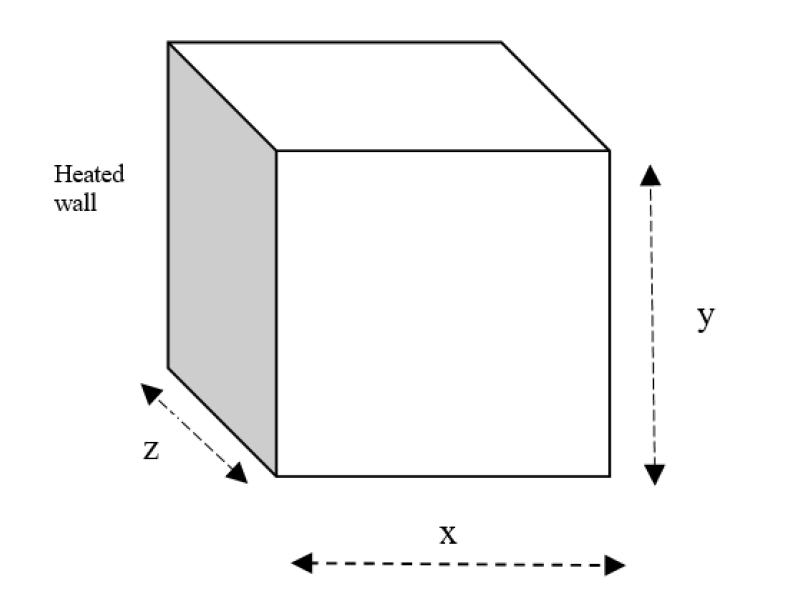
The problem geometry considered in the present work is illustrated in Figure 1. It represents a cube with dimensions x, y and z are 0.5 m each. The cube is filled with a fluid, three different fluids were tested in the present study: air, water and ethylene glycol. The cube is subjected to thermal radiation on the left wall. The natural convection was taken into consideration by taking the gravitational force into account
The cube has a hot wall at 473 K and all other walls at 293 K. Gravity acts downwards. The medium contained in the box is assumed to be absorbing and emitting so that the radiant exchange between the walls is attenuated by absorption and augmented by emission in the medium. All walls are black. The objective is to compute the flow and temperature patterns in the box, as well as the wall heat flux, using the surface-to-surface (S2S) model available in ANSYS FLUENT.
The working fluid has a Prandtl number of approximately 0.71 and the Rayleigh number is based on 0.5 m, this means the flow is most likely laminar. The Planck number is 0.003, which measures the relative importance of conduction to radiation. The mesh size considered in this work was set as 248460 cells.
Governing Equations
The governing equations were studied and solved in the current study are continuity, momentum equation and energy equation and can be expressed as:
Figure 1: Problem Geometry
Continuity Equation
Momentum Equation
Energy Equation
Numerical Approach
The commercial package ANSYS 18 was incorporated in the current study. The finite volume was used to solve the governing equations as well as the boundary conditions. The domain was divided into 248460 elements, the second-order upwind scheme was employed to discretize all the equations terms. To solve the pressure-velocity coupled equations, the SIMPLEC algorithm was selected. The convergence criteria was to reduce the maximum residual below 10⁻5. After the governing equations were solved, the quantities of fluid dynamics can be obtained
RESULTS AND DISCUSSION
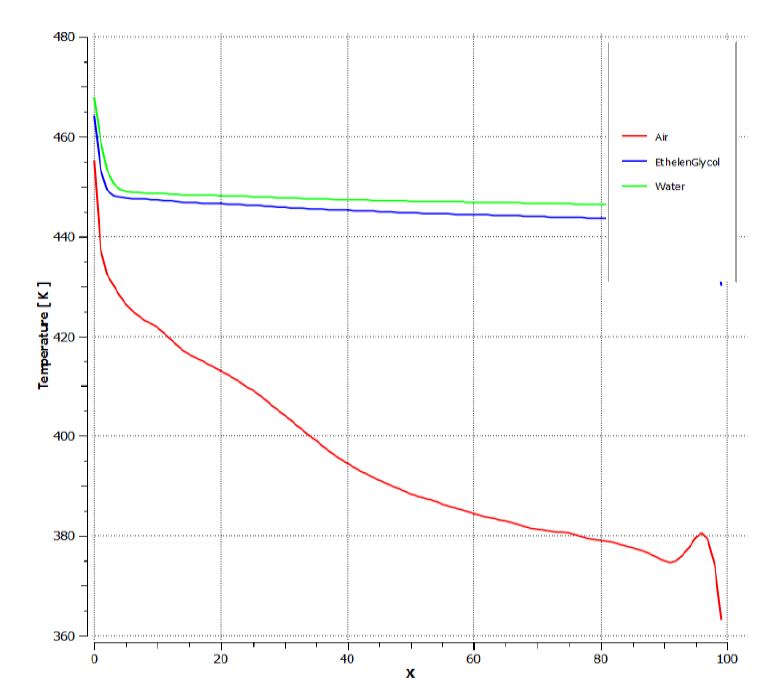
In this section, the results are introduced and discussed thoroughly. In order to investigate the change of temperature in the enclosure for all fluids considered, the results are presented in Figure 2. It can be seen from the Figure that at the top wall the starts with a high temperature at 462 K and decreased gradually for both Ethelyn and water whereas for air the drop in temperature was dramatic. It should be mentioned that water showed the highest temperature among all fluids tested.
Figure 2: Temperature at the Top Wall
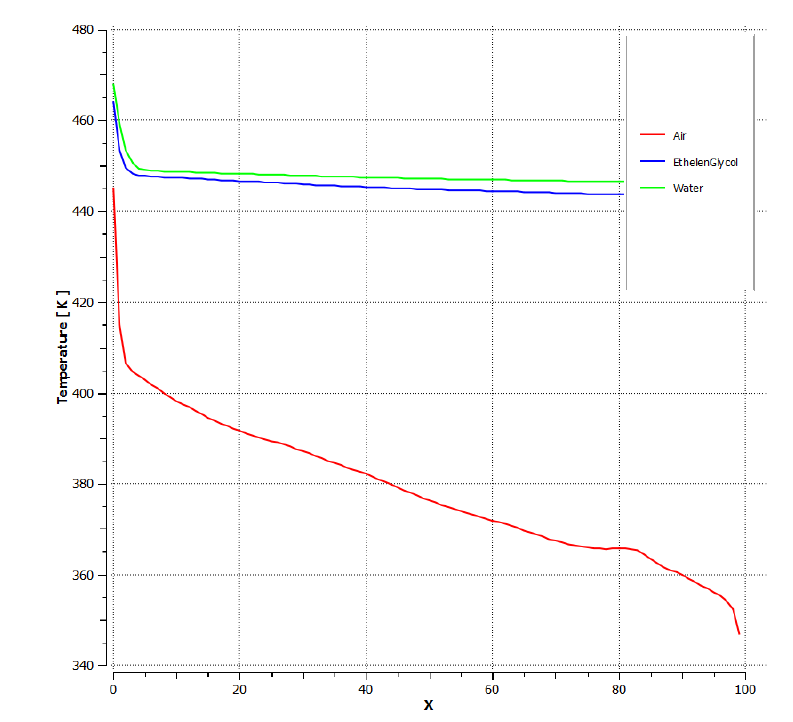
In the case of the bottom wall, the temperature variation was also investigated for all fluids considered in the enclosure. The results are depicted in Figure 3, the temperature declined gradually for ethylene and water, however, for air the temperature deteriorated sharply, this can be attributed to the lower density of air compared to the other two fluids investigated and the density variation the main reason for the heat transferred due to natural convection.
Figure 3: Temperature at the Bottom Wall
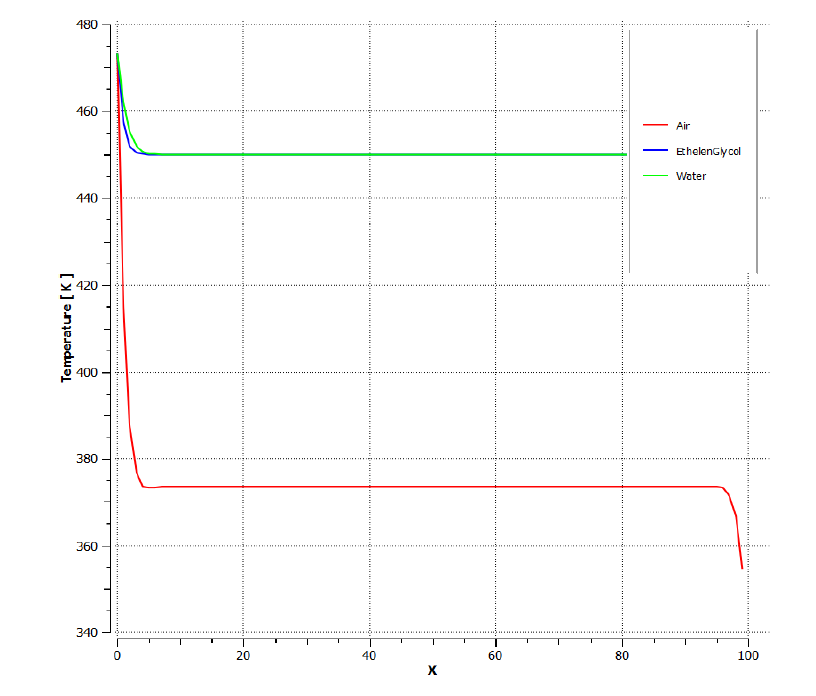
In order to understand the variation of temperature in the cubic enclosure, the effect of the radiation and natural convection is investigated and the results of temperature variation in the center of the enclosure are illustrated in Figure 4. It can be seen from the Figure that the temperature for both water and ethylene are identical as the density effect can be assumed neglected in the centerline which is of interest in this figure. On the other hand, air density is far less than water and ethylene, temperature showed a substantial drop in temperature which was found to be 33% lower than the other two fluids. The only noticeable change along the center is found at the near-wall regions. However, away from the near-wall region, the temperature was found to be steady on the center line for all fluids investigated.
Figure 4: Temperature at the Centerline
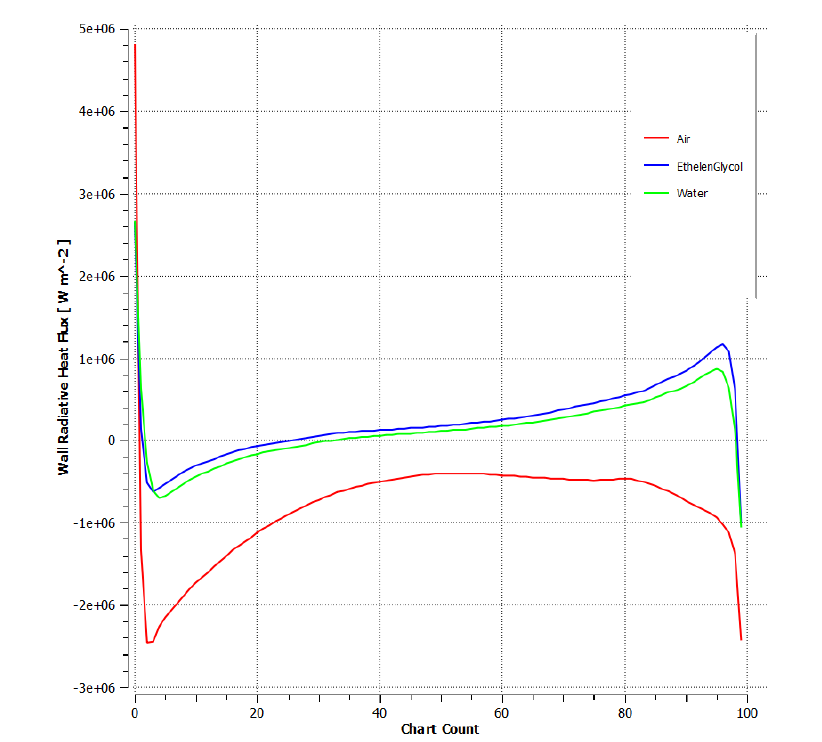
The understanding of the heat flux is essential to observing the temperature change in the geometry investigated. The results of the heat flux are presented in Figure 5. The heat flux dropped considerably at the left wall for all fluids studied, a gradual increase was seen away from the near-wall till the right wall where another decrease in the heat flux was found. This trend for heat flux is almost similar for all fluids, however, in the case of air, the heat flux, is noticeably lower.
Figure 5: Radiative Heat Flux at the Bottom Wall
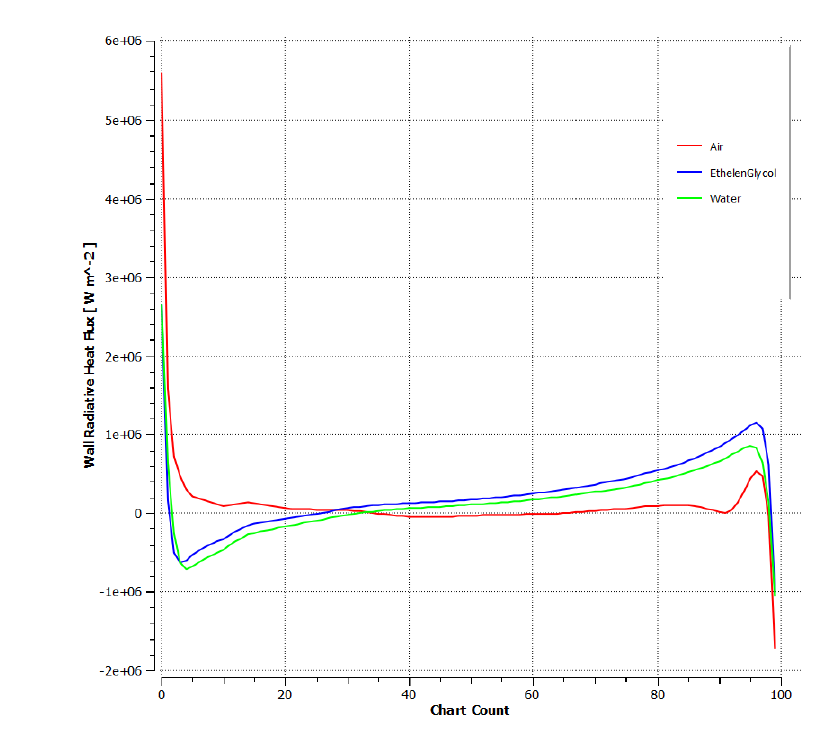
The heat flux at the top wall was also investigated and the results are introduced in Figure 6.
The interesting part of this work is that the radiative heat flux was fairly similar for all fluids investigated on the top wall where a sharp slump in the heat flux is seen in both enclosure walls.
Figure 6: Radiative Heat Flux at Top Wall
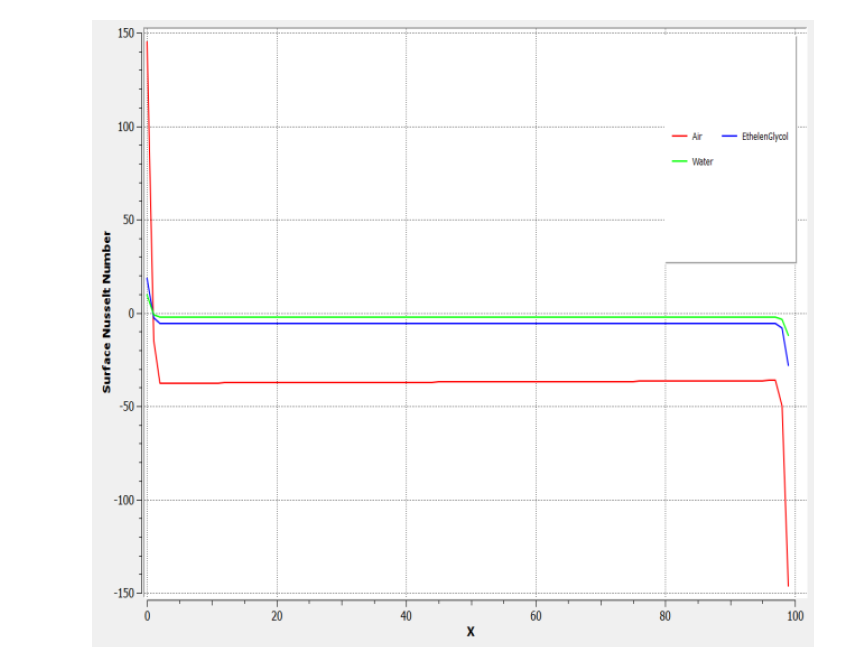
The Nu number variation was explored and the results are shown in Figure 7. The Figure represents the Nusselt number variation along the bottom wall for all fluids explored. It is worth mentioning that air showed the worst Nu number among all fluids explored, whereas water and ethylene looked very close variations along the bottom wall. This variation is in line with the variation of temperature and heat flux that were discussed earlier.
Figure 7: Variation of Nu Number Along the Bottom Wall for Different Fluids
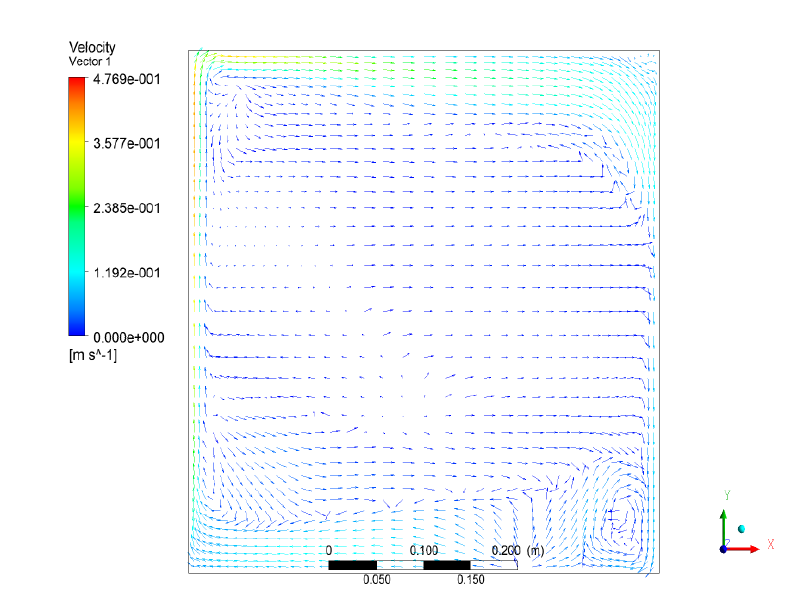
The velocity vector was also studied and the results are shown in Figure 8. The vector gives a comprehensive representation of the flow inside the enclosure. It is evident from the Figure that the velocity magnitudes are higher in the upper wall and a circulation zone in the lower right corner, this effect is due to the presence of the thermal radiation which is accompanied by natural convection.
Figure 8: Velocity Vector for Velocity in Air Case
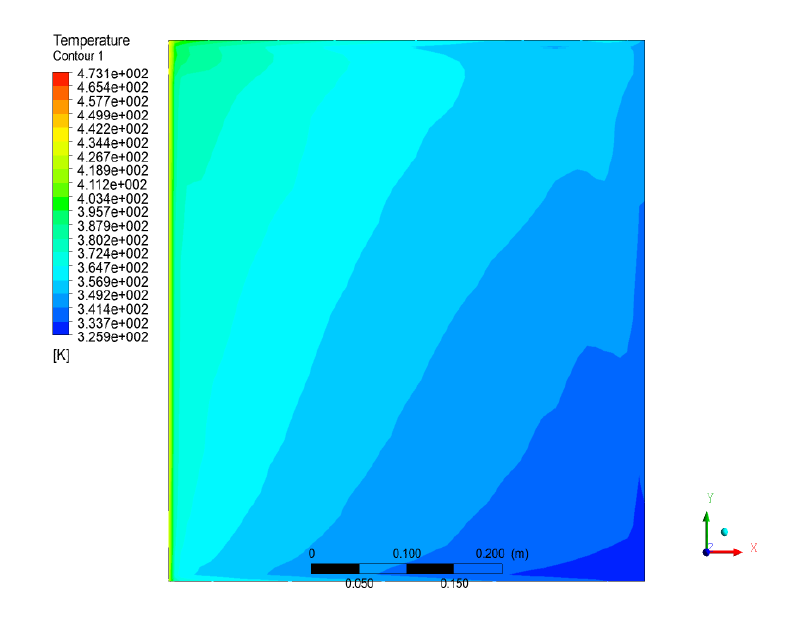
The contour of temperature was also represented in Figure 9. It can be seen from the Figure that the temperature is maximum at the left wall as a result of the applied heat flux due to radiation. The gradient temperature is also displayed in the enclosure. The minimum temperature is obvious in the lower right corner of the domain.
Figure 9: Temperature contour for the left side in the Air case
The velocity streamlines in the domain are displayed in a three-dimensional representation in Figure 10. The streamlines depict the velocity magnitude and direction in space and time. It can be shown that the velocity is higher in both the upper and left walls, this velocity direction is explained by the natural convection effect which is attributed to the density change due to the temperature difference.
CONCLUSION
A three-dimensional analysis for a cubic enclosure filled with three different fluids is introduced in the present work. The study is based on a finite volume approach. The commercial package ANSYS Workbench was adopted where governing equations were solved as well as the boundary conditions, from the results obtained in this study, it can be concluded that:
The temperature variation is similar for water and ethylene and was lower in the air on top and bottom walls
In the centerline, the air temperature was far lower than other fluids tested
The heat flux dropped considerably at the left wall for all fluids studied, a gradual increase was seen away from the near-wall till the right wall where another decrease in the heat flux was found
Air showed the worst Nu number among all fluids explored, whereas water and ethylene were found very close variations along the bottom wall
Conflict of Interest
This statement is to certify that all authors have seen and approved the manuscript being submitted and to declare any competing interest.
REFERENCE
Mahmud, S. and R.A. Fraser. “Mixed Convection-Radiation Interaction in a Vertical Porous Channel: Entropy Generation.” Energy, vol. 28, 2003, pp. 1557-1577.
Chang, L. et al. “Radiation-Natural Convection Interactions in Two-Dimensional Complex Enclosures.” 1983.
Bouali, H. et al. “Radiation-Natural Convection Heat Transfer in an Inclined Rectangular Enclosure.” International Journal of Thermal Sciences, vol. 45, 2006, pp. 553-566.
Akiyama, M. and Q. Chong. “Numerical Analysis of Natural Convection with Surface Radiation in a Square Enclosure.” Numerical Heat Transfer, Part A: Applications, vol. 32, 1997, pp. 419-433.
Yücel, A. et al. “Natural Convection and Radiation in a Square Enclosure.” Numerical Heat Transfer, vol. 15, 1989, pp. 261-278.
Ali, M.M. et al. “Natural Convection-Radiation Interaction in Boundary-Layer Flow over Horizontal Surfaces.” AIAA Journal, vol. 22, 1984, pp. 1797-1803.
Tan, Z. and J.R. Howell. “Combined Radiation and Natural Convection in a Two-Dimensional Participating Square Medium.” International Journal of Heat and Mass Transfer, vol. 34, 1991, pp. 785-793.
Dehghan, A. and M. Behnia. “Combined Natural Convection-Conduction and Radiation Heat Transfer in a Discretely Heated Open Cavity.” 1996.
Reddy, K. and N.S. Kumar. “Combined Laminar Natural Convection and Surface Radiation Heat Transfer in a Modified Cavity Receiver of Solar Parabolic Dish.” International Journal of Thermal Sciences, vol. 47, 2008, pp. 1647-1657.
Badruddin, I.A. et al. “Heat Transfer by Radiation and Natural Convection through a Vertical Annulus Embedded in Porous Medium.” International Communications in Heat and Mass Transfer, vol. 33, 2006, pp. 500-507.
Bello-Ochende, T. “Suppression of Natural Convection and Radiation Heat Losses in Solar Cavity Receivers: A Novel Approach.” Journal of Physics: Conference Series, 2019, p. 042050.
Lei, C. and J.C. Patterson. “Unsteady Natural Convection in a Triangular Enclosure Induced by Absorption of Radiation.” Journal of Fluid Mechanics, vol. 460, 2002, pp. 181-209.
Kuznetsov, G.V. and M.A. Sheremet. “Conjugate Natural Convection with Radiation in an Enclosure.” International Journal of Heat and Mass Transfer, vol. 52, 2009, pp. 2215-2223.
Fusegi, T. and B. Farouk. “Laminar and Turbulent Natural Convection-Radiation Interactions in a Square Enclosure Filled with a Nongray Gas.” Numerical Heat Transfer, vol. 15, 1989, pp. 303-322.
Recommended Articles
Research Article
The Possibility of Treating Corrosion in Iron Valves of Flow Regulators, Pumping Station Components, and Suspended Solids Filtration Networks in Rivers and Streams in Al-Qadisiyah Governorate
Qasim M. Turki,
...
Ahmed Hakem Jabor
Published: 02/03/2026
Download PDF
Research Article
OBSERVATIONS ON THE HOMOGENEOUS TERNARY QUADRATIC DIOPHANTINE EQUATION x2 + 4xy + 9y2 = 21z2
Download PDF
Research Article
Computer Driven Library Management and Service Rendering System: Mobile Library Landscape
Yekini N. A,
...
Ojo O
Published: 10/06/2020
Download PDF
Research Article
The Availability and Utilization of Some Selected Digital Technology Facilities among Students of Mathematical Sciences Using Krejcie and Morgan’s Sample Size Determination Technique, A Case Study of Kogi State University Anyigba
Download PDF
PO Box 101, Nakuru
Kenya.
Email: office@iarconsortium.org
Editorial Office:
J.L Bhavan, Near Radison Blu Hotel,
Jalukbari, Guwahati-India
Etaig, S. (2022). Three-dimensional Analysis of a Cubic Enclosure Subjected to Radiation and Natural Convection for Various Fluids. IAR Journal of Engineering and Technology, 3(2), 1-5.
MLA
Etaig, Saleh. "Three-dimensional Analysis of a Cubic Enclosure Subjected to Radiation and Natural Convection for Various Fluids." IAR Journal of Engineering and Technology 3.2 (2022): 1-5.
Chicago
Etaig, Saleh. "Three-dimensional Analysis of a Cubic Enclosure Subjected to Radiation and Natural Convection for Various Fluids." IAR Journal of Engineering and Technology 3, no. 2 (2022): 1-5.
Harvard
Etaig, S. (2022) 'Three-dimensional Analysis of a Cubic Enclosure Subjected to Radiation and Natural Convection for Various Fluids' IAR Journal of Engineering and Technology 3(2), pp. 1-5.
Vancouver
Etaig S. Three-dimensional Analysis of a Cubic Enclosure Subjected to Radiation and Natural Convection for Various Fluids. IAR Journal of Engineering and Technology. 2022 Jul;3(2):1-5.



 Download PDF
 Download XML