The need to avoid the high costs of unscheduled factory shutdowns, and the disruption of workflows and routines, and the contact between factory workers and their human neighbors (especially close to heavy equipment and a potential hazard). Crews used to wait for a breakdown, these days they are looking for the tiniest signs that components are malfunctioning or on the verge of malfunctioning. They are also integrated into systems to update the data associated with a machine's performance in real-time. The idea of what can go wrong with the data, and the tools for reading it better have made into our biology things are the expectation and consequence. They merely assist timeouts, which leads to work interruptions when most required. And when something goes wrong across the board, it's difficult to assess shady locations like digital factories and offshore platforms. When your complete functioning shatters within hours, time is the one and only currency that matters. Studies suggest using technology such as screens, smart software, and diagnostic kits to assist in equipment maintenance. The earlier you can catch a problem, the less likely it is that a shutdown will occur and the shorter that shutdown will be; one study showed that outages dropped by almost 50%. Easier and more streamlined operations with lower costs and risk. Digital storage and lightning-fast connections have rendered the tried-and-true methods of waiting for failure obsolete. When maintenance is performed before problems arise, machine life is extended. The current method of checking might be replaced with employing math that learns or by testing repairs in simulations, rather than relying on guesswork. Efforts made today on more efficient practices may determine tomorrow's maintenance procedures.
Keywords
Predictive Maintenance
Unplanned Downtime
IoT Sensors
Oil and Gas Industry
Industry 4.0
INTRODUCTION
Research Background
Production locations around the world deal with the problem of unexpectedly turning off equipment. Once critical systems fail, operations halt, employees sit idle, productivity plummets, and repairs pile up. Outages can quickly deplete supplies, throw schedules into a loop, and postpone delivery. Damage of tens of thousands of dollars might result from the mere halt of heavy-duty installations, such as oil drills, energy stations, and factory belts, for even sixty minutes. Many years have passed with company owners still attempting to prevent problems before they even start. Inspections occur periodically according to a predetermined schedule rather than waiting. Although it isn't flawless, being proactive rather than reactive is preferable. Keep systems working well by staying on top of maintenance rather than jumping in later. Gear may still break down in the time between such regular inspections, even though service plans can be adjusted. Changing things up could be due to habit rather than necessity. When different organizations aren't familiar with each other's processes, confusion and even collapse can ensue.
Occasionally, machines will stop working in the middle of an operation, which will stop everything that follows. When a tool breaks, progress halts, people have to wait, and the amount of work done decreases daily. Out of nowhere, problems start to affect other areas, causing delivery delays and goods to disappear. When they're not in use, power plants, mines, and assembly lines for cars all lose money. In order to identify problems quickly, some businesses cling to set protocols. Early solutions, sometimes difficult ones, occur because breakdowns produce bigger issues. Better than rushed solutions in the aftermath of chaos, adjustments made before problems arise help minimize lengthy delays. Flaws can still sneak into gear, even when it gets cared for on a cycle.
Expect the unexpected between visits, no matter how prepared you think you are. One possible reason for change is that people desire it. Beginning a task without a specific plan of action usually results in rapid setbacks.
Research Problem
Unplanned stoppages continue to be a problem for many manufacturers, even though smarter maintenance may assist. This research aims to reduce unexpected breakdowns in production contexts. There may be set protocols for fixing machinery, but problems nevertheless develop occasionally, either because inspections are done too soon or too late. When solutions are sent out according to fixed timelines, people may waste time finishing tasks ahead of time or miss hidden issues. An all-encompassing industry-wide plan for making decisions in real-time is still missing. It is still difficult to anticipate errors in advance without more precise methods linked directly to machine behavior.
Reasonable enough, given the extreme conditions encountered by workers in the oil and gas industry, their long-lasting equipment will inevitably fail. When pipes, turbines, or compressors break down for no apparent reason, things can go from chaotic to disastrous very fast.
Research Objectives
Establishing clear goals that directly connect with equipment performance will help to improve maintenance and therefore help to streamline your operations. Because it uses prediction to analyze data you fail to find a lot less and it also cuts down end-user mistakes. Because of sensor-based input that gives them real-time data, devices will be able to identify patterns and strange deviations before they have time to develop. Since these repairs are performed before full breakdowns, the time required to bring the work to a halt and prepare it for repair also decreases. Unlike post equipment fallen fixes, they expand the operational prolongation of its work in advance. Nevertheless, the progress is slow due to problems such as unreliable data and outdated infrastructure. Opportunities arise as decisions get made by people utilizing the information they have (filling in gaps), establishing connections between ongoing events and emerging trends.
Research Significance
Factory workers and academics are both interested in predictive maintenance. Companies save money, work more efficiently, stay safer, and reduce their environmental impact when equipment faults are detected early on. When equipment continues to function continuously, there is less waste, supplies last longer, and personnel can concentrate on what's really important in advance. Incorporating thinking-like software with smart sensor feedback reveals obvious ways to improve output while simultaneously revealing areas where researchers might delve more in the future. Making foresight work properly inside plants relies on strong signals and constant linkages between systems.
Literature Review
Maintenance Strategies in Production Systems: Various methods of maintaining machine operation were formerly used in factories. Out of all the approaches, three came out as very useful: problem prediction, routine inspections, time-based service, and failure-based repair. That is the very last one that is considered when equipment suddenly stops working. Employees are quick to step up when problems arise. Due to the random nature of breakdowns, the impact is seen as sudden. The unanticipated shutdown made dealing with delays more difficult. Perform routine maintenance, such as inspections once a month or when certain duties are complete; components are replaced even when functioning properly. Although there are fewer shocks this way, jobs that are rushed can waste more time and materials. Avoiding breakdowns requires jumping in ahead of deadlines and keeping track of repairs by time or usage. However, problems do arise with routine inspections, even though they are preferable to waiting until something breaks before taking action. Partial completion. Excessive debris. Totally wasted on unnecessary modifications. Long before the scheduled service call arrives, an unforeseen problem appears [1].
Predictive maintenance stands out because it monitors machinery for indications that repairs could be necessary soon. Sensors detect changes in vibration or temperature, which may indicate gradual degradation. As time becomes less important than actual behavior, date-based routine checks become less relevant. Teams can wait to intervene until circumstances warrant it because action is based on signals rather than deadlines. A lot of the time, problems manifest themselves far before anyone would typically notice. When surprises are kept at bay, work continues to progress. Equipment receives maintenance right before it's needed, so the accumulation of effort and materials is slower. Decisions are based on real-time data rather than speculation, which can lead to hasty purchases or failure. We are seeing less problems currently. The passage of time can be retraced. There is no mistaking the fact that each approach deals with near-misses in its own unique way [2].
It is evident from Table 1 that repairs frequently cause lengthy unscheduled stops when equipment run continuously until they fail. By scheduling regular checks, rather than waiting for problems to arise, you can reduce the likelihood of unexpected failures, but they will still occur.
Table 1: Comparison of Maintenance Strategies and their Effects on Unplanned Downtime (Placeholder)
Maintenance Strategy
Approach
Impact on Unplanned Downtime
Reactive (Run-to-failure)
Fix equipment after it fails; no regular maintenance schedule.
High – failures occur unexpectedly, leading to significant unplanned downtime.
Preventive (Scheduled)
Perform maintenance at regular intervals (time-based or usage-based).
Moderate – lowers the frequency of unexpected failures, but unplanned downtime can still occur between scheduled maintenance.
Predictive (Condition-based)
Continuously monitor equipment condition and service when indicators show risk of failure.
Low – most failures are anticipated and prevented, drastically reducing unplanned downtime events.
Gear repairs that are in line with actual degradation will cause a shift, allowing equipment to last longer without wasting effort. Spending has been steadily declining in the US, according to data tracked by machines. The Department of Energy conducted a research that indicated replacing regular maintenance with alternative ways reduced expenses by 8–12%. Costly fixes don't tend to pile up later because major problems are rarely fixed. When inspections are done only when necessary, according to established timetables, savings become apparent over time. This disparity widens, eventually reaching 30% or 40% when contrasted with the alternative of waiting until something fails. Time, more than frequency, determines how much it will cost to fix something.
In addition to routine maintenance, early problem detection requires constant system monitoring, which was not possible in earlier generations. Nowadays, machines work around the clock, providing data streams that older companies were unable to collect. When wrenches were the norm in garages, reading such signals would have required some very sophisticated software. Wear may now be detected hourly thanks to sensors, which have just recently been widely available. Programs of today are able to detect patterns in noisy data that were previously impossible [4].
IoT Sensors and Data Analytics for Predictive Maintenance
Guessing machine failures has recently become more feasible across several sectors because to interconnected devices and smarter data processing. Smack dab in the thick of things - little screens affixed to machinery. Wearing these tiny trackers allows machines to constantly get valuable information on the condition of its parts. Similar to the ones shown in Table 2, each type of sensor has its own unique way of detecting warning signals.
Table 2: Examples of Iot Sensors used in Predictive Maintenance and the Faults they Help Detect (Placeholder)
Gas or liquid leaks, cavitation in pumps, steam trap failures
Oil quality sensor (wear debris analysis)
Contaminants/particles in lubricant
Gearboxes, turbines, engines
Wear and tear of internal components (e.g., detecting metal particles from gear wear)
When machines shake, new signals enter the picture. These are little tremors that sensors designed for spinning parts pick up on. Noises or leaks? Silently carrying out their duties, sound detectors also capture them. Information arrives second by second without fail. This continuous flow allows maintenance to move away from human-performed scheduled walkarounds. On the contrary, machines monitoring other machines cause inspections to occur more frequently. The rate increases. Stay focused at all times [5].
By installing sensors on critical equipment, their health may be monitored continuously. Information such as temperature or shaking behavior is transmitted from these devices to main computers or online storage locations via wired industrial links or wireless internet hubs. After smart mathematical tools digest what comes in, hidden trends start to emerge. Experts use wave analysis and pattern recognition techniques rather than relying solely on numerical data; for example, one method converts jitters into audible tones in order to detect abnormal rhythms prior to motor failure. When records contain information concerning breakdowns, the software carefully examines them, looking for signs that problems are on the way. [6]
Later on, processing takes place, utilizing intelligent computations that are either located on distant systems or in close proximity to the gear itself. By analyzing trends over time, these calculations detect potential problems at an early stage. When a potential issue arises, alerts are immediately sent to the tools that maintenance teams utilize. Software that manages maintenance schedules and jobs is frequently closely linked to those tools. Thanks to this link, notifications can be automatically converted into tasks without any human intervention. Connected paths directing maintenance activities are formed by components such as digital sensing devices, computation modules, and planning functions (Figure 1) [7].
Figure 1: Overall Architecture of an IoT-Based Predictive Maintenance System in Oil and Gas Production Facilities
Figure 1
Typical architecture of a predictive maintenance system integrating IoT-based sensors for data collection, a data processing and analytics platform (edge or cloud), and a maintenance scheduling interface to trigger timely interventions. (Placeholder figure)
While some tools are kept in the dark about their own wear and tear, others are not. A different tale emerges through constant observation, though, when sensors are integrated with critical gear. Data, such as vibration pulses and temperature readings, flows deliberately and purposefully toward hubs via wired lanes or airwaves. It doesn't do nothing after it gets there. Software with built-in intelligence sorts the signals, searching for anything out of the ordinary. In the absence of visual cues, such as a spike or wobble, mathematical algorithms calibrated to the rhythms produced by machines just before they fail detect patterns. Models remember how heat increased alongside tremors shortly before crashes last time, and frequency work breaks down shaking into clues; previous errors educate future guesses. [8]
There are typically a number of interdependent components in a setup for failure prediction in equipment. Right at the point where machines are in use, sensors pick up indications like vibrations, heat, or noise. Data then makes its way through many networks to various storage locations, including distant servers. Not all processing takes place in the same physical location; some takes place close to the source, while others take place in large, remote data centers. Intelligent processes examine incoming data for unusual patterns before malfunctions occur. Data is fed into technologies that assist teams in determining when and what needs repairs. These tools communicate with the repair staff's software directly, so alerts are relayed instantly. Inside regular workflows, jobs pop up mechanically whenever problems are imminent. One view integrates real-time monitoring, data processing modules, and maintenance scheduling into a single loop; a diagram depicts the overall structure. [9]
Applications of Predictive Maintenance in Industry
When the stakes are high and the losses are large, predictive maintenance has found widespread application. Consider the energy industry, specifically the oil and gas industry, where machinery like processing units, compressors, rigs, and pumps have to be operational at all times. Bigger problems, such spills and injuries, can result from an abrupt stop at a refinery or on a marine rig. Companies started relying on early warning sign detection systems because failures aren't simply about delays. Modern monitoring systems now record the exact actions of equipment in real time. This change began to gain momentum about ten years ago. Team members now scan data streams for anomalies rather than waiting for failures to occur. More people are paying attention to the whimpers of machines just before they malfunction. Consider gas lines; typically, sensors that measure pressure or sound are installed to detect unusual activity, such as a blockage or leak, and to address the issue before to its catastrophic failure. Mechanisms that spin, such as pumps and compressors? They are examined by means of vibration patterns, which show subtle indications of worn bearings or uneven spin far in the future [9].
Machines began alerting humans before they broke down one day. The use of these alerts reportedly reduced unanticipated delays in the oil and gas industry. Using smart sensors reduced breakdowns by 30% or more for certain large organizations. Before a catastrophe happens, individuals fix broken technology that talks. Like a gas compressor whimpering under pressure, teams respond quickly, on their own terms, rather than in the midst of a crisis. That change prevents explosions and fires. Stories of longer-lasting gear are now shared by companies across continents. What is their cover story? The power to run, rest, and exert oneself is shaped by facts. Technology has made machines live slower, survive longer, and act smarter.
Smart procedures for upkeep enable the current factories to gain distinct benefits. From another angle, automated shops, particularly if they follow the tenants of Industry 4.0, equip their machines with measuring devices that provide data to control centers. Such as robotic arms, CNC units, moving belts etc. Any sudden halt on the assembly line for autos or semiconductors can cause ripple effects on long-delayed deadlines and sweeping billions in losses. In reaction to these threats, production equipment manufacturers have resorted to maintenance strategies based on foresight, which enables machines to achieve their peak capacity in the long, gradual, stage process. In a factory, one uses a sensor to sense the tiniest vibrations a robotic arm makes and measure the force at which it twists. Signals are always being developed, so intelligent software can recognize abnormal patterns before actual damage occurs. Alerts will be observed only between Worker changes (never mid-task) and fixes are implemented. Therefore, machines do not need to catch up with it, and supplies are untouched until they are needed [11].
Challenges and Recent Developments
While predictive maintenance does provide many benefits, research has also shown some significant drawbacks. It stands out as a fundamental problem that predictions are not accurate. For example, older versions of these systems would sometimes alert users to nonexistent issues, such as machines that were perfectly fine. Faith in the instrument quickly dwindles when repair teams persist in pursuing imaginary problems. Over time, employees may stop paying attention to warnings or revert to previous habits. Experts are still very much focused on improving software's ability to detect real problems. More accurate predictions are now possible as a result of more sophisticated AI and access to larger data sets. False conclusions? Even the most astute predictions are unable to withstand them. Accuracy requires keen sensors in addition to smart programming; results are severely hindered by skipped inputs or misaligned tools [12].
Integrating predictive maintenance into existing processes is a challenge. It takes time to change habits when routines depend on fixed checkups. Employees may require updated education to respond to computer signals rather than calendars. Team structures can change to accommodate quicker reactions. The upfront cost of purchasing sensors and equipment is high, so that is another factor to consider. To check if the figures add up, several businesses test out smaller initiatives first. Return on investment (ROI) studies typically show a positive trend after a few years, particularly in cases of high productivity, but it might be difficult to forecast ROI in the beginning. Nevertheless, there are maintenance supervisors who are skeptical about computerized predictions until they see concrete outcomes that apply to their specific case [13].
New challenges arise daily while dealing with data and expansion. The data produced by the interconnected devices in a smart factory are infinite. To make a move that loads quickly, you need powerful computers and remote servers to collaborate, which may include moving some operations closer to the data source. Equally important is ensuring that all devices are secure; otherwise, hackers may be able to access sensitive information through the connections between them [14].
Regardless of these obstacles, research and development progresses at a faster rate every month. More sophisticated algorithms, like as deep learning, have made it feasible to anticipate when and for how long components would fail. Systems shift their focus from problem prediction to next-step prediction. As soon as an issue is identified, it provides prompt solutions. For example, the system may anticipate when a motor is about to break down and schedule maintenance accordingly, ensuring that new parts are readily available. Smart sequences shaped by data replace conjecture in decision-making, thanks to data flow. The use of digital twins also makes it possible to virtually test machines in a variety of environments. Because of this, issues can be spotted sooner and remedies can be tested in a simulated setting before being implemented in the actual world [15].
METHODOLOGY
Building understanding by meticulous analysis rather than collecting new information, this approach relies on ideas already discussed in journals and real-world industry reports. It lays out what is known about anticipating equipment failures by combining academic literature with real-world factory operations. In the background, there is a goal: to understand how these predictions can reduce unexpected industrial stoppages. Oil rigs and high-tech factories have a very tight focus because breakdowns there cost a lot of money. Learning progresses at a snail's pace when established practices are compared to theoretical frameworks, allowing patterns to naturally arise.
Factories' use of contemporary tools for maintenance was illuminated by findings in scholarly articles and reports from the industry. The focus has recently shifted to works released within the last decade, in an effort to stay contemporary. The understanding was shaped by a combination of technical texts and expert summaries, rather than merely identifying sources. Words like "IoT sensors" and "predictive maintenance" helped direct our search. Experiences with tech-driven repairs in production settings were highlighted in each of the assessed pieces. Various studies' results indicated benefits and drawbacks of different approaches. Results related to smarter machine tracking that were coupled to real-world situations frequently stood out [16].
Predictive Maintenance Workflow
Machines buzz in fields, and sensors capture temperatures, vibrations, pressure, and velocity. Then live signals pass through contraptions that reasonable the fight of ambient sound and contribute to help additional explain designs. These flows are then fed into intelligent algorithms that are trained to identify abnormal behaviors, so you are not taken by surprise. Instead of having all teams waiting to be called, they are called based on the model expected wear and failure. Measurement, cleaning and evaluation, decision making So, that's the entire process. Smart gear, on the other hand, performs more than respond to activity because networked detectors are not embedded in secondary equipment but rather vital equipment [9] (Table 3).
Table 3: Examples of Predictive Maintenance Outcomes in Various Industries (Placeholder)
Industry / Sector
Predictive Maintenance Implementation
Reported Downtime Reduction
Other Benefits Noted
Oil & Gas (Offshore Platform)
IoT condition monitoring on critical pumps, compressors, and generators; AI-based failure prediction models.
~35% reduction in unplanned downtime (year-over-year).
Saved several million USD annually in lost production; improved safety by preventing catastrophic failures.
Automotive Manufacturing
Sensor network on assembly line robots and machines; predictive analytics scheduling maintenance during off-shifts.
~20% reduction in unexpected line stoppages.
Increased production throughput (more vehicles produced per year); optimized spare parts inventory usage.
Power Generation (Wind Farm)
Vibration and temperature monitoring on wind turbines; remote diagnostics predicting component failures.
~25% decrease in major turbine breakdowns.
Higher energy output reliability; extended equipment life through timely repairs; reduced maintenance labor hours.
Chemical Processing Plant
Advanced analytics on process pumps and valves; continuous monitoring for anomalies in pressure and flow.
~30% reduction in unplanned process interruptions.
Improved product yield consistency; lower risk of environmental incidents due to leaks or failures.
Historical data revealing an upcoming issue effectively activates the alert, providing time to address them quickly before sweet fix. It has the added advantage of allowing repairs to be scheduled so that work doesn't have to cease. When machines are serviced before they fail, you keep things operating the way they should [17].
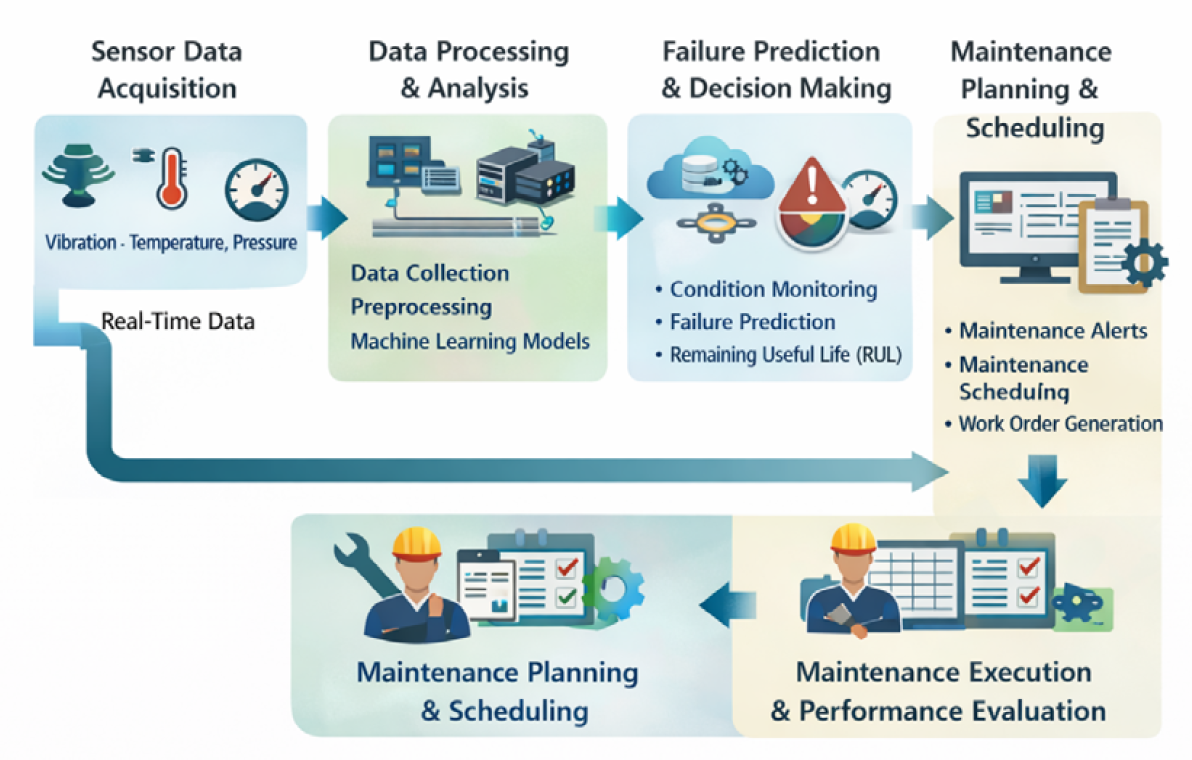
Figure 2 shows in the case of predictive maintenance, for example, data collection is done based on sensors. It then flows logically downward to a maintenance final call. It means a seamless flow without any Breaks, where data can quickly become results. Decisions evolve in a structured sequence of incremental evolution. Signals that become devised decisions.
Figure 2: Predictive Maintenance Workflow for Reducing Unplanned Downtime: From Sensor Data Acquisition to Maintenance Decision Making
Analytical Framework
Thus, Workflow became a way to explore the impact of intelligent repairs on everyday practices. Timed checks, supply organization and other maintenance habits are used alongside technology resources like live data monitors to drive outcomes. This isn't a bluff; factory data shows low low problems if systems warn in advance These are the first set of indicators that correlates well with outcomes such as sustained machine health and steady output flow. The bind is in the proof that if you stay mindful, you can run without issues for a long time.
The way this point of view drives perceptions of past work, in some cases without any new evidence. Sources of reliable data from various regions were prioritized due to their influence on the results. It is a simplified approach of assessing the effect of maintenance estimates influencing unpredicted failures in modern manufacturing environment by integrating conventional data collection, maintenance and storage methods into the process framework [18].
RESULTS AND DISCUSSION
Downtime Reduction Outcomes
Manufacturers can reduce unanticipated failures by up to fifty percent using predictive models and even eliminate shutdowns in some cases. In some factories, such as Whirlpool's laundry plant in the U.K., real-time machine data is used to prevent faults, which can lead to a reduction in pauses of up to 25%. Predictive maintenance will allow these machines to run for more extended periods before going into failure mode, hence lowering costs and utilizing more of existing assets. More data-driven decisions create good consequences with better planning and maintenance, less wear and tear and lower costs. Proactive detection of problems yields better performance in different industries by reducing downtime and improving production consistency.
Breakdown prediction is used across different sectors, though particularly when expensive downtime is even more costly, such as offshore oil rigs. Wind farms apply predictive maintenance to prevent catastrophic failures and ensure secure operations and extended equipment lifetime, while factories are able to enhance production and profitability by eliminating stops. Just adding sensors is insufficient for predictive maintenance as it depends on accurate predictions and speedy repairs. By integrating these structures into operations, maintenance has become proactive in nature rather than a reactive activity that improves performance.
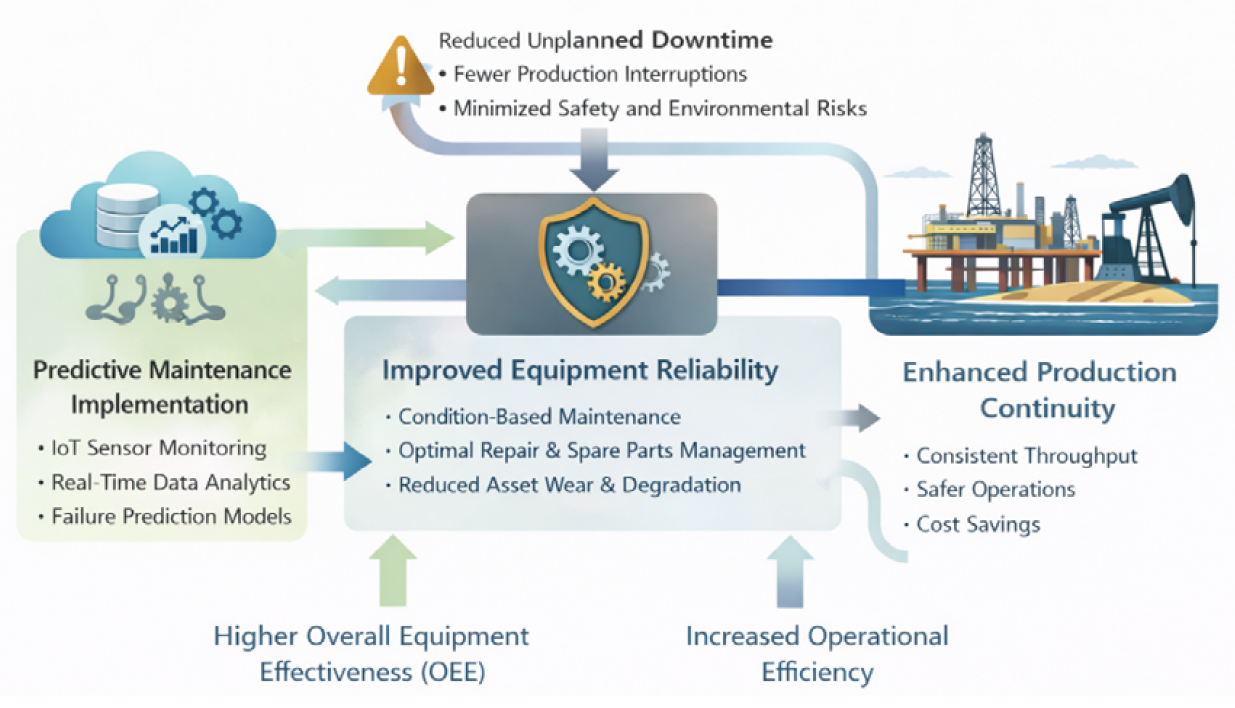
Figure 3: Conceptual Framework Illustrating the Impact of Predictive Maintenance on Equipment Reliability and Production Continuity
IMPLICATIONS AND DISCUSSION
The benefit of predictive maintenance over a traditional maintenance approach can be realized in terms of reduced unplanned downtime. An efficient implementation depends upon IoT sensors and analytics infrastructure. To achieve these wins, the appropriate firms of professionals should be provided the technology ecosystems (enabled with validated data and personalized algorithms) within existing maintenance systems. Human factors are equally important: staff will need to be trained in how to use predictive models, as time moves away from purely preventative approaches. Which means that starting risk is not only large but also starting costs are also large, but more than a few companies have been proven to achieve positive ROI in no time after adoption, primarily in high-downtime industries. As the price of IoT and analytics becomes cheaper, predictive maintenance should be next in line to take its turn. Although predictive algorithms have begun to offer promise, we believe that firms will begin to seek more sustainable operational improvements to better align technology in a more efficient manner before the impact of prescriptive maintenance is felt.
CONCLUSION AND FUTURE WORK
To virtually eliminate unexpected downtime, modern organizations employ continuous monitoring to detect potential equipment failures before they occur. With this view that only the sensors can provide for them, companies can remediate weak points versus leaving themselves open to catastrophic failures resulting from wear patterns not visible to unaided eye. This preventive measure enhances safety, reduces costs, and schedules more efficient repair needs. Thanks to technological advancements, maintenance work has become comparative cakewalk, and instead of waiting for unwanted problems to arise, predictive models can now foresee woes. Fast forward to today, where organizations are adopting smart solutions at an unprecedented speed. Integrating data-driven approach with classic mechanical principles is changing the way maintenance is addressed. This creates a culture of continuous improvement and adjustment. Future advancements, on the one hand, would utilize adaptive software and virtual models to enhance accuracy and efficiency performance of maintenance. Overall, predictive analytics has maintained to a point where it has enhanced the maintenance much significantly and this in turn has resulted in high operational reliability, low cost as well as durability of the equipment.
REFERENCE
Akbar, B.S. “Implementation of artificial intelligence-based predictive maintenance to improve efficiency in smart manufacturing systems.” Techno-Science and Engineering Dimension Journal vol. 1, no. 1, 2026, pp. 45–55.
Shuriya, B. “AI-powered predictive maintenance via sensor fusion and machine learning in downtime reduction and equipment efficiency in Industry 4.0 manufacturing plants.” 2026.
Hassan, M. and Björsell, N. “System and system-of-systems digital twins for predictive maintenance and root cause analysis.” Journal of Intelligent Manufacturing. 2026, pp. 1–19.
Manchadi, O. et al. “Predictive maintenance in pharma manufacturing: challenges and strategic directions.” Engineering Proceedings vol. 112, no. 1, 2026, pp. 80.
Pabitha, C. et al. “IoT and cloud-enabled AI predictive maintenance for manufacturing, energy, healthcare systems.” In: Advanced Materials for Biomedical Devices. Boca Raton, FL, USA: CRC Press; 2026, pp. 431–443.
Bekkour, Y. et al. “Predictive artificial intelligence for industrial waste reduction: a systematic literature analysis for sustainable manufacturing.” SSRN. pp. 6128227.
Kumar, S. and Shrivastav, M. “Smart embedded systems for predictive maintenance: AI at the edge.” AIP Conference Proceedings vol. 3345, no. 1, 2026, pp. 020118.
Mohammad, S.S. et al. “Optimizing marine logistics reliability: an AI-driven predictive maintenance and cost-risk framework.” Sustainable Marine Structures 2026, pp. 20–40.
Ojeda, J.C.O. et al. “Application of a predictive model to reduce unplanned downtime in automotive industry production processes: a sustainability perspective.” Sustainability vol. 17, no. 9, 2025, pp. 3926.
Henderson, J. and Sanders, M. “AI driven predictive maintenance: reducing downtime and enhancing productivity in manufacturing environments.” 2025.
Habeeb, A. “Reducing downtime in production lines through proactive maintenance strategies.” 2025.
Zonta, T. et al. “A predictive maintenance model for optimizing production schedule using deep neural networks.” Journal of Manufacturing Systems vol. 62, 2022, pp. 450–462.
Brodny, J. and Tutak, M. “Applying sensor-based information systems to identify unplanned downtime in mining machinery operation.” Sensors vol. 22, no. 6, 2022, pp. 2127.
Ahuja, A. and Gupta, M. “Optimizing predictive maintenance with machine learning and IoT: a business strategy for reducing downtime and operational costs.” 2024.
Okuh, C.O. et al. “Designing a reliability engineering framework to minimize downtime and enhance output in energy production.” 2025.
Sekar, K. et al. “Integrating machine learning and IoT for real-time predictive maintenance in industrial ecosystems: a case study analysis.” International Journal of Research in Industrial Engineering vol. 14, no. 2, 2025, pp. 385–409.
Rakholia, R. et al. “Integrating AI and IoT for predictive maintenance in Industry 4.0 manufacturing environments: a practical approach.” Information vol. 16, no. 9, 2025, pp. 737.
Gomaa, A.H. “Advancing total productive maintenance in smart manufacturing: from methodology to implementation.” International Journal of Smart Manufacturing, 2025.
Recommended Articles
Research Article
OBSERVATIONS ON THE HOMOGENEOUS TERNARY QUADRATIC DIOPHANTINE EQUATION x2 + 4xy + 9y2 = 21z2
Download PDF
Research Article
Computer Driven Library Management and Service Rendering System: Mobile Library Landscape
Yekini N. A,
...
Ojo O
Published: 10/06/2020
Download PDF
Research Article
Influence of Optimum Percentage of Waste Ceramic Powder as a Fine Aggregate Replacement on Hardened Properties of Concrete
Mohammad Ali Asaad,
...
Mohammed Muhsin
Published: 11/06/2020
Download PDF
Research Article
The Possibility of Treating Corrosion in Iron Valves of Flow Regulators, Pumping Station Components, and Suspended Solids Filtration Networks in Rivers and Streams in Al-Qadisiyah Governorate
Qasim M. Turki,
...
Ahmed Hakem Jabor
Published: 02/03/2026
Download PDF
PO Box 101, Nakuru
Kenya.
Email: office@iarconsortium.org
Editorial Office:
J.L Bhavan, Near Radison Blu Hotel,
Jalukbari, Guwahati-India
Al-Shamkhee, A. A. O. & Alhamzawi, A. (2026). Application of Predictive Maintenance to Reduce Unplanned Downtime in Production Systems. IAR Journal of Engineering and Technology, 7(1), 1-8.
MLA
Al-Shamkhee, Ameer A. O. and Ahmed Alhamzawi. "Application of Predictive Maintenance to Reduce Unplanned Downtime in Production Systems." IAR Journal of Engineering and Technology 7.1 (2026): 1-8.
Chicago
Al-Shamkhee, Ameer A. O. and Ahmed Alhamzawi. "Application of Predictive Maintenance to Reduce Unplanned Downtime in Production Systems." IAR Journal of Engineering and Technology 7, no. 1 (2026): 1-8.
Harvard
Al-Shamkhee, A. A. O. and Alhamzawi, A. (2026) 'Application of Predictive Maintenance to Reduce Unplanned Downtime in Production Systems' IAR Journal of Engineering and Technology 7(1), pp. 1-8.
Vancouver
Al-Shamkhee AAO, Alhamzawi A. Application of Predictive Maintenance to Reduce Unplanned Downtime in Production Systems. IAR Journal of Engineering and Technology. 2026 Jan;7(1):1-8.



 Download PDF
 Download XML