This study aimed to identify the pests of papaya cultivation, to take stock of the phytosanitary products used in papaya orchards in Côte d'Ivoire, and to evaluate the phytosanitary practices of producers in terms of potential impacts on human health and the environment. To do this, initially, a survey of three papaya orchards per zone was carried out. This prospecting consisted in randomly choosing 10 papaya plants per orchard and then examining with the naked eye or using a pocket magnifying glass the trunk, leaves and fruits of each papaya plant in order to determine the presence of pests. Secondly, a survey using a questionnaire sheet was carried out among 92 producers from three areas where papaya cultivation is intensive. The survey focused on the level of education of producers, sources of pesticide supply, phytosanitary practices and management of pesticide packaging. The results of the survey reveal that most of the pests are biting-sucking insects, namely mealybugs, white flies and red mites. Survey results reveal that most papaya farmers received no instruction. The Organophosphate family represented by herbicides is the most used in papaya orchards (92.4 %) followed by the Strobilurin family represented by insecticide-acaricides (29 %). Insecticide-acaricides are more used in the Anyama area. More than half of papaya producers have no knowledge of pesticide residues, which explains the non-compliance with the wearing of personal protective equipment by its producers and the abandonment of pesticide packaging on production sites. The phytosanitary practices of papaya producers constitute a major risk for the health of producers, consumers and the environment.
Keywords
Papaya orchards
Pesticides
Environment
Ivory Coast
IMPORTANT
Key findings:
Key findings include: the main papaya pests are biting-sucking insects; most farmers lack pesticide use instruction and residue knowledge; organophosphates are the most used pesticides, followed by strobilurins; producers' practices risk health and environment due to lack of protective equipment and improper pesticide packaging disposal.
What is known and what is new?
What is known is that the COVID-19 pandemic severely impacted small and micro-businesses, and entrepreneurs' openness is a strong predictor of entrepreneurial performance. What is new is the finding that entrepreneurs' openness positively impacts strategic decision comprehensiveness, which can negatively affect entrepreneurial performance during the pandemic, and that strategic decision comprehensiveness plays an inconsistent mediating role between openness and entrepreneurial performance.
What is the implication, and what should change now?
The implication is that entrepreneurs' openness positively impacts strategic decision comprehensiveness, which can negatively affect entrepreneurial performance during the pandemic. Changes needed include fostering entrepreneurial openness, developing strategies to mitigate the negative effects of comprehensive decision-making, and implementing policies to support small and micro-businesses during crises.
INTRODUCTION
Ivory Coast is an agricultural country. Agriculture holds an important place in the country's economy with a third of the Gross Domestic Product [1]. Alongside export crops such as coffee and cocoa, there are booming fruit crops such as papaya.
In Africa, Ivory Coast is the second largest exporter of papaya after Ghana. Today the volume of exports amounts to more than 1000 tonnes, mainly to the European Union [2]. Papaya cultivation has grown intensively in Ivory Coast thanks to the Project for the Promotion and Diversification of Agricultural Exports (PPDEA) [3].
The papaya is mainly grown for its fruit, the flesh of which is rich in vitamin (A and C), sugar and potassium. It is eaten as a dessert during meals, but also as jam and puree after processing. Its seeds have anthelmintic properties [2]. Furthermore, it is also cultivated for its latex (contained in the trunk) which contains a proteolytic enzyme (papain) used against gastrointestinal diseases [4, 5]. Unfortunately, production is slowed down by pressure from pests.
To deal with these pests, producers use synthetic chemical pesticides. Since their appearance (after the Second World War), chemical pesticides have attracted attention due to their speed and effectiveness in curbing the action of pests [6]. However, during the 1960s, its use was reduced in the United States and Europe due to the numerous environmental and human health problems that arose [7]. In Côte d'Ivoire, several studies have highlighted the existence of poor phytosanitary practices: non-compliance with prescribed doses and treatment frequencies, non-compliance of the pesticides used with the treated crop, non-compliance with protection and maintenance rules. hygiene recommended during treatments, poor storage of products and poor management of empty packaging after use of the products [8-12] and pollinating insects, the poisoning of farmers and consumers and finally environmental pollution [7, 13].
This study aims to identify the pests of papaya cultivation and to take stock of the phytosanitary products used in papaya orchards in Côte d'Ivoire, and to evaluate the phytosanitary practices of producers in terms of potential impacts on human health and the environment.
MATERIAL AND METHODS
Study sites: The study took place during 2017. A survey was conducted among 92 papaya producers located in seven localities (Table 1) belonging to the departments of Abidjan, Yamoussoukro, Toumodi and Tiassale (Figure 1).
The choice of these sites is guided by the importance of papaya production.
Prospecting for papaya plants: In each study area, three orchards of the same age (at least 1 year), at least 2 km apart, were sampled. Ten papaya plants were chosen at random per orchard to be surveyed. The prospecting consisted in examining the stem, fruits and leaves with the naked eye or using a pocket magnifying glass with the aim of detecting pests, their probable damage and their natural enemies. Pests and their natural enemies that are unknown to us were collected for identification.
Survey methodology: Using a questionnaire, an interview was carried out with the farmers in order to collect information relating to their identity, their level of education, previous cultivations, the phytosanitary problems encountered, the methods of control used, the phytosanitary products used, the dosage, the means of protection used during treatments, the management of packaging and their knowledge of the risks of intoxication.
The pesticides identified during this survey were compared to those authorized by the Sahelian Pesticides Committee [14] of which Côte d'Ivoire is part.
The survey data was entered and processed using Excel and Past version 2.17c software for Factorial Correspondence Analysis (AFC).
Table 1 : Study sites
Départements
Abidjan
Yamoussoukro
Toumodi
Tiassale
Localities
Anyama
Thomasse
Zatta
Ngattakro
Yobouekro
Mougnan
Sindressou
None
Study sites: The study took place during 2017. A survey was conducted among 92 papaya producers located in seven localities (Table 1) belonging to the departments of Abidjan, Yamoussoukro, Toumodi and Tiassale (Figure 1).
The choice of these sites is guided by the importance of papaya production.
Prospecting for papaya plants: In each study area, three orchards of the same age (at least 1 year), at least 2 km apart, were sampled. Ten papaya plants were chosen at random per orchard to be surveyed. The prospecting consisted in examining the stem, fruits and leaves with the naked eye or using a pocket magnifying glass with the aim of detecting pests, their probable damage and their natural enemies. Pests and their natural enemies that are unknown to us were collected for identification.
Survey methodology: Using a questionnaire, an interview was carried out with the farmers in order to collect information relating to their identity, their level of education, previous cultivations, the phytosanitary problems encountered, the methods of control used, the phytosanitary products used, the dosage, the means of protection used during treatments, the management of packaging and their knowledge of the risks of intoxication.
The pesticides identified during this survey were compared to those authorized by the Sahelian Pesticides Committee [14] of which Côte d'Ivoire is part.
The survey data was entered and processed using Excel and Past version 2.17c software for Factorial Correspondence Analysis (AFC).
Table 1 : Study sites
Départements
Abidjan
Yamoussoukro
Toumodi
Tiassale
Localities
Anyama
Thomasse
Zatta
Ngattakro
Yobouekro
Mougnan
Sindressou
None
RESULTS
Socio-demographic characteristics of papaya producers: out of a total of 92 papaya producers met during this survey, 88% are men and only 12% are women. Almost half of producers have an age ranging from 30 to 40 years old (53.3%). More than half have more than one year of professional experience (53.26%). However, in the Anyama area, more than half of the producers have more than 5 years of professional experience. The majority of producers are illiterate (87%). However, a few students and officials produce papaya. Nearly half of the producers interviewed say they receive supervisory visits from the state structures and researchers or students from local universities.
Pests and damage observed: the pests generally observed in all papaya orchards have been listed according to the organs they attack. They are all biting-sucking with the exception of Orthoptera (Table 2).
- At the stem level: the shield scale insect Pseudaulacaspis pentagona Targioni Tozzetti was observed.
- At the fruit level: the shield scale insects Coccus hesperidum L. and P. pentagona Targioni Tozzetti were observed.
On the leaves: the mealybug Paracoccus sp., the whitefly Aleurodicus dispersus, tetranyques mites and the Orthoptera Zonocerus variegatus were observed.
In Anyama, several papaya plants in various orchards presented cases of virus disease due to Papaya Ringspot Virus (PRSV).
Table 2 : Pests observed on papaya plants in all orchards visited
Organs attacked
Pest
References
Vernacular names
Species
Stem
Shield scale insect
Pseudaulacaspis pentagona
Targioni Tozzetti, 1886
Fruits
Shield scale insect
Coccus hesperidium
Linnaeus, 1758
Pseudaulacaspis pentagona
Targioni Tozzetti, 1886
Leaves
Mealybug
Paracoccus sp.
Whitefly
Aleurodicus dispersus
Russell, 1965
Stinking locust
Zonocerus variegatus
Linné, 1758
Red mite or two-spotted mite
Not identified
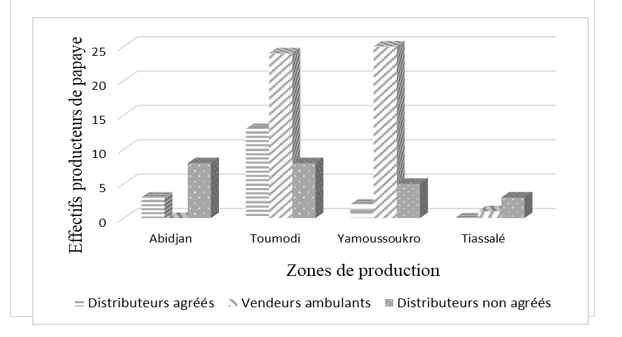
Sources of pesticide supply: Most producers in Yamoussoukro, Toumodi and Tiassalé (54%) claim to obtain pesticides from street sellers who travel from village to village or from door to door.
However, in Toumodi, some producers (13%) claim to receive pesticides from FIRCA. On the other hand, in Anyama, papaya producers (26%) obtain pesticides from small retailers (unapproved distributors) located in the Azaguié and
Adjamé markets (Figure 3).
On all study sites, almost half of producers obtain their pesticides from street vendors (54%).
Figure 3 : Supply of pesticides to producers on all study sites
Chemical pesticides, doses and frequency of use
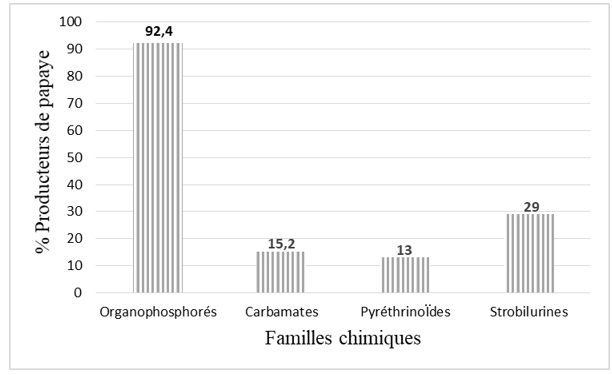
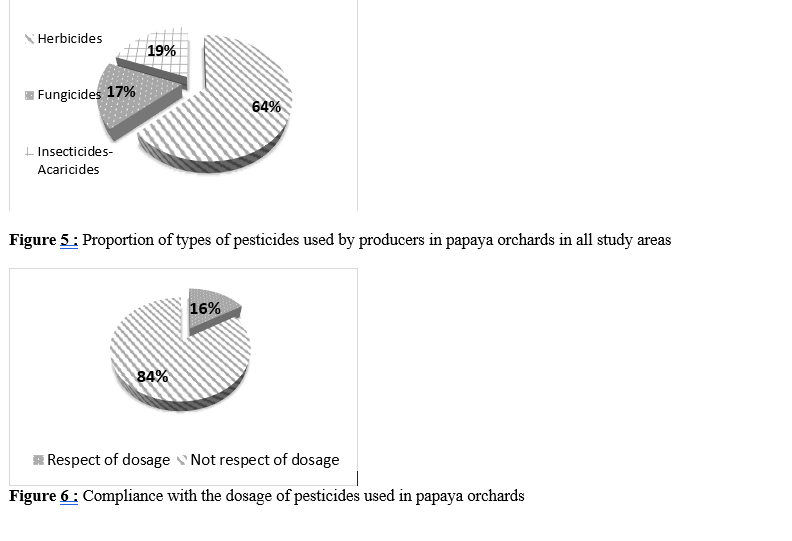
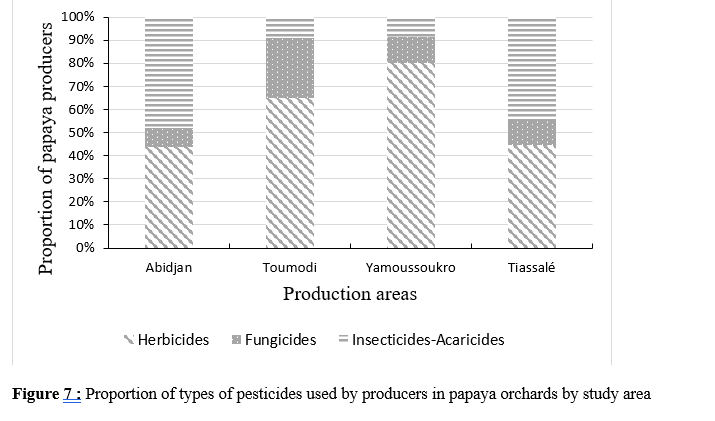
Chemical pesticides: A total of 09 formulations of pesticides including 04 herbicides, 01 fungicide, 01 insecticide, 01 acaricide and 02 insecticide-acaricides were identified in all production areas during this study (Table 3). Organophosphates are the most used families (92.4%) followed by Strobilurins (29%) (Figure 4). Herbicides are the most used phytosanitary products (64%) in all of the production areas covered by the study (Figure 5). As for insecticides-acaricides, which come in second place, they are used more in the Abidjan area (50%) (Figure 6). In fact, producers in the Toumodi and Yamoussoukro areas claim not to have the financial means to obtain them. Over the nine (9) pesticide formulations identified, six (6) are approved.
Doses and frequencies of use by farmers: In all study areas, farmers use the backpack sprayer for the treatment of papaya orchards. When asked, most producers say they respect the recommended dosage for treating orchards. But, we have found that only a few respect these doses. In reality, most farmers use instruments whose volume is not known to mix (spoons, bottle or can closures). 84% of papaya producers do not respect the dosage (Figure 7).
Table 3: Pesticides used by farmers in differents areas of papaya production
Commercial name
Matières active -doses
Pesticides type
Chimical families
Status
Kalach 360 SL
Glyphosate 360 g/l
Herbicide
Organophosphorés
Approved
Kalach extra 700 SG
Glyphosate 700 g/kg
Herbicide
Organophosphorés
Not Approved
Glyphader 75 SG
Glyphosate 750 g/kg
Herbicide
Organophosphorés
Approved
Glycot 700 SG
Glyphosate sel d’ammonium 700 g/kg
Herbicide
Organophosphorés
Not Approved
Manconyl 72 WP
Mancozèbe 640 g/kg
Cymoxanil 80 g/kg
Fungicide
Carbamates
Approved
Decis 12,5 EC
Deltaméthrine 12,5 g/l
Insecticide
Pyréthrinoïdes
Approved
Vertimec 18 EC
Abamectine 18 g/l
Insecticide-acaricide
Strobilurines
Approved
Fortime C18 EC
Abamectine 18 g/l
Insecticide-acaricide
Strobilurines
Not Approved
Abalone 18 EC
Abamectine 18 g/l
Insecticide-acaricide
Strobilurines
Approved
Figure 4 : Proportion of pesticide families used by producers in the fight against papaya pests in production areas
Phytosanitary practices
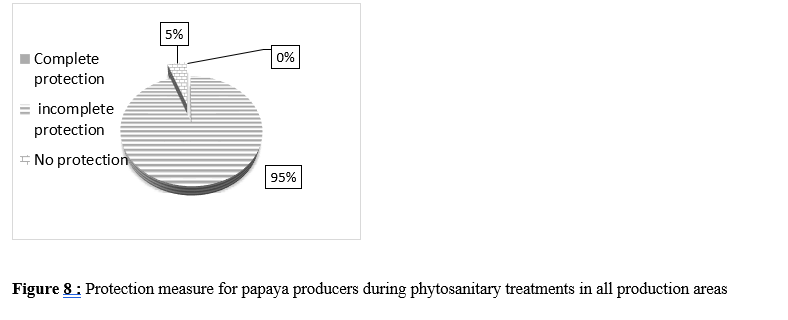
Wearing protective equipment: Almost all (95%) of producers in the different production areas do not fully use personal protective equipment (PPE) when treating papaya orchards. Some use either gloves, boots, or even a gown and often a nose mask. But never all at once (Figure 8). As an argument for not using PPE, producers put forward the fact that they are suffocating.
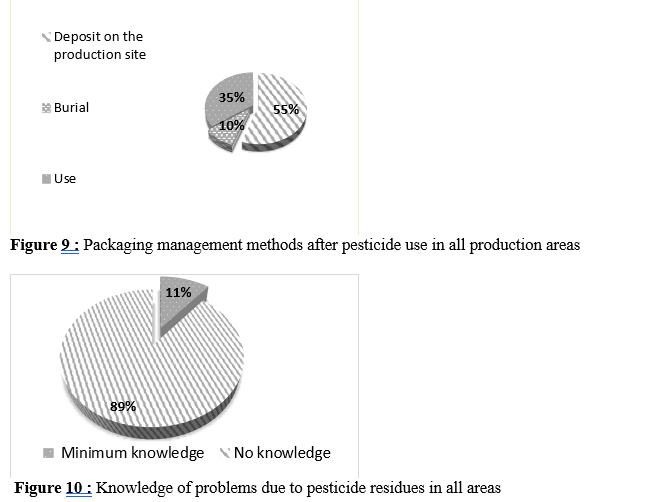
Management of pesticide packaging: Management of product packaging after use is practically the same in all production areas; Most (55%) of producers give up on the production site when it comes to sachet packaging. But when it comes to drum packaging, they use it for other purposes such as seed storage. On the other hand, some producers (10%) bury these packaging in the ground (Figure 9).
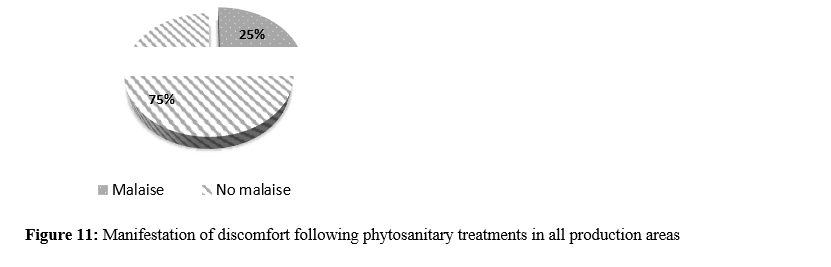
Risk for health and the environment: Most producers (89%) have no real knowledge of the problems caused by pesticide residues; only a minority among them has a minimum knowledge of it (Figure 10).
Symptoms characteristic of infections due to pesticide residues have been detected in certain producers. These producers recognize that these discomforts appeared after phytosanitary treatments. On the other hand, most of the producers questioned (75%) say they have no discomfort following phytosanitary treatments (Figure 11). The symptoms cited by producers are stomach aches followed by vomiting, headaches, itchy eyes and lower back pain. However, no children or women have experienced these symptoms.
Study of the links between the study areas and the practices of papaya producers using Correspondence Factorial Analysis
Sources of seed supply for papaya orchards: Correspondence Factor Analysis (CFA) reveals three types of producers according to seed supply sources (Figure 12). Producers who obtain local papaya seeds (Type I), that is to say by selecting the seeds by themselves or by obtaining them from other producers, are found in Toumodi and Yamoussoukro.
Type II constituting producers who obtain seeds from approved distributors are located in Tiassalé.
Type III constituents producers who obtain seeds from unauthorized distributors are located in Abidjan.
Sources of pesticide supply for papaya orchards: The AFC relating to pesticide supply sources reveals three types of producers (Figure 13). Producers who obtain pesticides from approved distributors (Type I) are located in Toumodi. Producers who obtain pesticides from non-approved distributors (Type II) are located in Abidjan and Tiassalé. And finally type III constituents producers who obtain pesticides from street vendors are located in Yamoussoukro.
Individual protection measures during phytosanitary treatments: The AFC relating to protective measures during phytosanitary treatments reveals three types of producers (Figure 14). First producers who have incomplete personal protective equipment (Type I) are found in Abidjan and Toumodi. Second producers who have complete personal protective equipment (Type II) are located in Tiassale. And finally, producers who have no personal protective equipment (Type III) are in Yamoussoukro.
Figure 12 : Factorial analysis of Correspondence of seed supply sources by papaya producers in the study areas.
Dna : Unauthorized distributors; Da : Authorized distributors; Slo : Local seeds
Figure 13 : Factorial analysis of Correspondence of sources of pesticide supply by papaya producers in the study areas
Dna : Unauthorized distributors ;
Da : Authorized distributors ;
Va : Street vendors
Figure 14 : Factorial analysis of Correspondence of pesticide packaging management methods by papaya producers in the study areas
Dps : On-site deposit; Enf : Landfill;
Usa : Domestic use
Figure 15 : Factorial analysis of the Correspondence of individual protection measures during phytosanitary treatments by papaya producers in the study areas
Pic : Incomplete protection; Pco : Complete protection ; Apo : No protection.
DISCUSSION
The survey showed that the majority of papaya orchards in Côte d'Ivoire are run by men who practice more arboriculture than women. Few women work in papaya cultivation. At this level, we have remarked that the few papaya orchards run by women are generally managed either by their husbands or brothers or by contract workers. This observation is made in most countries in the sub-region and can be explained by the fact that the establishment of perennial crops such as papaya is restrictive for women. In sub-Saharan Africa, women are more involved in market gardening. In these countries, market gardening constitutes a sector that provides employment for women [15]. In Casamance (Senegal), groups of women involved in market gardening are participating in the fight against food insecurity [16]. In Ouagadougou, Burkina Faso, the Moringa oleifera market gardening is run by women's associations [17]. Nearly half of papaya orchards are owned by young people who are mostly illiterate. Despite a very pronounced rural exodus in recent decades of young people towards big cities in search of a better life, we notice a significant percentage of young people in papaya production (53.3%). This observation can be explained on the one hand (for a minority of cases) by the government policy of returning young unemployed graduates to the land, initiated by the government of Côte d'Ivoire. And on the other hand, it is due to the good profitability of papaya cultivation. In Côte d'Ivoire, agriculture is generally practiced by people who are mostly illiterate, having received no professional training, representing nearly 67% of the total agricultural population in Côte d'Ivoire [18]. This lack of literacy among papaya producers compromises the proper use of phytosanitary products, namely non-compliance with the dose recommended by the manufacturer, lack of knowledge of the appropriate product to use depending on the target pest [19-21]. In Côte d'Ivoire, literate farmers, intellectuals and civil servants are mostly involved in export crops such as coffee, cocoa, palm oil, rubber growing [18].
The entomophagous species in papaya orchards is dominated by biting-sucking insects, including mealybugs and spider mites. The papaya tree contains a lot of sap; it is sometimes even cultivated for its sap, making it subject to attacks by biting-sucking pests. These biting-sucking plants are found on the stem, fruits and leaves, more precisely at the level of the veins [4, 23].
Most papaya producers are supplied with pesticides by unlicensed street vendors. This keeps farmers in rural areas traveling to town where there are generally approved or non-approved distributors. Indeed, the lack of education of farmers on one hand and acute control of pesticides on the other have caused anarchy in the marketing of phytosanitary products [24]. A survey carried out in the city of Abidjan and its suburbs revealed that most market gardeners obtain pesticides from unapproved street sellers [9]. The survey showed that the organophosphate family represented in our study by herbicides is the family most used in papaya orchards. This can be explained by the lack of labor [8] but also by the fact that in the areas of Toumodi and Yamoussoukro, almost all papaya producers only use herbicides because of a lack of financial resources. However, in market gardening, many reveal that the pyrethroid family of which insecticides, fungicides, and acaricides are the most used [25, 26].
The survey reveals low use of pesticides in papaya orchards. In addition to this, six pesticide formulations are approved out of the nine listed. This is satisfactory in terms of preserving the environment and the health of producers. But, the majority of papaya producers do not respect the dosage of pesticides prescribed by the manufacturer. This can be explained by the low level of education of most producers. In fact, the proper use of pesticides requires a minimum of reading and calculation skills [22].
Almost all papaya producers interviewed do not use full protective equipment. This remark is corroborated by other studies carried out in Côte d'Ivoire [9, 11] and carried out in certain countries in the sub-region such as Benin [25], Burkina Faso [22] and Niger [26]. This neglect of wearing PPE is at the origin of the discomfort felt by some producers. However, most producers consider themselves in good health. These farmers are unaware that poisoning due to the ingestion of pesticide residues is chronic. Thus, as time passes, these residues accumulate in the body and can cause discomfort. more acute which can result in the long term as malformations in men [27, 28]; spontaneous abortions, prematurity and malformation of newborns to women [27, 29].The absence of discomfort among women and children can be explained by the fact that they are not involved in the phytosanitary treatments of papaya orchards. This observation was also made by Doumbia and Kwadjo (2009), Son et al. (2017) [9, 22] during a survey of market gardeners.
The abandonment of pesticide packaging in nature (production site) presents numerous environmental consequences. Indeed, pesticide residues from packaging can accumulate in waterways through runoff and infiltration, thus causing pollution of the aquatic ecosystem and groundwater and resulting in poisoning. people. A study carried out by Coulibaly et al., 2012 [30] in a Comoé watershed in Ivory Coast highlighted this scourge. Also in Côte d'Ivoire, contamination of groundwater by organophosphate and organochlorine pesticides has been shown in agricultural regions where cocoa, coffee, bananas and vegetables are grown [8]. Regarding the contamination of agricultural products, a study conducted by Biego et al. (2009) [13], in Ivory Coast in the department of Agboville, showed a significant accumulation of organochlorine pesticide residues in the cocoa beans sampled.
CONCLUSION
The main pests of papaya in production areas in Côte d'Ivoire are biting-sucking homoptera and spider mites. Nini (09) pesticide formulations were identified during this study; among which herbicides are the most used. Pesticides used in papaya orchards are acquired, for the most part, from street vendors. Organophosphates are the most used chemical family. Most farmers have no idea of the dangers caused by pesticide residues. This explains the non-use of complete protective equipment during treatments and also the abandonment of pesticide packaging on the production site. All this could have a considerable impact on human health and the environment.
To overcome these problems, it would be interesting for the competent authorities to get more involved in this sector of phytosanitary products by carrying out training campaigns with farmers and pesticide sellers. But, they must also promote alternative means of biological control against crop pests.
Funding: No funding sources.
Conflict of interest: None declared.
Ethical approval: The study was approved by the Institutional Ethics Committee of Unité de Recherche en Entomologie Agricole du Pôle Production Végétale.
RÉFÉRENCES
Gnago, Jean Ayékpa, et al. "Efficacité des extraits de neem (Azadirachta indica) et de papayer (Carica papaya) dans la lutte contre les insectes ravageurs du gombo (Abelmoschus esculentus) et du chou (Brassica oleracea) en Côte d’Ivoire." International Journal of Biological and Chemical Sciences 4.4 (2010).https://doi.org/10.4314/ijbcs.v4i4.63035
N’Da AA, N’Guessan A., et al. "Bien cultiver le papayer en Côte d’Ivoire." Direction des programmes de recherche et de l’appui au développement-Direction des innovations et des systèmes d’information (CNRA), 4p (2008).
Koffi, E. K. Report on Plant Breeding and Related Biotechnology Capacity – Côte d’Ivoire. Global Partnership Initiative for Plant Breeding Capacity Building (GIPB), (2008), 33 pp.
Didier, C., and M. Doumbia. Itinéraire Technique Papaye Carica Papaya. Programme Initiatif Pesticides (PIP), (2011), 54 pp.
Telemans, B. La Culture du Papayer au Sénégal. RADHORT-Publications, (2012), 11 pp.
Sane, Banna, et al. "Évaluation de l’efficacité biologique d’extrait de neem (Azadirachta indica Juss.) comme alternatif aux pyréthrinoïdes pour le contrôle des principaux ravageurs du cotonnier (Gossypium hirsutum L.) au Sénégal." International Journal of Biological and Chemical Sciences 12.1 (2018): 157-167.https://doi.org/10.4314/ijbcs.v12i1.12
Cabrera Blanco, Paula. "Impacts de deux insecticides à risques réduits sur un prédateur envahissant et sur son compétiteur indigène." (2019).http://archipel.uqam.ca/id/eprint/12476
Traoré, Abdramane, and Steven Haggblade. "Mise en œuvre des politiques régionales sur les pesticides en Afrique de l’Ouest: Rapport de l’étude de cas en Côte d’Ivoire." (2017).http://dx.doi.org/10.22004/ag.econ.264388
Doumbia, Mamadou, and K. E. Kwadjo. "Pratiques d’utilisation et de gestion des pesticides par les maraîchers en Côte d’Ivoire: Cas de la ville d’Abidjan et deux de ses banlieues (Dabou et Anyama)." Journal of Applied Biosciences 18 (2009): 992-1002.https://www.m.elewa.org/JABS/2009/18/5BLOCKED.pdf
Yao, T. K., et al. "Évaluation de la potabilité chimique des eaux souterraines dans un bassin versant tropical: cas du Sud-Ouest de la Côte d’Ivoire." International Journal of Biological and Chemical Sciences 6.6 (2012): 7069-7086.https://doi.org/10.4314/ijbcs.v6i6.42
Akesse, E. N., S. W. M. Ouali-N'Doran, and Y. Tano. "Insectes ravageurs du piment Capsicum chinense Jacq.(Solanaceae) à Port-Bouët (Abidjan-Côte d’Ivoire): Pratiques de lutte par les pesticides chimiques." Journal of Applied Biosciences 93 (2015): 8667-8674.https://doi.org/10.4314/jab.v93i1.1
Traoré, Sory Karim, et al. "Contamination de l’eau souterraine par les pesticides en régions agricoles en Côte-d’Ivoire (Centre, Sud et Sud-Ouest)." Journal Africain des Sciences de l’environnement 1.1 (2006): 1-9.
Biego, H. M., et al. "Niveaux de résidus de pesticides organochlorés dans les produits du cacao en Côte d’Ivoire." International Journal of Biological and Chemical Sciences 3.2 (2009).
Mawussi, Gbénonchi, et al. "Utilisation de pesticides chimiques dans les systèmes de production maraîchers en Afrique de l’Ouest et conséquences sur les sols et la ressource en eau: Le cas du Togo." Protection des cultures et santé environnementale: héritages et conceptions nouvelles 100 (2014): 46.https://horizon.documentation.ird.fr/exl-doc/pleins_textes/divers21-02/010074634.pdf#page=57
Dao, Madjelia Cangré Ebou, Josias Sanou, and Souleymane Pare. "Maraichage urbain et semi-urbain de Moringa oleifera Lam. par des associations de femmes au Burkina Faso: contraintes et opportunités." VertigO-la revue électronique en sciences de l'environnement 16.1 (2016).https://doi.org/10.4000/vertigo.17225
FAO and Ministère de l’Agriculture et du Développement Rural (MINADER). Recensement des Exploitants et Exploitations Agricoles. Abidjan, (2019), 104 pp.
Kanda, Madjouma, et al. "Application des pesticides en agriculture maraichère au Togo." VertigO-la revue électronique en sciences de l'environnement 13.1 (2013).https://doi.org/10.4000/vertigo.13456
Wognin, Affou Séraphin, et al. "Perception des risques sanitaires dans le maraîchage à Abidjan, Côte d’Ivoire." International Journal of Biological and Chemical Sciences 7.5 (2013): 1829-1837.https://doi.org/10.4314/ijbcs.v7i5.4
Son, Diakalia, et al. "Pratiques phytosanitaires des producteurs de tomates du Burkina Faso et risques pour la santé et l’environnement." Cahiers Agricultures 26.2 (2017).https://doi.org/10.1051/cagri/2017010
Seif, A. A., and B. Nyambo. Guide de Bonnes Pratiques Phytosanitaires pour la Papaye (Carica Papaya) Issue de la Production Biologique en Pays ACP. Programme Initiatif Pesticides (PIP), (2010), p. 56.
ANOPACI. "Le Maraîchage: Un Secteur Où Beaucoup Reste à Faire." Le Professionnel Agricole, no. 4, (1999), pp. 8-11.
Ahouangninou, Claude, Benjamin Fayomi, and Thibaud Martin. "Évaluation des risques sanitaires et environnementaux des pratiques phytosanitaires des producteurs maraîchers dans la commune rurale de Tori-Bossito (Sud-Bénin)." (2011).https://doi.org/10.1684/agr.2011.0485
Bafada, Sayada Adamou, et al. "Diversité des pesticides et leur utilisation dans la lutte contre les ennemis des cultures maraichères dans la zone périurbaine de Niamey, Niger." Afrique Science 15.6 (2019): 374-383.https://reca-niger.org/IMG/pdf/sayada_et_al_2019.pdf
FAO and OIT. Protégeons Nos Enfants des Pesticides: Guide Visuel d’Animation. (2013). Disponible sur http://www.fao.org/docrep/019/ i3527f/i3527fpdf.
Samuel, Onil, and Louis St-Laurent. Guide de prévention pour les utilisateurs de pesticides en agriculture maraîchère: guide technique. Institut de recherche Robert-Sauvé en santé et en sécurité du travail du Québec, 2001.
A study of parasitic infections and evaluation of the nutritional status and level of( IFN-ˠ (ng/l), IL-2 (pg/ml), and) IL-10 (pg/ml), at children in Al-Hussein Teaching Hospital
Download PDF
Research Article
Survey on the pollutants effect of some physicals and chemicals characteristics of the White Nile River around Khartoum state in the Sudan
Zeinb E. Elamean,
...
Egbal Osman Ahmed
Published: 20/01/2021
Download PDF
Research Article
Growth and Yield Performance of “Sakurab” Scallion Green Onion (Allium Fistulusom L.) Under Different Rates of Chicken Dung and Sources of Soil Amendment
Rashdi Macalangcom Casim
Published: 20/01/2021
Download PDF
Research Article
Strategy of Cocoa Commodity Based Agrowisata Development in Jembrana Regency
I Gusti Ayu Widari Upadani,
...
Luh Putu Kirana Pratiwi
Published: 30/01/2021
Download PDF
PO Box 101, Nakuru
Kenya.
Email: office@iarconsortium.org
Editorial Office:
J.L Bhavan, Near Radison Blu Hotel,
Jalukbari, Guwahati-India
Moustapha, T., Kwadjo, K. E., Seydou, S. D., Dagobert, K. K., Doumbia, M. & Kreiter, S. (2024). Phytosanitary Practices in Papaya Orchards (Carica Papaya L.) in Côte D’ivoire and Risks for Health and the Environment. IAR Journal of Agriculture Research and Life Sciences, 5(1), 1-13.
MLA
Moustapha, Toure, et al. "Phytosanitary Practices in Papaya Orchards (Carica Papaya L.) in Côte D’ivoire and Risks for Health and the Environment." IAR Journal of Agriculture Research and Life Sciences 5.1 (2024): 1-13.
Chicago
Moustapha, Toure, Kouadio E. Kwadjo, Soro D. Seydou, Kra K. Dagobert, Mamadou Doumbia and Seige Kreiter. "Phytosanitary Practices in Papaya Orchards (Carica Papaya L.) in Côte D’ivoire and Risks for Health and the Environment." IAR Journal of Agriculture Research and Life Sciences 5, no. 1 (2024): 1-13.
Harvard
Moustapha, T., Kwadjo, K. E., Seydou, S. D., Dagobert, K. K., Doumbia, M. and Kreiter, S. (2024) 'Phytosanitary Practices in Papaya Orchards (Carica Papaya L.) in Côte D’ivoire and Risks for Health and the Environment' IAR Journal of Agriculture Research and Life Sciences 5(1), pp. 1-13.
Vancouver
Moustapha T, Kwadjo KE, Seydou SD, Dagobert KK, Doumbia M, Kreiter S. Phytosanitary Practices in Papaya Orchards (Carica Papaya L.) in Côte D’ivoire and Risks for Health and the Environment. IAR Journal of Agriculture Research and Life Sciences. 2024 Jan;5(1):1-13.


 Download PDF
 Download XML