Cervical cancer is the most common malignancies among females worldwide especially women of reproductive age, cervical cancer is one of the most preventable of all cancers through prophylactic human papilloma virus (HPV) vaccination and cervical screening. The study focuses on assessing the knowledge of cervical cancer screening services among women in Farin Tanki Area Argungu. Descriptive survey study utilized validated questionnaire developed by the researcher, 400 questionnaires were administered to women in Farin Tanki area Argungu who met the inclusion criteria using a systematic random sampling technique. Questionnaires were retrieved from respondent after successful completion. Data collection spanned a period of 14days. Data collected were coded and fed into computer using statistical package for social sciences (SPSS version 21.0). Descriptive statistics such as frequencies, proportions and confidence intervals were compared using the chi-square tests as appropriate. A p-value <0.05 was confidence statistically significance. The findings of the study revealed 71.3 % of respondents were to be aware a cervical cancer and screening services. There is a significant association between knowledge and utilization of cervical cancer screening services where P<0.002, a significant association exist between barrier and knowledge of cervical cancer screening.
Keywords
Knowledge
Utilization
Cervical Cancer
Screening
INTRODUCTION
Cervical cancer is the cancer of the cervix uteri or cervical area. This happens when normal cells in the cervix change into cancer cells [1]. Human Papilloma Virus (HPV) infection is a necessary factor in the development of nearly all cases of cancer. Sexually transmitted human papillomavirus infection leads to the development of cervical intraepithelial neoplasia and cervical cancer [2]. Women with many sexual partners and those whose partners have had many sexual consorts, or have been previously exposed to the virus, are most at risk of developing the disease. Cervical cancer is the most common genital tract malignancy of women, living in poor rural communities of developing countries [3]. Such populations lack cervical screening facilities and other necessary infrastructural and human resources essential for effective primary healthcare delivery. Globally, there are over 500,000 new cases of cervical cancer annually and over 270,000 deaths, accounting for 9% of female cancer deaths. 85% of cases occur in developing countries and Africa [4].
An estimated 1.4 million women worldwide are living with cervical cancer and 2 to 5 times more up to 7 million worldwide may have precancerous conditions that need to be identified and treated Alliance of Cervical Cancer Prevention. In the United Kingdom (UK), cervical cancer is the second most common cancer among females under 35 years of age, accounting for 702 new cases in 2007. According to the UK's statistics report for 2010, 2,828 new cases were diagnosed in 2007 [5]. In Nigeria, cervical cancer is the second most common female cancer with an age-standardized incidence rate of 34.5 per 100,000, with a mortality ratio of 0.6 [6]. The developing countries have carried a disproportionate share of the burden, with 80 % of the 250,000 cervical cancer deaths in 2005 occurring in the less developed countries [7]. A lack of knowledge concerning cervical cancer may be related to the high incidence [8]. In developed countries, the widespread use of cervical screening programs has reduced the incidence of invasive cervical cancer by 50% or more.
Cervical cancer is one of the most preventable of all cancers through primary and secondary prevention, prophylactic Human Papillomavirus (HPV) vaccination and cervical screening [9].
Increasing women's knowledge of cervical cancer and preventive health-seeking behaviour can have a significant impact on cervical cancer incidence and mortality [10]. In many developing countries, women’s knowledge of cervical cancer is minimal [11]. It has been demonstrated that the majority of women in some countries had not heard about cervical cancer and most knew nothing about cervical screening [12]. Many findings have shown that cervical cancer and pap testing awareness positively influence the utilization of cervical cancer screening services [13]. However, Huchko, done a study among Kenyan women to find out how much they know about cervical health [14]. He found that 89% of the study respondents knew of cancer in general, but only 15% had heard of cervical cancer, none of the women in the study knew about the HPV vaccine. A similar study found that women commonly believe that cervical cancer occurs as a result of having too many children [15]. The women did not identify HPV as the cause of cervical cancer and were not aware HPV is a sexually transmitted infection. Nduke, Williams and Sheppard [16], said that women often assume symptoms of cervical cancer are menstrual symptoms. Another study done in Kasarani, Nairobi Kenya, found out that 80% of the respondent are aware of pap smear and cervical cancer and only 21% of them had had a pap smear test done on them [17]. This study found out that knowledge of cervical cancer and pap smear does not translate to action. There could be more underlying reasons as to why women do not go for screening despite knowing the importance.
WHO observed that many women do not attend screening programs because of ignorance of the risk for cervical cancer and or the benefit of screening in its early detection and cure. About 250,000 women die of cancer annually said by wife of the executive governor of Kebbi state and also the founder Medicaid cancer foundation Dr Zainab Atiku Bagudu. She said this during a walk to create awareness on cancer in Abuja with the theme walk-away cancer in October 2017 intending to save 250 women who die from cancer annually. She stated that in the last six years, the Medicaid cancer foundation which she puts in place has so far freely screened 15,000 women suffering from cancer-related diseases, especially in Abuja and other parts of northern Nigeria in 2015. Similarly, she said that cervical cancer is 99% preventable, but yet it kills over 26 women daily.
Moreover, in Kebbi state so many seminars were organized by Dr Zainab Atiku Bagudu in which a large number of nurses and midwives from different hospitals around the state, including general hospital Argungu were trained on cervical cancer screening. However, there is a low percentage on the utilization of cervical cancer screening services in Argungu local government. The main objective of this paper is to determine the knowledge of cervical cancer screening among women in the Farin Tanki area Argungu.
MATERIALS AND METHODS
Research Design
A descriptive survey method of research was adopted for this study the prospective method of data collection was used, which involved the administration of a structured questionnaire to the respondent.
Research Setting
The area for study is the Farin Tanki area, Argungu local government. Farin Tanki is an area located in the Kokani South region of Argungu. The head of the area is Alhaji Samaila Muhammad Maiyaki. According to the national population commission, the area has an estimated population of 5370 people and the predominant language is Hausa. It is near Emirate primary school. There were four primary schools and three secondary schools in the area. Most of the people in the area are civil servants and there are also farmers and businessmen. There is also road, power supply, shops and mini market. There is also a big white water tank that supplies not only the area but including most of Argungu.
Sampling Techniques
The sampling technique used in the study was a simple random sampling technique. This method was chosen because it gives the subjects in the population an equal chance of being selected.
Instrument for Data Collection
A structured questionnaire was used to collect or gather information from the respondent. The questionnaire comprises two sections, A and B. Section A comprises of personal data of the respondent such as age, sex, religion, educational background, occupation, marital status and tribe. Section B will comprise of question items that may test the level of knowledge of women towards cervical cancer using five Likert rating format for each of the three research questions.
Method of Data Analysis
Statistical analysis used frequency distribution table and mean, the essence of representing this in the table and mean it is to allow easy comparison of information collected and equally give room for drawing an inference based on the analysis of data collected.
Ethical Consideration
Rules and regulations guiding this research study were duly observed; the researcher obtained an introduction letter from the school and permission from the head of the area before carrying out the research study. The respondent was assured of their confidentiality of all information provided and was mainly for the study in respect of the information given out in the questionnaire distributed to them in order to get honest and reliable responses.
RESULTS
Section: Socio-Demographic Data
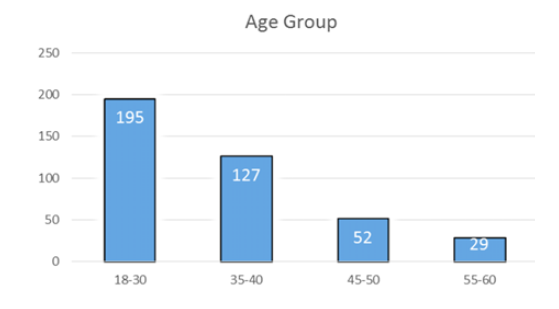
The Figure 1 shows that the age range of the respondent within 18-30 has the highest frequency of 195 and a percentage of 48.4% and the age range of 55-60 has the lowest frequency of 29 and a percentage of 7.2%.
Figure 1: Age Group of the Respondent
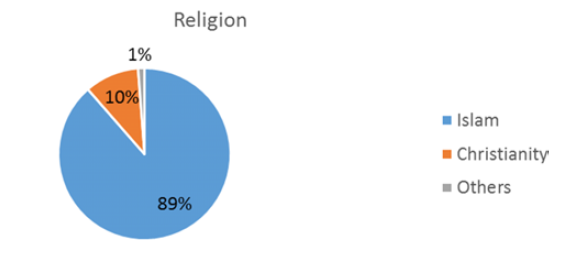
The Figure 2 shows that most of the respondents were Muslims, for Islam had a frequency of 355 and a percentage of 88.5% while Christianity had a frequency of 41 and 10.2%.
Figure 2: Religion of the Respondents
From the Figure 3, it is indicated that married women had the highest frequency of 28 and a percentage of 72.8%, where divorced women had the lowest percentage of 4.3%.
Figure 3: Marital Status of the Respondents
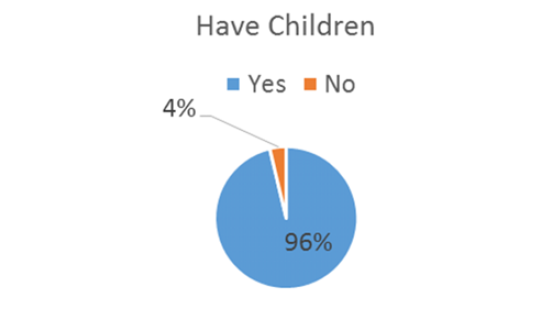
As seen in Figure 4, 83.2% of the women have children, while 16.8% of them don’t have children.
Figure 4: Percentage of Women with Children
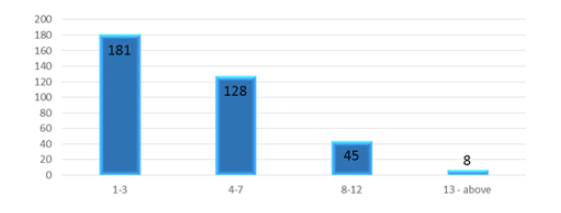
From the Figure 5, it shows that women that had 1-3 children were more with a frequency of 181 and a percentage of 50.0%, while those that have 13 and above children have the least percentage of 12.2%.
Figure 5: Percentage of Deliveries
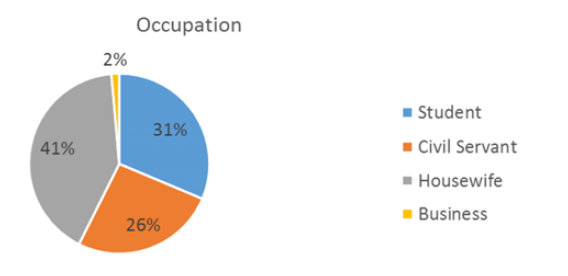
Figure 6, shows that the majority of the women were housewives with a frequency of 139 and a percentage of 35.5%, followed by students with a percentage of 27%, civil servants 22.4% and Businesswomen with least percentage of 15.1%.
Figure 6: Occupation of the Respondents
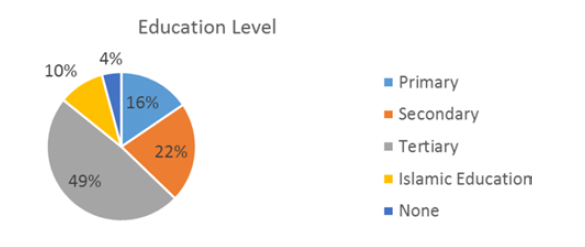
From the Figure 7, it shows that women with a tertiary level of education were more with the frequency of 195 and percentage of 48.6%, then secondary level had 21.7% primary 15.5%, Islamic education 10.0% and none 42%.
Figure 7: Level of Education of the Respondents
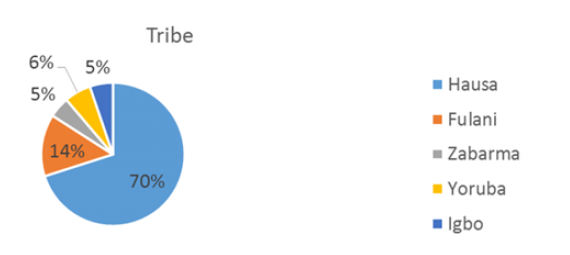
Figure 8 show that Hausa tribe women were more in the area with the frequency of 282 and 70.0%.
Figure 8: Hausa tribe women
The Table 1,2 shows that women were aware of cervical cancer screening services and this screening prevents and reduces the burden of cervical cancer. They also believed that awareness campaign reduces the incidence as they identified a lack of knowledge as one of the greatest risks of cervical cancer.
Table 1: Knowledge of Cervical Cancer Screening
Knowledge
Frequency
%
Awareness Level
Yes
No
268
108
71.3
28.7
Cervical cancer is cause by having many children
Yes
No
126
273
31.6
68.4
Exposure to sexual relationship
Yes
No
198
197
50.1
49.9
Screening Prevent cervical cancer
Yes
No
298
94
76.0
24.0
Does cervical and Pap testing influence utilization of CC
Yes
No
310
85
78.5
21.5
Does CC screening reduce the burden of CC
Yes
No
315
71
81.6
18.4
Does campaign Awareness reduces the incidence of CC
Yes
No
33
64
83.9
16.1
Pap smear cleansing of a womb after exposure to sexually transmitted infection
Yes
No
227
165
57.9
42.1
Women lack of knowledge of this cancer the greatest risk of CC
Yes
No
288
107
72.9
27.1
Table 2: Chi-Square Values
Knowledge*
Utilization
Df
1
X2
9.142
p-value
0.002
*Significant at p <0.05
DISCUSSION
Women are aware of cervical cancer screening services; awareness campaigns can reduce the burden of cervical cancer. They are also aware cervical cancer is not caused by having too many children and this screening is not cleansing or scraping of the womb. 71.3% of the respondent was found to be aware of cervical cancer and screening services which are in line with the study conducted by Ogilvie, [18], in Kasarani, Nairobi Kenya who found out that 80% of the respondent knew about pap smear and cervical cancer and only 21% of them has had a pap smear test done on them. This study found out that knowledge of cervical cancer and pap smear does not translate to action. There could be more underline reasons as to why women do not go for screening despite knowing the importance. It was discovered that the respondents do not believe that cervical cancer is caused by having too many children. This is contrary to the study carried out, which stated that women commonly believed that cervical cancer was caused by having too many children, the women did not identify HPV as the cause of cervical cancer and were not aware of HPV is a sexually transmitted infection [15].
Women were also aware that cervical cancer screening prevents cancer of the service this is similar to the study done by Ogilvie et al. [18], which revealed that women were aware that early diagnosis and treatment of precancerous lesion greatly improve the probability of a successful cure and prevention of cervical cancer, the respondents also believed that awareness campaign reduces the incidence of cervical cancer, this is related to the study by Tebeu et al., [19], who assess the knowledge, attitudes and assumption of cervical cancer by women living in Marouna and Cameroon, it was revealed that the knowledge of cervical cancer by women in Cameroon was inadequate.
In this study, Tebeu et al., [19], suggested that there was a need for an aggressive campaign to make women aware of cervical cancer and its prevention to avoid deaths from cervical cancer, a curable and preventable disease. It was discovered that 71% of women even being aware of the screening services does not utilize it because they did not perceive themselves to be at risk, this is in line with the study conducted in Singapore by Seow, Wong, Smith, & Lee [20], who found out that women who were aware of pap smear did not perceive themselves to be at risk and therefore did not indicate the future intention to have a smear. The study further revealed that a means of increasing utilization of screening for cervical cancer for both women who had a smear and those who had not had a smear are culture-specific and must address the appropriate health beliefs and attitudes.
It was also observed that embracement influence decision of women is not returning for a regular smear, this is similar with the study carried out by Wong et al., [12] at Guy’s hospital in London to gain an insight into women’s attitude towards and awareness of smear testing for cervical cancer, embarrassment and discomfort played a part in women’s decision in not returning for a regular smear, the respondents stated that self-collected samples to detect human papillomavirus encourages participation in screening program which coincides with the study conducted to explore the utilization of self-collection of samples to detect Human Papilloma Virus (HPV) testing in comparison with that of the pap test in Mexico, 98% of women reported privacy and comport with the self-sampling procedure than a pap test as it consistently provoked more discomfort, pain and embarrassment than self-sampling [20].
It was concluded that in cooperation of self-collected samples to detect HPV could encourage participation in screening programs among those women who reject the pap test because of the necessary pelvic examination.
Implication for Nursing
It is of great benefit to women in the Farin Tanki area Argungu local government of Kebbi state especially if the problems identified are directed to the Kebbi State Ministry of Health and State Government at large that can take measures to handle them. It will serve as a means of improving knowledge to women in not only Farin Tanki but the entire Argungu and Kebbi State at large.
CONCLUSION
The findings of the study revealed that women are aware of cervical cancer screening services; they are also aware that cervical cancer is not caused by having too many children and this screening is not cleansing or scraping of the womb.
REFERENCE
Arbyn, M. et al. “Prophylactic vaccination against human papillomaviruses to prevent cervical cancer and its precursors.”Cochrane Database of Systematic Reviews, no. 5, 2018.
Wright, T.C. Jr. et al. “2006 consensus guidelines for the management of women with abnormal cervical cancer screening tests.” American Journal of Obstetrics and Gynecology, vol. 197, no. 4, 2007, pp. 346–355.
Miller, K.D. et al. “Global cancer epidemiology and the cancer divide.” Global Perspectives on Cancer: Incidence, Care and Experience, vol. 5, 2015.
Campbell, P. et al. “Prevention of invasive cervical cancer in the united states: Past, present and future.” Cancer Epidemiology, Biomarkers & Prevention, vol. 21, no. 9, 2012, pp. 1402–1408.
World Health Organization. Meeting to Develop a Global Consensus on Preconception Care to Reduce Maternal and Childhood Mortality and Morbidity: World Health Organization Headquarters, Geneva, 6–7 February 2012: Meeting Report. World Health Organization, 2013.
Smith, R.A. et al. “American cancer society guidelines for breast cancer screening: update 2003.” CA: A Cancer Journal for Clinicians, vol. 53, no. 3, 2003, pp. 141–169.
Uysal, A. and A.Birsel. “Knowledge about cervical cancer risk factors and pap testing behaviour among Turkish women.”Asian Pacific Journal of Cancer Prevention, vol. 10, no. 3, 2009, pp. 345–350.
Aiken, L.H. et al. “Transformative impact of magnet designation: England case study.”Journal of Clinical Nursing, vol. 17, no. 24, 2008, pp. 3330–3337.
Afam, N.H. and M.Ba-Break. “Analysis of interventions for improving cervical-cancer screening uptake among Nigerian women.” Public Health Open Access, vol. 1, no. 2, 2017.
Goss, P.E. et al. “Challenges to effective cancer control in China, India and Russia.”The Lancet Oncology, vol. 15, no. 5, 2014, pp. 489–538.
Amarin, Z.O. et al. “Attitudes and beliefs about cervical smear testing in ever-married Jordanian women.” Eastern Mediterranean Health Journal, vol. 14, no. 2, 2008, pp. 389–397.
Wong, L.P. et al. “Cervical cancer screening attitudes and beliefs of Malaysian women who have never had a pap smear: A qualitative study.” International Journal of Behavioral Medicine, vol. 15, no. 4, 2008, pp. 289–292.
Aboyeji, P.A. et al. “Knowledge, attitude and practice of cervical smear as a screening procedure for cervical cancer in Ilorin, Nigeria.” Tropical Journal of Obstetrics and Gynaecology, vol. 21, no. 2, 2004, pp. 114–117.
Huchko, M.J. et al. “Building capacity for cervical cancer screening in outpatient HIV clinics in the nyanza province of western Kenya.” International Journal of Gynecology & Obstetrics, vol. 114, no. 2, 2011, pp. 106–110.
Brown, D.R. et al. “Cervical cancer screening among ethnically diverse black women: Knowledge, attitudes, beliefs and practices.” Journal of the National Medical Association, vol. 103, no. 8, 2011, pp. 719–728.
Ndukwe, E.G. et al. “Knowledge and perspectives of breast and cervical cancer screening among female African immigrants in the Washington DC Metropolitan Area.”Journal of Cancer Education, vol. 28, no. 4, 2013, pp. 748–754.
Ombech, E.A. et al. “Awareness of cervical cancer risk factors and practice of pap smear testing among female primary school teachers in Kasarani division, Nairobi Kenya.” African Journal of Health Sciences, vol. 21, no. 2, 2012, pp. 121–132.
Ogilvie, G. et al. “Optimizing secondary prevention of cervical cancer: recent advances and future challenges.” International Journal of Gynecology & Obstetrics, vol. 138, 2017, pp. 15–19.
Tebeu, P.M. et al. “The Attitude and knowledge of cervical cancer by cameroonian women: A clinical survey conducted in Maroua, the capital of far north province of cameroon.”International Journal of Gynecologic Cancer, vol. 18, no. 4, 2008.
Seow, A. et al. “Beliefs and attitudes as determinants of cervical cancer screening: A community-based study in Singapore.” Preventive Medicine, vol. 24, no. 2, 1995, pp. 134–141.
Recommended Articles
Research Article
Anti-SRP positive myositis following a SARS-CoV-2 vaccination
Josef Finsterer
Published: 30/05/2022
Download PDF
Research Article
Quality of the Nursing Care Provided to Patients Diagnosed with Cerebrovascular Accident (CVA)
Qassim Jawell Odah Abed,
Hussein Abdulmohsin Dabis
Published: 30/03/2024
Download PDF
Research Article
Isolation and Molecular Characterization of Bacterial Pathogens Associated with Circumcision-Related Infections in Pediatric Patients
Ghanim A. Abbas
Published: 30/06/2025
Download PDF
Research Article
Factors affecting pre hospital treatment delay in acute myocardial infarction patients
R. Jyoti Velmurugan,
Deepa Chugh
Published: 30/05/2022
Download PDF
PO Box 101, Nakuru
Kenya.
Email: office@iarconsortium.org
Editorial Office:
J.L Bhavan, Near Radison Blu Hotel,
Jalukbari, Guwahati-India
Argungu, Z. M. & Maisanda, K. A. (2020). Knowledge of Cervical Cancer Screening Among Women in Farin Tanki Area Argungu, Kebbi State, Nigeria. International Academic Journal of Advanced Practices in Nursing, 1(1), 1-5.
MLA
Argungu, Zulkiflu M. and Kabiru A. Maisanda. "Knowledge of Cervical Cancer Screening Among Women in Farin Tanki Area Argungu, Kebbi State, Nigeria." International Academic Journal of Advanced Practices in Nursing 1.1 (2020): 1-5.
Chicago
Argungu, Zulkiflu M. and Kabiru A. Maisanda. "Knowledge of Cervical Cancer Screening Among Women in Farin Tanki Area Argungu, Kebbi State, Nigeria." International Academic Journal of Advanced Practices in Nursing 1, no. 1 (2020): 1-5.
Harvard
Argungu, Z. M. and Maisanda, K. A. (2020) 'Knowledge of Cervical Cancer Screening Among Women in Farin Tanki Area Argungu, Kebbi State, Nigeria' International Academic Journal of Advanced Practices in Nursing 1(1), pp. 1-5.
Vancouver
Argungu ZM, Maisanda KA. Knowledge of Cervical Cancer Screening Among Women in Farin Tanki Area Argungu, Kebbi State, Nigeria. International Academic Journal of Advanced Practices in Nursing. 2020 Jul;1(1):1-5.


 Download PDF
 Download XML