Contents
Download PDF
pdf Download XML
1435 Views
199 Downloads
Share this article
Research Article | Volume 5 Issue 1 (Jan-June, 2024) | Pages 1 - 6
Coconut water improves the human sperm quality following freezing-thawing Process
1
Department of Medical Laboratory Techniques, College of Medical Technology, The Islamic University, Najaf, Iraq.
Under a Creative Commons license
Open Access
Received
July 3, 2024
Revised
Aug. 9, 2024
Accepted
Sept. 19, 2024
Published
Oct. 2, 2024
Abstract

Background: Stresses caused by the freezing/thawing process may alter the spermatozoa's lipid content in the plasma membrane, leading to elevated levels of oxidative stress. Cryopreserved spermatozoa may recover more quickly from oxidative damage if antioxidants are added to the cryosolution. Objectives: To determine whether coconut water (CW) has any effect on the quality of human sperm after the freezing/thawing process. Methodology: This study included 70 semen samples from men who met the World Health Organization's 2010 criteria for normozoospermia. After seminal fluid analysis, sperm DNA fragmentation (SDF), and mitochondrial function were measured. Each sample was cryopreserved with three different concentrations of CW (P1-P3): P1: Only SpermFreezTM –a glycerol-containing cryosolution- (zero- CW). P2: SpermFreezTM and 5% CW. P3: SpermFreezTM and 10% CW. Post-thawing samples were tested for sperm motility, SDF, and mitochondrial activity after a month of vapor-dependent cryopreservation. Results: Total and progressive motility and mitochondrial function were reduced significantly post-thawing compared to fresh samples, while the SDF statistically increased (P < 0.05). Among post-thawing groups, the additive of CW significantly improves motility, SDF, and mitochondrial function compared to the zero-CW group (p<0.05). Furthermore, the additive of 10% CW increased motility and decreased SDF significantly compared to 5% CW, while there was no significant difference observed between 5% and 10% CW regarding mitochondrial function. Conclusion: The addition of coconut water to cryosolution (SpermFreezTM) improves motility, DNA integrity, and mitochondrial function in human spermatozoa post-cryopreservation.


Keywords
INTRODUCTION

Sperm cryopreservation is a widely used technique in the field of Assisted reproductive technology (ART) [1]. It provides the advantage of storing spermatozoa for a long time for future use [2]. It has been used for several indications to preserve fertility prior to radiotherapy, chemotherapy, or vasectomy, or in cases of autoimmunity diseases, gender reassignment, and sperm donor] [2-3. Despite its advantages, there are several situations in which cryopreservation negatively impacts sperm cells. Apoptosis, DNA fragmentation, decreased or loss of motility and viability, and mitochondrial dysfunction are the most prevalent consequences of cryopreservation on sperm function[4-6]. Spermatozoa undergo physical and chemical stressors due to freezing/thawing shock, which may modify their plasma membrane lipid composition [7]. The freezing/thawing procedure disturbs the reduction-oxidation equilibrium and increases oxidative stress and Reactive oxygen species (ROS) generation [8]


Human spermatozoa contain an elevated level of unsaturated fatty acid in the plasma membrane and a large number of mitochondria that could be a source of ROS production, furthermore, a limited intrinsic antioxidant defense system in the spermatozoa makes it vulnerable to oxidative stress during the freezing-thawing process[9-10]. Because of this, adding antioxidants to cryosolution may improve the post-thaw recovery of the spermatozoa[11]. This is due to that the antioxidants minimize oxidative damage [12].


Coconut water (CW), is the liquid endosperm of coconut fruit. It is a nutritious beverage that contains carbohydrates, minerals, amino acids, vitamins, and growth hormones [13]. Catechin and other polyphenolic components in CW reduce free radical generation and lipid peroxidation, making it an effective antioxidant[14-15]. Furthermore, its antioxidant properties were associated with its ascorbic acid content [16]. The beneficial health functions of CW for avoiding cancer, aging, and cardiovascular illnesses were attributed to its antioxidant activities [17]


The main question of this study was: Does the supplementation of cryosolution with CW improve the recovery of spermatozoa after cryopreservation?

MATERIALS AND METHODS

Subjects and Sample Collection

The study spanned the months of March–December 2022 and included 70 normozoospermic semen samples taken from men who underwent standard semen analysis at the fertility center in Al-Sadder Medical City, Najaf, Iraq. Ages varied from 19-41 years old. Based on the medical history and the results of the seminal fluid examination, subjects were eliminated from the study if they had aberrant sperm parameters, varicocele, chronic sickness, genital infection, or systemic disorders. In addition, individuals who smoked, drank excessively, were exposed to chemicals or radiation, were taking any medicine during three months before sample collection, or were taking an antioxidant supplement were also eliminated. 


Ethical Approval

Prior to providing the semen samples, all patients were asked to sign an informed consent form, and the study was authorized by the local medical ethics committee "Approval No: 22-0797".


Seminal Fluid Analysis

Masturbation was used to collect the semen samples from the subjects after sexual abstinence for at least three days. light microscope (Optica, Italy) was used to analyze the samples. Sperm concentration, total and progressive motility were assessed according to the World Health Organization (WHO) 2010 standard criteria [18]. Each sample was reviewed twice by a blinded, highly experienced biologist to avoid observer bias. 


Assessment of sperm DNA fragmentation (SDF)

To assess the SDF pre-freezing and post-thawing, Acridine Orange (AO) stain and fluorescence microscopy were used concurrently according to Tejada et al.[19]. A drop of semen from each sample was placed on a clear microscope slide. Submerging it in Carnoy's solution overnight for fixation. The next day, the slides were rinsed with distilled water and then submerged in the AO solution for 5 minutes. After that, they were gently rinsed with tap water and then kept in a dark, cold spot until the evaluation was completed. Optica (Italy) fluorescence microscope was used at a 40X magnification to measure at least 500 spermatozoa in order to calculate the SDF. At a wavelength of 450–490 nm, normal, intact spermatozoa fluoresced green, while denatured spermatozoa fluoresced red or orange [19-20].


Assessment of Sperm Mitochondrial Potential 

The mitochondrial potential of the spermatozoa was measured pre-freezing and post-thawing using a slightly modified version of the rhodamine123 stain procedure published by Johnson et al. [21]. The approach included centrifuging the semen samples twice before placing them in FertiProNV medium from FertiPro (Belgium). This solution also contained 10 µg/mL of rhodamine 123 from ThermoFisher Scientific (USA) (Cat. No. R302). After that, the samples were incubated at 37ºC for 20 minutes. then, the samples were rinsed and the fluorescent microscope was used to determine the mitochondrial integrity. At least 500 spermatozoa were scored for every sample to establish whether the mitochondria were functioning or not. The spermatozoa with functional mitochondria demonstrated bright fluorescence at the sperm midpiece.


Preparation of Coconut Water (CW)

The coconuts were bought from the supermarket, their tough outer layer was peeled off and the liquid content (water) was emptied by puncturing one of the three top pits. Coconut water is colorless with a specific odor and flavor [22]. As a lot of fruits had been opened, some of them were discarded as weren't fresh and their water was either red or nutty.


Processes of Sperm Cryopreservation and Thawing

Each sample of semen was split into three portions: P1, which was cryopreserved only with a cryosolution including glycerol (SpermFreezTM, FertiPro, Belgium); P2, which was cryopreserved with SpermFreezTM and 5% CW; and P3, which was cryopreserved with SpermFreezTM and 10% CW. The semen was mixed (1:1) with SpermFreezTM cryosolution supplemented with or without 5% and 10% CW. Preliminary studies revealed that this concentration of CW maintained the best levels of sperm motility and DNA integrity post-thawing (data not shown). The mixture was inserted into a freezing straw (CBS) after equilibration at room temperature for 10 minutes, and exposed to liquid nitrogen (LN2) vapor (4 cm above the surface of the LN2) for 15 minutes. After that, the straws were immersed into LN2 using a cryopreservation LN2 tank (MVE SC series LN2 tank 40L).


After one month of cryopreservation, the straws were left the LN2 and placed in tap water (37C°) for 5 minutes, the samples were then transferred to a sterile test tube and washed with FertiPro NV washing media by centrifugation at 300g for 10 minutes. The samples were subsequently analyzed for sperm motility, DNA integrity, and mitochondrial function. 


Statistical Analysis 

Data analysis was carried out using the statistical analysis system (SAS) software (2012). In this study, mean ± standard deviation (SD) was used to express the parameters. To examine the variations among the groups, the analysis of variance (ANOVA) and the least significant difference (LSD) test were used. A p-value below 0.05 was deemed to indicate a significant difference.

RESULTS

The pre-freezing semen parameters of the samples used in this study are presented in Table 1. It was all within the normal range as the selected samples were from normozoospermic men.


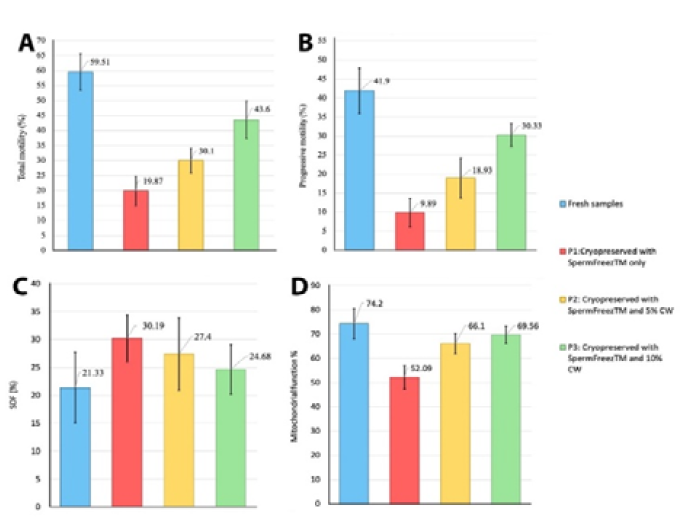
The percentage of total sperm motility and progressive motility in fresh samples were 59.51±6.12 and 41.90±5.90 respectively. The percentage of total and progressive motility significantly decreased post-thawing in all parts of the samples (p1, p2, and p3) than in fresh samples (p<0.05). Among the post-thawing parts of the samples, p3 (the samples cryopreserved with cryosolution containing 10% CW) exhibited the best level of total and progressive motility (43.6±6.22 and 30.33±2.98 respectively) which were significantly higher than in P1 and p2 (p<0.05) (Figure 1A and B).


The level of SDF was 21.33±6.32 in the fresh samples and increased significantly after cryopreservation in all parts of the samples (p<0.05). The higher level of SDF post-thawing was 30.19±4.2 in the samples cryopreserved without additive of CW (p1), while, the addition of CW to the cryosolution significantly reduced the SDF; 27.4±6.51 in p2 and 24.68±4.41 in p3 (p<0.05) (Figure 1C).


In comparison between the two concentrations of CW, the additive of 10% CW to the cryosolution recorded a significant increase in the recovery of sperm total and progressive motility than the additive of 5% CW (p<0.05) (Figure 1A and B). Furthermore, the level of DFI in p3 decreased significantly than its level in p2 (p<0.05) (Figure 1C).


As shown in Figure 1D, the level of percentage mitochondrial function in fresh samples was 74.2±6.24. A significant loss of mitochondrial potential was observed in all parts of the samples post-thawing (p<0.05). However, the supplementation of CW to cryosolution was found to significantly reduce the mitochondrial damage in the cryopreserved spermatozoa (p<0.05). In comparison between the two concentrations of CW, the difference between 5% and 10% of CW in reducing the sperm mitochondrial damage post-thawing was statistically non-significant (p<.05).


Table 1: Semen Parameters for the Samples Used in This Study According to WHO 2010 Standard Criteria

ParametersMean±SD (n = 70)Normal Values
Age (year)27.00±10.30 
Abstinence (day)3.00±0.803-5 days
Volume (ml)3.90±1.32≥ 1.5 ml
Liquefaction time 37.11±1.40Within 60 minutes
Semen pH7.44±0.217.2 -8.0
Concentration (million/ml)60.43±14.45≥ 15 million / ml
Total motility (%)59.51±6.12≥ 40%
Progressive motile sperms (%)41.90±5.90≥ 32 % within 60 minutes
Non-progressive motile sperms (%)17.61±3.32
Immotile (%)40.49±6.02
Normal sperm morphology (%)33.2±3.34≥ 30% (WHO,1999)
Sperm agglutination (%) 6.09±2.11< 10%
Round cells count (HPF)3.18±1.02< 5 cells\HPF


Figure 1: (A)Sperm Total Motility (B) Sperm Progressive Motility (C)Sperm DNA Fragmentation And (D) Mitochondrial Function In The Studied Samples Cryopreserved With Or Without The Coconut Water 5% And 10%. Different Letters (A, B, C, and D) On the Bars Indicate Significant Differences at p<0.05

DISCUSSION

It has been previously approved that excessive formation of reactive oxygen species (ROS) during freezing-thawing processes is a vital factor that contributes to cryodamage in sperm cells [11]. In the last stages of spermatogenesis, the cytoplasm that is present in spermatozoa is eliminated, resulting in a low cytoplasmic content. Because of this, seminal plasma serves as the first line of defense against ROS since it contains both enzymatic and non-enzymatic antioxidants [23-24]. Dilution of the semen before cryopreservation, on the other hand, minimizes the quantity of these components in seminal plasma, which in turn makes spermatozoa more sensitive to OS. Adding antioxidants to the cryopreservation solution may be a beneficial method for reducing the cryodamage. To improve the effectiveness of sperm cryopreservation, several antioxidants have been investigated and used. Although there have been some hopeful outcomes, the preventative impact during cryopreservation is currently partial. For instance, it has been proven that supplementing zinc oxide nanoparticles with resveratrol may reduce DNA damage or lipid peroxidation in sperm cells, but it does not significantly increase motility [25]. Coenzyme Q10, on the other hand, has been demonstrated to increase sperm motility and preserve the mitochondrial membrane without lowering DNA damage [26]. Nabavinia et al. 2023 found that the platelet-rich plasma improves human sperm motility and viability but they did not mention its effect on mitochondrial activity [27]. Furthermore, a previous study discovered that adding catalase or superoxide dismutase alone had little effect on sperm parameter recoveries. However, the combination of superoxide dismutase/catalase supplementation was found to significantly improve sperm motility and viability [28]. Thus, a more efficient additive to the cryoprotectant is required. 


Coconut water is among the most versatile natural products in the world that contains natural sugars, vitamins, minerals, amino acids, and phytohormones [13,29]. CW is found to be an excellent antioxidant due to its polyphenolic compounds especially the catechin and phenolic acids, including vanillic, chlorogenic, and protocatechuic acid which inhibits the formation of free radicals and lipid peroxidation [30-31]. Evaluating the effectiveness of CW in preserving sperm parameters after freezing-thawing processes has been previously studied in some animals [32-37], nevertheless, as far as we are aware, for human spermatozoa it has not been addressed so far. 


One of the major challenges associated with sperm cryopreservation is the significant reduction in sperm motility post-thawing [38]. The results of this study confirm this phenomenon, with a substantial decrease in sperm motility in all parts of the samples post-thawing. This decline in motility is probably due to the osmotic shock, and ROS production within the spermatozoa [39-40]Interestingly, the addition of CW to cryosolution seems to resolve this problem, particularly when using a concentration of 10% CW. Sperm samples cryopreserved with 10% CW exhibited significantly higher total and progressive motility compared to samples cryopreserved without or with 5% CW. These results suggest that CW acts as a protective agent, helping maintain the integrity of sperm cell membranes and reduce ROS production which decreases sperm motility post-thawing. Mitochondrial function is essential for sperm motility and overall sperm quality [41-412. The results of this study indicate a significant loss in the mitochondrial potential of cryopreserved spermatozoa compared to fresh samples, highlighting the adverse effect of cryopreservation on sperm mitochondria, and this finding was stated previously [43-44]. However, the supplementation of CW to the cryosolution was found to minimize mitochondrial damage. Importantly, there was no significant difference between the effects of 5% and 10% CW on mitochondrial function, suggesting that even a lower concentration of CW may be sufficient to protect mitochondria. Sperm DNA fragmentation is a crucial parameter to consider in ART, as high levels of DNA damage can compromise fertilization and embryo development [45-46]. It has been proven that SDF increased post-thawing [47-48] our current finding. Adding CW to cryosolution, especially at a concentration of 10%, significantly reduced SDF, suggesting that CW protects sperm DNA from cryo-induced damage.


The findings of this study explore the powerful effect of CW in protecting sperm quality post-thawing by reducing the formation of ROS and minimizing its deleterious effect. In a previous trial, we observed similar results but with different concentrations, the previous results were presented at the 39th Annual Meeting of the European Society of Human Reproduction and Embryology (ESHRE) 2023 [49]. Several studies confirm the antioxidant ability of CW to preserve sperms of different animals; Antonov and Ivanova in 2023 suggested the CW for routine use with cryopreservation of canine sperm [50]. Soltan et al. [51] found that the addition of 20% CW to the Tris-based extender improves the motility and acrosome integrity post-thawing in Egyptian buffalo bull’s sperm [51]. Conversely, Sawitri et al. [52] observed that CW had a deleterious effect on Bali Cattle semen when added in 20% to tris and egg yolk cryoprotectant. This harmful effect may be due to the high concentration of CW in tris egg yolk extender


In conclusion, the addition of CW at a concentration of 10%, was found to be a valuable strategy for improving post-thawing sperm quality and this underscores the potential of CW as an additive to cryoprotectants to minimize the deleterious effects of cryopreservation on human sperm quality. These findings offer insight into the optimization of human sperm cryopreservation techniques.

REFERENCE
  1. Zwamel Ahmed et al. “New Technique for Human Sperm Cryopreservation Using Emptied Sheep’s Ovarian Follicles.” Archives of Razi Institute, vol. 78, no. 2, March 2023, pp. 721–727.

  2. Ponchia, R. et al. “Oxidative Stress Measurement in Frozen/Thawed Human Sperm: The Protective Role of an In Vitro Treatment with Myo-Inositol.” Antioxidants, vol. 11, no. 1, January 2022.

  3. Mirzaei, J. et al. “Plasma-Rich in Growth Factors Ameliorates Detrimental Effects of Cryopreservation on Human Sperm: A Prospective Study.” Cell Journal, vol. 24, no. 6, June 2022, pp. 330–336.

  4. Hezavehei, M. et al. “Membrane Lipid Replacement with Nano-Micelles in Human Sperm Cryopreservation Improves Post-Thaw Function and Acrosome Protein Integrity.” Reproductive BioMedicine Online, vol. 43, no. 2, August 2021, pp. 257–268.

  5. Moradi, B. et al. “Cryopreservation of Human Spermatozoa: Utilization of L-Proline as a Novel Additive to Improve Sperm Quality Following Freezing–Thawing Process.” Proceedings of the 38th Hybrid Annual Meeting of the ESHRE, July 2022, pp. 3–6.

  6. Zwamel, A. et al. “Expression of Glutathione Peroxidase-1 (GPX1) Gene in Human Spermatozoa Cryopreserved in Emptied Sheep’s Ovarian Follicles as a New Cryopreservation Technique.” Biochemical and Cellular Archives, vol. 20, no. 2, 2020, pp. 5893–5897.

  7. Aydin, M.S. et al. “Cryopreservation Increases DNA Fragmentation in Spermatozoa of Smokers.” Acta Histochemica, vol. 115, no. 4, May 2013, pp. 394–400.

  8. Alqawasmeh, O. et al. “Green Tea Extract as a Cryoprotectant Additive to Preserve the Motility and DNA Integrity of Human Spermatozoa.” Asian Journal of Andrology, vol. 23, no. 2, March 2021, pp. 150–156.

  9. Tiwari, S. et al. “Targeted Antioxidant Delivery Modulates Mitochondrial Functions, Ameliorates Oxidative Stress and Preserves Sperm Quality during Cryopreservation.” Theriogenology, vol. 179, February 2022, pp. 22–31.

  10. Zwamel, A. et al. “Evaluation of Two Cryoprotectants Used in a New Human Sperm Cryopreservation Technique.” Wiadomości Lekarskie, vol. 75, no. 12, September 2022, pp. 3031–3035.

  11. Liu, J. et al. “Supplementation of Cryopreservation Medium with TAT-Peroxiredoxin 2 Fusion Protein Improves Human Sperm Quality and Function.” Fertility and Sterility, vol. 110, no. 6, November 2018, pp. 1058–1066.

  12. Sandoval-Vargas, L. et al. “Oxidative Stress and Use of Antioxidants in Fish Semen Cryopreservation.” Reviews in Aquaculture, vol. 13, 2021, pp. 365–387.

  13. Prathapan, A., and T. Rajamohan. “Antioxidant and Antithrombotic Activity of Tender Coconut Water in Experimental Myocardial Infarction.” Journal of Food Biochemistry, vol. 35, no. 5, October 2011, pp. 1501–1507.

  14. Arzeta-Ríos, A.J. et al. “Microwave Heating Effect on Total Phenolics and Antioxidant Activity of Green and Mature Coconut Water.” International Journal of Food Engineering, vol. 16, no. 12, December 2020.

  15. Mahayothee, B. et al. “Phenolic Compounds, Antioxidant Activity, and Medium Chain Fatty Acids Profiles of Coconut Water and Meat at Different Maturity Stages.” International Journal of Food Properties, vol. 19, no. 9, September 2016, pp. 2041–2051.

  16. Santos, J.L.A. et al. “Evaluation of Chemical Constituents and Antioxidant Activity of Coconut Water (Cocos nucifera L.) and Caffeic Acid in Cell Culture.” Anais da Academia Brasileira de Ciências, vol. 85, no. 4, 2013, pp. 1235–1246.

  17. Scalbert, A. et al. “Polyphenols: Antioxidants and Beyond.” American Journal of Clinical Nutrition, vol. 81, no. 1, 2005, pp. 215S–217S.

  18. World Health Organization. WHO Laboratory Manual for the Examination and Processing of Human Semen. 5th ed., 2010.

  19. Tejada, R.I. et al. “A Test for the Practical Evaluation of Male Fertility by Acridine Orange Fluorescence.” Fertility and Sterility, vol. 42, no. 1, 1984, pp. 87–91.

  20. Kadhim, K.N. and Zwamel Ahmed. “The GGC Medium Reduces the DNA Fragmentation of Human Spermatozoa via In Vitro Activation.” Archives of Razi Institute, vol. 78, no. 2, March 2023, pp. 709–714.

  21. Johnson, L.V. et al. “Localization of Mitochondria in Living Cells with Rhodamine 123.” Proceedings of the National Academy of Sciences of the United States of America, vol. 77, no. 2, 1980, pp. 990–994.

  22. Yong, J.W.H. et al. “The Chemical Composition and Biological Properties of Coconut (Cocos nucifera L.) Water.” Molecules, vol. 14, 2009, pp. 5144–5164.

  23. Vaccaro, F. et al. “Olea europaea Leaf Extract: Antioxidant Properties and Supplement in Human Sperm Cryopreservation.” Journal of Biological Regulators and Homeostatic Agents, vol. 37, no. 11, 2023, pp. 5795–5809.

  24. Agarwal, A. et al. “Effect of Antioxidant Supplementation on the Sperm Proteome of Idiopathic Infertile Men.” Antioxidants, vol. 8, no. 10, October 2019.

  25. Garcez, M.E. et al. “Effects of Resveratrol Supplementation on Cryopreservation Medium of Human Semen.” Fertility and Sterility, vol. 94, no. 6, November 2010, pp. 2118–2121.

  26. Tas, D.O. et al. “The Effects of Coenzyme Q10 and Curcumin Supplementation in Freezing Medium for Human Sperm Cryopreservation.” European Journal of Obstetrics & Gynecology and Reproductive Biology, vol. 287, August 2023, pp. 36–45.

  27. Nabavinia, M.S. et al. “Improvement of Human Sperm Properties with Platelet-Rich Plasma as a Cryoprotectant Supplement.” Cell and Tissue Banking, vol. 24, no. 2, 2023, pp. 307–315.

  28. Rossi, T. et al. “Improved Human Sperm Recovery Using Superoxide Dismutase and Catalase Supplementation in Semen Cryopreservation Procedure.” Cell and Tissue Banking, vol. 2, no. 1, 2001, pp. 9–13.

  29. Yong, J.W.H. et al. “The Chemical Composition and Biological Properties of Coconut (Cocos nucifera L.) Water.” Molecules, vol. 14, 2009, pp. 5144–5164.

  30. Leliana, L. et al. “Antioxidant Activity of Aqueous and Ethanolic Extracts of Coconut (Cocos nucifera) Fruit By-Products.” Agronomy, vol. 12, no. 5, May 2022.

  31. Arivalagan, M. et al. “Extraction of Phenolic Compounds with Antioxidant Potential from Coconut (Cocos nucifera L.) Testa and Identification of Phenolic Acids and Flavonoids Using UPLC Coupled with TQD-MS/MS.” LWT, vol. 92, June 2018, pp. 116–126.

  32. Nunes, J.F. and C.C.M. Salgueiro. “Strategies to Improve the Reproductive Efficiency of Goats in Brazil.” Small Ruminant Research, vol. 98, nos. 1–3, June 2011, pp. 176–184.

  33. Silva, C.G. et al. “Cryopreservation of Boar Sperm Comparing Different Cryoprotectants Associated in Media Based on Powdered Coconut Water, Lactose and Trehalose.” Cryobiology, vol. 70, no. 2, April 2015, pp. 90–94.

  34. Sandy, S. et al. “Cryopreservation of Spix’s Yellow-Toothed Cavy Epididymal Sperm Using Tris- and Coconut Water-Based Extenders Supplemented with Egg Yolk or Aloe vera.” Cryobiology, vol. 99, 2021, pp. 40–45.

  35. Wadood, F. et al. “Comparative Efficacy of Coconut Water Diluent with Different Semen Extenders for Cryopreservation of Nili Ravi Buffalo Bull Semen.” Buffalo Bulletin, vol. 41, no. 3, September 2022, pp. 363–372.

  36. Brasileiro, L.S. et al. “Coconut Water as an Extender Component for Cooled Equine Sperm.” Journal of Equine Veterinary Science, vol. 78, July 2019, pp. 69–73.

  37. El-Sheshtawy, R.I. et al. “Cryopreservation of Cattle Semen Using Coconut Water Extender with Different Glycerol Concentrations.” Asian Pacific Journal of Reproduction, vol. 6, no. 6, November 2017, pp. 279–282.

  38. Oberoi, B. et al. “Study of Human Sperm Motility Post Cryopreservation.” Medical Journal of Armed Forces India, vol. 70, no. 4, October 2014, pp. 349–353.

  39. Baharsaadi, M. et al. “Evaluation of the Effects of Hydroxytyrosol on Human Sperm Parameters during Cryopreservation.” Cryobiology, vol. 114, March 2024, pp. 104840.

  40. Shi, H. et al. “ROS-Induced Oxidative Stress Is a Major Contributor to Sperm Cryoinjury.” Human Reproduction, vol. 39, no. 2, February 2024, pp. 310–325.

  41. Irigoyen, P. et al. “Mitochondrial Function and Reactive Oxygen Species Production during Human Sperm Capacitation: Unraveling Key Players.” The FASEB Journal, vol. 38, no. 4, February 2024, pp. e23486.

  42. Hezavehei, M. et al. “Sperm Cryopreservation: A Review on Current Molecular Cryobiology and Advanced Approaches.” Reproductive BioMedicine Online, vol. 37, 2018, pp. 327–339.

  43. Gonzalez, M. et al. “Restoring Sperm Quality Post-Cryopreservation Using Mitochondrial-Targeted Compounds.” Antioxidants, vol. 11, no. 9, 2022.

  44. Gualtieri, R. et al. “Mitochondrial Dysfunction and Oxidative Stress Caused by Cryopreservation in Reproductive Cells.” Antioxidants, vol. 10, 2021, pp. 1–23.

  45. Muratori, M. et al. “Sperm DNA Fragmentation: Mechanisms of Origin.” Damage in Human Spermatozoa, edited by E. Baldi and M. Muratori, Springer, 2019, pp. 75–85.

  46. Agarwal, A. et al. “Reactive Oxygen Species and Sperm DNA Fragmentation.” Translational Andrology and Urology, vol. 6, suppl. 4, 2017, pp. S695–S706.

  47. Le, M.T. et al. “Does Conventional Freezing Affect Sperm DNA Fragmentation?” Clinical and Experimental Reproductive Medicine, vol. 46, no. 2, 2019, pp. 67–75.

  48. Aydin, M.S. et al. “Cryopreservation Increases DNA Fragmentation in Spermatozoa of Smokers.” Acta Histochemica, vol. 115, no. 4, May 2013, pp. 394–400.

  49. Zwamel, A.H. “Utilization of Coconut Water as an Additive to Improve Human Sperm Quality Following Freezing–Thawing Process.” Proceedings of the 39th Hybrid Annual Meeting of the ESHRE, June 2023, pp. i288–i289.

  50. Antonov, A., and B. Ivanova. “Canine Sperm Vitrification with Nonpermeable Cryoprotectants and Coconut Water Extender.” 2023.

  51. Soltan, W.M. et al. “Effect of Coconut Water on Freezability and Fertility of Buffalo Bulls’ Spermatozoa.” Nutrition and Feeds, vol. 26, no. 1, 2023, pp. 27–34.

  52. Sawitri, N.M. et al. “Evaluation of Bali Cattle Semen Quality during Cryopreservation with Coconut Water-Based Extenders.” International Journal of Veterinary Science, vol. 10, no. 4, September 2021, pp. 329–334.
None
None
None
Recommended Articles
Research Article
Identification of some Bacterial virulence factors of Staphylococcus aureus and Klebsiella pneumoniae
Download PDF
Research Article
Electrochemical Comparative Studies On The Redox Behavior Of Cu(II) And Cr(II) Before And After Interactions With Ciprofloxacin In Solutions
Published: 10/08/2021
Download PDF
Research Article
In Acute Appendicitis, Neutrophil/Lymphocyte Rate and C-Reactive Protein’s Radiological Relation with Appendix Diameter and İnvestigation of İts İmpact on The Diagnosis
Published: 10/03/2021
Download PDF
Research Article
A Rare Case Report of Waugh Syndrome in an Eight Months Old Male
...
Published: 10/03/2021
Download PDF
Chat on WhatsApp
Flowbite Logo
PO Box 101, Nakuru
Kenya.
Email: office@iarconsortium.org

Editorial Office:
J.L Bhavan, Near Radison Blu Hotel,
Jalukbari, Guwahati-India
Useful Links
Order Hard Copy
Privacy policy
Terms and Conditions
Refund Policy
Shipping Policy
Others
About Us
Team Members
Contact Us
Online Payments
Join as Editor
Join as Reviewer
Subscribe to our Newsletter
+91 60029-93949
Follow us
MOST SEARCHED KEYWORDS
Copyright © iARCON International LLP . All Rights Reserved.