The overall focus of the project involves studies on the fishing gears of Alappuzha. Rivers and reservoirs of Alappuzha harbor a rich and varied spectrum of fishes, which include commercially important fishes. The fish and fisheries play a crucial role in Kerala's economy, employment generation, food security and well-being of its people. It is very curious to see that in addition to the conventional methods of fishing a variety of non-conventional fishing techniques are adopted by local people. This includes pulladi fishing, pot fishing, kudukka fishing, olavallam fishing, pongu choonda fishing etc. In the present study, results of investigations conducted on riverine fishing gears of Alappuzha are presented along with detailed description of fishing gears, their distribution and operation covering aspects of selectivity and operational economics.
Keywords
Fishing Gear
Riverine Fishery
Gillnet
Cast Net
Traps
INTRODUCTION
The art of fishing can be divided in to three fields- subsistence fishing, sport fishing, and commercial fishing. The fishing gears used for the riverine fishery in Alappuzha district of Kerala represents an excellent example for the concern of fishermen in sustainable development. They use gears which afford a catch which is just enough for their subsistence.
The water area of Alappuzha comprises of lakes, rivers, water ways and channels. Fishing is an important primary activity involving about 21,000 full time and part time fishermen. The species collected from these areas includes fresh water fishes and estuarine fishes such as milk fish, mullet, Pearl spot, marine prawns, fresh water prawns, molluscs such as clams, mussels etc.
A fishing gear is any device used to catch fish in commercial fishing. There are perhaps endless varieties of gears that are used all over the world. However, these may be grouped under some principal categories distinguishable on the basis of characteristics of form, function and mode of operation. Chief among them are: nets, hooks and line, traps, spears and harpoon. Netting however is responsible for nearly 96% of the works fishing.
The study of fishing gear should aim at understanding of the principle involved in the design and working of the gear so that its efficacy in economic fishing (quantity and quality of fish caught at the cost of labor, time and money expended) could be judged. Such an understanding will also stimulate improvements on the prototype by way of new design as well as in the mode of operation of the gear. Nets are by far the most widely used of any gear and offer at the same time the greatest varieties.
Conventional fishing methods include various forms of netting operations, hook and line operations, trapping operations using devices other than nets, spearing operations, and so on. Unconventional methods some of which of rather recent origin, but having high prospects include electrifying, light fishing, fishing by stunning and concussion, fish wheeling and fish pumping. Except for the last two the idea is to use a device that is helpful in creating conditions for easier catching rather for actual catching of fish.
A number of studies have been conducted on fishing gears all over the world as it is one of the most important fishing aid in the fishing industry. A study on the traditional methods of fishing in Kuttanadu, Kerala, India was done by Ajith et al. [1]. A similar study was done in Thrissur district by Shaji and Laladhas in 2013.
The studies on lines started very early in India [2]. The status of long lines of Ecuador is explained by Anon [3]. The history of different line systems, their descriptions and status were described by Skeide [4]. Gopinath [5], John [6], Kurian and Sebastian [7] and Kurup and Samuel [8] have described about the indigenous gear used in India. Different types of line fishing were discussed by Abe and Dotsu [9]. Different types of 140 line fishing in Veraval, Gujarat were discussed by Pravin and Ramesan [10]. The techniques of tuna fishing with pole and line was discussed by Ben-Yami [11]. Line fishing gear relevant to Indian conditions was explained by Narsapurkar et al. [12] with the help of theoretical analysis and model study through mechanical simulation. Studies of Rao et al. [13] described the details of shark long lines and offered suggestions to improve the gear and its method of operations.
MATERIALS AND METHODS
The present project is an exhaustive effort to find the various fishing methods used in the entire Alappuzha district. A survey was conducted in selected locations of Alappuzha district which included areas like Kuttanad, Kinigiri, Pallathuruthi, Punnamada and many more. The first stage comprised of simple conversations with the fishermen. They were very generously co- operating and were very open hearted and the knowledge imparted about both conventional and nonconventional fishing gears were invaluable. During the second stage of study, I accompanied the fishermen to see how, when and where the gear is operated and what type of fish the gear is aiming to collect. The entire process was according to the plan informed by the fishermen and accordingly the time varied from early morning to late dusk. Photographs of the various gears were also taken.
RESULTS
Following Fishing Gears Were Found to be used in the Study Areas
Plunge basket (Local name is ottal)
It is a traditional fishing gear used in areas like Kuttanadu, Punnamada etc. It is used to catch local fishes like varal and small fishes like Puntius dorsalis, Etroplus maculatus etc. Plunge basket is also called cover pot. It is like a conical basket usually made of bamboo, with an opening for inserting the hand and arm at the top and is open at the bottom. This fishing results in low volume by catching large and small fishes. The size of basket is about 0.5m height and mouth of the bottom has 0.4 to 0.5m in diameter. The interior diameter of the upper opening varies between 12 and 15cm.The plunge basket is plunged to the bottom of shallow water such as rice field and the hand is inserted through the top to check fishes. It can be used even by a layman (Figure 1):.
Figure 1: Plunge Basket (local name: Ottal)
Fish Spear (Local name is muppally)
It is a traditional fishing gear that is widely used in Alappuzha in places like Pallathuruthy, Kuttanadu etc. In older days the fisher men used fishing spear to catch larger fishes like Channa marulius, Clarius brachysoma, Arius subrostratus etc. This is done during night. Spear fishing with hand held spear from land, shallow water or boat has been practiced for thousands of years. The fisherman must account for optional refraction at the water surface which makes fish appear higher in the line of sight than they appear. Lower calm and shallow water are favoured for spearing fish from above as water clarity is of utmost importance. It is an instrument with sharp point and is used to catch fishes in a damaged or injured condition (Figure 2).
Figure 2: Fish Spear (Local name: Muppally)
Stem of areca nut tree is cut into 6 feet long piece. It is then shaped to 2 cm diameter. At its tip an iron trident is fixed to form the fish spear. During twilight, coconut oil cake or beaten raw tapioca is deposited along the bank of the water body. The fishes lured by the feed arrive near the bank. These are then collected by spearing under the light of a torch.
Traps
It is a fishing method that is widely seen in Alappuzha lakes like Punnamada, Pallathuruthy etc. It is also used to catch fishes in ponds. This fishing method results in high volume of catching small fishes, small crabs, prawns etc and fish like Puntius dorsalis, Etroplus maculatus etc. Traps are of different types but in Alappuzha, cover port trap is mostly used. Trap means the pray enters into a catching chamber from which escaping is difficult or even impossible. The fishes enter the trap voluntarily, may be in search of shelter or lured by some bait or when guided by fisherman. The operation of traps may vary from species and time. Size of the traps is varied from types of behaviour and species of fishes to be captured. Cover pot traps are used in shallow water. It is clapped over the animal by the fisher man. The prey inside the pot is taken out through the top opening. It is successful only in turbid, especially in muddy water otherwise the prey will escape (Figure 3).
Figure 3: Traps (local name: Koodu)
Gill Net(Local name: odakku vala)
It is a typical fishing gear used in Kuttanadu, Punnamada, Pallathuruthy etc. It is usually set across the direction of the migrating fishes. It can be operated in varieties of ways. Bottom setting gill nets are used to catch demersal fishes. Free drifting gill nets are used to catch surface fishes. It is of 7 types. In Kuttanadu idivala, karavala, chemmanvala etc are the varieties of gill nets used. They are used to catch fishes like catfish, Etroplus suratensis etc. This method results in higher volume of catching large and small fishes (Figure 4).
Figure 4: Gill Net (Local name: odakku vala)
Cast Net (Local name: Veeshuvala)
It is a traditional fishing gear probably used in Alappuzha in areas like Punnamada lake, Kinigiri, Kuttanadu etc. Cast net is commonly called throw net or circular net. This fishing method results in high volumes of catching larger and smaller fishes like Mugil cephalus, mullet etc. It is a circular net with small weights, distributed around its edges. The net is cast or thrown by hand in such a manner that it is spread out on the water and sinks. It is also called as net casting or net throwing. Fishes are caught as the net is hauled back. This simple device is particularly effective for catching small bait or forage fishes like mullet, barbs, cat fish etc. It has a radius which ranges from 4 to 12 feet. Only strong and skillful people can handle it. The net is spread like an umbrella over the school of fishes. The perimeter lacing weighted with sinkers, rapidly starts sinking, dragging the entire net towards the bottom. The circumference is inversely curved so as to form an inner circular pocket around the perimeter. This prevents the escape of fish during hauling. As soon as the perimeter touches the bottom hauling line is pulled to raise net on board and the trapped fish is collected (Figure 5).
Figure 5: Cast Net (Local name: Veeshu vala)
Bow and arrow (Local name: thettali)
This method of fishing is commonly practiced in Kuttanad region of Alappuzha. This is the traditional way of using bow and arrow to collect local fishes of lakes, canals and brookes of Kuttanad. Fishing using thettali is done during the morning hours and the entire process is wound up by 4’O’clock in the evening. Pearl spot, channa, chermeen, vaala, kurua etc are collected by this method. This fishing method is also practiced in Aayaparambu, Thrikkunnapuzha, Punnamada and Pallanna of Alappuzha. Patience, severe training and correct aim are the pre-requisites for fishing using thettali. Fishes as far as 10 m can be caught by this method (Figure 6).
Figure 6: Bow and Arrow (Local neme: Thettali)
Fish Basket (Local name: oalavallam)
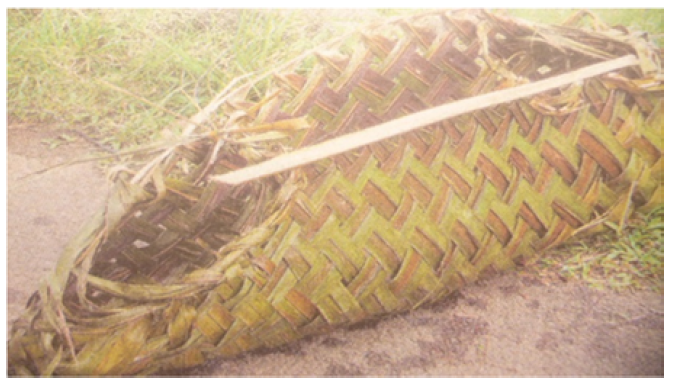
Palm leaves are made into a basket in which hay, cow dung dust and dry leaves are put. It is kept submerged in the water in the paddy field. It is usually practiced by the women. Saccobranchus and other fishes are caught using fish basket (Figure 7).
Figure 7: Fish Basket (Local name: Ola vallam)
Pong Choonda
It is used for fishing when water floods up in the backwaters of Kuttanad. A plastic line with a hook is wound around a plantain stem of a about an arm long. Small fishes are hooked as prey, this attracts bigger fishes. They get hooked and are unable to escape. Vaala, chermeen etc are caught in this way.
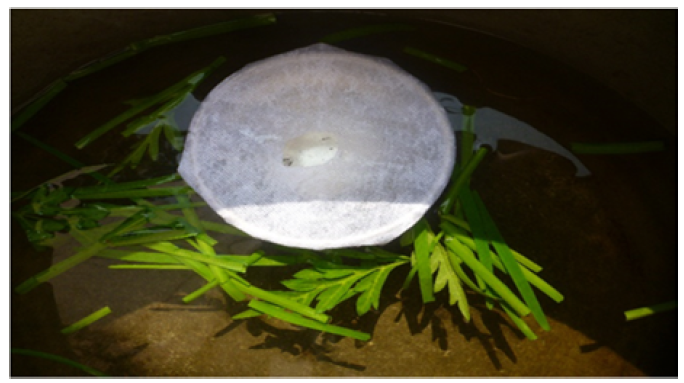
Figure 8: Kudukka Fishery
Kuduka Fishery
This method of fishing is mainly done by children. It is done in shallow rivers and canals of Kuttanad when water is flowing slowly over the bank. A wide mouthed split coconut shell is used for this purpose. The mouth is covered by a thick cloth with a hole in the centre. Boiled rice or dough is then pasted in the hole. The setup is placed against the water flow in the bank. Small fishes attracted by the food enter into the hole and get trapped (Figure 8).
Pulladi Fishery
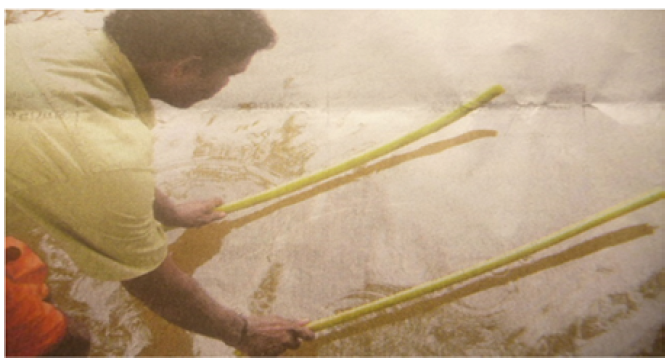
It is seen mostly in the paddy fields of Kuttanad. It is done during the onset of summer when water dries up and bunds get cleared. The gear consists of two plantain stems which are thick and 3 feet long. Plantain stem with their leaves shaved off are held in both the hands. Fishermen wade into the mud. The plantain stems are dipped into the mud on either side of the fishes swimming about. Then the fishes put the head downward in the mud, which are then caught by hand (Figure 9).
Figure 9: Pulladi Fishery
Fishing Using Pot
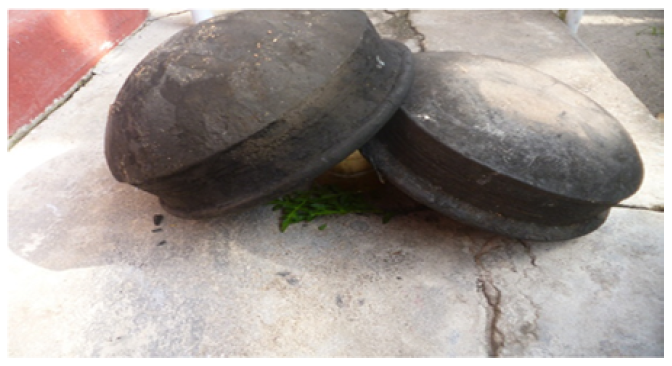
During dusk fishes are caught in aluminium pots from the canals of Alappuzha. The catcher dips himself in the water up to the shoulder level and the pot is allowed to float near him. The fishes hiding between the stones near the bank and at the base of coconut tree’s stem are forced to come out by throwing mud. Small fishes are caught by this method (Figure 10).
Figure 10. Fishing Using Earthen Pots
Man has been using various methods to catch fish since ancient days. The fishing gears have passed through various changes throughout their history. The design of the gear should suit for the habitat where it is used, the type of fish to be trapped, the number of fishes to be captured etc. The survey could bring out different types of indigenous, cost effective, simple and at the same time eco-friendly fishing gears used in Alappuzha district.
The fishing practices documented from the study area reflect the traditional wisdom and dexterity of fishing communities. The fabrication and operation of the various traditional as well as non-conventional fishing gears requires intelligence and meticulous observations. The fishing efficiency of most of the non-conventional gears is not high as it depends exclusively on chance. However these gears exert little pressure on the fish resources. The time of operation of a gear is an important factor of determining its eco-friendliness irrespective of traditional or not. The use of the traditional fishing methods endorses the role of traditional ecological knowledge on the responsible and wise use of bio resources. The earlier works on the fish and fisheries of Travancore during 1946 has recommended a closed season for fishing during the breeding period. The traditional wisdom of the fisher folk of this coastal district and the fishing gears designed by them explicitly shows the traditional wisdom perpetuated through generations. The fishing by the native inhabitants corroborates the consciousness of the stake holders on their biological resources.
The fishing attitude of the inhabitants of the district is welcoming in that they believe in sustainable fishing. Fishing for them is only for livelihood and not for money making and for the same reason they are not exploiting the fishery resources leading it to extinction.
CONCLUSION
The fishing practices documented from the study area reflect the traditional wisdom and dexterity of fishing communities. The fabrication and operation of the various traditional as well as non-conventional fishing gears requires intelligence and meticulous observations. Different types of indigenous, cost effective, simple and at the same time eco-friendly fishing gears are used in Alappuzha district. The use of the traditional fishing methods endorses the role of traditional ecological knowledge on the responsible and wise use of bio resources. Fishery methods of Alappuzha, are leading it to neither over exploitation nor extinction of their fishery resources.
REFERENCE
Ajith, A. et al. “A study on the traditional methods of fishing in Kuttanadu, Kerala, India.” Aquafind Aquatic Fish Database, 1991.
Hornell, J. Fishing Methods of Madras Presidency Report, vol. 1, 1937, pp. 40.
Anon. “Present status of the Ecuador artisanal fishery.” Revista de la Comisión Permanente del Pacífico Sur, no. 4, 1976, pp. 35-54.
Skeide, R. Baiting and handling of gears in coastal long line fisheries. FTFI-RAPP, no. 36, 1984.
Gopinath, K. “Some interesting methods of fishing in the backwaters of Travancore.” Journal of the Bombay Natural History Society, vol. 51, 1953, pp. 466-471.
John, C.C. “Freshwater fish and fisheries of Travancore.” Journal of the Bombay Natural History Society, vol. 38, 1936, pp. 702-712.
Kurien, C.V. and Sebastian, V.O. Prawn and prawn fisheries of India. Hindustan Publishing Corporation, 1986.
Kurup, S.M. and Samuel, C.T. “Fishing gear and fishing methods in the Vembanadu lake.” Harvest and Post Harvest Technology of Fish, Society of Fisheries Technologists (India), Cochin, 1985.
Abe, S. and Dotsu, Y.A. “Note on yellowfin tuna fishing with hand line in the northwestern Coral Sea in October.” Bulletin of the Japanese Society of Fisheries Oceanography, 1977.
Pravin, P. and Ramesan, M.P. “An emerging low energy fishing technique at Veraval: hand lining.” Fishing Chimes, vol. 18, no. 5, 1998, pp. 30-31.
Narsapurkar, R.R. et al. “Design of longlines for Indian coastal water.” Proceedings of the World Symposium on Fishing Gear and Fishing Vessel Design, Marine Institute, Canada, 1988, pp. 173-176.
Rama Rao, S.V.S. et al. “Shark long line gear of India.” Fishery Technology, vol. 26, no. 2, 1989, pp. 73-80.
Recommended Articles
Research Article
Identification of some Bacterial virulence factors of Staphylococcus aureus and Klebsiella pneumoniae
Download PDF
Research Article
Electrochemical Comparative Studies On The Redox Behavior Of Cu(II) And Cr(II) Before And After Interactions With Ciprofloxacin In Solutions
H. M. Naseem Akhtar,
M. Q. Ehsan
Published: 10/08/2021
Download PDF
Research Article
In Acute Appendicitis, Neutrophil/Lymphocyte Rate and C-Reactive Protein’s Radiological Relation with Appendix Diameter and İnvestigation of İts İmpact on The Diagnosis
Ethem Bilgiç,
Özden Yıldırım Akan
Published: 10/03/2021
Download PDF
Research Article
A Rare Case Report of Waugh Syndrome in an Eight Months Old Male
Pielly Hanna,
...
Bassem Abou Merhi
Published: 10/03/2021
Download PDF
PO Box 101, Nakuru
Kenya.
Email: office@iarconsortium.org
Editorial Office:
J.L Bhavan, Near Radison Blu Hotel,
Jalukbari, Guwahati-India
L. P., R. (2020). Fishery in the Context of Sustainable Development: Survey on the Fishing Gears Used For the Riverine Fishery in Alappuzha of Kerala. International Academic Journal of Applied Bio-Medical Sciences, 1(1), 1-5.
MLA
L. P., Rema. "Fishery in the Context of Sustainable Development: Survey on the Fishing Gears Used For the Riverine Fishery in Alappuzha of Kerala." International Academic Journal of Applied Bio-Medical Sciences 1.1 (2020): 1-5.
Chicago
L. P., Rema. "Fishery in the Context of Sustainable Development: Survey on the Fishing Gears Used For the Riverine Fishery in Alappuzha of Kerala." International Academic Journal of Applied Bio-Medical Sciences 1, no. 1 (2020): 1-5.
Harvard
L. P., R. (2020) 'Fishery in the Context of Sustainable Development: Survey on the Fishing Gears Used For the Riverine Fishery in Alappuzha of Kerala' International Academic Journal of Applied Bio-Medical Sciences 1(1), pp. 1-5.
Vancouver
L. P. R. Fishery in the Context of Sustainable Development: Survey on the Fishing Gears Used For the Riverine Fishery in Alappuzha of Kerala. International Academic Journal of Applied Bio-Medical Sciences. 2020 Jul;1(1):1-5.



 Download PDF
 Download XML