In the rapidly evolving landscape of resource management, optimizing resource allocation is crucial to ensure efficient and cost-effective operations. This paper explores the concept of Trapezoidal Fuzzy Assignment Problem (TFAP) as a novel approach to address resource allocation challenges in dynamic environments. TFAP leverages fuzzy logic principles to provide a flexible and adaptive framework for resource assignment, accommodating uncertainties and variations in resource demands. In this study, a real problem was used: assignment five workers to five machines with different tasks, with trapezoidal fuzzy working times. This problem is analyzed by a trapezoidal fuzzy cost by using a method called Ranking Trapezoidal Fuzzy function to find a Optimizing Resource Allocation to the problem, This algorithm is very effective in determining the optimal assignment and trapezoidal cost function, in the future other non-traditional methods will be used and compared to find solutions to problems involving trapezoidal fuzzy costs, In future expansion, other unconventional methods will be used and compared to find solutions to problems involving fuzzy trapezoidal costs..
Keywords
Trapezoidal Fuzzy Assignment Problem (TFAP)
Fuzzy logic
Optimizing resource allocation
Membership function.
INTRODUCTION
Resource allocation is a critical component in decision-making processes across various fields, including operations research, project management, and logistics. The challenge lies in efficiently distributing limited resources to competing tasks or entities while satisfying constraints and maximizing performance. Traditional methods often rely on precise data, which may not always be available due to uncertainty, ambiguity, or incomplete information. To address these challenges, fuzzy logic has emerged as a powerful tool, offering a framework to handle uncertainty and imprecision in resource allocation problems. In particular, fuzzy assignment models provide a means to allocate resources under conditions of vagueness, allowing for more robust and adaptable decision-making processes.
Among the various fuzzy membership functions, trapezoidal fuzzy numbers (TFNs) have gained prominence due to their simplicity and effectiveness in representing uncertainty. A trapezoidal fuzzy number is defined by four parameters, making it flexible for modeling a wide range of imprecise scenarios. When incorporated into assignment models, TFNs enable decision-makers to evaluate potential allocations based on fuzzy criteria rather than relying solely on crisp numerical values, The problem of assignment has been studied by many researchers since ancient times. Moreover, many efficient algorithms have been developed For example [1] This paper presents an improved Shapley value for cooperative games in ambiguous situations regarding unclear profit allocation in an e-commerce logistics alliance for forest products. This value maximizes player satisfaction by minimizing the surplus contribution, according to which the least squares contribution of the trapezoidal fuzzy number is calculated. [2] presented the intuitionistic fuzzy assignment problem (IFAP) is used in circumstances where decision makers have to deal with uncertainty. The domains are trapezoidal intuitionistic fuzzy numbers (TrIFNs) and the techniques used are the Hungarian method (HM), the brute force method (BFM) and the greedy method (GM). [3] In this paper, the assignment problem using fuzzy trapezoidal parameters is studied and solved using the new Dhouib-Matrix-AP1 (DM-AP1) method. In fact, this research work presents the first application of the Dhouib-Matrix-AP1 method to the fuzzy assignment problem. [4] In this paper, a trapezoidal fuzzy mapping problem is proposed to be solved using a novel ranking approach to find the optimal solution. [5] In this paper, we first describe the trapezoidal fuzzy number (TrFN) using arithmetic operations and solve the assignment problem using the Hungarian method for trapezoidal fuzzy number (TrFN). [6] This paper proposes a new classification method that distinguishes between fuzzy numbers as few existing methods fail to distinguish between fuzzy numbers. This method classifies all types of fuzzy numbers.
This research explores the optimization of resource allocation using trapezoidal fuzzy assignment models. By integrating the principles of fuzzy logic with allocation methodologies, the study aims to Optimizingresource allocation processes in uncertain environments by studying the resource allocation problem in the General Company for Electrical Industries-Baghdad. The approach not only enhances decision quality but also provides a systematic way to deal with the ambiguity inherent in real-world problems. The contributions of the study include:
1- Developing a comprehensive framework for fuzzy trapezoidal allocation models in resource allocation.
2- Analyzing the effectiveness of these models compared to traditional methods.
3- The research emphasizes the importance of innovative methodologies in addressing the complexities of modern resource allocation problems, paving the way for more flexible and adaptive decision-making systems.
The assignment problem
The assignment problem is concerned with assigning n objects (i activities) to n other objects (j resources) based on their efficiency in performing the task and the assignment cost (Cij) The basic assumption in the assignment problem is that exactly one activity can be assigned to one resource, and the main goal is to construct a minimal assignment network plan such that the total cost is as low as possible. Mathematically, the problem is formulated as in (1). [3] [7]
Subject to constraints
Xij =
The Fuzzy set
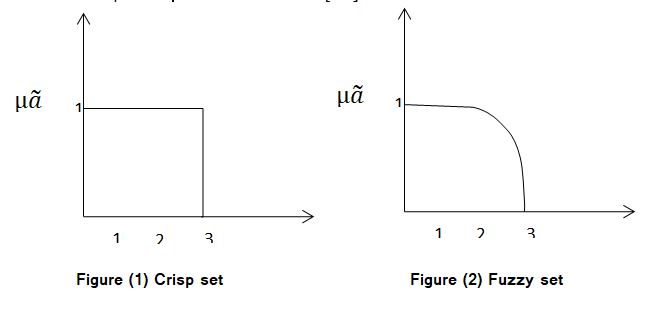
The element in the Crispset is either a member of the set or not a member of it, while in the fuzzy set the element has degrees of membership to that set. For example, in the Crispset, if (U) is a set and () is a subset of (U) and (µ) is a function that gives each element of the set (U) its degree of membership to the set (), then if the element, for example (X) belongs to the set () then (µ=1), but if the element (X) does not membership to the set () then (µ=0) and the membership function in this case is defined as follows: [8]
µ∶ U→[0,1] …(2)
The following conditions must be met in the membership function: [9]
The fuzzy set Convex
The set µ is defined in the interval [0,1]
Table (1) Differences between the Crisp sets and the Fuzzy sets
Crisp sets
Fuzzy sets
has sharp boundaries, which means that the element belongs to that set or not.
has vague or unclear boundaries, which means that an element is allowed to belong partially to the set.
The membership function in a traditional set consists of two elements, either 0 or 1.
The membership function in the fuzzy set takes all values between (0, 1).
It is used in many fields, but lacks flexibility in some applications such as data classification and analysis, etc.
More flexible, addresses problems that cannot be addressed by the Crisp sets.
Members of a Crisp sets cannot be members unless they are full members of that sets.
The fuzzy set contains elements with varying degrees of membership in the set.
Tpezoidal Fuzzy Numbers
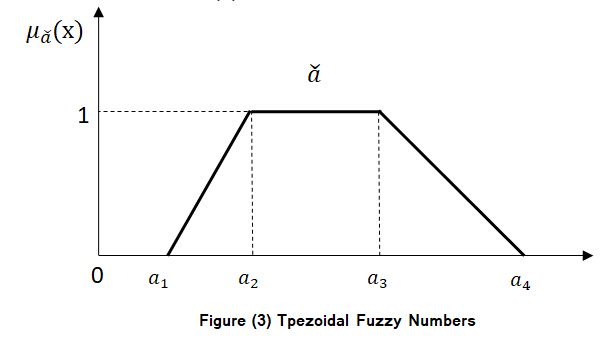
Its appearance is determined in light of the values specified in a trapezoidal form, i.e. the fuzzy numbers consist of four real numbers, and let be a four-valued fuzzy number.
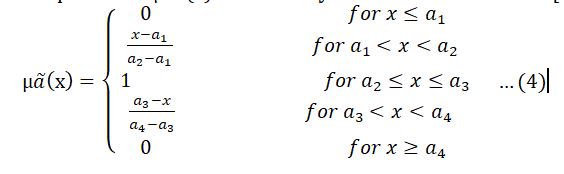
It belongs to the membership function µ (x) and is represented graphically as in Figure (3). [10]
Where the membership function µ (x) for the fuzzy number is as follows: [11] [12]
Fuzzy Assignment Model
Fuzzy assignment Model (FAM) are predominant in decision-making problems, where the appearance and conditions in the actual decision-making environment are pervaded by uncertainty, and no accurate data are available for constructing the problems. Incorporating fuzziness into the classical deterministic assignments has led to the development of fuzzy assignment problems. Principally, the fuzzification of classical assignments resembles quantizing others’ preferences in the process of evaluation. Classical assignments do not reflect the actual decision-making scenarios.
Since the mathematical models are the ones that help structure and solve our problems, the classical models have to be modified to reflect real decision-making conditions, where uncertainties prevail. They provide better techniques for dealing with and solving phased problems of uncertainties than classical deterministic assignments. Many models and algorithms exist to solve fuzzy assignment problems. The results may differ from one another. This discrepancy motivates researchers to conduct research on fuzzy assignment problems. The fuzzy assignment problem can be represented as follows: [13] [14]
Suppose there are n jobs to be done and n person are available to perform these jobs. Assume that each person can do one job at a time and that each job can be assigned to only one person.
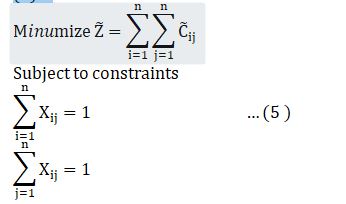
Let Cij be the fuzzy numbers Cost (Payment) If job jth is an assignment to person pth The problem is to find an assignment Xij such that the total cost of performing all jobs is minimum. [15]
The chosen fuzzy assignment Model (FAM) can be formulated in the following fuzzy linear programming Model in (5):
Such that Z is Total fuzzy cost for performing all the jobs. [16]
Ranking Trapezoidal Fuzzy Assignment
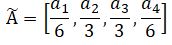
The value of a trapezoidal fuzzy number is obtained by the Ranking formula (6):
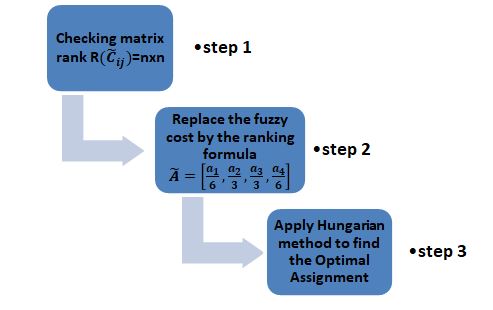
So, this approach will be used to convert the trapezoidal fuzzy assignment problem (TFAP) into a crisp assignment problem (CAP) using this algorithm. [10]
Figure (4) Solving algorithm
Case study
To apply the approach to the problem of trapezoidal fuzzy assignment, we will apply to the study sample, which is “Electrical Industries Company”, one of the companies of the Iraqi Ministry of Industry and Minerals. It is a large company with diverse production lines and advanced manufacturing facilities. Five types of production machines will be used, each of which is dedicated to producing a specific type of products: (1) a machine for producing copper wires, (2) a machine for producing lamps, (3) a machine for producing iron bases, (4) a machine for punching aluminum sheets, and (5) a machine for producing plastic parts.
The objective of the model is to assign five skilled workers to five machines, where each worker can complete the task for a given product in a different time period compared to the other products. Table (3) shows the fuzzy times (in minutes) for each worker on each machine.
Table (3) Time Fuzzy Matrix
Machine 1
Machine 2
Machine 3
Machine 4
Machine 5
Worker 1
(123,231,154,183)
(120,222,145,209)
(142,190,176,215)
(165,198,175,201)
(176,225,146,178)
Worker 2
(134,198,167,241)
(132,229,144,191)
(150,213,156,188)
(144,223,184,196)
(122,212,151,217)
Worker 3
(125,175,136,148)
(110,222,123,189)
(112,212,154,178)
(156,190,162,180)
(125,198,144,142)
Worker 4
(89,231,162,154)
(123,219,165,210)
(142,219,145,178)
(143,241,167,188)
(98,210,175,183)
Worker 5
(147,179,141,198)
(128,231,142,186)
(152,200,140,177)
(120,208,159,174)
(115,257,131,183)
Step 1:
No. of rows =5
No. of columns =5
So, the problem is balanced
Step 2:
Use the Ranking Trapezoidal Fuzzy Assignment formula:
Machines(j)
1
2
3
4
5
Workers(i)
1
179.3
177.2
181.5
185.3
182.7
2
184.2
178.2
179.3
192.3
177.5
3
149.2
164.8
170.3
173.3
158.5
4
171.5
183.5
174.7
191.2
175.2
5
164.2
176.7
168.2
171.3
179
Step 3:
Apply Hungarian method, First We find the smallest element of each row and subtract it from that row. We do the same for all the remaining rows. We get,
Machines(j)
1
2
3
4
5
Workers(i)
1
2.1
0
4.3
8.1
5.5
2
6.7
0.7
1.8
14.8
0
3
0
15.6
21.1`
24.1
9.3
4
0
12
3.2
19.7
3.7
5
0
12.5
4
7.1
14.8
Secondly, we find the smallest element in each column and subtract it from that column. We do the same for all the remaining columns, and We draw the minimum number of lines that cover all the zeros, the rule (we must cover those zeros with the least number of straight lines). We get,
Machines(j)
1
2
3
4
5
Workers(i)
1
2.1
0
2.5
1
5.5
2
6.7
0.7
0
7.7
0
3
0
15.6
19.3
17
9.3
4
0
12
1.4
12.6
3.7
5
0
12.5
2.2
0
14.8
Now, We choose the smallest cost element that is not covered by the lines (here it is 1.4). Then we subtract this element from all the uncovered elements including itself and add this element to each element that falls at the intersection of any two lines. The cost elements that the line passes through remain unchanged. As shown in the table below:
Machines(j)
1
2
3
4
5
Workers(i)
1
3.3
0
2.5
1
5.5
2
8.1
0.7
0
7.7
0
3
0
14.2
17.9
15.6
7.9
4
1.4
10.6
0
11.2
2.3
5
1.4
12.5
2.2
0
14.8
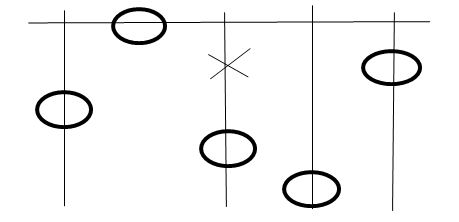
Since the minimum number of lines drawn is 5, the optimal solution is found. Noting that the assignment will be made by crossing out all zeros in the column corresponding to the specified zero, repeat the same procedure until a zero is marked in every row.
Optimal assignment is,
Worker 1 >> Machine 2
Worker 2 >> Machine 5
Worker 3 >> Machine 1
Worker 4 >> Machine 3
Worker 5 >> Machine 4
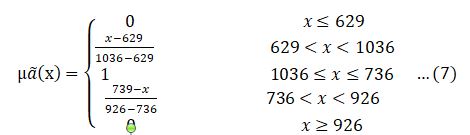
And the total cost of the trapezoidal fuzzy assignment is Z =(629,1036,736,926), This solution is calculated by:
Thus, the levels of the membership function µ(x) of the remaining values of the minimum cost increase and decrease as shown in (7).
Figure (5) shows a picture of the membership function of the resulting trapezoidal fuzzy solution.
CONCLUSION
Assignment problem is often used to find solutions out of problems facing the real world, though in reality, data are typically imperfect. A practical problem was examined in this research: assignment five workers to five machines with different tasks, with trapezoidal fuzzy working times, with the aim of Optimizing Resource Allocation of the problem. This assignment problem is analyzed by a trapezoidal fuzzy cost by using a method called Ranking Trapezoidal Fuzzy function to find a Optimizing Resource Allocation of the problem. first step of the process, the trapezoidal fuzzy numbers are converted to Crisp sets. Then the Ranking algorithm applied in three simple steps. This algorithm is very effective in determining the optimal assignment and trapezoidal cost function, in the future other non-traditional methods will be used and compared to find solutions to problems involving trapezoidal costs.
Conflict of Interest:
The authors declare that they have no conflict of interest
Funding:
No funding sources
Ethical approval:
The study was approved by the Al-Iraqia University/ College of Administration and Economics, Iraq.
REFERENCES
Liu et al.; "Improved Shapley Value with Trapezoidal Fuzzy Numbers and Its Application to the E-Commerce Logistics of the Forest Products" Appl. Sci. 2.1 (2025) pp. 1–23, doi: https://doi.org/10.3390/app15010444.
Sanjana and Ramesh; "Optimization Techniques of Assignment Problem Using Trapezoidal Intuitionistic Fuzzy Numbers and Interval Arithmetic" Stat. Optim. Inf. Comput. 2.1 (2024) pp. 1984–1999, doi: https://doi.org/10.19139/soic-2310-5070-1842.
Dhouib and Sutikno; "Solving the Trapezoidal Fuzzy Assignment Problem Using the Novel Dhouib-Matrix-AP1 Heuristic" Bull. Electr. Eng. Informatics 2.1 (2023) pp. 950–957, doi: https://doi.org/10.11591/eei.v12i2.4855.
Arora; "Ranking of Trapezoidal Fuzzy Assignment Problem" Int. J. Res. Publ. Rev. 2.1 (2022) pp. 1559–1564.
Kar, Shaw, and Mishra; "Trapezoidal Fuzzy Numbers (TrFN) and Its Application in Solving Assignment Problems by Hungarian Method: A New Approach" Fuzzy Intell. Syst. Methodol. Tech. Appl. 2.1 (2021) pp. 315–373, doi: https://doi.org/10.1002/9781119763437.ch11.
Malini and Ananthanarayanan; "Solving Fuzzy Assignment Problem Using Ranking of Generalized Trapezoidal Fuzzy Numbers" Indian J. Sci. Technol. 2.1 (2016) pp. 1–7, doi: https://doi.org/10.17485/ijst/2016/v9i20/88691.
Gani and Mohamed; "Solution of a Fuzzy Assignment Problem by Using a New Ranking Method" Int. J. Fuzzy Math. Arch. 2.1 (2013) pp. 8–16, www.researchmathsci.org.
Ansseif and Dammak; "Application of a Two-Stage Multi-Item Fuzzy Transportation Model for Medical Resources During the (COVID-19) Pandemic in Baghdad" Math. Stat. Eng. Appl. 2.1 (2022) pp. 1022–1043.
Kaur and Kumar; "A New Approach for Solving Fuzzy Transportation Problems Using Generalized Trapezoidal Fuzzy Numbers" Appl. Soft Comput. J. 2.1 (2012) pp. 1201–1213, doi: https://doi.org/10.1016/j.asoc.2011.10.014.
Anand; "New Methodology for Assignment Problems in Trapezoidal Fuzzy Numbers" Int. J. Adv. Res. Sci. Commun. Technol. 2.1 (2021) pp. 1046–1053, doi: https://doi.org/10.48175/568.
Dinagar and Kamalanathan; "A Comparison of Two New Ranking Methods on Solving Fuzzy Assignment Problem" Ann. Pure Appl. Math. 2.1 (2017) pp. 151–161, doi: https://doi.org/10.22457/apam.v15n2a1.
Palanivel et al.; "Fuzzy Assignment Problem of Trapezoidal Membership Functions Within the Sort of Alpha Optimal Solution Using Ranking Principle" 2014 Int. Conf. Adv. Eng. Technol. ICAET 2014 2.1 (2014) pp. 1–7, doi: https://doi.org/10.1109/ICAET.2014.7105256.
Muamer; "Fuzzy Assignment Problems" J. Sci. 2.1 (2020) pp. 40–47.
Khairuddin et al.; "Generating Clustering-Based Interval Fuzzy Type-2 Triangular and Trapezoidal Membership Functions: A Structured Literature Review" Symmetry (Basel) 2.1 (2021) pp. 1–25, doi: https://doi.org/10.3390/sym13020239.
Ganesh and Suresh; "On Solving Interval Data-Based Assignment Problem Under Fuzzy Environment" J. Math. Comput. Sci. 2.1 (2021) pp. 1970–1996, doi: https://doi.org/10.28919/jmcs/5442.
Thorani and Shankar; "Multi-Objective Assignment Problem with Generalized Trapezoidal Fuzzy Numbers" Appl. Math. Sci. 2.1 (2013) pp. 3511–3537, doi: https://doi.org/10.12988/ams.2013.34228.
Recommended Articles
Research Article
Agentic AI in Information Systems: Toward Autonomous Decision-Making in Organizations
Duoha Suhail Najm
Published: 30/07/2026
Download PDF
Research Article
A Comparative Study of Online Fashion Promotion: Hennes & Mauritz (H&M) and Label in India
Riya Jamble
Published: 20/07/2021
Download PDF
Research Article
Developing Social Media Marketing Visual Contents to Increase Engagement Rate (A Case Study of Healthy Tails Animal Clinic in Malang City)
Aditya Nirwana,
...
Felicia Joscelind Verrel
Published: 20/11/2022
Download PDF
Research Article
The Determinants of the Financial Behaviour of SMEs: Empirical Evidence from an Emerging Economy
Santiago Hernandez,
...
Remo Roscigno
Published: 20/03/2022
Download PDF
PO Box 101, Nakuru
Kenya.
Email: office@iarconsortium.org
Editorial Office:
J.L Bhavan, Near Radison Blu Hotel,
Jalukbari, Guwahati-India



 Download PDF
 Download XML