Introduction: Medical products are mostly manufactured for single use, including peripheral nerve block needles [1]. Under these conditions, the reuse of disposable peripheral nerve block needles has been thought to be a saving tool. Materials and Method: The Nerve stimulator and multimeter were connected to the peripheral block needles and the control needle, which had been sterilized with the technique described below and used 20 times on the artificial model tissue beforehand, and the stimulator was given current with the stimulator. Results: When the control needle and 1, 2, 3, 4, 6, 7, 10 needles were compared, in the independent sample t test analysis, the p value was 0.14, and no statistical significance was found. When the control needle and the 5,8,9 needles were compared, the p value was found to be <0.05 and was statistically significant.
Keywords
Peripheral Nerve Block Needles
Reuse And Sterilization
Needle Wear And Deformation
Electrical Conduction Defects
Nerve Stimulator Performance
INTRODUCTION
Medical products are mostly manufactured for single-use, including peripheral nerve block needles [1]. Under these conditions, the reuse of disposable peripheral nerve block needles has been thought to be a saving tool. Both the needle price and the need to dispose of the used needle as medical waste increases the cost. (Needle unit price is about 12 $-Invoiced to the institution, Sterilization cost is 0.15 $(cost per needle-Our Institution conditions). Also, this approach is compatible with the principle of producing less waste. It has been reported that peripheral block needles have been sterilized by current techniques effectively [2]. The sterilization cost is meager compared to the needle unit price. For this reason, the objective evaluation of the wear problem caused by reuse is essential. The wear can occur in different ways. With reuse, blunting at the needle tip, tearing-rupture due to sterilization, deformation in current conducting cables and loss of transmission may occur. While some of the physical deformations are visible, it may be necessary to test electrical conduction defects with current measuring devices. For these reasons, the need to investigate the effect of wear on electrical conduction is clear. Because, the peripheral nerve block needles work with the principle of getting a contraction response from the relevant muscle tissue by giving low voltage electrical current to the nerves [3]. Healthy electrical conduction means a robust operation of a nerve stimulator. The study is planned on these principles.
MATERIALS AND METHODS
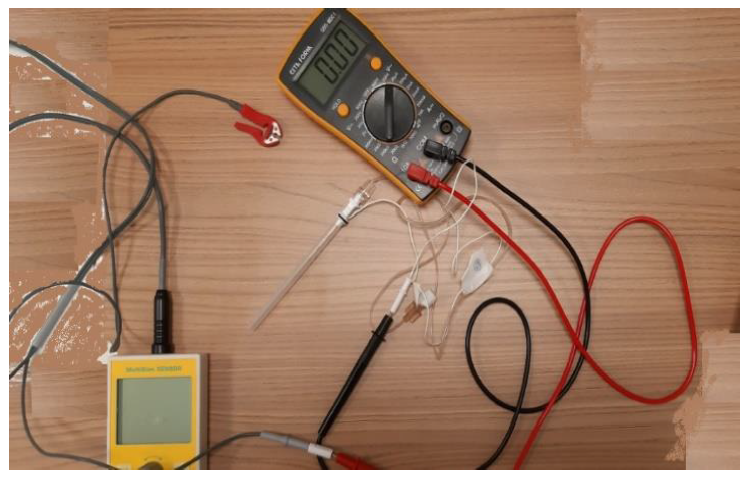
The Nerve stimulator and multimeter were connected to the peripheral block needles and the control needle, which had been sterilized with the technique described below and used 20 times on the artificial model tissue beforehand, and the stimulator was given current with the stimulator. The current to be given and the currents measured from the multimeter were recorded. Apart from needles that passed 20 times from the use-sterilization cycle, 1 control needle was also used in the study and the results were recorded. The recorded results were compared. The block needles sterilized 20 times by the described sterilization method (Pajunk® Sonoplex Stim cannula model 22-gauge 50 mm peripheral nerve block needle was used) and the unused reference needle, were connected to the stimuplex nerve stimulator device in order. Then the device was started to apply 0.5 milliamperes (mAmp) current power at 2 Hz frequency. Then, a connection was made with the block needle and the multimeter (T-Technic A830L (2017 China) digital multimeter) device, and the current measured with the supplied current was recorded (recorded in milliamperes).
Figure 1: Stim Cannula and T-Technic A830L multimeter), measurement procedures, and comparison method.
In our study, the results of 10 used needles (artificially re-used and sterilized) and 1 unused needle were compared. The measurement setup is shown in figure 1.
Sterilization technique; the needles were rinsed with an isotonic solution. They were then sent to the sterilization unit. The needles packaged in the sterilization unit were sterilized in a CASP brand CASP-120 model sterilization device with 55-60% hydrogen peroxide at 45±5 ° C in 53 minutes and a cycle was completed.
The study was carried out at an ambient temperature of 18-22 ° C in order to avoid temperature effects.
RESULTS
When the control needle and 1, 2, 3, 4, 6, 7, 10 needles were compared, in the independent sample t test analysis, the p-value was 0.14, and no statistical significance was found. When the control needle and the 5,8,9 needles were compared, the p-value was found to be <0.05 and was statistically significant.
Statistical analysis; SPSS 22.0 for Windows software was used for statistical analysis. Shapiro Wilks test was used to determine whether the data showed normal distribution. Descriptive statistical analyses were used to evaluate demographic data and data collected from tests and scales. Independent sample t-test was used to compare the data. p<0.05 was considered statistically significant. (Needle 5,8,9 has more mAmp of current transmission, therefore, the negative statement about the current conduction of used needles has not been discussed.)
Table 1: Comparison of Electrical Current Transmission in Control and Reused Needles at 0.5 mAmp Stimulation
Needle number
0.5mAmp
Control needle
0.16
1
0.16
2
0.16
3
0.16
4
0.16
5
0.17
6
0.16
7
0.16
8
0.17
9
0.17
10
0.16
DISCUSSION
In our study, it was seen that there was no significant difference between the current value measured from the tip of the re-used peripheral block needles and the values measured from the unused needle tip. Since sterilization has been shown in previous studies [4], it is important to show that the current conduction is at the level of the unused needle, in order to show that there is no technical obstacle to reuse.
Considering used needles as medical waste brings ecological costs. As a way of reducing the production of medical waste, it has been suggested to use recycled materials [5]. This can be considered a form of recycling, as medical waste can be reduced by reuse. In addition, reuse should be considered as a method to reduce medical waste. It has been determined that the costs of medical waste disposal, which has economic and ecological costs, can have a significant impact on health expenditures with the development of health services [6].
Considering the recommended principles for the reuse of medical equipment [7], even if savings are achieved by re-use, recording these procedures, and obtaining patient consent will increase the workload. This is one of the disadvantages associated with reuse. In addition, it was emphasized that a responsible person should be appointed for these tasks, but the qualifications of this person have not been not discussed (7).
REFERENCE
Epstein A. "American College of Cardiology/American Heart Association Task Force on Practice Guidelines (writing committee to revise the ACC/AHA/NASPE 2002 guideline update for implantation of cardiac pacemakers and antiarrhythmia devices), American Association for Thoracic Surgery; Society of Thoracic Surgeons" Circulation vol. 117, 2008, pp. e350-e408.
Möllmann M. et al. "The reuse of 29-gauge spinal needles following combined spinal-epidural anesthesia" Der Anaesthesist vol. 41, no. 12, 1992, p. 769.
Hadzic A. et al. "Nerve stimulators used for peripheral nerve blocks vary in their electrical characteristics" Anesthesiology: The Journal of the American Society of Anesthesiologists vol. 98, no. 4, 2003, pp. 969-974.
Aydoğan E. and Kozanhan B. "Evaluation of ultrasonography probe disinfection habits in peripheral and/or central regional blocks applied with ultrasound guidance" Agri: Agri (Algoloji) Dernegi'nin Yayin Organidir = The Journal of the Turkish Society of Algology vol. 31, no. 1, 2019, pp. 9-14.
Ertaş H. and Güden M.A. "Hastanelerde tibbi atik yönetimi" Sosyal Araştırmalar ve Yönetim Dergisi vol. 2019, 2019, pp. 53-67.
Cerrahoğlu M.N. and Kılıçaslan H. "Tıbbî atıkların sağlık harcamaları üzerindeki etkisi" Uluslararası Ekonomik Araştırmalar Dergisi vol. 5, no. 4, 2019, pp. 59-68.
Doyle D.J. "Medical equipment reuse: some principles" Canadian Journal of Anaesthesia vol. 45, no. 10, 1998, p. 1033.
Recommended Articles
Research Article
Evidence Guided, Experience Based and Patient Compatible 3-Step Protocol for Managing Moderate to Severe Category of COVID19 Infections
Farah Husain,
...
Kirti N Saxena
Published: 05/01/2021
Download PDF
Research Article
A Descriptive Cross-Sectional Study to Evaluate the Knowledge about Symptoms and Risk Factors for Heart Attack (Myocardial Infarction) Among the General Population of New Delhi
Aastha Sehgal,
...
Avneet Kaur
Published: 06/05/2023
Download PDF
Research Article
Knowledge About Risk and Preventive Factors for Osteoarthritis Knee among Ortho OPD Patients in Regional Hospital, Keylong in District Lahaul and Spiti of Himachal Pradesh
Ajay Thakur,
Jaspal Chaudhary
Published: 20/06/2022
Download PDF
Research Article
A Randomized Controlled Trial Comparing the Effect of Oral Preemptive Pregabalin Compared to IV Lignocaine in Attenuating Hemodynamic Response to Laryngoscopy
P. Aashik,
...
B.N. Reddy
Published: 17/05/2023
Download PDF
PO Box 101, Nakuru
Kenya.
Email: office@iarconsortium.org
Editorial Office:
J.L Bhavan, Near Radison Blu Hotel,
Jalukbari, Guwahati-India
Aydoğan, E. & Tire, Y. (2021). Investigation of Current Conduction Levels of Sterilized Peripheral Nerve Block Needles: Invitro Study. IAR Journal of Anaesthesiology and Critical Care, 2(1), 1-2.
MLA
Aydoğan, Eyüp and Yasin Tire. "Investigation of Current Conduction Levels of Sterilized Peripheral Nerve Block Needles: Invitro Study." IAR Journal of Anaesthesiology and Critical Care 2.1 (2021): 1-2.
Chicago
Aydoğan, Eyüp and Yasin Tire. "Investigation of Current Conduction Levels of Sterilized Peripheral Nerve Block Needles: Invitro Study." IAR Journal of Anaesthesiology and Critical Care 2, no. 1 (2021): 1-2.
Harvard
Aydoğan, E. and Tire, Y. (2021) 'Investigation of Current Conduction Levels of Sterilized Peripheral Nerve Block Needles: Invitro Study' IAR Journal of Anaesthesiology and Critical Care 2(1), pp. 1-2.
Vancouver
Aydoğan E, Tire Y. Investigation of Current Conduction Levels of Sterilized Peripheral Nerve Block Needles: Invitro Study. IAR Journal of Anaesthesiology and Critical Care. 2021 Jan;2(1):1-2.


 Download PDF
 Download XML