Purpose: Aims to discuss the Religiosity and price of the shop switching behavior from modern retail stores to the Moslem ethnic Store in Indonesia. Design/Methodology/Approach: Explanatory research by employing the variables of religiosity price to predict shop switching behavior from modern to moslem ethnic store in Indonesia. One hundred and twenty samples defined from customer modern retail stores to Basmalah Moslem ethnic Store in Jember branch, a region where majority of Basmalah Moslem ethnic store exist. Researcher uses multiple linear regressions to test the hypothesis. Findings: The religiosity and price had a positive and significant influence on the store's transition behavior from modern to the Basmalah Moslem ethnic Store in Indonesia. Originality: The shop switching behavior from modern to Moslem ethnic store in Indoneisa has unique behavior particularly on religiosity and price aspect. Research Limitation/Implications: Limitedscope of the area and lack of supporting empirical studies are pioneering this research. Future research with more relevant variables is the potential to enrich the literature. Practical Implications: This research is exploring the anti-mainstream of consumer behavior from modern retail to ethnic Moslem store, which is unbelievable findings. The leveraging brand image of the ethnic Moslem stores induced from this study. Social Implications: Moslem ethnic store is not a marginally stream in Indonesia.
Keywords
Religiosity
Price
Modern Retail
Moslem ethnic store
Multiple Linear Regression Analysis
INTRODUCTION
Business ventures have experienced rapid development over the past few years with various formats and types. This situation encourages companies to compete for market share and provide the best service for the company's sustainability. Accordingly, the business activities that selling and adding the value to the product or services to the customer for personal use or family in a series categorize as a retail business [1]. Retail sellers provide a variety of products such as household needs, necessities, stationery to cover daily consumer's needs.
According to the Association of Retail Business Indonesia (Aprindo), the trend of retail business in Indonesia is still positive, increasing with the fact that in between September 2018 to September 2019, the Fast-Moving Consumer Goods (FMCG) consumption is 2.5% in growth. The most rapid growth of FMCG consumption in modern retail is 7.6% [2]. In this fast and easy era, minimarkets provide a lot of convenience in terms of service, product completeness, price, secure payment process, location near the settlement and even a service between orders to consumers' homes. Consumers prefer to shop at the convenience store, increasingly congested traffic conditions and consumers avoiding excessive consumption in supermarkets and hypermarkets. In contrast, minimarket, with many visitors, tends to attract customers at a low price and has a value of Religiosity. Basmalah is a Moslem ethnic store with a religious nuance carries the theme of sharia, operated in many districts in Indonesia.
Basmalah Moslem ethnic store is an individual business and brand infrastructure built by the Cooperative Boarding School (Kopontren), Pasuruan, East Java. It has been established in 2013 and has the motto "Good Shopping" but, it seems simple but full of meaning. In Islam, it means as the Halalan Thayyiban (halal and right) and the goods sold in the Basmalah Store in Moslem ethnic store are halal and ethical. This mini market provides various kinds of basic needs and daily necessities such as basic needs, stationery, snacks, medicines and other necessities. The store also offers a refrigerator that sells various kinds of drinks. Still, there do not sell water and different types of alcoholic beverages, there only sell Santri and aqua brand mineral water. The type of water of the "santri" brand in the store dominates more. This minimarket also sells Zam-Zam water with large bottle size.
Another thing that is not less interesting than the Basmalah Moslem ethnic store is the Al-Quran Mushaf, iqra' books, Juz Amma and digital prayer beads, sarong, hat, hijab and perfume. Basmalah Moslem ethnic store provides discounts/wholesale prices for every purchase of three items at once. The store sells some original products made by Moslem ethnic stores, such as soy sauce, sauce, rice and cooking oil.
All employees at the Basmalah Moslem ethnic store-are male employees who are alumni of the Islamic Boarding School of Moslem ethnic store Islamic Boarding School. When working, they wear a white, green uniform with the logo of letter "Yes" (the last letter of the message in the Arab language), the logo of the Basmalah in Moslem ethnic store. When entering to the store, it hear Islamic music or the sound of reading the Qur'an that makes consumers feel a different sensation when purchasing at the store. Those are the uniqueness of Moslem ethnic store Basmalah from other minimarkets. The Kopontren Moslem ethnic store business continues to develop until it earns hundreds of billions of IDRs annually, as evidenced by the continued proliferation of Moslem ethnic store Basmalah in city sharing. In Jember, there are 15 branches out of 126 stores around Indonesia. The Moslem ethnic store Basmalah in the region is mirroring the society and potentially they shop switching one with another.
Many things encourage consumers to do shop switching from modern retail stores to Basmalah. Consumers in Moslem ethnic store are looking for variety, hunting low prices, which is not satisfying with the previous store. They want to find more benefits, unavailability of products and so on. Transfer of consumers from a general minimarket to the Basmalah Moslem ethnic store due to various uniqueness and differences with other modern stores. Experience shopping in these stores is charming with excellent and friendly services. Low prices, beautiful sound of reading Qur’an and cold air condition that is not inferior to other minimarkets make consumers feel at home in the store and are compelling to make a transfer of purchase to Moslem ethnic store Basmalah. Another thing considered by consumers is that they hope that shopping at the Basmalah Moslem ethnic store-which is Islamic-owned cooperative - can blessing. Part of the store's profits was allocated to poor people and funding it.
Shop switching behavior is the tendency of consumer behavior related to the process of switching purchases from one store to another [3,4]. If there is more healthy option such as dietary pattern, consumers will tend to move [5]; due to religiosity [6]. The tendency to move from one store to another is described by research modelling of push pull and mooring model [7]. The majority of consumers hunt for a product at a lower price [8]. Basmalah Moslem ethnic store provides products with lower rates and quality that are not less competitive with products available at other retail stores. Besides that, the Basmalah Moslem ethnic store - also provides wholesale prices for every purchase of three products and provides necessities such as rice, sugar, oil, flour, etc. which can cover consumer demand.
Consumer behavior is the attitudes towards the things by the circumstances of the society in which he was born and growth [9]. The different walks of life or environments of the consumers creates the different judgments, needs, opinions, attitudes and tastes so that will influence decision making in the purchasing phase. Engell et al. [9] and Hawkin et al. [10] mentioned that there are four factors influencing consumer behavior; (1) A culture (culture, sub-culture and social class), (2) A social (reference group, family, as well as roles and status); (3) Personal (age, income, work, lifestyle) and (4) Personality and self-concept) and psychological (motivation, perception, knowledge, beliefs and attitudes). These factors can individually or jointly influence a person's decision to purchase a product or service, choose the type, determine when to buy or place where to buy.
Religiosity refers to a person that committed to his religion and the teachings of the faith [11]. They highlighted that integrate their religion into most aspects of their lives by evaluating the world from religiosity views as the essential element of a culture. Religiosity is also one of the factors that influence consumer behavior to make purchases at a store in developing countries [6]. According to Hawkin et al. [10] and Mokhlis [12] religion affects various aspects of consumer behavior in making purchases (shop switching behavior). Consumers want to evaluate new things, find information and consumption processes such as entertainment, search for new products, transportation and family. The existence of the Basmalah Moslem ethnic store, which is a Islamic-based retail store, is different from other retailers, encourages consumers to transfer purchases from general retail stores. Imammudin [13] and Dekhil et al. [14]; shows that Religiosity affects shop switching behavior.
Instead of religiosity, price has potentially influenced the shop-switching behavior on purchasing the products in a retail business. The price set by the company is a benchmark for consumers to make purchases. Price, according to Kotler et al. [15], is the amount of money deliver for a product and service. Price is one of the crucial ingredients in making decisions to buy a product. Consumers will decide to buy a product if the perceived benefits are greater or equal to what they spent to get it. Research conducted by Levy et al. [1] and Calvo-Porrala et al. [8] shows that price affects shop switching behavior. In this study, the price has a significant positive effect on shop switching behavior from modern retail stores to the Basmalah Moslem ethnic store in Indonesia.
The research problems are as follows:
Does Religiosity have a significant effect on shop switching behavior from Modern Retail Stores to Basmalah Moslem ethnic store in Indonesia?
Does the price have a significant effect on shop switching behavior from Retail Modern Store to Basmalah Moslem ethnic store in Indonesia?
The research objectives are as follows:
To test and analyze the effect of Religiosity on shop switching behavior from Retail Modern Stores to Basmalah Moslem ethnic store in Indonesia
To test and investigate the impact of prices on shop switching behavior from Retail Modern Stores to Basmalah Moslem ethnic store in Indonesia
LITERATURE REVIEW
Consumer Behavior
In this 4.0 era, there is a continuous change and this condition occurs because of the development process. The process of this development will directly or indirectly affect the life of the economy. Along with human development, consumer behavior and tastes also indicate changes. Changes in consumer behavior require companies with interest always to know their customers well. To understand how people's behavior in purchasing service goods requires a separate study. Studying consumer behavior means that you will learn something that concerns social behavior in general. Economics in the field of management marketing also studies social behavior by utilizing thinking as a scientific discipline in marketing aspects.
Kotlar et al. [15] interpret consumer behavior as buying behavior for end consumers, both individuals and households who purchase products for personal consumption. Consumer behavior defined as the individuals activities involved in obtaining and using goods and services through a decision-making process includes the preparation and determination of activities [9]. The behavior also studies the exchange processes of buying units that involve the acquisition, consumption and disposal of goods, experience services and ideas. In the buying process, a consumer is always associated with the exchange process, resources that occur between the two parties, namely between consumers and companies, or can also happen between two companies when facing an industrial purchasing situation.
Mowen et al. [16] explains that there are three perspectives of consumer behavior, namely the perspective of decision making, experience perspective and behavioral influence perspective. These three perspectives are beneficial to understand. The decision-making perspective describes a consumer doing a series of specific steps when making a purchase. These steps include the introduction of problems, seeking information, evaluating alternatives, selecting and evaluating post-acquisition. Consumer decision making is an experiential perspective; for some things, consumers do not make purchases following rational decision making. However, consumers purchase products or services to obtain pleasure, just creating a fantasy or feelings.
Basic Concepts of Muslim Consumers
In Islamic economic life, human beings must always reflect the values that come from Qur'an and Hadith. Humans in their lives unable to fulfill the obligation of spiritual and material without fulfilling primary needs such as food, shelter and security. In Islamic economics, meeting the requirements for clothing, food and accommodation based on the values of spiritualism and the balance in the management of wealth. Besides, the obligations that fulfill by humans in meaning, they cover needs based on the limits of adequacy both for personal and family needs [17]. Furthermore, there is no prohibition to carry out economic activities if the action aims at a benefit and a decent life. But all efforts made to achieve these goals must not conflict with understanding and Islamic values. Consuming things Muslim can maximize the utility value that he wants to get from a commodity with a note that it does not exceed the prescribed limits of sharia. Besides, the quality and quantity of goods consumed by a Muslim must be under sharia. In this sense, the existing quality does not negatively impact the community's socio-economic life. Likewise, the quantity consumed must be far from israf and tabdzir, which can damage the source of economic growth.
Religiosity (Religiosity)
Religious teachings influence consumer attitudes, motivations, perceptions and behavior in consuming goods and services [14]. A person's commitment to carrying out this religion is then called Religiosity. In other words, the individual that committed to faith, including responsibilities based on religion rules, attitudes and behavior teaching [11]. “[…] religiosity as "the degree to which a person adheres to religious values, beliefs and uses them in daily life" [18]. They argue that highly religious people point out the world through religious schemes and tend to integrate them in a whole live.
A high levels of religiosity consumer tend to be less impulsive when making purchasing decisions, behave in a more mature, disciplined and responsible way [19]. Religion is a cultural factor that is important to study because religion is an universal embodies that influences attitudes, values and behavior both at the individual and community level [12]. These religiousity derive the commitment and beliefs that potentially affect consumer behavior. Dekhil et al. [14] also mentioned that: “Religion is part of these values and cultures and deeply rooted in time. It has determining effect on the individual, both as human being and as a consumer”. We will investigate the ways in which religiosity influence shop witching behavior since religiosity of the consumers will be more inclined to choose foods that have obtained halal labels from authorized institutions in consumer goods, especially food. In this case, the role of Indonesian religion authorization on halal food [13]. Also, Muslim consumers will seek information about the halal food they will consume before making a purchase.
According to Glock et al. [20] and El-Menouar et al. [21] religiosity has several indicators, including:
Dimensions of Belief (Belief): The level of acceptance of consumers and acknowledges dogmatic things in his religion. For example, the belief in God's attributes, the existence of angels, the Prophets and so on
Dimensions of Religious Practice (Ritual): The aspects of religious practice are the fulfilment of his ethical ritual obligations such as performing prayer, zakat, fasting, pilgrimage
Dimensions of Understanding (Experience): The aspect of appreciation is the religious feeling experienced and felt like feeling close to God, calm when praying, touched by hearing the verses of the Holy Quran, feeling afraid of committing sins
Dimensions of Knowledge (Knowledge): The dimension of religious knowledge is the extent to which someone knows and understands the teachings of his religion, especially those in the Holy Quran, hadith, fiqh and so on
Dimensions of Consequences (Consequences): The aspects of consequences are the extent to which the implications of religious teachings influence a person's behavior in social life. For example, fear of sinning and avoiding things that are prohibited by religion
This opinion is following five aspects in the implementation of Islamic teachings on issues of Religiosity: “[…..] A five-dimensional structure of Muslim religiosity: (1) Basic religiosity, (2) Central duties, (3) Religious experience, (4) Religious knowledge and (5) Orthopraxis [21].”
Those, the religiosity in Islam refers to:
Aspects of faith parallel to religious belief, related to belief in Allah, Prophets Mohammad and so on
Islamic aspects are related to religious practice, the frequency or intensity of the implementation of religious teachings such as prayer, fasting and others
Aspects of Ihsan are related to religious experience, relating to one's experiences and feelings about God's existence, fear of violating His prohibitions and so on
The aspect of science is the religious knowledge, which is one's knowledge of spiritual teachings
Charity aspects identical to religious consequences, related to one's life in society and so on
Prices
Price is one of the important attributes that consumers often use to evaluate products or services offered by producers. Price is the number of financial required to have a product or service offered as an exchange rate for consumers as a consequence of owning or using a product or service [15]. According to Tjiptono, prices are one of the marketing mixes attributes that require careful calculation. Several strategic dimensions are as follows:
Price is a description of the value of a product or service. Value is a comparison between perceptions of benefits and costs incurred by consumers to get the product or service
Price includes an aspect that is obvious to customers
Price is the primary determinant of a request. The higher the price requested, the fewer requests for the service or product in question
Price is a flexible aspect, meaning that prices can be changed or adjusted quickly according to market dynamics
Prices can affect the image and positioning strategy of the product or service in question. Consumers tend to associate prices with the level of product quality
The purpose of pricing involves profit from the sale of the product or service, market share leadership, brand image building, retaining customer and creating relationships. Specifically, companies set prices to find new customers or retain existing customers [4].
Indicators that characterize prices according to Kotlar et al. [4], namely:
Affordability of prices, namely aspects of price determination made by producers or sales that are under the customer's purchasing ability
Price competitiveness, price quotes provided by producers or sellers are different and compete with those given by other producers on the same type of product
Price conformity with product quality is the aspect of price-fixing made by the producer or seller per the quality of the product to be obtained by the customer
Price conformity with the benefits of the product, namely the aspect of price-fixing carried out by the producer or seller by the benefits obtained by the customer from the product purchased
Purchase Transfer (Shop Switching Behavior)
The transfer of purchases or shop switching behavior is the tendency of consumer behavior associated with the process of switching investments from one store to another. The transfer of purchases from one store to another is closely related. The concept of the desire to behave on consumer attitudes towards previous objects and behaviors. Transfer of purchases occurs from various factors that influence it, including price mismatches and failures in the service of goods or services. The ignorance of consumers or lack of information about goods or services consumed makes the possibility of consumers tending to move higher. The desire of consumers to move will decrease when the profits obtained after moving imbalance with the effort, time and costs spent to move. Customer satisfaction is an essential thing because satisfied or not, the customer greatly influences the back and forth of customer-oriented business. Customer satisfaction is a full-time evaluation, where alternatives are chosen at least equal to or exceed customer expectations, while customer dissatisfaction arises when the results do not meet expectations.
Several factors that can influence the transfer of purchases can be grouped into three categories, according to Bansal et al. [7] as follows:
Variable Push includes satisfaction, quality, value, trust and price perception
Pull Variables are the attractiveness of competitors
Mooring variables include moving costs, social influences, past behavior and variable search tendencies
These factors will later be able to influence consumers to conduct shop switching behavior. According to Haryanto and Chairy, mentioning three types of indicators as follows:
The desire of consumers to make purchases because a shop provides adequate facilities
Consumers want to make a purchase change because a store sells products at a more affordable price than other stores
The desire of consumers to make purchases for reasons
Empirical research
Several previous studies explain various authors' points of view; research variables, methods and findings which are presenting in Table 1.
Table 1: Various Authors' Points of View; Research Variables, Methods and Findings
No.
Author (Year)
Variables
Analysis Method
Conclusion
1
Morris Kalliny and Angela Hausman
Cultural, Religiousity, Shop Switching Behavior
Logistic Regression Analysis
Cultural variables and religiousity have a significant effect on shop switching behavior
2
Dekhil et al. [14]
Effect of religiosity on luxury consumer behavior: the case of the Tunisian Muslim
Simple linear regression
There is significant effect of religiosity on luxury consumer behavior.
3
Imammudin [13]
Halal Label, Religiosity, Purchase Decision
Inferential Statistical Analysis
Halal and religiosity label variables have a significant effect on purchasing decisions.
4
Lili Salfina and Heza Gusri
Brand Image, Product Quality, Price, Interest in Buying
Multiple Linear Regression Analysis
Variable brand image, product quality and price have a significant effect on buying interest.
Variables of dissatisfaction and price have a positive effect on purchasing switching (shop switching behavior).
Conceptual Framework
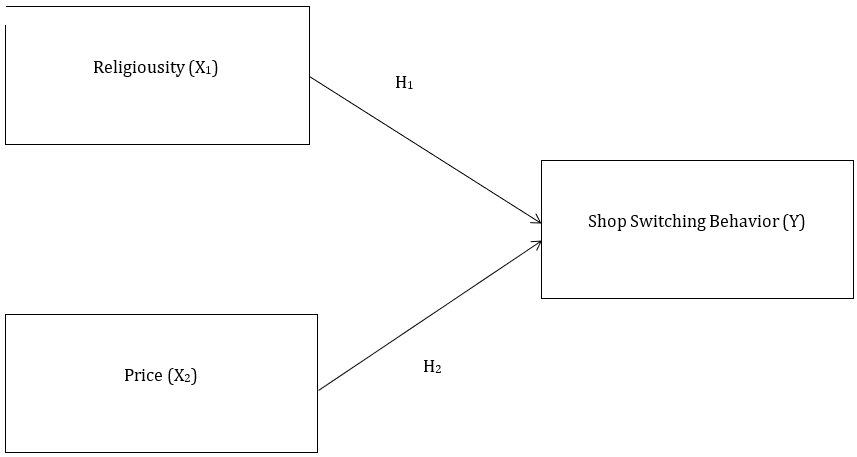
The theoretical foundation and previous research are references in this study. Several factors influence the transfer of purchases (shop switching behavior). This study is to examine the relationship of independent variables, namely Religiosity (X1) and Price (X2), to the Shop Switching Behavior (Y) as the dependent variable. The conceptual research framework is as follows in Figure 1.
Figure 1: Conceptual Research Framework
Hypothesis
Effect of Religiosity on Shop Switching Behavior
According to Hawkin et al. [10], religion influences consumer behavior in making purchases (shop switching behavior). Consumers want to evaluate new things, find information and consumption processes such as entertainment, search for new products, transportation
and family. Consumers with high levels of Religiosity tend to be less impulsive when making purchasing decisions, behave in a more mature, disciplined and responsible way. Religion is important to study because religion applied to the individual and community level [12]. These religious commitments and beliefs affect consumer behavior.
In consuming goods, especially food, consumers will be more inclined to choose foods that have obtained halal labels from authorized institutions. In this case, the halal name under Majeleis Ulama Indonesia/MUI. With this, Muslim consumers will seek information in advance about the halal food they will consume before making a purchase.
With the existence of the Moslem ethnic store, Basmalah Store, which is a boarding school-based retail store and one of the shops that sell halal products, encourages consumers to transfer purchases from general retail stores. Consumers evaluate products sold by Moslem ethnic store Basmalah Stores. Consumers want to find information about the retail store because it differs from other retail stores. The existence of retail stores such as the Basmalah Moslem ethnic store-that has Islamic nuances has its charm for most people, mainly Muslim communities. Thus, it does not rule out the possibility for consumers to make a purchase change (shop switching behavior) at the Basmalah Moslem ethnic store. The store has a high level of reliability. This refers to the research from Morris Kalliny and Angela Hausman, which explains that Religiosity has a significant positive effect on purchasing switching (shop switching behavior).
H1: Religiosity has a significant positive effect on Shop Switching Behavior
Effect of Prices on Shop Switching Behavior
Price is something essential that consumers often use in evaluating products or services offered by a producer. Price is the amount of money requested for a product or service offered as an exchange rate for consumers to benefit from owning or using a product or service [15]. It mentioned that prices also play an essential role in transferring purchases (shop switching behavior). Most consumers hunt for a product at a low price. If there is a store selling a product at a low cos t, it does not rule out that consumers will make a transfer of purchases (shop switching behavior) from one store to another. This explanation refers to the research by Ani Madaniyah and Sanaji, which explain that prices have a significant positive effect on purchasing switching (shop switching behavior).
H2: Price has a significant positive effect on Shop Switching Behavior
RESEARCH METHODS
This study uses explanatory research with a quantitative approach. Explanatory research aims to explain the relationship between variables through testing hypotheses (Parasuraman?). The population in this study are consumers who have already made a purchase switch (Shop Switching Behavior) from Modern Retail Stores to Moslem ethnic store Basmalah Stores in Jember. The sampling technique in this study is considering, such as limited time, energy and funds, so that it cannot take large and far samples. The sampling technique uses a double sampling technique, namely the sampling area (sample area) and quota sampling (quota sample). Determination of the number of samples in this study refers to Joseph et al., who stated that the sample size depends on the number of indicators used in all variables. The number of samples is the same as the number of indicators multiplied by 5 to 10. In this study, the number of variables studied was two independent and one dependent variable with four indicators in each, so the total indicator is 12. Referring to Joseph et al., the number of samples in this study are 120 respondents gaining from 10 x number of indicators.
RESEARCH FINDINGS
Analysis of Multiple Linear Regression
Multiple linear regression analysis is one analysis that aims to measure the relationships that occur between variables [22]. In the regression analysis, there are two kinds of variables used, namely the independent variable (X) and the dependent variable (Y). By using regression analysis can be measured changes in the dependent variable based on changes in independent variables. Linear regression analysis is to find out how the influence of independent variables, namely Religiosity (X1) and Price (X2) on Shop Switching Behavior (Y). Using SPSS software, the result of regression analysis presented in Table 2.
Table 2: Regression Analysis Result
Variable
Regression Coeffecient
Sig.
Information
Constants
3,870
-
-
Religiosity (X1)
0,220
0,001
Significant
Price (X2)
0,240
0,004
Significant
N = 120, R = 0,559, R Square = 0,313
Table 2, presents the value of R (the correlation coefficient number) is 0.559, indicating that the closeness of the direct relationship between Religiosity (X1) and price (X2) to the shop switching behavior (Y) is 55.9%. While the value of R2 (R Square) shows that the magnitude of the direct effect between Religiosity (X1) and price (X2) on shop switching behavior (Y) is 31.3% so the remaining 68.7% explains outside the research model. The finding implies the Religiosity and price have little effect on shop switching behavior from modern retail stores to Moslem ethnic store Basmalah Stores, Jember Branch. This is due to consumers make the transfer of purchases not only from the side of Religiosity and price. But consumers also choose shopping places that have excellent facilities and services that can satisfy buyers. On this basis, the regression model produced as an explanatory model of the effect of religiosity (X1) and price (X2) on shop switching behavior (Y) from modern retail stores to the Basmalah Moslem ethnic store in Indonesia as follows:
Y = 3.870+0.220X1+0.240X2+e
Constant Value
From the above equation, the constant value is 3.870, which means that if the value of the variable Religiosity (X1) and price (X2) is equal to zero, the shop switching behavior (Y) is equal to the constant 3.870.
Religiosity (X1)
The religiosity coefficient has a positive value of 0.220, which means that every increase in one unit of the Religiosity will increase the probability of the shop switching behavior (Y) by 0.220.
Price (X2)
The coefficient value of the price variable is positive value 0.240, which means that every increase in one unit of the price variable will increase the shop switching behavior by 0.240.
CONCLUSION
Based on the results of the analysis and discussion, the following are the conclusion:
Religiosity has a significant positive effect on shop switching behavior. It means that the higher the level of customer religiosity, it will increase shop switching behavior from modern retail stores to Moslem ethnic store Basmalah in Indonesia
Price has a significant positive effect on shop switching behavior, meaning that both the price offered will increase shop switching behavior from modern retail stores to Moslem ethnic store Basmalah in Indonesia
Suggestions
Based on the results of data analysis, discussion and conclusions in this study, the suggestions given include:
For companies, Basmalah Moslem ethnic store, it is necessary to continue to maintain the image of Religiosity. That is, owned as well as lower prices from modern retail stores and other stores so that customers will be interested in choosing Muslim ethnic store Basmalah as a shopping place to meet their daily needs
For the next researcher, it is better to add analytical methods using interviews to expand the discussion of the research and add variables that might influence shop switching behavior
REFERENCE
Levy, M. et al.Retail Management. McGraw-Hill, 2012.
Aprindo. “Retail Growth Is Still Hampered up to 2020 (Pertumbuhan Ritel Masih Terhambat Hingga Tahun 2020).” Republika, September 2019, http://republika. co.id/berita/q0umsv383/aprindo-pertumbuhan-ritel-masih-terhambat-hingga-tahun-2020.
Grassl, W. “Strategic Brand Management: Building, Measuring and Managing Brand Equity.” Journal of Consumer Marketing, vol. 17, no. 3, 2000, https://doi.org/ 10.1108/jcm.2000.17.3.263.3.
Kotler, P. et al.Marketing Management. 14th ed., Prentice Hall, 2012.
Nasse, T.B. et al. “Religiosity and Consumer Behavior in Developing Countries: An Exploratory Study on Muslims in the Context of Burkina Faso.” African Journal of Business Management, vol. 13, no. 4, 2019, pp. 116-127.
Bansal, H.S. et al. “Migrating to New Service Providers: Toward a Unifying Framework of Consumers’ Switching Behaviors.” Journal of the Academy of Marketing Science, vol. 33, no. 1, 2005, pp. 96-115.
Calvo-Porrala, C. et al. “Smooth Operators? Drivers of Customer Satisfaction and Switching Behavior in Virtual and Traditional Mobile Services.” Revista Española de Investigación de Marketing ESIC, vol. 19, 2015, pp. 124-138.
Engell, J.F. et al.Consumer Behavior. 8th ed., Dryden Press, 1995.
Hawkin, B. et al.Consumer Behavior: Building Marketing Strategy. McGraw-Hill Companies, 2010.
Johnson, B.R. et al. “Does Adolescent Religious Commitment Matter? A Reexamination of the Effects of Religiosity on Delinquency.” Journal of Research in Crime and Delinquency, vol. 38, no. 1, 2001, pp. 22-44, http:// journals.sagepub.com/doi/abs/10.1177/0022427801038001002.
Mokhlis, S. “The Effect of Religiosity on Shopping Orientation: An Exploratory Study in Malaysia.” Journal of the American Academy of Business, vol. 9, no. 1, 2006, pp. 64-74.
Imammudin, M. “The Influence of Halal Labels and Religiosity Against the Decision of Instant Noodle Purchasing for Students of Bukit Tinggi IAIN T.A. 2016/2017.” Journal of Economic Studies, vol. 1, no. 1, 2017, pp. 34-47.
Dekhil, F. et al. “Effect of Religiosity on Luxury Consumer Behavior: The Case of the Tunisian Muslim.” Journal of Islamic Marketing, vol. 8, no. 1, 2017, pp. 74-104, http:// www.emeraldinsight.com/1759-0833.htm.
Kotler, P. et al.Principles of Marketing. 8th ed., Erlangga, 2016.
Mowen, J.C. et al.Consumer Behavior: A Framework. Prentice Hall, 2001.
Nawawi Uha, I. Islamic Microeconomics. CV Dwiputra, 2010.
Worthington, L. et al. “The Religious Commitment Inventory-10: Development, Refinement and Validation of a Brief Scale for Research and Counseling.” Journal of Counseling Psychology, vol. 50, no. 1, 2003, pp. 84-96.
LaBarbara, A. et al. “The Role of Materialism, Religiosity and Demographics in Subjective Well-Being.” Psychology and Marketing, vol. 14, no. 1, 1998, pp. 71-97.
Glock, C.Y. et al.Religion and Society in Tension. Rand McNally, 1965.
El-Menouar, Y. et al. “The Five Dimensions of Muslim Religiosity: Results of an Empirical Study.” Methods, Data, Analyses, vol. 8, no. 1, 2014, pp. 53-78.
Hair, J.F. et al.Multivariate Data Analysis. Pearson Education Limited, 1998.
Recommended Articles
Research Article
Country of Origin and Foreign Branding on Perceived Quality of Local Products in Indonesia: The Moderating Role of Consumer Ethnocentrism
Download PDF
Research Article
The Effect of Beauty Vlogger on Purchase Decision for Local Skincare Products in Indonesia: Brand Image as a Mediating Variable
Download PDF
Research Article
The Effect of Employer Attractiveness and Compensation on Job Persuit Intention to Fmcg Companies in Indonesia: Coporate Reputation as an Intervening Variable
Download PDF
Research Article
The Effect of Self-Efficacy and Working Environment on Work Achievement with Organizational Commitment as Mediation
Sri Wahyuni,
...
Veithzal Rivai Zainal
Download PDF
PO Box 101, Nakuru
Kenya.
Email: office@iarconsortium.org
Editorial Office:
J.L Bhavan, Near Radison Blu Hotel,
Jalukbari, Guwahati-India
Sudaryanto, S., Hanim, A. & Anggraeni, F. (2021). Shop Switching Behavior from Moslem Retail to Cultural-based Store in Indonesia; The Religiosity and Price Effect. Scientific Research Journal of Economics and Business Management, 1(2), 1-7.
MLA
Sudaryanto, Sudaryanto, Anifatul Hanim and Fian Anggraeni. "Shop Switching Behavior from Moslem Retail to Cultural-based Store in Indonesia; The Religiosity and Price Effect." Scientific Research Journal of Economics and Business Management 1.2 (2021): 1-7.
Chicago
Sudaryanto, Sudaryanto, Anifatul Hanim and Fian Anggraeni. "Shop Switching Behavior from Moslem Retail to Cultural-based Store in Indonesia; The Religiosity and Price Effect." Scientific Research Journal of Economics and Business Management 1, no. 2 (2021): 1-7.
Harvard
Sudaryanto, S., Hanim, A. and Anggraeni, F. (2021) 'Shop Switching Behavior from Moslem Retail to Cultural-based Store in Indonesia; The Religiosity and Price Effect' Scientific Research Journal of Economics and Business Management 1(2), pp. 1-7.
Vancouver
Sudaryanto S, Hanim A, Anggraeni F. Shop Switching Behavior from Moslem Retail to Cultural-based Store in Indonesia; The Religiosity and Price Effect. Scientific Research Journal of Economics and Business Management. 2021 Jul;1(2):1-7.



 Download PDF
 Download XML